
Matthew 21:10
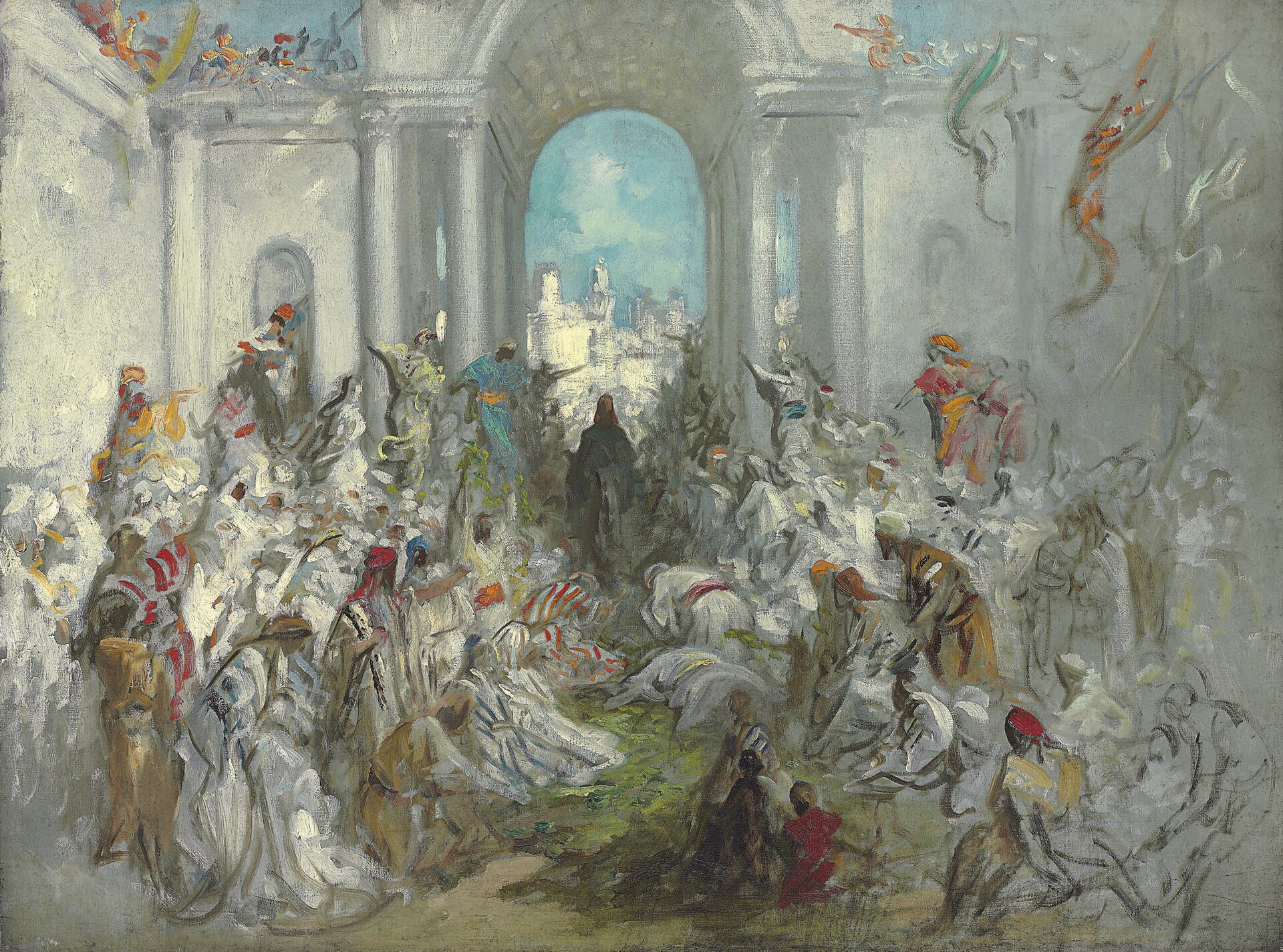
in Matthew 21When Jesus had entered Jerusalem, the whole city was stirred and asked, “Who is this?”
BSB
The same verse in ASV and KJV ▾
ASV
And when he was come into Jerusalem, all the city was stirred, saying, Who is this?
KJV
And when he was come into Jerusalem, all the city was moved, saying, Who is this?
⋯
This verse in Matthew 21
Commentary
21 notes on this verse(Verse 10) And when he entered Jerusalem, the whole city was stirred up, saying, 'Who is this?' And the people ((or Many)) were saying, 'This is Jesus, the prophet from Nazareth in Galilee.' As Jesus entered the city with the whole crowd, the city of Jerusalem was stirred up, amazed at the multitude, not knowing the truth, and saying, 'Who is this?' Indeed, we read in another place the angels saying: 'Who is this King of glory?' (Psalm 24:8).
This site's exposition
all the city was moved
on Matthew 21:10-11
All the city was moved, seio, the earthquake verb, the same shaking word the Gospel uses again at the crucifixion and the resurrection, as though Jerusalem itself cannot hold this entry without trembling. Yet the crowd's own answer to Who is this softens the acclamation of a moment before into a hometown label, Jesus the prophet of Nazareth of Galilee, true as far as it goes and short of what the Hosanna just confessed. The chapter's pattern of partial recognition, loud praise beside shallow understanding, opens here and will not resolve before the cross.
The record, by era
The Church Fathers4 voices
Moreover, when Jesus entered the true Jerusalem, they cried out, wondering at His heavenly virtues, and said, Who is this King of glory?
When Jesus entered with the multitudes, the whole city of Jerusalem was moved, wondering at the crowds, and not knowing the power.
With good reason were they moved at sight of a thing so to be wondered at. Man was praised as God, but it was the God that was praised in the man. But, I suppose, that neither they who praised knew what they praised, but the Spirit that suddenly inspired them poured forth the words of truth.
A commentator
John ChrysostomHomily on the Gospel of Matthew 66 · Written in the 5th century.
proposed
But see the baseness of the Jews. He had wrought so many miracles, and never were they thus amazed at Him; but when they saw a multitude running together, then they marvel. "For all the city was moved, saying, Who is this? But the multitudes said, This is Jesus the prophet of Nazareth of Galilee." And when they thought they were saying something great, even then were their thoughts earthly, and low, and dragging on the ground.
The Medieval Church1 voice
But it is to be noted, that this entry of His into Jerusalem was five days before the passover. For John relates, that six days before the Passover He came to Bethany, and on the morrow sitting on the ass entered Jerusalem. (John 12:1.) In this observe the correspondence between the Old and New Testaments, not only in things but in seasons. For on the tenth day of the first month, the lamb that was to be sacrificed for the passover was to be taken into the house, (Exod. 12:3.) because on the same day of the same month, that is, five days before the passover, the Lord was to enter the city in which He was to suffer.
14 more voices on this verse
The Medieval Church2 voices
"And when he had entered Jerusalem" etc. Here he treats of the glory exhibited to him in the city. And first, the wonder of the crowds is presented: "and the whole city was moved," i.e., was in wonder. Isa 60:5: "Then shalt thou see, and …
The multitude, being simple and guileless, were not spiteful towards Christ, but neither did they have the proper understanding of Who He was. Therefore they call Him "prophet." Yet since they said it with the article, "the prophet," it could be understood as "the long …
The Puritans and the Awakening2 voices
And when he was come into Jerusalem.....
So various are the motions in the minds of men upon the approach of Christ's kingdom! Upon this commotion we are further told, (1.) What the citizens said; Who is this? [1.] They were, it seems, ignorant concerning Christ.
The Nineteenth Century10 voices
All the city was moved - Or, the whole city was in motion. Εσεισθη, was in a tumult - they saw and heard plainly that the multitude had proclaimed Christ king, and Messiah. Who is this? Who is accounted worthy of this honor?
A commentator
Charles Spurgeon1834–1892
The Metropolitan Tabernacle Pulpit, Sermon No. 2939: “A Stir-and What Came of It” (lightly modernized text, CCEL edition) · Written before 1892.
proposed
MANY things make a stir in a city and, sometimes, these stirs are full of evil. I always think, each time I read Carlyle's history of the French Revolution, how thankful we ought to be that the city of London has not been excited, from end to end, by political storms as the unhappy city of Paris was at that time and has been many times since. We are not grateful enough, I fear, for the social order and quiet which reign in our midst.
These verses contain a very remarkable passage in our Lord Jesus Christ’s life. They describe his public entry into Jerusalem when he came there for the last time, before he was crucified. There is something peculiarly striking in this incident in our Lord’s history. The narrative reads like the account of some royal conqueror’s return to his own city: “A very great multitude” accompanies him in a kind of triumphal procession. Loud cries and expressions of praise are heard around him: “All the city was moved.” The whole transaction is singularly at variance with the past tenor of our Lord’s life; it is curiously unlike the ways of him who did not “cry nor strive ” nor let his voice be heard “in the streets”—who withdrew himself from the multitude on other occasions, and sometimes said to those he healed, “See thou say nothing to any man.” ( Mark 1:44 ). And yet the whole transaction admits of explanation. The reasons of this public entry are not hard to find out. Let us see what they were. The plain truth is that our Lord knew well that the time of his earthly ministry was drawing to a close; he knew that the hour was approaching when he must finish the mighty work he came to do, by dying for our sins upon the cross. He knew that his last journey had been accomplished, and that there remained nothing now in his earthly ministry but to be offered as a sacrifice on Calvary. Knowing all this, he no longer, as in times past, sought secrecy; knowing all this, he thought it good to enter the place where he was to be delivered to death, with peculiar solemnity and publicity. It was not fitting that the Lamb of God should come to be slain on Calvary privately and silently. Before the great sacrifice for the sin of the world was offered up, it was right that every eye should be fixed on the victim.
These verses contain a very remarkable passage in our Lord Jesus Christ’s life. They describe his public entry into Jerusalem when he came there for the last time, before he was crucified. There is something peculiarly striking in this incident in our Lord’s history. The narrative reads like the account of some royal conqueror’s return to his own city: “A very great multitude” accompanies him in a kind of triumphal procession. Loud cries and expressions of praise are heard around him: “All the city was moved.”
A commentator
Charles Spurgeon1834–1892
The Metropolitan Tabernacle Pulpit, Sermon No. 2939: “A Stir-and What Came of It” (lightly modernized text, CCEL edition) · Written before 1892.
proposed
MANY things make a stir in a city and, sometimes, these stirs are full of evil. I always think, each time I read Carlyle's history of the French Revolution, how thankful we ought to be that the city of London has not been excited, from end to end, by political storms as the unhappy city of Paris was at that time and has been many times since. We are not grateful enough, I fear, for the social order and quiet which reign in our midst. There are other countries where the people, when they go to bed at night, cannot tell what will be the form of government when they wake in the morning— whether they will still be free nations or beneath a tyrant's heel. I heard an excellent man—one highly esteemed among us—prophesy that before long the streets of London will run with blood. He was afraid of the power of the democracy of whom he stood in great terror. I confess that I have never participated in his fears for a single moment, for I fully believe that, by God's Grace, our country will continue for many years to enjoy the blessing which results from having a form of government which with all its faults and imperfections, is so satisfactory on the whole. May God grant that we may not, on some future day, have to remember with regret our ingratitude for the peace we now possess—when we have lost it— and may we all do our best to cement the various classes of society together and promote that Christian love, that spirit ofjustice and that spirit of philanthropy which will tend to hold together the whole nation in bonds that cannot easily be broken. Let us not be envious. Let us not be proud. Let us not oppress one another and let us not demand too much from one another. Let the golden rule be the rule of life to all with whom we are brought into contact.
A commentator
Charles Spurgeon1834–1892
The Metropolitan Tabernacle Pulpit, Sermon No. 3085: “An Exciting Enquiry” (lightly modernized text, CCEL edition) · Written before 1892.
proposed
OH, that something would move this great city of ours! I am afraid that at least one-third of our population is settling down in stolid indifference to all religion. It is not that there are thousands of professed infidels, but without making the profession of being so, infidels they really are. It is not that they hate the Gospel—they do not care to hear it, or to know what it teaches. They have not enough interest in it to enter the sanctuary even for once in their lives, unless influenced by fashion or by fear they may attend some ceremonial observance. I think we can hardly form a conception of the fearful heathenism of this great metropolis. You might go down street after street and find that the larger proportion of the people, so far from making any profession of religion, did not even enter a place of worship and knew nothing more than what the city missionary or the Bible woman may have been helped to teach them. We are getting into a very, very, very sad state of things—we need something or other that will get at the masses and compel the city to be moved. The theater services which have been lately attempted have no doubt proved a great blessing—the opening of cathedrals was a step in the right direction—but everybody can see that the effect of such departures from the ordinary routine is naturally transient. There will be no greater attraction in a theater than there will be in a chapel or church if the same Gospel is preached, after the novelty of its having been preached there shall have worn off. We can no more expect to see cathedrals crowded long together, now, than we might have expected it 20 years ago. The thing is good as an expedient, but it must be temporary in its results.
A commentator
Charles Spurgeon1834–1892
The Metropolitan Tabernacle Pulpit, Sermon No. 3085: “An Exciting Enquiry” (lightly modernized text, CCEL edition) · Written before 1892.
proposed
OH, that something would move this great city of ours! I am afraid that at least one-third of our population is settling down in stolid indifference to all religion. It is not that there are thousands of professed infidels, but without making the profession of being so, infidels they really are. It is not that they hate the Gospel—they do not care to hear it, or to know what it teaches.
A commentator
Charles Spurgeon1834–1892
The Metropolitan Tabernacle Pulpit, Sermon No. 3394: “'Who Is This?'” (lightly modernized text, CCEL edition) · Written before 1892.
proposed
THIS was not the first time that question had been asked, or asked concerning the same Person. "Who is this?" is a common question in reference to our Lord. "Who is this that comes from Edom, with dyed garments from Bozrah?" "Who is this king of glory?" and so on. Doubtless, the angels who are represented as standing on the Mercy Seat gazing down upon its golden brightness, desired to look into this very question in the olden times, and often said to one another, "Who is this?"
A commentator
Charles Spurgeon1834–1892
The Metropolitan Tabernacle Pulpit, Sermon No. 3394: “'Who Is This?'” (lightly modernized text, CCEL edition) · Written before 1892.
proposed
THIS was not the first time that question had been asked, or asked concerning the same Person. "Who is this?" is a common question in reference to our Lord. "Who is this that comes from Edom, with dyed garments from Bozrah?" "Who is this king of glory?" and so on. Doubtless, the angels who are represented as standing on the Mercy Seat gazing down upon its golden brightness, desired to look into this very question in the olden times, and often said to one another, "Who is this?" We hear the Prophet speak of One who is anointed with the oil of gladness above His fellows, and is therefore Man, but He is called by the same Prophet equal with God, Fellow of the Eternal! How can this be? "Who is this?" The subject of the Incarnation of a pure Spirit such as God is, in human flesh, must have been staggering even to the intellect of seraphs—and again and again they must have said, one to another
A commentator
Albert Barnes1798–1870
Notes, Explanatory and Practical, on the Old and New Testaments (1832-1869)
proposed
And when he was come into Jerusalem, all the city was moved - There was great excitement. The sight of such a multitude, the shouts of the people, and the triumphant procession through the city, excited much attention and inquiry.
The words behind it
13 Greek wordsEvery Greek word of this verse in the order it stands, with what it means and the door to its own study. The last column counts the times a word stands in the whole Bible: the rarer the word, the more the places it appears belong together.
| Greek | Sound | Meaning | Word study | In the Bible |
|---|---|---|---|---|
| Καὶ | kai | And | G2532 → | 9120 times |
| εἰσελθόντος | eiselthontos | when was entering | G1525 → | 194 times |
| αὐτοῦ | autou | He | G846 → | 5565 times |
| εἰς | eis | into | G1519 → | 1755 times |
| Ἱεροσόλυμα | hi'erosoluma | Jerusalem | G2414 → | 62 times |
| ἐσείσθη | eseisthe | was stirred | G4579 → | 5 times |
| πᾶσα | pasa | all | G3956 → | 1235 times |
| ἡ | he | the | G3588 → | 19766 times |
| πόλις | polis | city | G4172 → | 163 times |
| λέγουσα· | legousa | saying; | G3004 → | 1325 times |
| τίς | tis | Who | G5101 → | 563 times |
| ἐστιν | estin | is | G1510 → | 2333 times |
| οὗτος;¶ | houtos | this? | G3778 → | 1381 times |
ΚαὶAnd
kaiG2532 →9120 times
εἰσελθόντοςwhen was entering
eiselthontosG1525 →194 times
αὐτοῦHe
autouG846 →5565 times
εἰςinto
eisG1519 →1755 times
ἹεροσόλυμαJerusalem
hi'erosolumaG2414 →62 times
ἐσείσθηwas stirred
eseistheG4579 →5 times
πᾶσαall
pasaG3956 →1235 times
ἡthe
heG3588 →19766 times
πόλιςcity
polisG4172 →163 times
λέγουσα·saying;
legousaG3004 →1325 times
τίςWho
tisG5101 →563 times
ἐστινis
estinG1510 →2333 times
οὗτος;¶this?
houtosG3778 →1381 times
A shaded row is a word that stands 400 times or fewer in the Bible.
The walk
8 stopsEach card is a verse this one points to, and under it the verses that one points to in turn. Where several paths arrive at the same place, that place is listed first: the text keeps returning to it.
Through
Isaiah 63:1Who is this coming from Edom, from Bozrah with crimson-stained garments? Who is this robed in splendor, marching in the greatness of His strength? “It is I, proclaiming vindication, mighty to save.”
it leads to
- Revelation 19:13
He is dressed in a robe dipped in blood, and His name is The Word of God.
- Isaiah 34:5–6
When My sword has drunk its fill in the heavens, then it will come down upon Edom, upon the people I have devoted to destruction.
- Psalms 137:7
Remember, O LORD, the sons of Edom on the day Jerusalem fell: “Destroy it,” they said, “tear it down to its foundations!”
- Isaiah 63:2–3
Why are Your clothes red, and Your garments like one who treads the winepress?
- Numbers 23:19
God is not a man, that He should lie, or a son of man, that He should change His mind. Does He speak and not act? Does He promise and not fulfill?
- Revelation 19:13
Through
Luke 5:21But the scribes and Pharisees began thinking to themselves, “Who is this man who speaks blasphemy? Who can forgive sins but God alone?”
it leads to
- Isaiah 43:25
I, yes I, am He who blots out your transgressions for My own sake and remembers your sins no more.
- Isaiah 43:25
Through
Acts 9:5“Who are You, Lord?” Saul asked. “I am Jesus, whom you are persecuting,” He replied.
it leads to
- 1 Timothy 1:13
I was formerly a blasphemer, a persecutor, and a violent man; yet because I had acted in ignorance and unbelief, I was shown mercy.
- 1 Samuel 3:4–10
Then the LORD called to Samuel, and he answered, “Here I am.”
- 1 Timothy 1:13
Where this verse is studied
About Matthew
Who and where
1 name in this verse with a page on the site.
This page draws on 18 works. Open the list of works
This page draws on Adam Clarke, Commentary on the Bible; Albert Barnes, Notes, Explanatory and Practical, on the Gospels; Albert Barnes, Notes, Explanatory and Practical, on the Old and New Testaments (1832-1869); Charles Spurgeon, The Metropolitan Tabernacle Pulpit, Sermon No. 2939: “A Stir-and What Came of It” (lightly modernized text, CCEL edition); Charles Spurgeon, The Metropolitan Tabernacle Pulpit, Sermon No. 3085: “An Exciting Enquiry” (lightly modernized text, CCEL edition); Charles Spurgeon, The Metropolitan Tabernacle Pulpit, Sermon No. 3394: “'Who Is This?'” (lightly modernized text, CCEL edition); J.C. Ryle, Expository Thoughts on the Gospels: Matthew; Jerome, Commentary on Matthew; Jerome, Catena Aurea by Aquinas; John Chrysostom, Homilies on the Gospel of Matthew; John Chrysostom, Homily on the Gospel of Matthew 66; John Gill, Exposition of the New Testament (1746-1748); Matthew Henry, Commentary on the Whole Bible; Origen of Alexandria, Catena Aurea by Aquinas; Pseudo-Chrysostom, Catena Aurea by Aquinas; Rabanus Maurus, Catena Aurea by Aquinas; Theophylact of Ohrid, Commentary on Matthew and Thomas Aquinas, Commentary on Matthew.