
Matthew 21:16
in Matthew 21“Do You hear what these children are saying?” they asked. “Yes,” Jesus answered. “Have you never read: ‘From the mouths of children and infants You have ordained praise’?”
BSB
The same verse in ASV and KJV ▾
ASV
and said unto him, Hearest thou what these are saying? And Jesus saith unto them, Yea: did ye never read, Out of the mouth of babes and sucklings thou hast perfected praise?
KJV
And said unto him, Hearest thou what these say? And Jesus saith unto them, Yea; have ye never read, Out of the mouth of babes and sucklings thou hast perfected praise?
⋯
This verse in Matthew 21
Commentary
16 notes on this verseBut the answer of Christ was cautions. He spake not what the Scribes would fain have heard, The children do well that they bear witness to me; nor on the other hand, They do what is wrong, they are but children, you ought to be indulgent to their tender years. But He brings a quotation from the eighth Psalm, that though the Lord were silent, the testimony of Scripture might defend the words of the children (Ps. 8:2) as it follows, But Jesus said unto them, Yea, have ye never read, &c.
This site's exposition
The blind and the lame came to Him at the temple
on Matthew 21:14-16
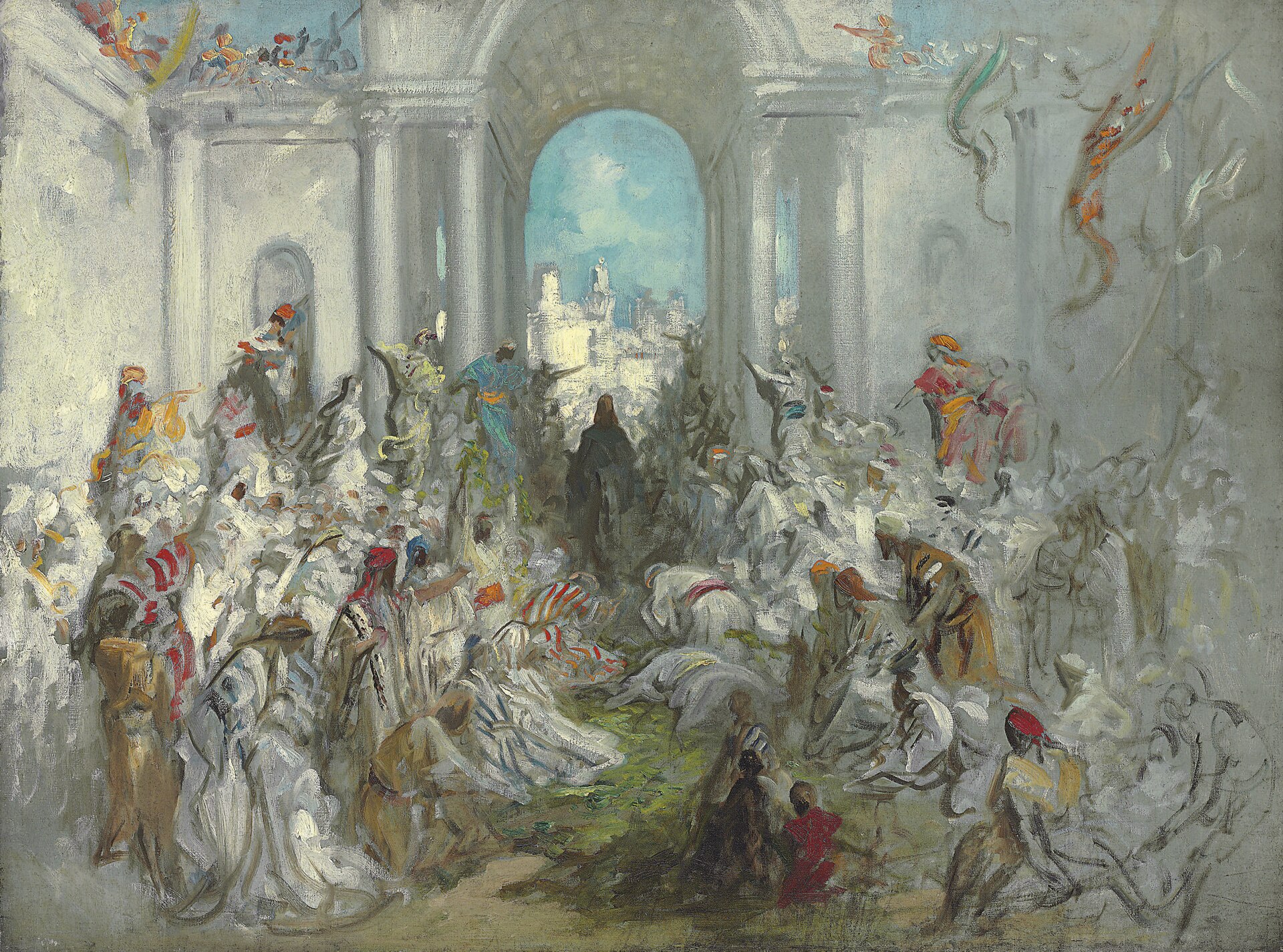
The blind and the lame came to Him at the temple, and He healed them in the courts He had just cleared. When the chief priests and scribes were indignant at the children shouting Hosanna to the Son of David, Jesus answered with Psalm 8:2.
This site's exposition
From the mouths of children
Jerome observes the care of the answer: Jesus gives the scribes no word to use against him, and lets Scripture defend the children. Adam Clarke notes the same psalm is applied to Christ at 1 Corinthians 15:27, Ephesians 1:22 and Hebrews 2:6. Children often joined public praise among the Jews.
The record, by era
The Church Fathers4 voices
But (we hold the contrary): for Christ, by "accepting praise out of the mouth of babes and sucklings," has declared that neither childhood nor infancy is without sensibility, -the former of which states, when meeting Him with approving shouts, proved its ability to offer Him testimony; while the other, by being slaughtered, for His sake of course, knew what violence meant.
(Verse 16.) But Jesus said to them: Of course. Have you never read that from the mouths of infants and nursing babies you have perfected praise? How moderate is this statement, and how balanced is the response, not giving in to slander? He did not say what the Scribes wanted to hear, that children do good, to testify to me, nor did he say they are mistaken: they are children, you should forgive their age; but he brings forward an example from the eighth psalm, to strengthen the testimony of the Scriptures through the words of children, when the Lord is silent.
As though He had said, Be it so, it is My fault that these cry thus. But is it My fault that so many thousand years before the Prophet foretold that so it should be? But babes and sucklings cannot know or praise any one. Therefore they are called babes, not in age, but in guilelessness of heart; sucklings, because they cried out being moved by their joy at the wonderful things they beheld, as by the sweetness of milk. Miraculous works are called milk, because the beholding of miracles is no toil, but rather excites wonder, and gently invites to the faith. Bread is the doctrine of perfect righteousness, which none can receive but they who have their senses exercised about spiritual things.
But they not even so would be persuaded, but together with the rest of the miracles hearing even the children proclaiming, were ready to choke, and say, "Hearest thou not what these say?" And yet it was Christ's part to have said this to them, "Hear ye not what these say?" for the children were singing to Him as to God. What then saith He? Since they were speaking against things manifest, He applies His correction more in the way of reproof, saying, "Have ye never read, Out of the mouths of babes and sucklings Thou hast perfected praise?" And well did He say, "Out of the mouth." For what was said was not of their understanding, but of His power giving articulation to their tongue yet immature. And this was also a type of the Gentiles lisping, and sounding forth at once great things with understanding and faith. And for the apostles also there was from hence no small consolation. For that they might not be perplexed, how being unlearned they should be able to publish the gospel, the children anticipate them, and remove all their anxiety, teaching them, that He would grant them utterance, who made even these to sing praises. And not so only, but the miracle showed that He is Creator even of nature. The children then, although of age immature, uttered things that had a clear meaning, and were in accordance with those above, but the men things teeming with frenzy and madness. For such is the nature of wickedness.
The Medieval Church1 voice
"And said to him: hearest thou what these say?" As if to say, it is not just that a mere man should allow himself to be praised as God. Acts 12:22f.: because Herod allowed himself to be honored as God, therefore he was struck by …
8 more voices on this verse
The Medieval Church1 voice
When the Pharisees saw the children offering to Christ the hymn of David which the prophet seems to offer to God (Ps. 117:26), they exploded with spite and reviled Him for allowing things of God to be said of Him. But He confirmed this by …
The Puritans and the Awakening2 voices
And said unto him, hearest thou what these say?....
Observe, (1.) The children were in the temple, perhaps playing there; no wonder, when the rulers make it a market-place, that the children make it a place of pastime; but we are willing to hope that many of them were worshipping there. Note, It is good to bring children betimes to the house of prayer, for of such is the kingdom of heaven.
The Nineteenth Century5 voices
Out of the mouth of babes - The eighth Psalm, out of which these words are quoted, is applied to Jesus Christ in three other places in the new covenant, 1Co 15:27; Eph 1:22; Heb 2:6. Which proves it to be merely a prophetic psalm, relating to the Messiah. It was a common thing among the Jews for the children to be employed in public acclamations; and thus they were accustomed to hail their celebrated rabbins.
We have in these verses an account of two remarkable events in our Lord's history. In both, there was something eminently figurative and typical. Each was an emblem of spiritual things. Beneath the surface of each, lie lessons of solemn instruction. The first event that demands our attention, is our Lord's visit to the temple. He found His Father's house in a state which too truly shadowed forth the general condition of the whole Jewish church--everything out of order, and out of course. He found the courts of that holy building disgracefully profaned by worldly transactions. Trading, and buying, and selling, were actually going on within its walls. There stood dealers ready to supply the Jew who came from distant countries, with any sacrifice he wanted. There sat the money-changer, ready to change his foreign money for the current coin of the land. Bulls, and sheep, and goats, and pigeons, were there exposed for sale, as if the place had been a market. The jingling of money might there be heard, as if these holy courts had been a bank or an exchange. Such were the scenes that met our Lord's eyes. He saw it all with holy indignation. "He drove out all of those who sold and bought." He "overthrew the money changers' tables." Resistance there was none, for men knew that He was right. Objection there was none, for all felt that he was only reforming a notorious abuse, which had been basely permitted for the sake of gain. Well might He sound in the ears of the astonished traders, as they fled from the temple--"It is written, 'My house shall be called a house of prayer,' but you have made it a den of robbers!" Let us see in our Lord's conduct on this occasion, a striking type of what He will do when He comes again the second time. He will purify His visible church as He purified the temple.
We have in these verses an account of two remarkable events in our Lord's history. In both, there was something eminently figurative and typical. Each was an emblem of spiritual things. Beneath the surface of each, lie lessons of solemn instruction. The first event that demands our attention, is our Lord's visit to the temple. He found His Father's house in a state which too truly shadowed forth the general condition of the whole Jewish church--everything out of order, and out of course. He found the courts of that holy building disgracefully profaned by worldly transactions.
THESE scribes and Pharisees always come in very conveniently as a sort of shadow to bring out the bright lights of the picture. One feels glad that they are not alive to worry us now, but somewhat glad that they were alive just then to put some of their strange cross questions to the Savior and to awaken His spirit to utter precious Truths of God which are all the better understood because of the occasion which called for them. Here was their question, "Do You hear what these are saying?"
THESE scribes and Pharisees always come in very conveniently as a sort of shadow to bring out the bright lights of the picture. One feels glad that they are not alive to worry us now, but somewhat glad that they were alive just then to put some of their strange cross questions to the Savior and to awaken His spirit to utter precious Truths of God which are all the better understood because of the occasion which called for them. Here was their question, "Do You hear what these are saying?" I suppose that if interpreted at full length the question means, "Do You permit these mere children to salute You with hosannas? What do You think of Yourself when Your name is in the mouths of noisy boys and girls who make the Temple courts to ring, again?" I have met with that spirit in these days, for the Pharisees are not all dead, nor the scribes either. They may be dead literally, but their spiritual successors—are they not still among us? Listen to their criticism—"It is true that the good man has many converts, but they are only a parcel of young people—mere boys and girls!" Oh yes, I know you, my old friend, I have met with you before! This is the very language of the ancestors of your house—they, also, enquired sarcastically—"Do you hear what these are saying?" A despising of true religion, when it is found among the very young, is a pernicious evil which springs up, again, in each generation—however diligently we may pull up the weed! Explanations are sometimes given of the light esteem in which men hold juvenile godliness.
The words behind it
23 Greek wordsEvery Greek word of this verse in the order it stands, with what it means and the door to its own study. The last column counts the times a word stands in the whole Bible: the rarer the word, the more the places it appears belong together.
| Greek | Sound | Meaning | Word study | In the Bible |
|---|---|---|---|---|
| καὶ | kai | and | G2532 → | 9120 times |
| εἶπαν | eipan | said | G2036 → | 925 times |
| αὐτῷ· | auto | to Him; | G846 → | 5565 times |
| ἀκούεις | akoueis | Hear you | G191 → | 425 times |
| τί | ti | what | G5101 → | 563 times |
| οὗτοι | houtoi | these | G3778 → | 1381 times |
| λέγουσιν; | legousin | say? | G3004 → | 1325 times |
| ὁ | ho | <the> | G3588 → | 19766 times |
| δὲ | de | And | G1161 → | 2765 times |
| Ἰησοῦς | iesous | Jesus | G2424 → | 908 times |
| λέγει | legei | says | G3004 → | 1325 times |
| αὐτοῖς· | autois | to them; | G846 → | 5565 times |
| ναί. | nai | Yes. | G3483 → | 33 times |
| οὐδέποτε | oudepote | surely sometime | G3763 → | 16 times |
| ἀνέγνωτε | anegnote | you did read | G314 → | 32 times |
| ὅτι | hoti | that | G3754 → | 1292 times |
| ἐκ | ek | Out of [the] | G1537 → | 911 times |
| στόματος | stomatos | mouth | G4750 → | 78 times |
| νηπίων | nepion | of babes | G3516 → | |
| καὶ | kai | and | G2532 → | 9120 times |
| θηλαζόντων | thelazonton | sucklings | G2337 → | |
| κατηρτίσω | katertiso | You have prepared for yourself | G2675 → | |
| αἶνον;¶ | ainon | praise’? | G136 → |
καὶand
kaiG2532 →9120 times
εἶπανsaid
eipanG2036 →925 times
αὐτῷ·to Him;
autoG846 →5565 times
ἀκούειςHear you
akoueisG191 →425 times
τίwhat
tiG5101 →563 times
οὗτοιthese
houtoiG3778 →1381 times
λέγουσιν;say?
legousinG3004 →1325 times
ὁ<the>
hoG3588 →19766 times
δὲAnd
deG1161 →2765 times
ἸησοῦςJesus
iesousG2424 →908 times
λέγειsays
legeiG3004 →1325 times
αὐτοῖς·to them;
autoisG846 →5565 times
ναί.Yes.
naiG3483 →33 times
οὐδέποτεsurely sometime
oudepoteG3763 →16 times
ἀνέγνωτεyou did read
anegnoteG314 →32 times
ὅτιthat
hotiG3754 →1292 times
ἐκOut of [the]
ekG1537 →911 times
στόματοςmouth
stomatosG4750 →78 times
νηπίωνof babes
nepionG3516 →
καὶand
kaiG2532 →9120 times
θηλαζόντωνsucklings
thelazontonG2337 →
κατηρτίσωYou have prepared for yourself
katertisoG2675 →
αἶνον;¶praise’?
ainonG136 →
A shaded row is a word that stands 400 times or fewer in the Bible.
The walk
8 stopsEach card is a verse this one points to, and under it the verses that one points to in turn. Where several paths arrive at the same place, that place is listed first: the text keeps returning to it.
Through
Matthew 19:4Jesus answered, “Have you not read that from the beginning the Creator ‘made them male and female,’
it leads to
- Genesis 2:23
And the man said: “This is now bone of my bones and flesh of my flesh; she shall be called ‘woman,’ for out of man she was taken.”
- Genesis 1:27
So God created man in His own image; in the image of God He created him; male and female He created them.
- Genesis 2:23
Through
Psalms 8:2From the mouths of children and infants You have ordained praise on account of Your adversaries, to silence the enemy and avenger.
it leads to
- 2 Corinthians 12:9–10
But He said to me, “My grace is sufficient for you, for My power is perfected in weakness.” Therefore I will boast all the more gladly in my weaknesses, so that the power of…
- Isaiah 40:31
But those who wait upon the LORD will renew their strength; they will mount up with wings like eagles; they will run and not grow weary, they will walk and not faint.
- Psalms 46:10
“Be still and know that I am God; I will be exalted among the nations, I will be exalted over the earth.”
- 1 Corinthians 1:27
But God chose the foolish things of the world to shame the wise; God chose the weak things of the world to shame the strong.
- Matthew 11:25
At that time Jesus declared, “I praise You, Father, Lord of heaven and earth, because You have hidden these things from the wise and learned, and revealed them to little children.
- 2 Corinthians 12:9–10
Through
Matthew 12:3Jesus replied, “Have you not read what David did when he and his companions were hungry?
it leads to
- 1 Samuel 21:3–6
Now then, what do you have on hand? Give me five loaves of bread, or whatever can be found.”
- 1 Samuel 21:3–6
Where this verse is studied
On this page
Studies11
About Matthew
This page draws on 13 works. Open the list of works
This page draws on Adam Clarke, Commentary on the Bible; Charles Spurgeon, The Metropolitan Tabernacle Pulpit, Sermon No. 1785: “The Children and Their Hosannas” (lightly modernized text, CCEL edition); J.C. Ryle, Expository Thoughts on the Gospels: Matthew; Jamieson, Fausset & Brown, Commentary Critical and Explanatory on the Whole Bible; Jerome, Catena Aurea by Aquinas; Jerome, Commentary on Matthew; John Chrysostom, Homily on the Gospel of Matthew 67; John Gill, Exposition of the New Testament (1746-1748); Matthew Henry, Commentary on the Whole Bible; Pseudo-Chrysostom, Catena Aurea by Aquinas; Tertullian, A Treatise on the Soul; Theophylact of Ohrid, Commentary on Matthew and Thomas Aquinas, Commentary on Matthew.