
Matthew 21:11
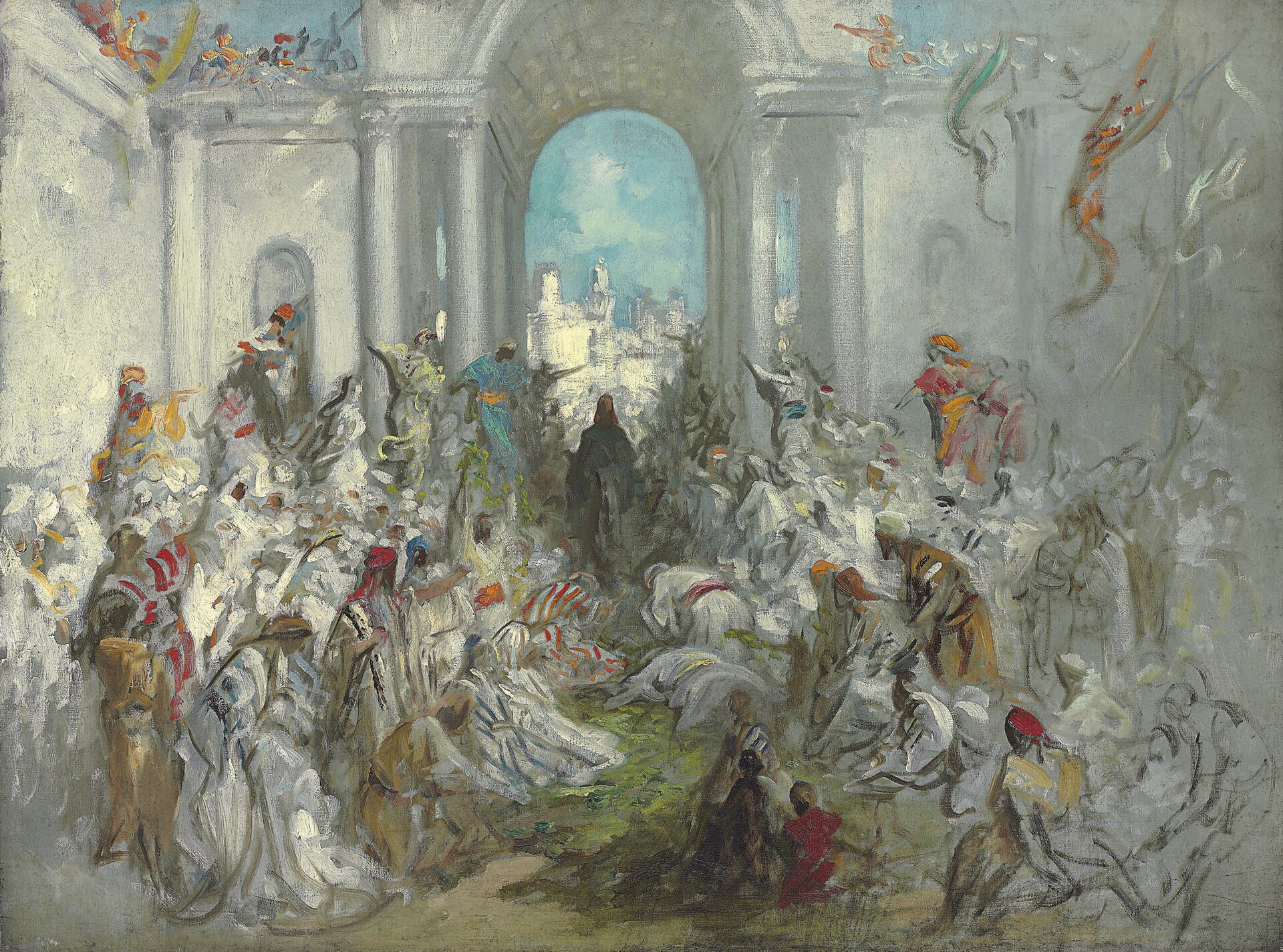
in Matthew 21The crowds replied, “This is Jesus, the prophet from Nazareth in Galilee.”
BSB
The same verse in ASV and KJV ▾
ASV
And the multitudes said, This is the prophet, Jesus, from Nazareth of Galilee.
KJV
And the multitude said, This is Jesus the prophet of Nazareth of Galilee.
⋯
This verse in Matthew 21
Commentary
12 notes on this verseWhile others were in doubt or enquiring, the worthless multitude confessed Him; But the people said, This is Jesus the Prophet from Nazareth in Galilee. (Ps. 24:8.) They begin with the lesser that they may come to the greater. They hail Him as that Prophet whom Moses had said should come like to himself, (Deut. 15:18.) which is rightly written in Greek with the testimony of the article, (ὁ προφήτες.) From Nazareth of Galilee, for there He had been brought up, that the flower of the field might be nourished with the flower of all excellencies.
This site's exposition
all the city was moved
on Matthew 21:10-11
All the city was moved, seio, the earthquake verb, the same shaking word the Gospel uses again at the crucifixion and the resurrection, as though Jerusalem itself cannot hold this entry without trembling. Yet the crowd's own answer to Who is this softens the acclamation of a moment before into a hometown label, Jesus the prophet of Nazareth of Galilee, true as far as it goes and short of what the Hosanna just confessed. The chapter's pattern of partial recognition, loud praise beside shallow understanding, opens here and will not resolve before the cross.
The record, by era
The Church Fathers1 voice
A commentator
John ChrysostomHomily on the Gospel of Matthew 66 · Written in the 5th century.
proposed
But see the baseness of the Jews. He had wrought so many miracles, and never were they thus amazed at Him; but when they saw a multitude running together, then they marvel. "For all the city was moved, saying, Who is this? But the multitudes said, This is Jesus the prophet of Nazareth of Galilee." And when they thought they were saying something great, even then were their thoughts earthly, and low, and dragging on the ground.
The Medieval Church2 voices
The multitude, being simple and guileless, were not spiteful towards Christ, but neither did they have the proper understanding of Who He was. Therefore they call Him "prophet." Yet since they said it with the article, "the prophet," it could be understood as "the long …
The response is presented: "and the people said, this is Jesus the prophet, from Nazareth of Galilee." Prophet signifies the act of proclamation. From Nazareth, because he was reared there, and from there was better known, and therefore was called Nazarene.
The Puritans and the Awakening2 voices
This is Jesus from Nazareth - What a stumbling block was this! if he was of Nazareth, he could not be the Messiah. But they who earnestly desired to know the truth would not stumble thereat: for upon inquiry (which such would not fail to make) they would find, he was not of Nazareth, but Bethlehem.
Hoseanna - (Lord save us) was a solemn word in frequent use among the Jews. The meaning is, "We sing hosanna to the Son of David. Blessed is he, the Messiah, of the Lord.
quarantine:debris (2026-07-29) — odd-straight-quotes
5 more voices on this verse
The Puritans and the Awakening2 voices
And the multitude said,.... Or the people, as the Vulgate Latin, and Munster's Hebrew Gospel read; the common people, that went before, and followed after him: these knew Christ better than the inhabitants of Jerusalem, the Scribes and Pharisees, and rulers of the people.
Christ's priestly office was, of all the three, last discovered. [2.] Yet they missed it, in saying he was of Nazareth; and it helped to confirm some in their prejudices against him. Note, Some that are willing to honour Christ, and bear their testimony to him, yet labour under mistakes concerning him, which would be rectified if they would take pains to inform themselves.
The Nineteenth Century3 voices
This is Jesus The Prophet - Ο προφητης That prophet whom Moses spoke of, Deu 18:18. I will raise them up a prophet - like unto thee, etc. Every expression of the multitude plainly intimated that they fully received our blessed Lord as the promised Messiah. - How strange is it that these same people (if the creatures of the high priest be not only intended) should, about five days after, change their hosannas for, Away with him! crucify him! crucify him! How fickle is the multitude!
These verses contain a very remarkable passage in our Lord Jesus Christ’s life. They describe his public entry into Jerusalem when he came there for the last time, before he was crucified. There is something peculiarly striking in this incident in our Lord’s history. The narrative reads like the account of some royal conqueror’s return to his own city: “A very great multitude” accompanies him in a kind of triumphal procession. Loud cries and expressions of praise are heard around him: “All the city was moved.” The whole transaction is singularly at variance with the past tenor of our Lord’s life; it is curiously unlike the ways of him who did not “cry nor strive ” nor let his voice be heard “in the streets”—who withdrew himself from the multitude on other occasions, and sometimes said to those he healed, “See thou say nothing to any man.” ( Mark 1:44 ). And yet the whole transaction admits of explanation. The reasons of this public entry are not hard to find out. Let us see what they were. The plain truth is that our Lord knew well that the time of his earthly ministry was drawing to a close; he knew that the hour was approaching when he must finish the mighty work he came to do, by dying for our sins upon the cross. He knew that his last journey had been accomplished, and that there remained nothing now in his earthly ministry but to be offered as a sacrifice on Calvary. Knowing all this, he no longer, as in times past, sought secrecy; knowing all this, he thought it good to enter the place where he was to be delivered to death, with peculiar solemnity and publicity. It was not fitting that the Lamb of God should come to be slain on Calvary privately and silently. Before the great sacrifice for the sin of the world was offered up, it was right that every eye should be fixed on the victim.
These verses contain a very remarkable passage in our Lord Jesus Christ’s life. They describe his public entry into Jerusalem when he came there for the last time, before he was crucified. There is something peculiarly striking in this incident in our Lord’s history. The narrative reads like the account of some royal conqueror’s return to his own city: “A very great multitude” accompanies him in a kind of triumphal procession. Loud cries and expressions of praise are heard around him: “All the city was moved.”
The words behind it
14 Greek wordsEvery Greek word of this verse in the order it stands, with what it means and the door to its own study. The last column counts the times a word stands in the whole Bible: the rarer the word, the more the places it appears belong together.
| Greek | Sound | Meaning | Word study | In the Bible |
|---|---|---|---|---|
| Οἱ | hoi | <the> | G3588 → | 19766 times |
| δὲ | de | And | G1161 → | 2765 times |
| ὄχλοι | ochloi | the crowds | G3793 → | 175 times |
| ἔλεγον· | elegon | were saying; | G3004 → | 1325 times |
| οὗτός | houtos | This | G3778 → | 1381 times |
| ἐστιν | estin | is | G1510 → | 2333 times |
| ὁ | ho | the | G3588 → | 19766 times |
| προφήτης | prophetes | prophet | G4396 → | 144 times |
| Ἰησοῦς, | iesous | Jesus, | G2424 → | 908 times |
| ὁ | ho | the [One] | G3588 → | 19766 times |
| ἀπὸ | apo | from | G575 → | 640 times |
| Ναζαρὲθ | nazareth | Nazareth | G3478 → | 12 times |
| τῆς | tes | <the> | G3588 → | 19766 times |
| Γαλιλαίας.¶ | galilaias | of Galilee. | G1056 → | 61 times |
Οἱ<the>
hoiG3588 →19766 times
δὲAnd
deG1161 →2765 times
ὄχλοιthe crowds
ochloiG3793 →175 times
ἔλεγον·were saying;
elegonG3004 →1325 times
οὗτόςThis
houtosG3778 →1381 times
ἐστινis
estinG1510 →2333 times
ὁthe
hoG3588 →19766 times
προφήτηςprophet
prophetesG4396 →144 times
Ἰησοῦς,Jesus,
iesousG2424 →908 times
ὁthe [One]
hoG3588 →19766 times
ἀπὸfrom
apoG575 →640 times
ΝαζαρὲθNazareth
nazarethG3478 →12 times
τῆς<the>
tesG3588 →19766 times
Γαλιλαίας.¶of Galilee.
galilaiasG1056 →61 times
A shaded row is a word that stands 400 times or fewer in the Bible.
The walk
8 stopsEach card is a verse this one points to, and under it the verses that one points to in turn. Where several paths arrive at the same place, that place is listed first: the text keeps returning to it.
Through
John 6:14When the people saw the sign that Jesus had performed, they began to say, “Truly this is the Prophet who is to come into the world.”
it leads to
- Deuteronomy 18:15–18
The LORD your God will raise up for you a prophet like me from among your brothers. You must listen to him.
- John 1:21
“Then who are you?” they inquired. “Are you Elijah?” He said, “I am not.” “Are you the Prophet?” He answered, “No.”
Reached by 2 separate paths from here.
- Acts 7:37
This is the same Moses who told the Israelites, ‘God will raise up for you a prophet like me from among your brothers.’
- Matthew 11:3
to ask Him, “Are You the One who was to come, or should we look for someone else?”
- Genesis 49:10
The scepter will not depart from Judah, nor the staff from between his feet, until Shiloh comes and the allegiance of the nations is his.
- Deuteronomy 18:15–18
Through
Matthew 2:23and he went and lived in a town called Nazareth. So was fulfilled what was spoken through the prophets: “He will be called a Nazarene.”
it leads to
- Judges 13:5
For behold, you will conceive and give birth to a son. And no razor shall come over his head, because the boy will be a Nazirite to God from the womb, and he will…
- John 1:45–46
Philip found Nathanael and told him, “We have found the One Moses wrote about in the Law, the One the prophets foretold—Jesus of Nazareth, the son of Joseph.”
- Judges 13:5
Through
Luke 7:16A sense of awe swept over all of them, and they glorified God. “A great prophet has appeared among us!” they said. “God has visited His people!”
it leads to
- Matthew 9:8
When the crowds saw this, they were filled with awe and glorified God, who had given such authority to men.
- Matthew 9:8
Where this verse is studied
About Matthew
Who and where
1 name in this verse with a page on the site.
This page draws on 11 works. Open the list of works
This page draws on Adam Clarke, Commentary on the Bible; Albert Barnes, Notes, Explanatory and Practical, on the Gospels; J.C. Ryle, Expository Thoughts on the Gospels: Matthew; Jerome, Catena Aurea by Aquinas; John Chrysostom, Homilies on the Gospel of Matthew; John Chrysostom, Homily on the Gospel of Matthew 66; John Gill, Exposition of the New Testament (1746-1748); John Wesley, Explanatory Notes upon the New Testament; Matthew Henry, Commentary on the Whole Bible; Theophylact of Ohrid, Commentary on Matthew and Thomas Aquinas, Commentary on Matthew.