
Matthew 21:8
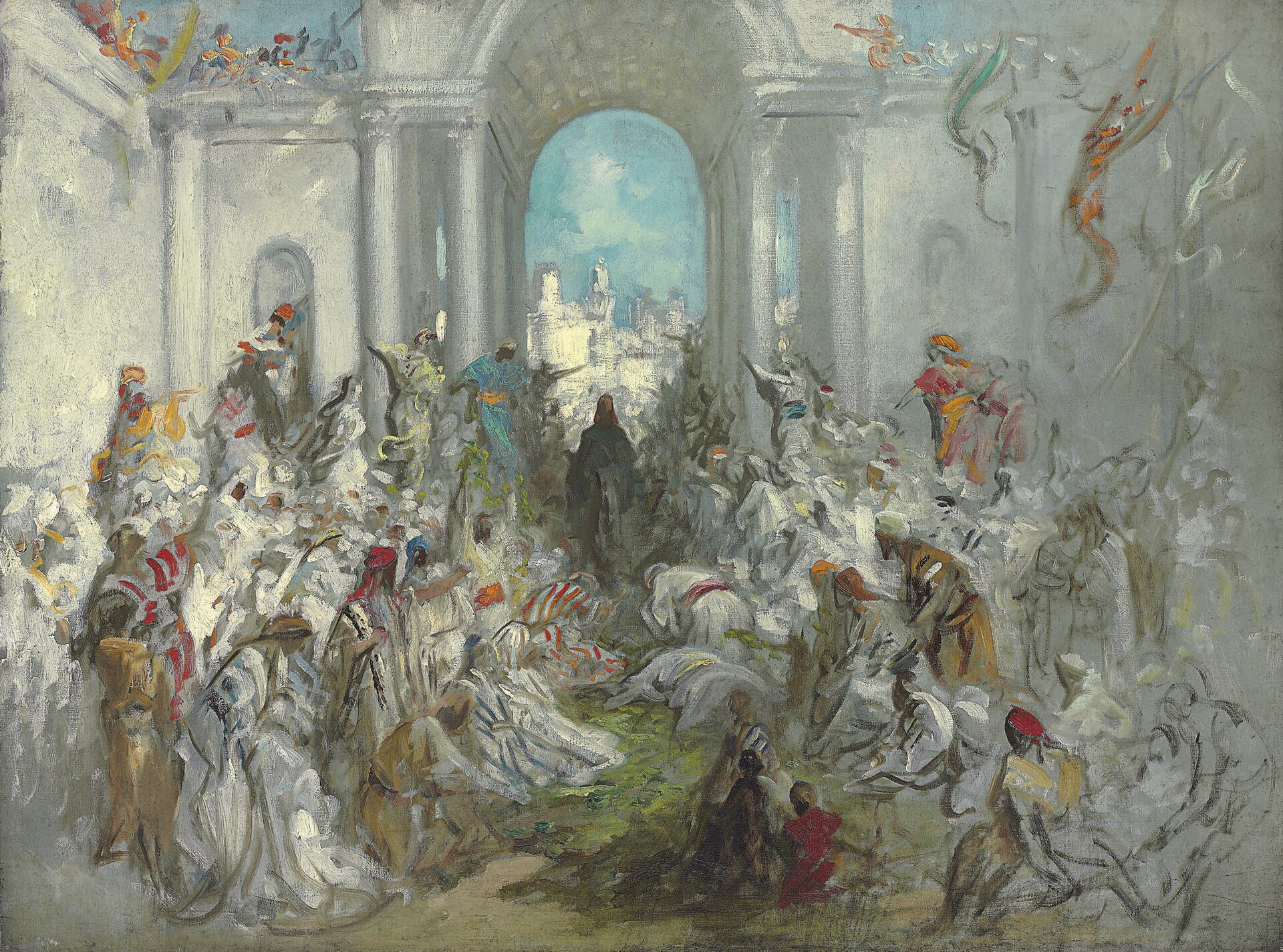
in Matthew 21A massive crowd spread their cloaks on the road, while others cut branches from the trees and spread them on the road.
BSB
The same verse in ASV and KJV ▾
ASV
And the most part of the multitude spread their garments in the way; and others cut branches from the trees, and spread them in the way.
KJV
And a very great multitude spread their garments in the way; others cut down branches from the trees, and strawed them in the way.
⋯
This verse in Matthew 21
Commentary
17 notes on this verseThe multitudes that came out of Jericho, and followed the Saviour, cast down their garments, and strewed the way with branches of trees; and therefore it follows, But the multitudes spread their garments in the way; that is, beneath the feet of the ass, that it should not stumble against a stone, nor tread upon a thorn, nor fall into a ditch. Others cut down branches from the trees, and strewed them in the way; from the fruit-trees, that is, with which mount Olivet was clothed.
This site's exposition
spread their garments in the way
on Matthew 21:8-9
The multitude spreads garments and branches in the way, the same royal courtesy Jehu received at his own anointing in 2 Kings 9:13, and their cry lifts Psalm 118:25-26 word for word, Hosanna, save now, addressed to the Son of David. The thread the book has carried since Joseph was first addressed as son of David reaches its loudest public sounding here, a crowd naming what Jerusalem's own leaders will not name. Some commentators tie the timing to a computed reading of Daniel 9:25's sixty-nine weeks landing on this very entry, a chronology argued rather than plainly stated in the text, and the exposition names it as that kind of reading rather than a settled date.
The record, by era
The Church Fathers5 voices
Never before had the Lord employed the services of beasts, nor surrounded Himself with the ornaments of green boughs, till now when He is going up to Jerusalem to suffer. He moved them that beheld to do that which they had before desired to do; so it was opportunity that was now given them, not their purpose that was changed.
A commentator
John ChrysostomHomily on the Gospel of Matthew 66 · Written in the 5th century.
proposed
Again, setting measures of sorrow, when He had need to mourn, He weeps moderately, everywhere setting us rules, as I have said, and limits how far one ought to proceed, and not any further. So for this intent now also, since it happens that some are weak and have need of beasts to carry them, in this too He fixes a measure, showing that one ought not to yoke horses or mules to be borne by them, but to use an ass, and not to proceed further, and everywhere to be limited by the want. But let us look also at the prophecy, that by words, that by acts. What then is the prophecy? "Behold, thy King cometh to thee, meek, and riding on an ass, and a young colt;" not driving chariots, like the rest of the kings, not demanding tributes, not thrusting men off, and leading about guards, but displaying His great meekness even hereby. Ask then the Jew, what King came to Jerusalem borne on an ass? Nay, he could not mention, but this alone.
A commentator
John ChrysostomHomily on the Gospel of Matthew 66 · Written in the 5th century.
proposed
And yet He had often entered Jerusalem before, but never with so much circumstance. What then is the cause? It was the beginning then of the dispensation; and neither was He very well known, nor the time of His passion near; wherefore He mixed with them with less distinction, and more disguising Himself. For He would not have been held in admiration, had He so appeared, and He would have excited them to greater anger. But when He had both given them sufficient proof of His power, and the cross was at the doors, He makes Himself then more conspicuous, and doeth with greater circumstance all the things that were likely to inflame them. For it was indeed possible for this to have been done at the beginning also; but it was not profitable nor expedient it should be so. But do thou observe, I pray thee, how many miracles are done, and how many prophecies are fulfilled. He said, "Ye shall find an ass;" He foretold that no man should hinder them, but that all, when they heard, should hold their peace. But this is no small condemnation of the Jews, if them that were never known to Him, neither had appeared before Him, He persuades to give up their own property, and to say nothing against it, and that by His disciples, while these, being present with Him at the working of His miracles, were not persuaded.
A commentator
John ChrysostomHomily on the Gospel of Matthew 66 · Written in the 5th century.
proposed
And do not account what was done to be a small thing. For who persuaded them, when their own property was taken from them, and that, when they were perhaps poor men and husbandmen, not to forbid it? Why say I not to forbid it? not to ask, or even if they asked, to hold their peace, and give it up. For indeed both things were alike marvellous, as well, if they said nothing, when their beasts were dragged away, or if having spoken, and heard, "The Lord hath need of them," they yielded and withstood not, and this when they see not Him, but His disciples. By these things He teaches them, that it was in His power to have entirely hindered the Jews also, even against their will, when they were proceeding to attack Him, and to have made them speechless, but He would not. And another thing again together with these doth He teach the disciples, to give whatever He should ask; and, though he should require them to yield up their very life, to give even this, and not to gainsay. For if even strangers gave up to Him, much more ought they to strip themselves of all things. And besides what we have said, He was fulfilling also another prophecy, one which was twofold, one part in words, and another in deeds. And that in deeds was, by the sitting on the ass; and that by words, the prediction of Zacharias; because he had said, that the King should sit on an ass. And He, having sat and having fulfilled it, gave to the prophecy another beginning again, by what He was doing typifying beforehand the things to come. How and in what manner? He proclaimed beforehand the calling of the unclean Gentiles, and that He should rest upon them, and that they should yield to Him and follow Him, and prophecy succeeded to prophecy. But to me He seemeth not for this object only to sit on the ass, but also as affording us a standard of self-denial. […]
A commentator
John ChrysostomHomily on the Gospel of Matthew 66 · Written in the 5th century.
proposed
But these things He did, not as displaying any pomp, but at once, as I have said, both fulfilling a prophecy, and teaching self-denial, and at the same time also comforting His disciples, who were grieving for His death, and showing them that He suffers all these things willingly. And mark thou, I pray thee, the accuracy of the prophet, how he foretold all things. And some things David, some things Zechariah, had proclaimed beforehand. Let us also do likewise, and let us sing hymns, and give up our garments to them that bear Him. For what should we deserve, when some clothe the ass on which He was set, and others strew the garments even under her feet; but we, seeing him naked, and not being even commanded to strip ourselves, but to spend of what is laid by, not even so are liberal? And when they indeed attend upon Him before and behind, but we, when He cometh unto us, send Him away, and thrust Him off and insult Him.
10 more voices on this verse
The Church Fathers3 voices
A commentator
John ChrysostomHomily on the Gospel of Matthew 66 · Written in the 5th century.
proposed
But He did these things, as I said, signifying beforehand the things to come. For here the church is signified by the colt, and the new people, which was once unclean, but which, after Jesus sat on them, became clean. And see the image preserved throughout. I mean that the disciples loose the asses. For by the apostles, both they and we were called; by the apostles were we brought near. But because our acceptance provoked them also to emulation, therefore the ass appears following the colt. For after Christ hath sat on the Gentiles, then shall they also come moving us to emulation. And Paul declaring this, said, "That blindness in part is happened to Israel, until the fullness of the Gentiles be come in; and so all Israel shall be saved." For that it was a prophecy is evident from what is said. For neither would the prophet have cared to express with such great exactness the age of the ass, unless this had been so. But not these things only are signified by what is said, but also that the apostles should bring them with ease. For as here, no man gainsaid them so as to keep the asses, so neither with regard to the Gentiles was any one able to prevent them, of those who were before masters of them. But He doth not sit on the bare colt, but on the apostles' garments. For after they had taken the colt, they then gave up all, even as Paul also said, "I will very gladly spend and be spent for your souls." But mark how tractable the colt, how being unbroken, and having never known the rein, he was not restive, but went on orderly; which thing itself was a prophecy of the future, signifying the submissiveness of the Gentiles, and their sudden conversion to good order. For all things did that word work, which said, "Loose him, and bring him to me:" so that the unmanageable became orderly, and the unclean thenceforth clean.
The multitudes spread their garments in the way, when they of the circumcision who believed, despised the glory which they had by the Law. They cut down branches from the trees, because out of the Prophets they had heard of the green Branch as an emblem of Christ. (Is. 11:1. Jer. 23:5.) Or, the multitudes who spread their garments in the way, are the martyrs who gave to martyrdom for Christ their bodies, which are the clothing of their minds. Or, they are signified, who subdue their bodies by abstinence. They who cut down the branches of the trees, are they who seek out the sayings and examples of the holy fathers for their own or their children's salvation.
(Verse 8.) But a great crowd spread their garments on the road. Notice the difference in each person. The apostles put their garments on the donkey, while the crowd, which is more humble, lays their garments in front of the donkey's feet, so that it does not stumble on a stone, step on a thorn, or fall into a ditch. On the other hand, some were cutting branches from the trees and spreading them on the road. They were cutting branches from fruit-bearing trees, with which the Mount of Olives is planted, and spreading them on the road in order to make the crooked straight and the rough places smooth, so that Christ, the victor over demons and vices, could walk more easily and securely in the hearts of believers.
The Medieval Church2 voices
"And a very great multitude spread their garments in the way." After he has treated of the ministry of the disciples, he treats of the glory from the crowds. And first, the glory which they exhibit to him in deed; secondly, that which they exhibit …
In the literal account, laying down of clothing is a sign of great reverence, and the cutting of branches is a sign of festivity. But in the spiritual sense, learn that the apostles first laid down their garments, which are their virtues, and then the …
The Puritans and the Awakening1 voice
And a very great multitude,.... Which consisted partly of the great multitude which followed Christ from Jericho, and partly of the much people that were come up to the feast of the passover from divers parts, and met him from Jerusalem; see Joh 12:12. These, many of them, for it cannot be thought to be done by them all, spread their garments in the way; either in the middle of the road, instead of carpets, to ride upon; the Persic version adds, "that he might pass over them": this they did, in honour to him as a king.
The Nineteenth Century4 voices
Cut down branches from the trees - Carrying palm and other branches was emblematical of victory and success. See 1 Maccabees 13:51; 2 Maccabees 10:7; and Rev 7:9. The rabbins acknowledge that the prophecy in Zechariah refers to the Messiah; so Rab. Tancum, and Yalcut Rubeni has a strange story about the ass. “This ass is the colt of that ass which was created in the twilight of the sixth day. This is the ass which Abraham found when he went to sacrifice his son.
These verses contain a very remarkable passage in our Lord Jesus Christ’s life. They describe his public entry into Jerusalem when he came there for the last time, before he was crucified. There is something peculiarly striking in this incident in our Lord’s history. The narrative reads like the account of some royal conqueror’s return to his own city: “A very great multitude” accompanies him in a kind of triumphal procession. Loud cries and expressions of praise are heard around him: “All the city was moved.” The whole transaction is singularly at variance with the past tenor of our Lord’s life; it is curiously unlike the ways of him who did not “cry nor strive ” nor let his voice be heard “in the streets”—who withdrew himself from the multitude on other occasions, and sometimes said to those he healed, “See thou say nothing to any man.” ( Mark 1:44 ). And yet the whole transaction admits of explanation. The reasons of this public entry are not hard to find out. Let us see what they were. The plain truth is that our Lord knew well that the time of his earthly ministry was drawing to a close; he knew that the hour was approaching when he must finish the mighty work he came to do, by dying for our sins upon the cross. He knew that his last journey had been accomplished, and that there remained nothing now in his earthly ministry but to be offered as a sacrifice on Calvary. Knowing all this, he no longer, as in times past, sought secrecy; knowing all this, he thought it good to enter the place where he was to be delivered to death, with peculiar solemnity and publicity. It was not fitting that the Lamb of God should come to be slain on Calvary privately and silently. Before the great sacrifice for the sin of the world was offered up, it was right that every eye should be fixed on the victim.
These verses contain a very remarkable passage in our Lord Jesus Christ’s life. They describe his public entry into Jerusalem when he came there for the last time, before he was crucified. There is something peculiarly striking in this incident in our Lord’s history. The narrative reads like the account of some royal conqueror’s return to his own city: “A very great multitude” accompanies him in a kind of triumphal procession. Loud cries and expressions of praise are heard around him: “All the city was moved.”
A commentator
Albert Barnes1798–1870
Notes, Explanatory and Practical, on the Old and New Testaments (1832-1869)
proposed
And a very great multitude ... - Others showed the same respect by throwing their garments before him; others by cutting down branches of trees and casting them in the way. This was the way in which conquerors and princes were often honored. To cast flowers, or garlands, or evergreens before a warrior returning from victory, or a king entering into his kingdom, was a common way of testifying joyful and triumphant feeling. Thus Josephus says that Alexander and Agrippa were received at Jerusalem. So in our own land some of the most acceptable tokens of rejoicing ever bestowed upon Washington were garlands of roses scattered in his path by children. So the path of Lafayette was often strewed with flowers, as a mark of respect and of a nation’s gratitude. John says Joh 12:13 that these branches were branches of the “palm-tree.” The palm was an emblem of “joy and victory.” It was used by the Roman soldiers, as well as the Jews, as a symbol of peace. See 1 Macc. 13:51; 2 Macc. 10:6, 7; Rev 7:9. The “palm-tree” is common in warm climates, and was abundant in Palestine. The finest grew about Jericho and Engedi. Hence, Jericho was called the city of “palm-trees.” The palm has a long and straight body, a spreading top, and an appearance of very great beauty. It produces an agreeable fruit, a pleasant shade, a kind of “honey” little inferior to the honey of bees, and from it was drawn a pleasant “wine” much used in the East. On ancient coins the palm-tree is often a symbol of Judea. On coins made after Jerusalem was taken, Judea is represented by a female sitting and weeping under a palm-tree. A reference to the palm-tree occurs often in the Bible, and its general form and uses are familiar to most readers. Strictly speaking, the palm has no branches, but at the summit from forty to eighty twigs or leaf-stalks spring forth. These are referred to in Neh 8:15. […]
The words behind it
23 Greek wordsEvery Greek word of this verse in the order it stands, with what it means and the door to its own study. The last column counts the times a word stands in the whole Bible: the rarer the word, the more the places it appears belong together.
| Greek | Sound | Meaning | Word study | In the Bible |
|---|---|---|---|---|
| ὁ | ho | The | G3588 → | 19766 times |
| δὲ | de | now | G1161 → | 2765 times |
| πλεῖστος | pleistos | very great | G4118 → | |
| ὄχλος | ochlos | crowd | G3793 → | 175 times |
| ἔστρωσαν | estrosan | spread | G4766 → | |
| ἑαυτῶν | he'auton | their own | G1438 → | 322 times |
| τὰ | ta | <the> | G3588 → | 19766 times |
| ἱμάτια | himatia | cloaks | G2440 → | 60 times |
| ἐν | en | on | G1722 → | 2738 times |
| τῇ | tea | the | G3588 → | 19766 times |
| ὁδῷ, | hodo | road, | G3598 → | 101 times |
| ἄλλοι | alloi | others | G243 → | 155 times |
| δὲ | de | now | G1161 → | 2765 times |
| ἔκοπτον | ekopton | were cutting down | G2875 → | 8 times |
| κλάδους | kladous | branches | G2798 → | 11 times |
| ἀπὸ | apo | from | G575 → | 640 times |
| τῶν | ton | the | G3588 → | 19766 times |
| δένδρων | dendron | trees | G1186 → | 25 times |
| καὶ | kai | and | G2532 → | 9120 times |
| ἐστρώννυον | estronnuon | were spreading [them] | G4766 → | |
| ἐν | en | on | G1722 → | 2738 times |
| τῇ | tea | the | G3588 → | 19766 times |
| ὁδῷ. | hodo | road. | G3598 → | 101 times |
ὁThe
hoG3588 →19766 times
δὲnow
deG1161 →2765 times
πλεῖστοςvery great
pleistosG4118 →
ὄχλοςcrowd
ochlosG3793 →175 times
ἔστρωσανspread
estrosanG4766 →
ἑαυτῶνtheir own
he'autonG1438 →322 times
τὰ<the>
taG3588 →19766 times
ἱμάτιαcloaks
himatiaG2440 →60 times
ἐνon
enG1722 →2738 times
τῇthe
teaG3588 →19766 times
ὁδῷ,road,
hodoG3598 →101 times
ἄλλοιothers
alloiG243 →155 times
δὲnow
deG1161 →2765 times
ἔκοπτονwere cutting down
ekoptonG2875 →8 times
κλάδουςbranches
kladousG2798 →11 times
ἀπὸfrom
apoG575 →640 times
τῶνthe
tonG3588 →19766 times
δένδρωνtrees
dendronG1186 →25 times
καὶand
kaiG2532 →9120 times
ἐστρώννυονwere spreading [them]
estronnuonG4766 →
ἐνon
enG1722 →2738 times
τῇthe
teaG3588 →19766 times
ὁδῷ.road.
hodoG3598 →101 times
A shaded row is a word that stands 400 times or fewer in the Bible.
The walk
8 stopsEach card is a verse this one points to, and under it the verses that one points to in turn. Where several paths arrive at the same place, that place is listed first: the text keeps returning to it.
Through
John 12:13They took palm branches and went out to meet Him, shouting: “Hosanna!” “Blessed is He who comes in the name of the Lord!” “Blessed is the King of Israel!”
it leads to
- Psalms 118:25–26
O LORD, save us, we pray. We beseech You, O LORD, cause us to prosper!
- Revelation 15:3
and they sang the song of God’s servant Moses and of the Lamb: “Great and wonderful are Your works, O Lord God Almighty! Just and true are Your ways, O King of the nations!
- Matthew 21:9–11
The crowds that went ahead of Him and those that followed were shouting: “Hosanna to the Son of David!” “Blessed is He who comes in the name of the Lord!” “Hosanna in the highest!”
- Luke 19:35–38
Then they led the colt to Jesus, threw their cloaks over it, and put Jesus on it.
- Mark 11:8–10
Many in the crowd spread their cloaks on the road, while others spread branches they had cut from the fields.
- Psalms 118:25–26
Through
Leviticus 23:40On the first day you are to gather the fruit of majestic trees, the branches of palm trees, and the boughs of leafy trees and of willows of the brook. And you are to…
it leads to
- Revelation 7:9
After this I looked and saw a multitude too large to count, from every nation and tribe and people and tongue, standing before the throne and before the Lamb. They were wearing white robes…
- Philippians 4:4
Rejoice in the Lord always. I will say it again: Rejoice!
- Revelation 7:9
Through
2 Kings 9:13Quickly, each man took his garment and put it under Jehu on the bare steps. Then they blew the ram’s horn and proclaimed, “Jehu is king!”
it leads to
- 1 Kings 1:39
Zadok the priest took the horn of oil from the tabernacle and anointed Solomon. Then they blew the ram’s horn, and all the people proclaimed, “Long live King Solomon!”
- 1 Kings 1:39
Where this verse is studied
About Matthew
This page draws on 13 works. Open the list of works
This page draws on Adam Clarke, Commentary on the Bible; Albert Barnes, Notes, Explanatory and Practical, on the Old and New Testaments (1832-1869); J.C. Ryle, Expository Thoughts on the Gospels: Matthew; Jamieson, Fausset & Brown, Commentary Critical and Explanatory on the Whole Bible; Jerome, Catena Aurea by Aquinas; Jerome, Commentary on Matthew; John Chrysostom, Homily on the Gospel of Matthew 66; John Gill, Exposition of the New Testament; John Gill, Exposition of the New Testament (1746-1748); Pseudo-Chrysostom, Catena Aurea by Aquinas; Remigius of Rheims, Catena Aurea by Aquinas; Theophylact of Ohrid, Commentary on Matthew and Thomas Aquinas, Commentary on Matthew.