
Lamentationschapter 1
22 verses · Jeremiah, by tradition · about 586 BC · The Prophets
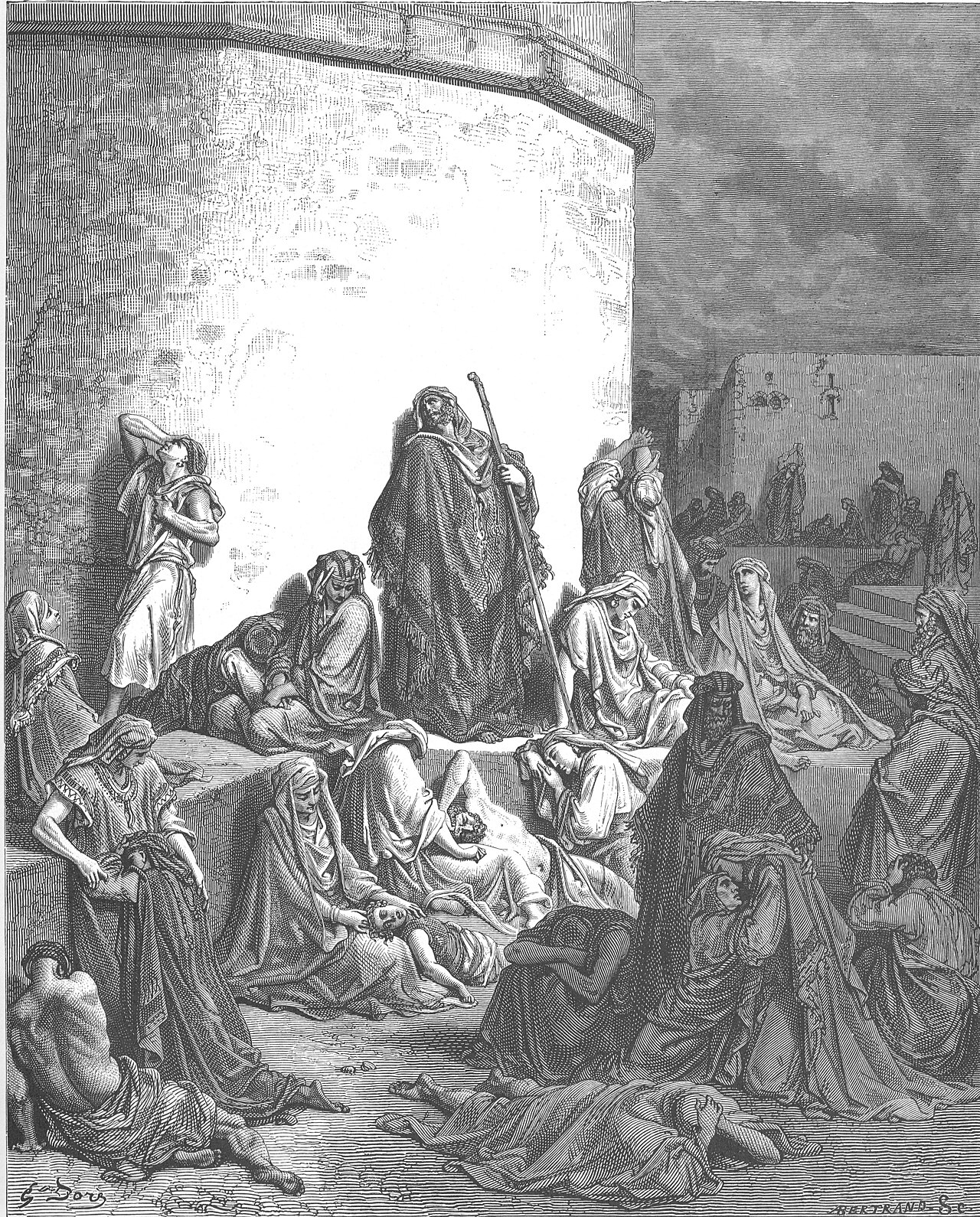
How lonely lies the city, once so full of people! She who was great among the nations has become a widow. The princess of the provinces has become a slave.
Introduction
Jeremiah, by tradition, The Prophets, Lamentations Overview.
Tradition gives this poem to Jeremiah, the prophet who warned Jerusalem for forty years and then lived through its fall. It was written for the survivors of 586 BC, some left among the ruins and some marched away to Babylon. It is a funeral song over a city, and each of its twenty-two verses begins with the next letter of the Hebrew alphabet. Listen for two voices, a mourner who describes the city and the city herself who answers in her own words. Listen too for the phrase about comfort that keeps coming back. The poem gives grief a shape that a people could learn by heart and say together.
Context
- Who
- Survivors gathering at the ruins on fast days to grieve together
- What
- A funeral song over Jerusalem, spoken first by a mourner and then by the city herself, in twenty-two verses from the first letter of the alphabet to the last.
- Where
- Jerusalem after the Babylonian army had burned it, with its gates deserted and its pilgrim roads empty.
- When
- Soon after the city fell in the summer of 586 BC; the book gives no date, and tradition places it within the next few years.
- Why
- To give the survivors words for their loss that name its cause honestly and turn their grief into prayer.
Historical context
Each of the first four chapters of this book is an alphabet poem: twenty-two verses, one for each letter of the Hebrew alphabet, in order. That is a deliberate structure for grief that would otherwise have no shape, an A to Z of loss, and a way for people to learn it by heart and say it together.
Show the rest of the historical context, 3 more paragraphs
The city is pictured as a widow sitting on the ground. Sitting in the dust, head covered, was the recognised posture of mourning, held for days while friends came and sat in silence. A widow in that society had no legal standing of her own and depended on the mercy of relatives, which is exactly the point of the image.
The most concrete detail is the roads. The roads to Zion mourn because none come to the appointed feasts. Three times a year the country emptied into Jerusalem for the pilgrim festivals; the highways would have been crowded with families walking up in company. Now they are empty and the gates are desolate.
Poems mourning a destroyed city were a known form in that part of the world, Mesopotamian scribes had composed laments over the fall of Ur and other cities centuries earlier, in which the city's goddess weeps over the ruin. This book uses the familiar form and changes the content: there is no capricious god here, only a city that says the LORD is in the right, for I have rebelled against his word.
Significance
The survivors needed permission to grieve out loud and words that would not lie. This chapter gives both: the horror is fully stated, and so is the reason for it.
Show the rest of the significance, 1 more paragraph
The refrain is loneliness rather than pain. She weeps bitterly in the night, and among all her lovers she has none to comfort her, those lovers being the allies Judah had courted for a century, none of whom came.
This chapter in Jewish lifeWhat this chapter is in Jewish life and reading.
What is done
This chapter opens the one public reading the book receives in the year. The site's own table in src/lib/hebraic/readings.ts records that Lamentations is read on the eve of the fast of Tisha B'Av, the ninth of Av. It records the room as well. The book is read at night in a darkened room, by candle or low light, and the congregation sits on the floor or on low stools as mourners do. The reading is chanted in its own mournful melody. The table gives Shulchan Aruch, Orach Chayim 559, on the customs of the night of the ninth of Av, as its source. Probed for this lane, the same table printed parashot total 0 and haftarah uses total 0 for this book, so no weekly portion and no Haftarah is drawn from it.
Rashi's own text ties the night and the date to this chapter. On the words in the night at the second verse he gives three readings. The first is that the Temple "was burned at night", and the edition points to Taanit 29a for it. The second is that "the night of the weeping of the spies on the ninth of Av caused it to happen to them" (Rashi on Lamentations 1:2:2). The third is that "whoever weeps at night, the one who hears his voice weeps along with him" (Rashi on Lamentations 1:2:2). The edition points to Sanhedrin 104b for the last.
How it is read
Rashi is the one commentator on this chapter whose English the corpus carries, quoted here from The Metsudah Five Megillot, Lakewood, N.J., 2001, which Sefaria reports as CC-BY. The translation is modern, so every quotation is held to fifty words or fewer. The edition sets numbered notes of its own inside Rashi's text, and only Rashi's own words are quoted as his.
Rashi reads the opening verse by its plain sense. The city sits "In isolation. Devoid of her inhabitants" (Rashi on Lamentations 1:1:2). The city great with people means "that her people were many" (Rashi on Lamentations 1:1:3). The entry in the Metsudah text then closes with a line on method: "There are many Aggadic midrashim, but I have come to explain the Scripture according to its literal meaning" (Rashi on Lamentations 1:1:3). The same entry sets two other readings in the edition's notes, one from Eikhah Rabbah and one from Ibn Ezra, and they stand there as the edition's.
The weeping of the second verse he counts twice, "Weeping twice over the two destructions [of the Beis Hamikdosh]" (Rashi on Lamentations 1:2:1). The festival visitors of the fourth verse are the "People who went up [to Yerusholayim] for the festivals" (Rashi on Lamentations 1:4:1). The princes of the sixth verse are like harts who "have no strength to flee" (Rashi on Lamentations 1:6:1). The defilement at her hem of the ninth verse he reads as open sin: "her sins are conspicuous; she committed them flagrantly" (Rashi on Lamentations 1:9:1). The edition's note sets the opposite reading beside it and names the Alshich for it. The oppressor who stretched out his hand at the tenth verse he names as "Ammon and Mo’av" (Rashi on Lamentations 1:10:1), and the edition's note names Nevuchadnetzar from the Targum.
At the twelfth verse Rashi reports a teaching of the Sages. From this verse, he says, it is derived that "to [publicly] complain about one’s troubles has a basis in Scripture" (Rashi on Lamentations 1:12:1). The edition points to Sanhedrin 104b. The yoke of the fourteenth verse is the record of Israel's sins. They are "marked in the hand of the Holy One, Blessed Is He, for a remembrance; their number and recompense have not been forgotten" (Rashi on Lamentations 1:14:1). The eyes of the sixteenth verse shed tears "without interruption" (Rashi on Lamentations 1:16:1).
The twenty-first verse he reads as the reason the nations hated Israel. God separated Israel from their food and drink and from marriage with them. "If I had intermarried with them, they would have had compassion upon me and upon their daughters’ children" (Rashi on Lamentations 1:21:1). The chapter closes on a plea that the enemies' sins be counted: "May all their iniquities be remembered and counted before You" (Rashi on Lamentations 1:22:1).
The corpus carries two further notes on this chapter without an English text, each marked linked because Sefaria holds no English version of the ref. They stand cited and unquoted at Ibn Ezra on Lamentations 1:11:1 and 1:18:1.
What the rabbis say
The corpus carries forty rabbinic locators on this chapter and the text of none, so each is cited and linked here rather than quoted. Most of them are Eikhah Rabbah, the Midrash on this book. It stands under the second verse at 1:22 and 1:24, and under the third, fourth, fifth, seventh and eighth at 1:28, 1:30, 1:31, 1:34 and 1:35. It stands under the ninth through the twelfth at 1:36, 1:38, 1:14, 1:39 and 1:40, and under the fourteenth through the nineteenth at 1:42, 1:44, 1:45, 1:51, 1:52, 1:53 and 1:54. Under the twenty-first it stands at 1:56, and under the twenty-second at 1:21.
Bereshit Rabbah stands beside it at 19:9 on the first verse, 33:6 on the third, 42:3 on the fifth, 41:3 on the tenth, 68:13 on the twelfth and 14:10 on the fourteenth. Bereshit Rabbati stands at Parashat Vayetze 35 on the first verse, and at Parashat Vayetze 53 and Parashat Vayishlach 58 on the thirteenth. Aggadat Bereshit stands at 64:1 on the sixth verse, 8:3 on the eighth and 66:1 on the twentieth. Midrash Lekach Tov on Lamentations 1:7:1 stands on the seventh.
Two pages of the Talmud stand among them. Berakhot 28a:19 is set on the fourth verse and Bava Kamma 55a:5 on the ninth. Ein Yaakov (Glick Edition) stands at Shabbat 16:20 on the sixth verse, Sanhedrin 11:38 on the fifteenth, Kiddushin 4:15 on the seventeenth and Taanit 3:14 on the eighteenth. What each of them teaches is a saying of the rabbis, and is reported as theirs wherever this site quotes one. The quotations wait on a fetch that carries the text.
Sources: Rashi, Rashi on Lamentations 1:1:2 to 1:22:1, The Metsudah Five Megillot, Lakewood, N.J., 2001, reported CC-BY; Ibn Ezra, Ibn Ezra on Lamentations 1:11:1 and 1:18:1, cited by ref because the corpus carries no English text; The Sefaria corpus, scripts/data/sources/sefaria/lamentations/1.json, the 40 Talmud and Midrash locators of this chapter; The site's own files, src/lib/hebraic/readings.ts, probed for this book and printing parashot total 0, haftarah uses total 0, and the festival reading on the eve of the fast of Tisha B'Av, sourced there to Shulchan Aruch, Orach Chayim 559.
The heads below are this chapter's scenes. The numbered points under each are its verses.
How Doth the City Sit Solitary
Lamentations 1:1-3
How lonely lies the city: Lamentations 1 is an acrostic, each of its twenty-two verses opening with the next letter of the Hebrew alphabet. Verse 1 names what was lost, a city once full of people that “has become a widow” and a princess who “has become a slave”.
Lamentations 1:1
“In these two verses is the same sad image as appears in the well-known medal of Titus, struck to celebrate his triumph over Jerusalem. A woman sits weeping beneath a palm-tree, and below is the legend “Judaea capta.” Translate Lam 1:1: How sitteth solitary the city that was full of people: She is become as a widow that was great among the nations: A princess among provinces she is become a vassal. Tributary - In the sense of personal labor Jos 16:10.”
1 more voice on this verseWhat preachers and commentators have said about this verse, in their own words.
Lamentations 1:1
“As for Isaiah, Jeremiah, Ezekiel and Daniel, who can fully understand or adequately explain them? The first of them seems to compose not a prophecy but a gospel. The second speaks of a rod of an almond tree and of a seething pot with its face toward the north, and of a leopard that has changed its spots. He also goes four times through the alphabet in different meters.”
Jerome · written before 420 · LETTER 53.8patristic
She weeps aloud in the night: John Gill hears the doubled Hebrew verb, weeping she weeps, as grief without rest through the night. Adam Clarke and Albert Barnes take her lovers and friends to be the allied nations that now serve her enemies. The want of comfort returns at Lamentations 1:9, 1:16, 1:17 and 1:21.
Lamentations 1:2
“She weepeth sore in the night,.... Or, "weeping weeps" (i); two weepings, one for the first, the other for the second temples (k); and while others are taking their sleep and rest; a season fit for mourners, when they can give their grief the greater vent, without any interruption from others; and it being now a night of affliction with her, which occasioned this sore weeping.”
Judah has gone into exile: Matthew Henry reads the harsh slavery as Judah's own sin, the slaves she freed and then seized again in Jeremiah 34:8-22. Distress here means narrow places, with no way to flee. Adam Clarke asks whether this recalls the king's flight by night from the city, Jeremiah 52:7.
Lamentations 1:4-6
The roads to Zion mourn: The roads grieve, since “no one comes to her appointed feasts”, the pilgrim festivals the Law set in Deuteronomy 16:16. The temple's people are named: “her priests groan, her maidens grieve”. Her princes “are like deer that find no pasture”, too weak “to flee in the face of the hunter”.
Lamentations 1:4
“The ways of Zion do mourn - A fine prosopopoeia. The ways in which the people trod coming to the sacred solemnities, being now no longer frequented, are represented as shedding tears; and the gates themselves partake of the general distress. All poets of eminence among the Greeks and Romans have recourse to this image.”
Adam Clarke · Commentary on the Bible (1810-1826)evangelical
Her foes have become her masters: The Hebrew says her foes have become the head, the reversal Moses warned of in Deuteronomy 28:44. The poem names the cause for the first time. Albert Barnes notes her children go before the enemy as slaves, and Matthew Henry reads the grief as the sentence of a righteous Judge.
Lamentations 1:5
“Are the chief ... prosper - Or, “are become the head”... are at rest. Judaea is so entirely crushed that her enemies did not need to take precautions against resistance on her part. Children - i. e. “young children,” who are driven before the enemy (literally the adversary), not as a flock of lambs which follow the shepherd, but for sale as slaves.”
All the splendor has departed: Matthew Henry reads the departed splendor as the temple, the beauty of Zion. John Gill sees princes weak with hunger, too faint to flee. Albert Barnes sees Zedekiah and his men of war, caught in the plains of Jericho as they fled the city, Jeremiah 39:4-5.
Lamentations 1:6
“The beauty of holiness was the beauty of the daughter of Zion; when the temple, that holy and beautiful house, was destroyed, her beauty was gone; that was the breaking of the staff of beauty, the taking away of the pledges and seals of the covenant, Zech. xi.”
Matthew Henry · Commentary on the Whole Bible (1707-1721)puritan
Lamentations 1:7-9
In the days of her affliction and wandering Jerusalem remembers: Jerusalem “remembers all the treasures that were hers in days of old” while her enemies laugh at her downfall, so memory adds to the affliction. Her uncleanness stains her skirts because “she did not consider her end”, and the unit closes on the line: “Look, O LORD, on my affliction”.
Lamentations 1:7
“Jerusalem remembers in the days of her affliction, And of her homelessness, All her pleasant things which have been from the days of old: Now that her people fall by the hand of the adversary, And she hath no helper; Her adversaries have seen her, They have mocked at her sabbath-keepings. The word rendered “homelessless” means wanderings, and describes the state of the Jews, cast forth from their homes and about to be dragged into exile. Sabbaths - Or, sabbath-keepings, and the cessation from labor every seventh day struck foreigners as something strange, and provoked their ridicule.”
1 more voice on this verse
Lamentations 1:7
“MAURER translates it "ruin." But English Version better expresses the point of their "mocking," namely, their involuntary "Sabbaths," that is, the cessation of all national movements. A fourth line is added in this stanza, whereas in all the others there are but three.”
Jamieson, Fausset & Brown · Commentary Critical and Explanatory on the Whole Bible (1871)reformed
Jerusalem has sinned greatly: The Hebrew reads that Jerusalem has sinned a sin, and Albert Barnes takes the doubling as settled, continued wickedness. Jamieson, Fausset & Brown read the word rendered scorn as the separation of an unclean woman under Leviticus 15:19, an image Lamentations 1:17 repeats. She turns away in shame.
Lamentations 1:8
“Grievously sinned - literally, “Jerusalem hath sinned a sin,” giving the idea of a persistent continuance in wickedness. Removed - Or, become an abomination. Sin has made Jerusalem an object of horror, and therefore she is cast away. Yea, she sigheth ... - Jerusalem groans over the infamy of her deeds thus brought to open shame, and turns her back upon the spectators in order to hide herself.”
Her uncleanness stains her skirts: John Gill reads the stain as sin shown openly, the image of the unclean woman from Lamentations 1:8. Her downfall was astounding, in the Hebrew a fall of wonders, and Albert Barnes sees a princess forced to sit on the ground. The closing plea is the first time Zion speaks.
Lamentations 1:9
“Her filthiness is in her skirts,.... Her sin is manifest to all, being to be seen in her punishment. The allusion is to a menstruous woman, to whom she is compared, both before and after; whose blood flows down to the skirts of her garments, and there seen; by which it is known that she is in her separation.”
2 more voices on this verse
Lamentations 1:9
“Her filthiness is in her skirts - Her personal defilement is no longer concealed beneath the raiment Jer 13:22. She came down wonderfully - Jerusalem once enthroned as a princess must sit on the ground as a slave.”
Lamentations 1:9
“She forgot how fatal must be the end of her iniquity. Or, as the words following imply: She, in despair, cannot lift herself up to lay hold of God's promises as to her "latter end" [CALVIN]. wonderfully--Hebrew, "wonders," that is, with amazing dejection.”
Jamieson, Fausset & Brown · Commentary Critical and Explanatory on the Whole Bible (1871)reformed
Lamentations 1:10-11
The adversary has seized all her treasures: The adversary seizes the temple's treasures, and the nations enter the sanctuary, “those You had forbidden to enter Your assembly”, the exclusion in Deuteronomy 23:3. Verse 11 shows the famine behind the siege in one trade: “They have traded their treasures for food to keep themselves alive”.
Lamentations 1:10
“Her pleasant things - Chiefly, the sacred vessels of the temple 2Ch 36:10. Sanctuary ... congregation - Even a Jew might not enter the innermost sanctuary, which was for the priests only; but now the tramp of pagan soldiery has been heard within its sacred precincts.”
1 more voice on this verse
Lamentations 1:10
“What these pleasant things are we may learn from Isa. lxiv. 11 , where, to the complaint of the burning of the temple, it is added, All our pleasant things are laid waste; the ark and the altar, and all the other tokens of God's presence with them, these were their pleasant things above any other things, and these were now broken to pieces and carried away.”
Matthew Henry · Commentary on the Whole Bible (1707-1721)puritan
All her people groan: The people groan and search for bread in a siege that lasted a year and a half, Jeremiah 52:4-6. Albert Barnes pictures them bringing out their treasures to buy one meal. Zion's plea to the LORD rests on being despised.
Lamentations 1:11
“All her people sigh,.... Not her priests only, Lam 1:4; but all the common people, because of their affliction, particularly for want of bread.”
Is It Nothing to You, All Ye That Pass By?
Lamentations 1:12-16
Is this nothing to you, all you who pass by?: Jerusalem asks every passerby whether any sorrow is like hers, “which the LORD made me suffer on the day of His fierce anger”. The cry is the city's over her ruin, with fire in her bones and the Lord treading “the Virgin Daughter of Judah” in a winepress.
Lamentations 1:12
“The pathetic appeal of Jerusalem, not only to her neighbors, but even to the strangers "passing by," as her sorrow is such as should excite the compassion even of those unconnected with her. She here prefigures Christ, whom the language is prophetically made to suit, more than Jerusalem. Compare Israel, that is, Messiah, Isa 49:3.”
Jamieson, Fausset & Brown · Commentary Critical and Explanatory on the Whole Bible (1871)reformed
1 more voice on this verse
Lamentations 1:12
“Is it nothing to you, all ye that pass by? - The desolations and distress brought upon this city and its inhabitants had scarcely any parallel. Excessive abuse of God’s accumulated mercies calls for singular and exemplary punishment.”
Adam Clarke · Commentary on the Bible (1810-1826)evangelical
He sent fire from on high: Lamentations 1:13-15 names the Lord as the one who acts in each image: fire, net, yoke and winepress. Jamieson, Fausset & Brown compare the net spread for Zedekiah in Ezekiel 12:13. Albert Barnes pictures a hunted animal with every way out blocked.
My transgressions are bound into a yoke: Albert Barnes explains the yoke: her transgressions are the cords knit round it, bound so tight by His hand that she cannot throw it off. Jeremiah wore such a yoke on his neck in Jeremiah 27:2. The Lord is Adonai, the title Barnes counts fourteen times in the book.
Lamentations 1:14
“The yoke of my transgressions - I am now tied and bound by the chain of my sins; and it is so wreathed, so doubled and twisted round me, that I cannot free myself. A fine representation of the miseries of a penitent soul, which feels that nothing but the pitifulness of God’s mercy can loose it.”
Adam Clarke · Commentary on the Bible (1810-1826)evangelical
The Lord has rejected all the mighty men: The word behind army is the word for the appointed feasts, and Albert Barnes reads it as a festival the Lord proclaimed against Zion. Her warriors fell inside the city. Jamieson, Fausset & Brown link the winepress to Isaiah 63:3, where the treader's garments are stained red.
For these things I weep: Zion speaks here, and John Gill hears Jeremiah and the faithful of Judah weeping with her. The words revive my soul use the Hebrew idiom of Lamentations 1:11 and 1:19, where food keeps the starving alive. The verse opens with ayin, the letter whose name means eye.
Lamentations 1:16
“For these things I weep,.... The congregation of Judah, the godly among them, particularly Jeremiah, who represented them, wept for the sins the people had been guilty of, and for the punishment inflicted on them, or the sore calamities that were brought upon them.”
Lamentations 1:17-19
Zion stretches out her hands: “Zion stretches out her hands, but there is no one to comfort her”, the refrain of 1:2, 1:9, 1:16 and 1:21. The Hebrew word behind “an unclean thing” is the Law's term for a woman's ritual impurity in Leviticus 15:19. Zion confesses, “I have rebelled against His command”.
Lamentations 1:17
“Spreadeth forth her hands - In prayer Exo 9:29, Exo 9:33, but Zion entreats in vain. There is no one to comfort her - not God, for He is chastising her, nor man, for all the neighboring nations have become her enemies. See Lam 1:2. That his adversaries ... - Rather, that those round about him should be his adversaries; all the neighboring states should regard him with aversion. Jerusalem is ... - i. e. is become an abomination. The words are virtually the same as in Lam 1:8.”
The LORD is righteous: Zion calls the LORD righteous and owns she rebelled against His command, which Jamieson, Fausset & Brown call the sure sign of repentance, Nehemiah 9:33. In the Hebrew, command is His mouth, His word through the prophets. The first word, righteous, gives the letter tsade.
Lamentations 1:18
“The sure sign of repentance; justifying God, condemning herself (Ne 9:33; Da 9:7-14). his commandment--literally, "mouth"; His word in the mouth of the prophets.”
Jamieson, Fausset & Brown · Commentary Critical and Explanatory on the Whole Bible (1871)reformed
I called out to my lovers: Adam Clarke names her lovers as her allies, Egypt among them, whose army drew off the Chaldeans for a time, Jeremiah 37:5-7. Her priests and elders perished while they searched for food, and Albert Barnes completes the line: they found none. Matthew Henry notes her comforters had no comfort left.
Lamentations 1:19
“Those that made court to her in her prosperity were shy of her, and strange to her, in her adversity. Happy are those that have made God their friend and keep themselves in his love, for he will not deceive them! Those whose office it was to guide her were disabled from doing her any service.”
Matthew Henry · Commentary on the Whole Bible (1707-1721)puritan
Lamentations 1:20-22
See, O LORD, how distressed I am!: The chapter closes as prayer, “See, O LORD, how distressed I am!” The prayer asks Him to “deal with them as You have dealt with me”, laying the case before the Judge. The acrostic ends on “my heart is faint”, still spoken to the God who sent the affliction.
Lamentations 1:20
“Abroad the sword bereaves and slays all that comes in its way, and at home all provisions are cut off by the besiegers, so that there is as death, that is, famine, which is as bad as the pestilence, or worse-- the sword without and terror within, Deut. xxxii.”
Matthew Henry · Commentary on the Whole Bible (1707-1721)puritan
1 more voice on this verse
Lamentations 1:20
“Abroad the sword bereaveth - War is through the country; and at home death; the pestilence and famine rage in the city; calamity in every shape is fallen upon me. Virgil represents the calamities of Troy under the same image: - - Nec soli poenas dant sanguine Teucri: Quondam etiam victis redit in praecordia virtus; Victoresque cadunt Danai. Crudelis ubique Luctus, ubique Pavor, et plurima mortis imago. Aeneid. lib. 2:366. “Not only Trojans fall; but, in their turn, The vanquished triumph, and the victors mourn. Ours take new courage from despair and night; Confused the fortune is, confused the fight.”
Adam Clarke · Commentary on the Bible (1810-1826)evangelical
People have heard my groaning: The enemies are glad that the LORD caused her trouble, and Jamieson, Fausset & Brown say they thought Judah ruined for good. The day the LORD announced is Babylon's, foretold in Jeremiah 50 and 51. Albert Barnes calls Judah's fall the proof that her enemies would become like her.
Lamentations 1:21
“They have heard ... - Or, “They heard that I sigh,” that I have “no comforter.” Thou wilt bring the day ... - literally, thou hast brought “the day thou hast proclaimed, and they shall be like unto me.” The day of Judah’s punishment was the proof that the nations now triumphing over Jerusalem’s fall would certainly be visited.”
1 more voice on this verse
Lamentations 1:21
“Note, Our prayers may and must agree with God's word; and what day God has here called we are to call for, and no other. And though we are bound in charity to forgive our enemies, and to pray for them, yet we may in faith pray for the accomplishment of that which God has spoken against his and his church's enemies, that will not repent to give him glory.”
Matthew Henry · Commentary on the Whole Bible (1707-1721)puritan
Let all their wickedness come before You: Zion asks the LORD to deal with her enemies as He has dealt with her transgressions. Adam Clarke reads the plea as a forecast of sure judgment, and Jamieson, Fausset & Brown compare Babylon remembered before God in Revelation 16:19. The acrostic ends here on tav, with her heart faint.
Lamentations 1:22
“Let all their wickedness come before thee - That is, Thou wilt call their crimes also into remembrance; and thou wilt do unto them by siege, sword, famine, and captivity, what thou hast done to me. Though thy judgments, because of thy long-suffering, are slow; yet, because of thy righteousness, they are sure. For my sighs are many - My desolations continue; and my heart is faint - my political and physical strength almost totally destroyed. Imprecations in the sacred writings are generally to be understood as declarative of the evils they indicate; or, that such evils will take place.”
Adam Clarke · Commentary on the Bible (1810-1826)evangelical
1 more voice on this verse
Lamentations 1:22
“Such prayers against foes are lawful, if the foe be an enemy of God, and if our concern be not for our own personal feeling, but for the glory of God and the welfare of His people. come before thee--so Re 16:19, "Babylon came in remembrance before God" (compare Ps 109:15).”
Jamieson, Fausset & Brown · Commentary Critical and Explanatory on the Whole Bible (1871)reformed
How this psalm is built
The form: An alphabetic acrostic of twenty-two verses, one letter to each verse in the usual order of the Hebrew alphabet, as Jerome classes it.
The patterns in this chapter
| Device | What it does | Where to see it |
|---|---|---|
| From Aleph to Taw | Each verse opens with the next letter of the Hebrew alphabet, Aleph at verse 1 and Taw at verse 22. Counted over the store's own tagged Hebrew, all twenty-two letters stand in their usual order, with Ayin at verse 16 before Pe at verse 17. The form gave the grief a fixed course from the first letter to the last and made the poem easy to learn by heart.Jerome, Letter 53, 8. | Lamentations 1:1, Lamentations 1:16, Lamentations 1:17, Lamentations 1:22 |
| No one to comfort | The words no one to comfort, once as no one nearby to comfort, come back five times, at verses 2, 9, 16, 17 and 21. The mourner says them of the city in verses 2, 9 and 17, and the city says them of herself in verses 16 and 21. The allies she once courted are named as her lovers in verse 2 and again in verse 19, and none of them comes.the site's Lamentations guide, src/components/book/guides/lamentations/LamentationsGuide.tsx, the chapter spine, chapter 1. | Lamentations 1:2, Lamentations 1:9, Lamentations 1:16, Lamentations 1:17, Lamentations 1:21 |
| The mourner, then the city | A mourner speaks of the city in the third person through verse 11, and twice the city breaks in to call on the LORD, at the close of verses 9 and 11. From verse 12 she speaks for herself to the end of the poem. Verse 17 is the one place in that second half where the mourner's voice returns.the site's Lamentations guide, src/components/book/guides/lamentations/LamentationsGuide.tsx, the chapter spine, chapter 1. | Lamentations 1:1, Lamentations 1:9, Lamentations 1:11, Lamentations 1:12, Lamentations 1:17 |
How this chapter is built
2 more paragraphs on the patterns
The poem runs through the Hebrew alphabet one verse to a letter, in the usual order, from Aleph at verse 1 to Taw at verse 22. A mourner speaks through verse 11, and the city breaks in twice to call on the LORD. From verse 12 the city speaks for herself. The words no one to comfort return five times and tie the two halves together.
The letters are counted from the store's tagged Hebrew. The other sources are Jerome, Letter 53, 8, and the chapter spine of the site's Lamentations guide.
Key words
The words this chapter repeats, each one a lemma of the store’s tagged Hebrew however the chapter inflects it, with the verses it stands in. The grammar words are struck out, and the eight terms the psalm says the word of God by stand in the figure above the patterns rather than here. Every row opens that word’s own page.
| Word | Said | No.Strong’s | Meaning | Where it stands |
|---|---|---|---|---|
| אָנַח | ʼânach | H584 | to sigh | 4, 8, 11, 21 |
| יָגָה | yâgâh | H3013 | to suffer | 4, 5, 12 |
| צַר | tsar | H6862 | narrow | 5, 7, 10, 17, 20 |
| נָחַם | nâcham | H5162 | to be sorry | 2, 9, 16, 17, 21 |
| בְּתוּלָה | bᵉthûwlâh | H1330 | virgin | 4, 15, 18 |
| אֹיֵב | ʼôyêb | H341 | enemy | 2, 5, 9, 16, 21 |
Show the next 12 words
| Word | Said | No.Strong’s | Meaning | Where it stands |
|---|---|---|---|---|
| בָּכָה | bâkâh | H1058 | to weep | 2, 16 |
| רָאָה | râʼâh | H7200 | to see | 7, 8, 9, 10, 11, 12 and 2 more |
| אַיִן | ʼayin | H369 | nothing | 2, 7, 9, 17, 21 |
| שׁוּב | shûwb | H7725 | to return | 8, 11, 13, 16, 19 |
| אֲדֹנָי | ʼĂdônây | H136 | Lord | 14, 15 |
| גּוֹי | gôwy | H1471 | nation | 1, 3, 10 |
| יָד | yâd | H3027 | hand | 7, 10, 14, 17 |
| יוֹם | yôwm | H3117 | day | 7, 12, 13, 21 |
| בּוֹא | bôwʼ | H935 | to come (in) | 4, 10, 21, 22 |
| עַם | ʻam | H5971 | people | 1, 7, 11, 18 |
| יְהֹוָה | Yᵉhôvâh | H3068 | LORD | 5, 9, 11, 12, 17, 18 and 1 more |
| הָלַךְ | hâlak | H1980 | to go | 5, 6, 18 |
Keep studying
Studies6
Sources for this chapter
The summary
Jamieson, Fausset & Brown, Commentary Critical and Explanatory; John Calvin, Commentaries; John Wesley, Notes on the Old Testament and Matthew Henry, Complete Commentary.
The form and classifications
Jerome, Letter 53, 8, where he says Jeremiah goes four times through the alphabet.
The exposition
Adam Clarke, Commentary on the Bible; Albert Barnes; Carl Friedrich Keil, Lamentations; Glossa Ordinaria, Commentary (church-history corpus); Jamieson, Fausset & Brown, Commentary Critical and Explanatory on the Whole Bible; Jamieson, Fausset and Brown, Commentary Critical and Explanatory on the Whole Bible; John Calvin, Commentary on Jeremiah and Lamentations; John Gill and Matthew Henry, Commentary on the Whole Bible.