
Lamentations 1:11
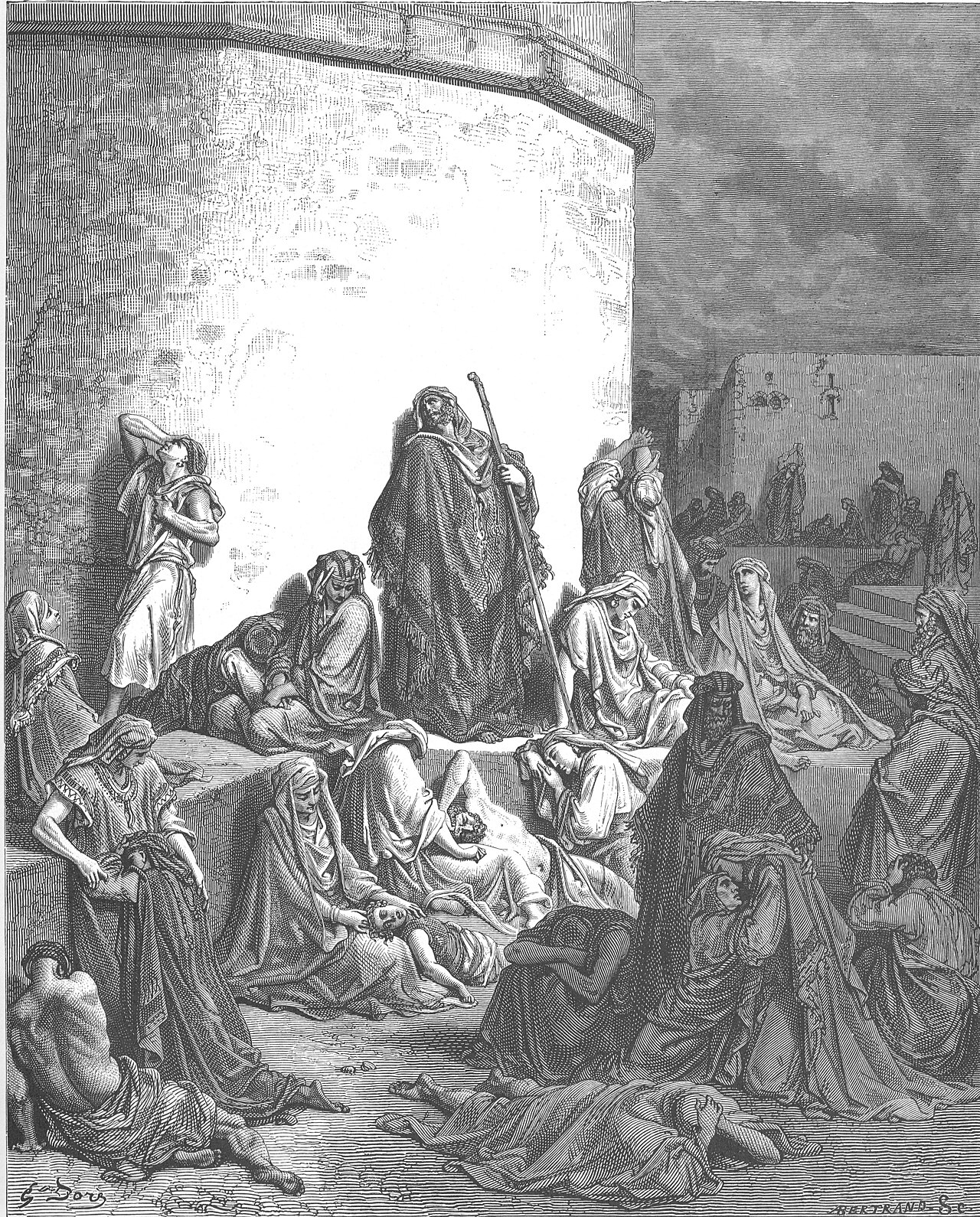
in Lamentations 1All her people groan as they search for bread. They have traded their treasures for food to keep themselves alive. Look, O LORD, and consider, for I have become despised.
BSB
The same verse in ASV and KJV ▾
ASV
All her people sigh, they seek bread; They have given their pleasant things for food to refresh the soul: See, O Jehovah, and behold; for I am become abject.
KJV
All her people sigh, they seek bread; they have given their pleasant things for meat to relieve the soul: see, O Lord, and consider; for I am become vile.
⋯
This verse in Lamentations 1
Commentary
11 notes on this verseAll her people sigh,.... Not her priests only, Lam 1:4; but all the common people, because of their affliction, particularly for want of bread.
This site's exposition
The adversary has seized all her treasures
on Lamentations 1:10-11
The adversary seizes the temple's treasures, and the nations enter the sanctuary, “those You had forbidden to enter Your assembly”, the exclusion in Deuteronomy 23:3. Verse 11 shows the famine behind the siege in one trade: “They have traded their treasures for food to keep themselves alive”.
This site's exposition
All her people groan
The people groan and search for bread in a siege that lasted a year and a half, Jeremiah 52:4-6. Albert Barnes pictures them bringing out their treasures to buy one meal. Zion's plea to the LORD rests on being despised.
The record, by era
The Medieval Church3 voices
ALL HER PEOPLE: the fourth topic of complaint. SEE O LORD: the fourteenth topic of complaint. Historical interpretation. ALL HER PEOPLE SIGH &c: how great the hunger and pestilence the Jews suffered, the histories do not pass over in silence, and Josephus manifests it in …
A commentator
BonaventureCollations on the Hexaemeron, Collation 17 · Written in the 13th century.
proposed
As the body loses its strength, beauty and health in the absence of food, so the soul without the understanding of truth becomes dark and weak, distorted and unstable in all things; and so it needs to be fed. Hence, the unsettled mind, lacking food, …
Here is noticed the spoiling of possessions taken away from the people. First is observed the need for withdrawing, as to a deficiency of things needed. As expressed: "All her people groan as they search for bread". Psalm 102:4 thus remarks: "My heart is smitten …
The Puritans and the Awakening2 voices
): All her people sigh in despondency and despair; they are ready to faint away; their spirits fail, and therefore they sigh, for they seek bread and seek it in vain. They were brought at last to that extremity that there was no bread for the people of the land ( Jer. lii.
quarantine:debris (2026-07-29) — leading-punctuation
It is time to sigh when the priests, the Lord's ministers, sigh. Her virgins also, that used, with their music and dancing, to grace the solemnities of their feasts, are afflicted and in heaviness. Notice is taken of their service in the day of Zion's prosperity ( Ps. lxviii.
quarantine:debris (2026-07-29) — unbalanced-parens
3 more voices on this verse
The Nineteenth Century3 voices
A commentator
Albert Barnes1798–1870
Notes, Explanatory and Practical, on the Old and New Testaments (1832-1869)
Sigh ... seek - Are sighing ... are seeking. The words are present participles, describing the condition of the people. After a siege lasting a year and a half the whole country, far and near, would be exhausted. To relieve the soul - See the margin, i. e. to bring back life to them. They bring out their jewels and precious articles to obtain with them at least a meal.
A commentator
Jamieson, Fausset & Brown1802–1910
Commentary Critical and Explanatory on the Whole Bible (1871)
proposed
52:6). given . . . pleasant things for meat-- (2Ki 6:25; Job 2:4). relieve . . . soul--literally, "to cause the soul or life to return." for I am become vile--Her sins and consequent sorrows are made the plea in craving God's mercy.
quarantine:debris (2026-07-29) — unbalanced-parens
They have given their pleasant things - Jerusalem is compared to a woman brought into great straits, who parts with her jewels and trinkets in order to purchase by them the necessaries of life.
How the passage was read
What the Jewish commentators add
On the verses either side of this one
The oppressor extended his hand. Ammon and Mo’av. 40 Alternatively, Nevuchadnetzar. (Targum)
1 more on this passage, in their own words ▾
May this not happen to you. Such a calamity should not happen to all those who transgress the law.
This section is reception history: how the passage was read and kept in the Jewish tradition. Where a reading parts from an essential of the Christian faith, the section says so at that point.
Texts and citation data: Sefaria; each excerpt follows its version’s licence. 4 further sources are cited on this chapter that carry no English text this site may quote or only restate the verse.
The words behind it
16 Hebrew wordsEvery Hebrew word of this verse in the order it stands, with what it means and the door to its own study. The last column counts the times a word stands in the whole Bible: the rarer the word, the more the places it appears belong together.
| Hebrew | Sound | Meaning | Word study | In the Bible |
|---|---|---|---|---|
| כָּל־ | kol- | all | H3605 → | 5413 times |
| עַמָּ֤הּ | ʾamah | people its | H5971 → | 1873 times |
| נֶאֱנָחִים֙ | neenachim | [are] groaning | H584 → | 13 times |
| מְבַקְּשִׁ֣ים | mevakeshim | [are] seeking | H1245 → | |
| לֶ֔חֶם | lechem | bread | H3899 → | 298 times |
| נָתְנ֧וּ | natenu | they have given | H5414 → | 2011 times |
| מַחֲמַדֵּיהֶ֛ם | machamodeihem | precious things their | H4261 → | 13 times |
| בְּאֹ֖כֶל | beokhel | for food | H400 → | |
| לְהָשִׁ֣יב | lehashiv | to restore | H7725 → | 1056 times |
| נָ֑פֶשׁ | nafesh | life | H5315 → | 754 times |
| רְאֵ֤ה | reeh | see | H7200 → | 1300 times |
| יְהוָה֙ | yahweh | O Yahweh | H3068 → | 6520 times |
| וְֽהַבִּ֔יטָה | vehabitah | and look ! | H5027 → | 69 times |
| כִּ֥י | ki | for | H3588 → | 4482 times |
| הָיִ֖יתִי | hayiti | I am | H1961 → | 3559 times |
| זוֹלֵלָֽה׃ ס | zolelah | despised | H2151 → |
כָּל־all
kol-H3605 →5413 times
עַמָּ֤הּpeople its
ʾamahH5971 →1873 times
נֶאֱנָחִים֙[are] groaning
neenachimH584 →13 times
מְבַקְּשִׁ֣ים[are] seeking
mevakeshimH1245 →
לֶ֔חֶםbread
lechemH3899 →298 times
נָתְנ֧וּthey have given
natenuH5414 →2011 times
מַחֲמַדֵּיהֶ֛םprecious things their
machamodeihemH4261 →13 times
בְּאֹ֖כֶלfor food
beokhelH400 →
לְהָשִׁ֣יבto restore
lehashivH7725 →1056 times
נָ֑פֶשׁlife
nafeshH5315 →754 times
רְאֵ֤הsee
reehH7200 →1300 times
יְהוָה֙O Yahweh
yahwehH3068 →6520 times
וְֽהַבִּ֔יטָהand look !
vehabitahH5027 →69 times
כִּ֥יfor
kiH3588 →4482 times
הָיִ֖יתִיI am
hayitiH1961 →3559 times
זוֹלֵלָֽה׃ סdespised
zolelahH2151 →
A shaded row is a word that stands 400 times or fewer in the Bible.
The walk
8 stopsEach card is a verse this one points to, and under it the verses that one points to in turn. Where several paths arrive at the same place, that place is listed first: the text keeps returning to it.
Through
Jeremiah 52:6By the ninth day of the fourth month, the famine in the city was so severe that the people of the land had no food.
it leads to
- Isaiah 3:1
For behold, the Lord GOD of Hosts is about to remove from Jerusalem and Judah both supply and support: the whole supply of food and water,
- Jeremiah 39:2
And on the ninth day of the fourth month of Zedekiah’s eleventh year, the city was breached.
- 2 Kings 25:3
By the ninth day of the fourth month, the famine in the city was so severe that the people of the land had no food.
- Jeremiah 38:9
“My lord the king, these men have acted wickedly in all that they have done to Jeremiah the prophet. They have dropped him into the cistern, where he will starve to death, for there…
- Jeremiah 21:9
Whoever stays in this city will die by sword and famine and plague, but whoever goes out and surrenders to the Chaldeans who besiege you will live; he will retain his life like a…
- Isaiah 3:1
Through
Jeremiah 38:9“My lord the king, these men have acted wickedly in all that they have done to Jeremiah the prophet. They have dropped him into the cistern, where he will starve to death, for there…
it leads to
- Jeremiah 37:21
So King Zedekiah gave orders for Jeremiah to be placed in the courtyard of the guard and given a loaf of bread daily from the street of the bakers, until all the bread in…
- Esther 7:4–6
For my people and I have been sold out to destruction, death, and annihilation. If we had merely been sold as menservants and maidservants, I would have remained silent, because no such distress would…
- Jeremiah 52:6
By the ninth day of the fourth month, the famine in the city was so severe that the people of the land had no food.
- Jeremiah 37:21
Where this verse is studied
On this page
About Lamentations
This page draws on 10 works. Open the list of works
This page draws on Adam Clarke, Commentary on the Bible; Albert Barnes, Notes on the Old Testament; Albert Barnes, Notes, Explanatory and Practical, on the Old and New Testaments (1832-1869); Bonaventure, Collations on the Hexaemeron, Collation 17; Glossa Ordinaria, Commentary (church-history corpus); Jamieson, Fausset & Brown, Commentary Critical and Explanatory on the Whole Bible; John Gill, Exposition of the Old Testament (1748-1763); John Gill, Exposition of the Old Testament; Matthew Henry, Commentary on the Whole Bible and Thomas Aquinas, Commentary on Lamentations.