
Lamentations 1:2
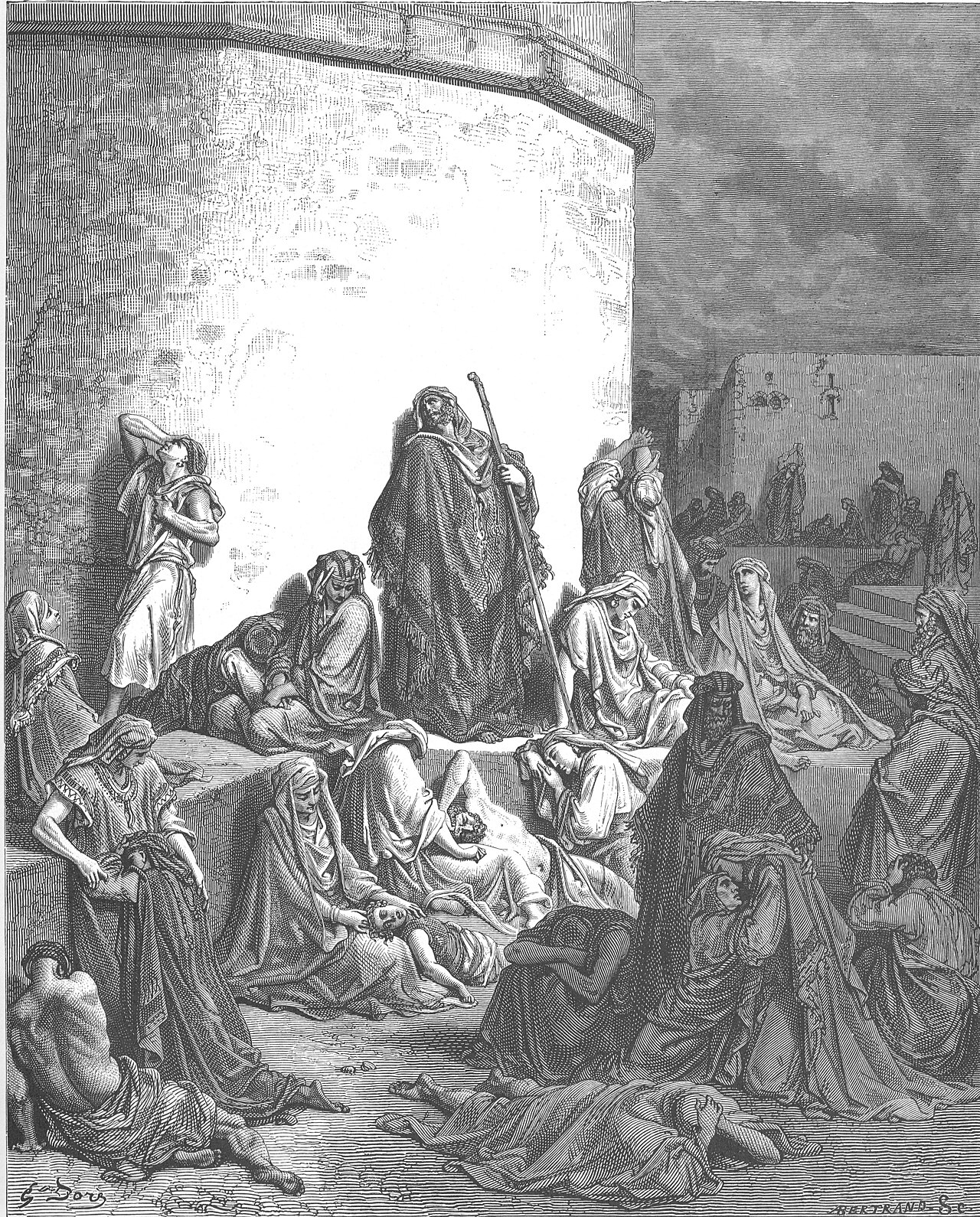
in Lamentations 1She weeps aloud in the night, with tears upon her cheeks. Among all her lovers there is no one to comfort her. All her friends have betrayed her; they have become her enemies.
BSB
The same verse in ASV and KJV ▾
ASV
She weepeth sore in the night, and her tears are on her cheeks; Among all her lovers she hath none to comfort her: All her friends have dealt treacherously with her; they are become her enemies.
KJV
She weepeth sore in the night, and her tears are on her cheeks: among all her lovers she hath none to comfort her: all her friends have dealt treacherously with her, they are become her enemies.
⋯
This verse in Lamentations 1
Commentary
10 notes on this verseAs for Isaiah, Jeremiah, Ezekiel and Daniel, who can fully understand or adequately explain them? The first of them seems to compose not a prophecy but a gospel. The second speaks of a rod of an almond tree and of a seething pot with its face toward the north, and of a leopard that has changed its spots. He also goes four times through the alphabet in different meters.
This site's exposition
How lonely lies the city
on Lamentations 1:1-3
Lamentations 1 is an acrostic, each of its twenty-two verses opening with the next letter of the Hebrew alphabet. Verse 1 names what was lost, a city once full of people that “has become a widow” and a princess who “has become a slave”.
This site's exposition
She weeps aloud in the night
John Gill hears the doubled Hebrew verb, weeping she weeps, as grief without rest through the night. Adam Clarke and Albert Barnes take her lovers and friends to be the allied nations that now serve her enemies. The want of comfort returns at Lamentations 1:9, 1:16, 1:17 and 1:21.
The record, by era
The Church Fathers1 voice
Bringing someone to his senses is censure, which makes one think. And he does not abstain from this form of instruction either, but says by Jeremiah, "How long shall I cry, and you not hear? So your ears are uncircumcised." O blessed forbearance! And again, by the same: "All the heathen are uncircumcised, but this people is uncircumcised in heart," "for the people are disobedient children," he says, "in whom faith does not exist." … Bewailing one's fate is latent censure and artfully helps to bring salvation, albeit under stealth. He made use of this by Jeremiah: "How did the city sit solitary that was full of people! She that ruled over territories became as a widow; she came under tribute; weeping, she wept in the night." … In the end, the system God pursues to inspire fear is the source of salvation. And it is the prerogative of goodness to save: "The mercy of the Lord is on all flesh, while he reproves, corrects and teaches as a shepherd does his flock. He pities those who receive his instruction and those who eagerly seek union with him." … "For according to the greatness of his mercy, so is his rebuke." For it is indeed noble not to sin, but it is good also for the sinner to repent, just as it is best to be always in good health but well to recover from disease. So he commands by Solomon, "Strike your son with the rod, that you may deliver his soul from death." And again, "Do not abstain from chastising your son but correct him with the rod, for he will not die." For reproof and rebuke, as also the original term implies, are the stripes of the soul, chastising sins, preventing death and leading to self-control for those who are out of control.… And so we, too, who in our lives are sick with shameful lusts and reprehensible excesses and other inflammatory effects of the passions, need the Savior. And he administers not only mild but also stringent medicines. […]
The Medieval Church2 voices
Verse 2 laments the violation of friendship. So, first is indicated the need for friends. As expressed: "She weeps bitterly": as if continuously: Jerusalem. And, "in the night": privately, due to fear of enemies, or as one in adversity. Also: "tears on her cheeks": since …
WEEPING SHE HAS WEPT: the fourth topic of complaint, in which shameful, mean and ignoble acts are recounted before the suffering, which is very often the case here. ALL HER FRIENDS HAVE DESPISED HER: similarly the Church is sometimes afflicted for her sins and spurned …
The Puritans and the Awakening2 voices
She weepeth sore in the night,.... Or, "weeping weeps" (i); two weepings, one for the first, the other for the second temples (k); and while others are taking their sleep and rest; a season fit for mourners, when they can give their grief the greater vent, without any interruption from others; and it being now a night of affliction with her, which occasioned this sore weeping.
), when none sees; my eye, my eye, runs down with water. " Note, This world is a vale of tears to the people of God. Zion's sons are often Zion's mourners.
quarantine:debris (2026-07-29) — leading-punctuation+unbalanced-parens+odd-straight-quotes
2 more voices on this verse
The Nineteenth Century2 voices
Among all her lovers - Her allies; her friends, instead of helping her, have helped her enemies. Several who sought her friendship when she was in prosperity, in the time of David and Solomon, are now among her enemies.
A commentator
Albert Barnes1798–1870
Notes, Explanatory and Practical, on the Old and New Testaments (1832-1869)
proposed
Lovers ... friends - i. e. the states in alliance with Judaea, and all human helpers.
The words behind it
18 Hebrew wordsEvery Hebrew word of this verse in the order it stands, with what it means and the door to its own study. The last column counts the times a word stands in the whole Bible: the rarer the word, the more the places it appears belong together.
| Hebrew | Sound | Meaning | Word study | In the Bible |
|---|---|---|---|---|
| בָּכ֨וֹ | bakho | bitterly <weep> | H1058 → | 114 times |
| תִבְכֶּ֜ה | tivkeh | she weeps | H1058 → | 114 times |
| בַּלַּ֗יְלָה | balaylah | in the night | H3915 → | 233 times |
| וְדִמְעָתָהּ֙ | vedimatah | and tear[s] her | H1832 → | 23 times |
| עַ֣ל | ʾal | [are] on | H5921 → | 5755 times |
| לֶֽחֱיָ֔הּ | lecheyah | cheek her | H3895 → | |
| אֵֽין־ | ʾein- | not | H369 → | 789 times |
| לָ֥הּ | lah | [belongs] to her | ||
| מְנַחֵ֖ם | menachem | a comforter | H5162 → | 108 times |
| מִכָּל־ | mikol | from all | H3605 → | 5413 times |
| אֹהֲבֶ֑יהָ | ʾohaveiha | lovers her | H157 → | |
| כָּל־ | kol- | all | H3605 → | 5413 times |
| רֵעֶ֙יהָ֙ | reeiha | friends her | H7453 → | |
| בָּ֣גְדוּ | bagedu | they have dealt treacherously | H898 → | |
| בָ֔הּ | vah | with her | ||
| הָ֥יוּ | hayu | they have become | H1961 → | 3559 times |
| לָ֖הּ | lah | of her | ||
| לְאֹיְבִֽים׃ ס | leoyevim | <into> enemies | H341 → | 282 times |
בָּכ֨וֹbitterly <weep>
bakhoH1058 →114 times
תִבְכֶּ֜הshe weeps
tivkehH1058 →114 times
בַּלַּ֗יְלָהin the night
balaylahH3915 →233 times
וְדִמְעָתָהּ֙and tear[s] her
vedimatahH1832 →23 times
עַ֣ל[are] on
ʾalH5921 →5755 times
לֶֽחֱיָ֔הּcheek her
lecheyahH3895 →
אֵֽין־not
ʾein-H369 →789 times
לָ֥הּ[belongs] to her
lah
מְנַחֵ֖םa comforter
menachemH5162 →108 times
מִכָּל־from all
mikolH3605 →5413 times
אֹהֲבֶ֑יהָlovers her
ʾohaveihaH157 →
כָּל־all
kol-H3605 →5413 times
רֵעֶ֙יהָ֙friends her
reeihaH7453 →
בָּ֣גְדוּthey have dealt treacherously
bageduH898 →
בָ֔הּwith her
vah
הָ֥יוּthey have become
hayuH1961 →3559 times
לָ֖הּof her
lah
לְאֹיְבִֽים׃ ס<into> enemies
leoyevimH341 →282 times
A shaded row is a word that stands 400 times or fewer in the Bible.
The walk
8 stopsEach card is a verse this one points to, and under it the verses that one points to in turn. Where several paths arrive at the same place, that place is listed first: the text keeps returning to it.
Through
Micah 7:5Do not rely on a friend; do not trust in a companion. Seal the doors of your mouth from her who lies in your arms.
it leads to
- Jeremiah 9:4
“Let everyone guard against his neighbor; do not trust any brother, for every brother deals craftily, and every friend spreads slander.
- Psalms 118:8–9
It is better to take refuge in the LORD than to trust in man.
- Matthew 10:16
Behold, I am sending you out like sheep among wolves; therefore be as shrewd as snakes and as innocent as doves.
- Job 6:14–15
A despairing man should have the kindness of his friend, even if he forsakes the fear of the Almighty.
- Judges 16:5–20
The lords of the Philistines went to her and said, “Entice him and find out the source of his great strength and how we can overpower him to tie him up and subdue him.…
- Jeremiah 9:4
Through
Jeremiah 9:1Oh, that my head were a spring of water, and my eyes a fountain of tears! I would weep day and night over the slain daughter of my people.
it leads to
- Jeremiah 13:17
But if you do not listen, I will weep in secret because of your pride. My eyes will overflow with tears, because the LORD’s flock has been taken captive.
- Isaiah 22:4
Therefore I said, “Turn away from me, let me weep bitterly! Do not try to console me over the destruction of the daughter of my people.”
- Jeremiah 13:17
Through
Psalms 6:6I am weary from groaning; all night I flood my bed with weeping and drench my couch with tears.
it leads to
- Psalms 42:3
My tears have been my food both day and night, while men ask me all day long, “Where is your God?”
- Psalms 42:3
Where this verse is studied
On this page
About Lamentations
This page draws on 9 works. Open the list of works
This page draws on Adam Clarke, Commentary on the Bible; Albert Barnes, Notes, Explanatory and Practical, on the Old and New Testaments (1832-1869); Carl Friedrich Keil, Lamentations; Clement of Alexandria, The Instructor Book 1; Glossa Ordinaria, Commentary (church-history corpus); Jerome, LETTER 53.8; John Gill, Exposition of the Old Testament (1748-1763); Matthew Henry, Commentary on the Whole Bible and Thomas Aquinas, Commentary on Lamentations.