
Lamentations 1:4
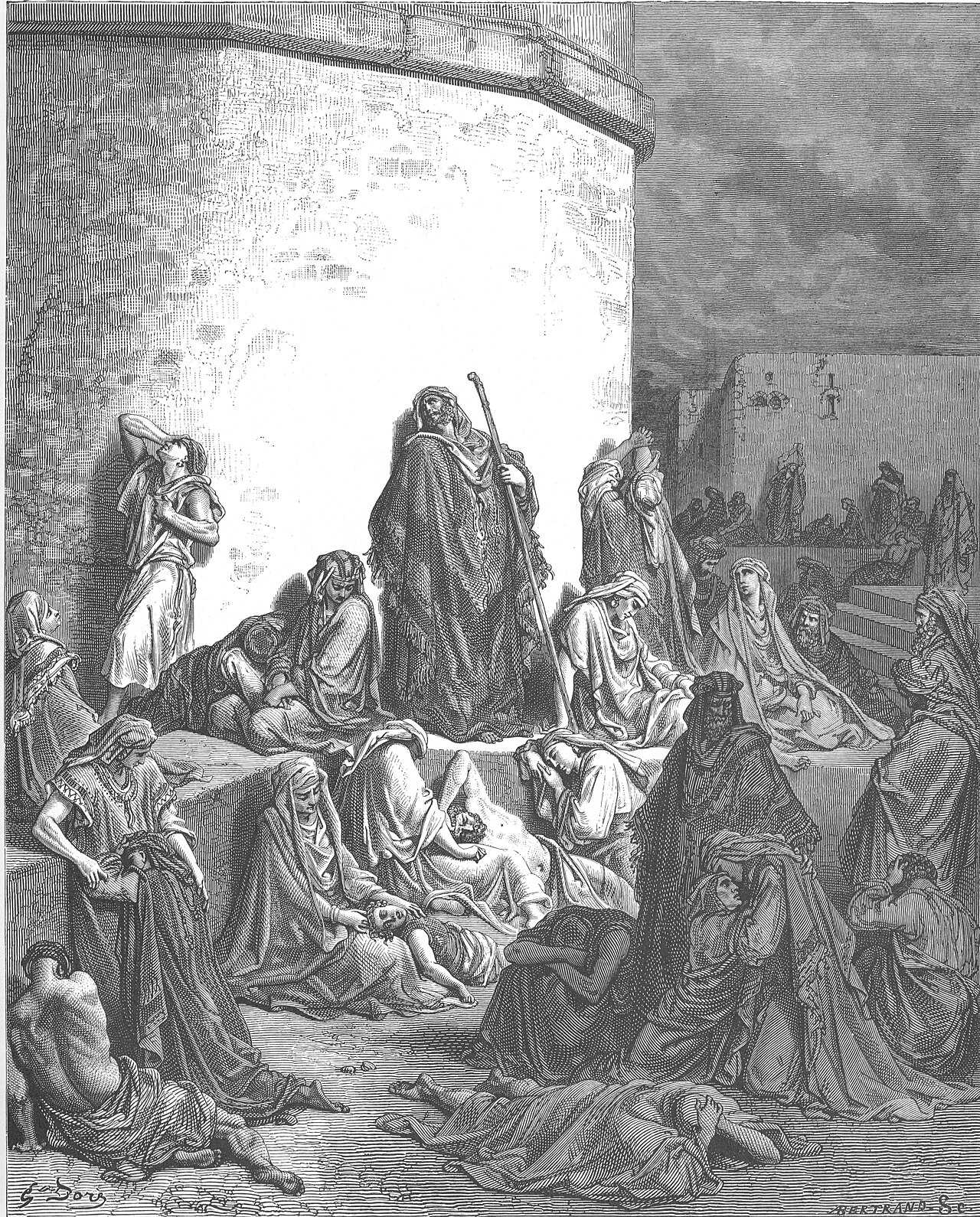
in Lamentations 1The roads to Zion mourn, because no one comes to her appointed feasts. All her gates are deserted; her priests groan, her maidens grieve, and she herself is bitter with anguish.
BSB
The same verse in ASV and KJV ▾
ASV
The ways of Zion do mourn, because none come to the solemn assembly; All her gates are desolate, her priests do sigh: Her virgins are afflicted, and she herself is in bitterness.
KJV
The ways of Zion do mourn, because none come to the solemn feasts: all her gates are desolate: her priests sigh, her virgins are afflicted, and she is in bitterness.
⋯
This verse in Lamentations 1
Commentary
8 notes on this verseThe ways of Zion do mourn - A fine prosopopoeia. The ways in which the people trod coming to the sacred solemnities, being now no longer frequented, are represented as shedding tears; and the gates themselves partake of the general distress. All poets of eminence among the Greeks and Romans have recourse to this image.
This site's exposition
The roads to Zion mourn
on Lamentations 1:4-6
The roads grieve, since “no one comes to her appointed feasts”, the pilgrim festivals the Law set in Deuteronomy 16:16. The temple's people are named: “her priests groan, her maidens grieve”. Her princes “are like deer that find no pasture”, too weak “to flee in the face of the hunter”.
The record, by era
The Church Fathers1 voice
"Call for the mourning women," as says the prophet Jeremiah. In no other way can the burning heart cool down, swelling as it is with its affliction, unless it relieves itself by sobs and tears. Formerly the hope of his return consoled us for the pang of separation, but now he has been torn from us by that final separation. A huge intervening chasm is fixed between the Church and him. He rests indeed in the bosom of Abraham, but there exists not one who might bring the drop of water to cool the tongue of the agonized. Gone is that beauty, silent is that voice, closed are those lips, fled that grace. Our happy state has become a tale that is told. Elijah of old time caused grief to the people of Israel when he soared from earth to God. But Elisha consoled them for the loss by being adorned with the mantle of his master. But now our wound is beyond healing; our Elijah has been caught up, and no Elisha left behind in his place. You have heard certain mournful and lamenting words of Jeremiah, with which he bewailed Jerusalem as a deserted city, and how among other expressions of passionate grief he added this, "The ways of Zion do mourn." These words were uttered then, but now they have been realized. For when the news of our calamity shall have been spread abroad, then will the ways be full of mourning crowds, and the sheep of his flock will pour themselves forth, and like the Ninevites utter the voice of lamentation, or, rather, will lament more bitterly than they. For in their case their mourning released them from the cause of their fear, but with these no hope of release from their distress removes their need of mourning. I know, too, of another utterance of Jeremiah, which is reckoned among the books of the Psalms; it is that which he made over the captivity of Israel. […]
The Medieval Church2 voices
Here in Verse 4 is loudly lamented the misery of persons remaining. First, regarding such persons who frequent pilgrimages. As expressed: "The roads to Zion mourn, for none come to the appointed feasts". That is, while they arouse contentions during three feasts: (Pesach, Pentecost, and …
DELETH: a fourfold species of planks is introduced according to anagogy. Through the service of which the house of the Lord rises, joined together in a fourfold cupola, namely by the ways, gates, priests and virgins. THE WAYS OF ZION &c: the eighth topic of …
The Puritans and the Awakening2 voices
The ways of Zion do mourn,....
It is very grievous to good men to see religious assemblies broken up and scattered, and those restrained from them that would gladly attend them. And, as the ways of Zion mourned, so the gates of Zion, in which the faithful worshippers used to meet, are desolate; for there is none to meet in them.
1 more voice on this verse
The Nineteenth Century1 voice
A commentator
Albert Barnes1798–1870
Notes, Explanatory and Practical, on the Old and New Testaments (1832-1869)
proposed
Zion, as the holy city, is the symbol of the religious life of the people, just as Judah in the previous verse represents their national life. The “virgins” took a prominent part in all religious festivals Jer 31:13; Exo 15:20.
The words behind it
16 Hebrew wordsEvery Hebrew word of this verse in the order it stands, with what it means and the door to its own study. The last column counts the times a word stands in the whole Bible: the rarer the word, the more the places it appears belong together.
| Hebrew | Sound | Meaning | Word study | In the Bible |
|---|---|---|---|---|
| דַּרְכֵ֨י | darkhei | [the] roads of | H1870 → | 707 times |
| צִיּ֜וֹן | tziyon | Zion | H6726 → | 154 times |
| אֲבֵל֗וֹת | ʾavelot | [are] mourning | H57 → | |
| מִבְּלִי֙ | mibeli | because not | H1097 → | |
| בָּאֵ֣י | baei | [those who] come | H935 → | 2568 times |
| מוֹעֵ֔ד | moed | <of> an appointed feast | H4150 → | 223 times |
| כָּל־ | kol- | all | H3605 → | 5413 times |
| שְׁעָרֶ֙יהָ֙ | sheareiha | gates her | H8179 → | 374 times |
| שֽׁוֹמֵמִ֔ין | shomemin | [are] desolate | H8074 → | 86 times |
| כֹּהֲנֶ֖יהָ | kohaneiha | priests her | H3548 → | 750 times |
| נֶאֱנָחִ֑ים | neenachim | [are] groaning | H584 → | 13 times |
| בְּתוּלֹתֶ֥יהָ | betuloteiha | virgins her | H1330 → | 50 times |
| נּוּג֖וֹת | nugot | [are] grieving | H3013 → | 8 times |
| וְהִ֥יא | vehi' | and she | H1931 → | 1879 times |
| מַר־ | mar- | it is bitter | H4843 → | |
| לָֽהּ׃ ס | lah | to her |
דַּרְכֵ֨י[the] roads of
darkheiH1870 →707 times
צִיּ֜וֹןZion
tziyonH6726 →154 times
אֲבֵל֗וֹת[are] mourning
ʾavelotH57 →
מִבְּלִי֙because not
mibeliH1097 →
בָּאֵ֣י[those who] come
baeiH935 →2568 times
מוֹעֵ֔ד<of> an appointed feast
moedH4150 →223 times
כָּל־all
kol-H3605 →5413 times
שְׁעָרֶ֙יהָ֙gates her
sheareihaH8179 →374 times
שֽׁוֹמֵמִ֔ין[are] desolate
shomeminH8074 →86 times
כֹּהֲנֶ֖יהָpriests her
kohaneihaH3548 →750 times
נֶאֱנָחִ֑ים[are] groaning
neenachimH584 →13 times
בְּתוּלֹתֶ֥יהָvirgins her
betuloteihaH1330 →50 times
נּוּג֖וֹת[are] grieving
nugotH3013 →8 times
וְהִ֥יאand she
vehi'H1931 →1879 times
מַר־it is bitter
mar-H4843 →
לָֽהּ׃ סto her
lah
A shaded row is a word that stands 400 times or fewer in the Bible.
The walk
8 stopsEach card is a verse this one points to, and under it the verses that one points to in turn. Where several paths arrive at the same place, that place is listed first: the text keeps returning to it.
Through
Jeremiah 14:2“Judah mourns and her gates languish. Her people wail for the land, and a cry goes up from Jerusalem.
it leads to
- Isaiah 3:26
And the gates of Zion will lament and mourn; destitute, she will sit on the ground.
- Jeremiah 8:21
For the brokenness of the daughter of my people I am crushed. I mourn; horror has gripped me.
- 1 Samuel 5:12
Those who did not die were afflicted with tumors, and the outcry of the city went up to heaven.
- Lamentations 4:8–9
But now their appearance is blacker than soot; they are not recognized in the streets. Their skin has shriveled on their bones; it has become as dry as a stick.
- Isaiah 3:26
Through
Jeremiah 9:11“And I will make Jerusalem a heap of rubble, a haunt for jackals; and I will make the cities of Judah a desolation, without inhabitant.”
it leads to
- Isaiah 25:2
Indeed, You have made the city a heap of rubble, the fortified town a ruin. The fortress of strangers is a city no more; it will never be rebuilt.
- Isaiah 13:22
Hyenas will howl in her fortresses and jackals in her luxurious palaces. Babylon’s time is at hand, and her days will not be prolonged.
- Jeremiah 10:22
Listen! The sound of a report is coming— a great commotion from the land to the north. The cities of Judah will be made a desolation, a haunt for jackals.
- Isaiah 25:2
Through
Jeremiah 10:22Listen! The sound of a report is coming— a great commotion from the land to the north. The cities of Judah will be made a desolation, a haunt for jackals.
it leads to
- Jeremiah 9:11
“And I will make Jerusalem a heap of rubble, a haunt for jackals; and I will make the cities of Judah a desolation, without inhabitant.”
- Jeremiah 9:11
Where this verse is studied
On this page
About Lamentations
Who and where
1 name in this verse with a page on the site.
This page draws on Adam Clarke, Commentary on the Bible; Albert Barnes, Notes, Explanatory and Practical, on the Old and New Testaments (1832-1869); Glossa Ordinaria, Commentary (church-history corpus); Gregory of Nyssa, FUNERAL ORATION ON MELETIUS; John Gill, Exposition of the Old Testament; John Gill, Exposition of the Old Testament (1748-1763); Matthew Henry, Commentary on the Whole Bible and Thomas Aquinas, Commentary on Lamentations.