
Lamentations 1:12
in Lamentations 1Is this nothing to you, all you who pass by? Look around and see! Is there any sorrow like mine, which was inflicted on me, which the LORD made me suffer on the day of His fierce anger?
BSB
The same verse in ASV and KJV ▾
ASV
Is it nothing to you, all ye that pass by? Behold, and see if there be any sorrow like unto my sorrow, which is brought upon me, Wherewith Jehovah hath afflicted me in the day of his fierce anger.
KJV
Is it nothing to you, all ye that pass by? behold, and see if there be any sorrow like unto my sorrow, which is done unto me, wherewith the Lord hath afflicted me in the day of his fierce anger.
⋯
This verse in Lamentations 1
Commentary
15 notes on this verseIs it nothing to you, all ye that pass by? - The desolations and distress brought upon this city and its inhabitants had scarcely any parallel. Excessive abuse of God’s accumulated mercies calls for singular and exemplary punishment.
This site's exposition
Is this nothing to you, all you who pass by
on Lamentations 1:12-16
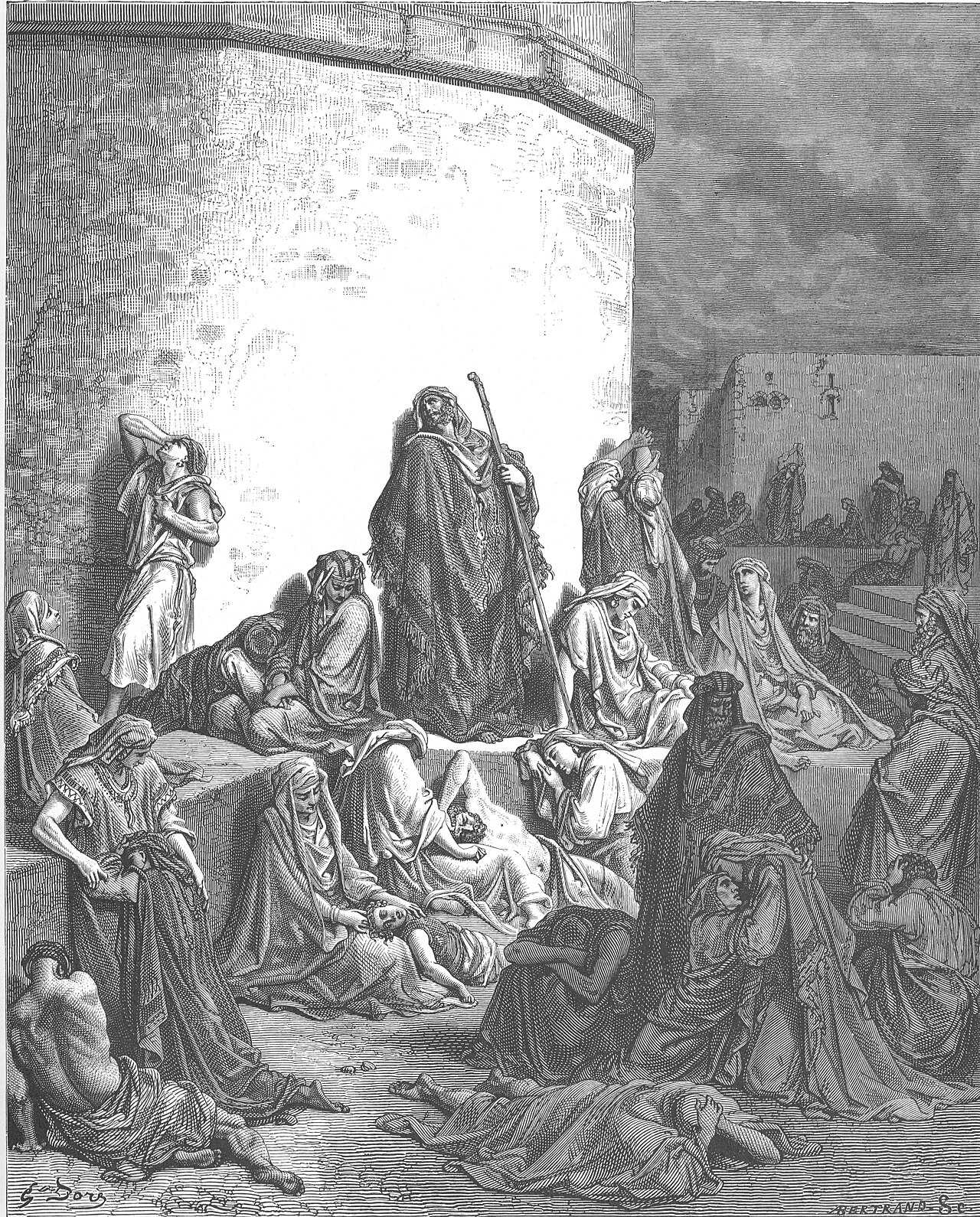
Jerusalem asks every passerby whether any sorrow is like hers, “which the LORD made me suffer on the day of His fierce anger”. The cry is the city's over her ruin, with fire in her bones and the Lord treading “the Virgin Daughter of Judah” in a winepress.
The record, by era
The Medieval Church3 voices
A commentator
BonaventureCollationes de Septem Donis, Collation 6 · Written in the 13th century.
proposed
In other women there is pain of the body, in her there is pain of the heart; in others there is pain of corruption, in her there is pain of compassion and charity. Whence she invites us to consider her sorrow, in Jeremiah: "All you," …
O ALL YOU : the twelfth topic of indignation; for he seems to be displeased, because it has happened to him first. Historical interpretation. O ALL YOU THAT PASS BY : it is characteristic of the unfortunate to estimate by so much more their own …
Here is exposed the captivity of the city Jerusalem, and the tribe of Judah. First is interpreted these people enduring a severity of judgment, second, the judgment of the enemy's cruelty. As said in Verse 11: "Look, O Lord, and behold, for I am despised." …
The Puritans and the Awakening2 voices
She here looks beyond the instruments to the author of her troubles, and owns them all to be directed, determined, and disposed of by him: "It is the Lord that has afflicted me, and he has afflicted me because he is angry with me; the greatness of his displeasure may be measured by the greatness of my distress; it is in the day of his fierce anger, "
Afflictions cannot but be very much our griefs when we see them arising from God's wrath; so the church does here. She is as one in a fever, and the fever is of God's sending: " He has sent fire into my bones (
quarantine:debris (2026-07-29) — unbalanced-parens+odd-straight-quotes
8 more voices on this verse
The Puritans and the Awakening1 voice
Is it nothing to you, all ye that pass by?.... O ye strangers and travellers that pass by, and see my distress, does it not at all concern you? does it not in the least affect you? can you look upon it, and have no commiseration? or is there nothing to be learned from hence by you, that may be instructive and useful to you?
The Nineteenth Century6 voices
A commentator
Jamieson, Fausset & Brown1802–1910
Commentary Critical and Explanatory on the Whole Bible (1871)
The pathetic appeal of Jerusalem, not only to her neighbors, but even to the strangers "passing by," as her sorrow is such as should excite the compassion even of those unconnected with her. She here prefigures Christ, whom the language is prophetically made to suit, more than Jerusalem. Compare Israel, that is, Messiah, Isa 49:3.
On a night when the Tabernacle was thrown open to all comers, the ordinary hearers vacating their seats for the occasion. SYMPATHY with suffering ones is never content to act her part alone. The man who is sorrowful for another is sure to invite others to join him in his sympathy. It seems to him so sad a thing that he would have all men weep over it with himself. It is so great a grief that he would hang the heavens with blackness and drape the world in sackcloth.
On a night when the Tabernacle was thrown open to all comers, the ordinary hearers vacating their seats for the occasion. SYMPATHY with suffering ones is never content to act her part alone. The man who is sorrowful for another is sure to invite others to join him in his sympathy. It seems to him so sad a thing that he would have all men weep over it with himself. It is so great a grief that he would hang the heavens with blackness and drape the world in sackcloth. Hence Jeremiah, when he saw the sorrows of Jerusalem, complained of all who dared to pass her by without a lamentation. He beheld that ancient and glorious city besieged by her adversaries, invaded by their fierce armies and given over to plunder, to murder, to fire and desolation. He beheld the streets running with the blood of her sons and daughters, her houses broken down and her glorious Temple defiled and laid in ashes. Do you wonder that he wept and called upon others to weep with him? He pictured Jerusalem as sitting by the wayside, like a maiden who has been sorely wounded and is in bitter grief, crying out in her loveliness and anguish, "Is it nothing to you, all you that pass by? Behold and see if there is any sorrow like unto my sorrow." In all the annals of history there never was sorrow equal to the fate of Jerusalem! Many cities have been destroyed, but none have fallen amid such a tempest of terrors. Some have been devoured with famine, wasted with pestilence, or broken down by war—but as for you, O Jerusalem—all these evils met upon you as when the vultures hasten from afar and meet upon the slain.
A commentator
Charles Spurgeon1834–1892
The Metropolitan Tabernacle Pulpit, Sermon No. 3360: “Pleading With the Indifferent” (lightly modernized text, CCEL edition) · Written before 1892.
proposed
THIS was the lamentation of Jeremiah. As he saw the desolation of the beloved city, as he marked the cruelties inflicted by the invaders upon the Jewish youth, children and maidens, and as he foresaw the long years of bitterness reserved for the captives in Babylon, he felt as if he were a peer in the realm of misery—indeed peerless. He stands foremost, a very emperor of grief, a king of sighs and tears. "Behold, and see," he said, "if there was ever sorrow like unto my sorrow, which is done unto me."
A commentator
Charles Spurgeon1834–1892
The Metropolitan Tabernacle Pulpit, Sermon No. 3360: “Pleading With the Indifferent” (lightly modernized text, CCEL edition) · Written before 1892.
proposed
THIS was the lamentation of Jeremiah. As he saw the desolation of the beloved city, as he marked the cruelties inflicted by the invaders upon the Jewish youth, children and maidens, and as he foresaw the long years of bitterness reserved for the captives in Babylon, he felt as if he were a peer in the realm of misery—indeed peerless. He stands foremost, a very emperor of grief, a king of sighs and tears. "Behold, and see," he said, "if there was ever sorrow like unto my sorrow, which is done unto me." But may there not have been griefs as great as those of Jeremiah? Is the language that flows from his lips strictly accurate? Like most of the periods which flow from abundant grief, is there not some exaggeration here? If we take the words out of the mouth of Jeremiah and put them into the mouth of Jesus—if we suppose them to be spoken by Him, as, hanging on the Cross He did bear the wrath of God for us, then there is no hyperbole, no exaggeration! The words may be read as they stand—and stand as we read them—and their fullest weight shall not outweigh the truth! This evening two things challenge our attention—an earnest expostulation—"Is it nothing to you, all you that pass by?" And a solemn question—"Behold, and see, was there ever sorrow like unto my sorrow, which is done unto me?" First— I. AN EARNEST EXPOSTULATION. The Son of God has become Incarnate. He became Man out of love to men. But men loved Him not and though in Him was every perfection, they hunted and hounded Him to death! The story is told four times over by Inspired authority in this Book, but the mass of mankind feel no concern in it. I come here tonight and I say to many of you—does not the story of Jesus at all interest you? You heard it read just now, did it fall flat and stale upon your ears? Did you say to yourselves, "It is dry work to listen to that.
A commentator
Albert Barnes1798–1870
Notes, Explanatory and Practical, on the Old and New Testaments (1832-1869)
proposed
The lamentation of the city, personified as a woman in grief over her fate. Lam 1:13 It prevaileth - Or, hath subdued. He hath turned me back - Judaea, like a hunted animal, endeavors to escape, but finds every outlet blocked by nets, and recoils from them with terror and a sense of utter hopelessness. Lam 1:14 Bound by his hand - As the plowman binds the yoke upon the neck of oxen, so God compels Judah to bear the punishment of her sins. They are wreathed, and ... - Or, they are knotted together, “they come up” etc. Judah’s sins are like the cords by which the pieces of the yoke are fastened together Jer 27:2; they are knotted and twined like a bunch upon the neck, and bind the yoke around it so securely that it is impossible for her to shake it off. He hath made ... - Or, it hath made “my strength” to stumble. The yoke of punishment thus imposed and securely fastened, bows down her strength by its weight, and makes her totter beneath it. The Lord - The third distich of the verse begins here, and with it a new turn of the lamentation. The title Adonai (properly, my Lord) is in the Lamentations used by itself in fourteen places, while the name Yahweh is less prominent; as if in their punishment the people felt the lordship of the Deity more, and His covenant-love to them less. Lam 1:15 The Lord hath trodden under foot - Or, אדני 'ădonāy has made contemptible (i. e. put into the balance, made to go up as the lighter weight, and so made despicable) “my war-horses” (put metaphorically for heroes). In the midst of me - They had not fallen gloriously in the battlefield, but remained ignominiously in the city. Assembly - Or, “a solemn feast;” the word especially used of the great festivals Lev 23:2. אדני 'ădonāy has proclaimed a festival, not for me, but against me. The Lord hath trodden ... […]
Modern Voices1 voice
Doubtless there is an older and better hero-worship than this. But the old hero was a being who, like Achilles, was more human than humanity itself. Nietzsche's Superman is cold and friendless. Achilles is so foolishly fond of his friend that he slaughters armies in …
How the passage was read
What the Jewish commentators add
May this not happen to you. Such a calamity should not happen to all those who transgress the law.
1 more on this passage, in their own words ▾
Crushing it. It [the fire] crushed it and broke it through punishment and suffering.
This section is reception history: how the passage was read and kept in the Jewish tradition. Where a reading parts from an essential of the Christian faith, the section says so at that point.
Texts and citation data: Sefaria; each excerpt follows its version’s licence. 4 further sources are cited on this chapter that carry no English text this site may quote or only restate the verse.
The words behind it
20 Hebrew wordsEvery Hebrew word of this verse in the order it stands, with what it means and the door to its own study. The last column counts the times a word stands in the whole Bible: the rarer the word, the more the places it appears belong together.
| Hebrew | Sound | Meaning | Word study | In the Bible |
|---|---|---|---|---|
| ל֣וֹא | lo' | not | H3808 → | 5168 times |
| אֲלֵיכֶם֮ | ʾaleikhem | to you | H413 → | 5510 times |
| כָּל־ | kol- | O all | H3605 → | 5413 times |
| עֹ֣בְרֵי | oerei | [those who] pass by of | H5674 → | 556 times |
| דֶרֶךְ֒ | derekh | [the] road | H1870 → | 707 times |
| הַבִּ֣יטוּ | habitu | look | H5027 → | 69 times |
| וּרְא֗וּ | ureu | and see | H7200 → | 1300 times |
| אִם־ | ʾim- | if | H518 → | 1069 times |
| יֵ֤שׁ | yesh | there | H3426 → | |
| מַכְאוֹב֙ | makhov | [is] pain | H4341 → | 16 times |
| כְּמַכְאֹבִ֔י | kemakhovi | like pain my | H4341 → | 16 times |
| אֲשֶׁ֥ר | ʾasher | which | H834 → | 5497 times |
| עוֹלַ֖ל | olal | it has been done | H5953 → | 20 times |
| לִ֑י | li | to me | ||
| אֲשֶׁר֙ | ʾasher | which | H834 → | 5497 times |
| הוֹגָ֣ה | hogah | he has caused grief | H3013 → | 8 times |
| יְהוָ֔ה | yahweh | Yahweh | H3068 → | 6520 times |
| בְּי֖וֹם | beyom | on [the] day of | H3117 → | 2304 times |
| חֲר֥וֹן | charon | [the] burning of | H2740 → | |
| אַפּֽוֹ׃ ס | ʾapo | anger his | H639 → | 276 times |
ל֣וֹאnot
lo'H3808 →5168 times
אֲלֵיכֶם֮to you
ʾaleikhemH413 →5510 times
כָּל־O all
kol-H3605 →5413 times
עֹ֣בְרֵי[those who] pass by of
oereiH5674 →556 times
דֶרֶךְ֒[the] road
derekhH1870 →707 times
הַבִּ֣יטוּlook
habituH5027 →69 times
וּרְא֗וּand see
ureuH7200 →1300 times
אִם־if
ʾim-H518 →1069 times
יֵ֤שׁthere
yeshH3426 →
מַכְאוֹב֙[is] pain
makhovH4341 →16 times
כְּמַכְאֹבִ֔יlike pain my
kemakhoviH4341 →16 times
אֲשֶׁ֥רwhich
ʾasherH834 →5497 times
עוֹלַ֖לit has been done
olalH5953 →20 times
לִ֑יto me
li
אֲשֶׁר֙which
ʾasherH834 →5497 times
הוֹגָ֣הhe has caused grief
hogahH3013 →8 times
יְהוָ֔הYahweh
yahwehH3068 →6520 times
בְּי֖וֹםon [the] day of
beyomH3117 →2304 times
חֲר֥וֹן[the] burning of
charonH2740 →
אַפּֽוֹ׃ סanger his
ʾapoH639 →276 times
A shaded row is a word that stands 400 times or fewer in the Bible.
The walk
8 stopsEach card is a verse this one points to, and under it the verses that one points to in turn. Where several paths arrive at the same place, that place is listed first: the text keeps returning to it.
Through
Jeremiah 30:24The fierce anger of the LORD will not turn back until He has fully accomplished the purposes of His heart. In the days to come you will understand this.
it leads to
- Jeremiah 23:20
The anger of the LORD will not turn back until He has fully accomplished the purposes of His heart. In the days to come you will understand this clearly.
- Hosea 3:5
Afterward, the people of Israel will return and seek the LORD their God and David their king. They will come trembling to the LORD and to His goodness in the last days.
- Micah 4:1
In the last days the mountain of the house of the LORD will be established as the chief of the mountains; it will be raised above the hills, and the peoples will stream to…
- Jeremiah 23:20
Through
Jeremiah 18:16They have made their land a desolation, a perpetual object of scorn; all who pass by will be appalled and shake their heads.
it leads to
- Psalms 22:7
All who see me mock me; they sneer and shake their heads:
- Jeremiah 25:9
behold, I will summon all the families of the north, declares the LORD, and I will send for My servant Nebuchadnezzar king of Babylon, whom I will bring against this land, against its residents,…
- Jeremiah 19:8
I will make this city a desolation and an object of scorn. All who pass by will be appalled and will scoff at all her wounds.
- 1 Kings 9:8
And when this temple has become a heap of rubble, all who pass by it will be appalled and will hiss and say, ‘Why has the LORD done such a thing to this land…
- Psalms 22:7
Through
Daniel 9:12You have carried out the words spoken against us and against our rulers by bringing upon us a great disaster. For under all of heaven, nothing has ever been done like what has been…
it leads to
- Ezekiel 5:9
Because of all your abominations, I will do to you what I have never done before and will never do again.
- Ezekiel 5:9
Where this verse is studied
On this page
About Lamentations
This page draws on 12 works. Open the list of works
This page draws on Adam Clarke, Commentary on the Bible; Albert Barnes, Notes, Explanatory and Practical, on the Old and New Testaments (1832-1869); Bonaventure, Collationes de Septem Donis, Collation 6; Charles Spurgeon, The Metropolitan Tabernacle Pulpit, Sermon No. 1620: “Is It Nothing To You?” (lightly modernized text, CCEL edition); Charles Spurgeon, The Metropolitan Tabernacle Pulpit, Sermon No. 3360: “Pleading With the Indifferent” (lightly modernized text, CCEL edition); GK Chesterton, Heretics, Ch. 5: Mr. H. G. Wells and the Giants (1905); Glossa Ordinaria, Commentary (church-history corpus); Jamieson, Fausset & Brown, Commentary Critical and Explanatory on the Whole Bible; Jamieson, Fausset and Brown, Commentary Critical and Explanatory on the Whole Bible; John Gill, Exposition of the Old Testament (1748-1763); Matthew Henry, Commentary on the Whole Bible and Thomas Aquinas, Commentary on Lamentations.