
Judgeschapter 19
30 verses · Samuel, by tradition · 11th century BC · History
And it came to pass in those days, when there was no king in Israel, that there was a certain Levite sojourning on the side of mount Ephraim, who took to him a concubine out of Beth–lehem–judah.
Introduction
Samuel, by tradition, History, Judges Overview.
This chapter was written for Israelites who lived by the duty of hospitality and knew what its failure meant, and tradition gives the book to Samuel. It opens the second of the two closing accounts and the darkest passage in the book. It follows a trip home that stops for the night in the wrong place, and it asks what Israel had become when an Israelite town behaved like Sodom. Listen for how long the hosting lasts at the start and how short it is at the end. Notice where the account follows Genesis 19 and where it departs from it. The last verse puts a question to every reader.
Context
- Who
- Israelites who lived by the duty of hospitality and knew what its failure meant
- What
- An account of a Levite and his concubine, their night at Gibeah in Benjamin, the crime committed against her, and the message he sent to the tribes.
- Where
- Bethlehem in Judah, the road north past Jebus, and the town square of Gibeah in Benjamin.
- When
- About 1350 BC, early in the judges period, since Phinehas the grandson of Aaron is still serving at Judges 20:28.
- Why
- To show how far Israel had fallen when it had no king, and to explain the war that follows in chapter 20.
Historical context
The account belongs to a Levite from the far side of the hill country of Ephraim and to his concubine, who came from Bethlehem in Judah. A concubine was a wife of second rank, with a standing the household recognised.
Show the rest of the historical context, 4 more paragraphs
The time is early in the period, on the evidence of Phinehas at 20:28. He is the man of Numbers 25:7 and Joshua 22:13, one generation from Aaron.
The road is about fifteen miles from Bethlehem north to Gibeah. Jerusalem was still a Jebusite town on that road, which Joshua 15:63 and Judges 1:21 both record, and it stayed Jebusite until David took it at 2 Samuel 5:6 to 9. Gibeah is a Benjamite town, and it is where Saul lives when the kingdom begins.
The occasion is the road home after four months apart, and it turns on an hour. The father keeps his guest past the customary three days, and the party leaves on the fifth afternoon, which puts them near Gibeah at sunset.
A first hearer knew that taking in a traveller was a duty rather than a kindness, and that a man who sat in the open square at nightfall had been refused. He knew the washing of a guest's feet from Genesis 18:4 and 19:2. He also knew the account of Sodom well enough to hear it repeated. The demand at the door and the offer of a substitute at verses 22 to 24 follow Genesis 19:4 to 8 closely.
Significance
The chapter was built so that a hearer would recognise Sodom and then notice where the two accounts part. At Sodom the visitors pulled Lot inside and struck the men at the door blind. Here nothing intervenes.
Show the rest of the significance, 2 more paragraphs
The town was chosen for being Israelite. The Levite refused Jebus on that ground at verse 12, and a hearer would have felt the weight of what followed in Benjamin.
Verse 30 gives the reaction of everyone who saw the twelve pieces, that nothing like it had been seen since the day Israel came up out of Egypt.
This chapter in Jewish lifeWhat this chapter is in Jewish life and reading.
How it is read
The chapter records a crime, and the commentators work it line by line without softening any of it. The first reading that parts from the plain English concerns the woman herself. Rashi takes the verb used of her leaving as a word for departure rather than for unfaithfulness, following the Targum: "She strayed away from his home to the outside" (Rashi on Judges 19:2:1, the Metsudah Tanach series, Lakewood, N.J., CC-BY). On the journey he explains the phrase about the failing day as the sun having passed its strength and begun to set, and on the refusal to lodge in Jebus he says the place the travellers turn to instead is the Gibeah of Benjamin (Rashi on Judges 19:9:1 and 19:12:1, same edition). Metzudat David identifies the city they passed by: "There was a district within Jerusalem which was called Yevus and David conquered it" (Metzudat David on Judges 19:10:1, Rabbi Mike Feuer, Jerusalem Anthology, CC-BY). On the Levite's answer to the old man at Gibeah, Rashi reads his statement about where he is going as Shiloh, where the house of God then stood (Rashi on Judges 19:18:1, same edition). On the demand made at the door that night he glosses it in its plainest terms, as the men of the city demanding to use the guest sexually (Rashi on Judges 19:22:1, same edition). Radak, Malbim and Metzudat David comment across the rest of the chapter and the corpus holds no English version of those comments, so they stand as citations: Radak on Judges 19:3:1, Radak on Judges 19:11:1, Radak on Judges 19:16:1, Radak on Judges 19:25:1, Malbim on Judges 19:17:1, Metzudat David on Judges 19:23:1, Metzudat David on Judges 19:24:1, Metzudat David on Judges 19:26:1 and Metzudat David on Judges 19:27:1.
What the rabbis say
The corpus records twenty-four rabbinic locators on this chapter, twenty-one of them Midrash and three Talmud, each a locator without text. The departure of the concubine draws Gittin 6b:11 and Ein Yaakov, Gittin 1:1, which is where the rabbinic dispute over what she did is carried. The four days of eating and drinking at her father's house draw Bereshit Rabbah 48:11, Midrash Lekach Tov, Genesis 18:5:1, Midrash Sekhel Tov, Bereshit 18:5:2, Midrash Tehillim 104:8 and Yalkut Shimoni on Torah 82:13, and the pressing to stay another night draws Shemot Rabbah 1:33, Sifrei Devarim 4:1, Midrash Shmuel 16:2, Midrash Aggadah, Exodus 2:21:2, Midrash Lekach Tov, Deuteronomy 1:5:1, Midrash Tanchuma Buber, Shemot 11:4 and Yalkut Shimoni on Torah 169:6. The passing of Jebus draws Seder Olam Rabbah 12:2 and Otzar Midrashim, Baraita of Rabbi Pinchas Ben Yair 1:37. The night at Gibeah draws Jerusalem Talmud Berakhot 6:1:2 and Midrash Sekhel Tov, Bereshit 33:13:5, and what was done to the woman draws Bamidbar Rabbah 20:14, Esther Rabbah 3:2, Midrash Tanchuma, Balak 9:1 and Midrash Tanchuma Buber, Balak 13:3. The rabbis teach in these places, and this site reports them as their teaching rather than as a rule of the text.
Sources: Rashi, Rashi on Judges 19:2:1, 19:9:1, 19:12:1, 19:18:1 and 19:22:1, the Metsudah Tanach series, Lakewood, N.J., CC-BY; Metzudat David, Metzudat David on Judges 19:10:1, Rabbi Mike Feuer, Jerusalem Anthology, CC-BY; and 19:23:1, 19:24:1, 19:26:1 and 19:27:1, cited only; Radak, Radak on Judges 19:3:1, 19:11:1, 19:16:1 and 19:25:1, cited only, no English version in the corpus; Malbim, Malbim on Judges 19:17:1, cited only.
The heads below are this chapter's scenes. The numbered points under each are its verses.
A Levite goes to fetch his concubine home
Judges 19:1-2
when there was no king in Israel: The formula “no king in Israel” falls at 17:6, 18:1, 19:1 and 21:25, bracketing the closing block at both ends. Chapter 17 sent a Levite of Bethlehem to Ephraim, and here a Levite of Ephraim takes a concubine from Bethlehem, reversing the pairing. The Hebrew says she was “unfaithful to him”, while the Septuagint says she was angry, the Vulgate that she left, and Josephus that she became estranged.
Judges 19:1
“It was no disreputable connection this Levite had formed; for a nuptial engagement with a concubine wife (though, as wanting in some outward ceremonies, it was reckoned a secondary or inferior relationship) possessed the true essence of marriage; it was not only lawful, but sanctioned by the example of many good men.”
Jamieson, Fausset & Brown · Commentary Critical and Explanatory on the Whole Bible (1871)reformed
Clarke argues from what follows: a husband betrayed in the marriage bed would hardly travel to Bethlehem to speak kindly to her. Gill reads it as unfaithfulness to his bed and reports that some take it as ill treatment and desertion. She stayed four months in her father's house.
Judges 19:2
“Played the whore - Neither the Vulgate, Septuagint, Targum, nor Josephus, understand this word as implying any act of conjugal infidelity on the woman’s part. They merely state that the parties disagreed, and the woman returned to her father’s house. Indeed all the circumstances of the case vindicate this view of the subject. If she had been a whore, or adulteress, it is not very likely that her husband would have gone after her to speak friendly, literally, to speak to her heart, and entreat her to return.”
Adam Clarke · Commentary on the Bible (1810-1826)evangelical
1 more voice on this verse
Judges 19:2
“Other versions concur with JOSEPHUS, in representing the reason for the flight from her husband's house to be, that she was disgusted with him, through frequent brawls. And her husband arose, and went after her, to speak friendly unto her--Hebrew, "speak to her heart," in a kindly and affectionate manner, so as to rekindle her affection.”
Jamieson, Fausset & Brown · Commentary Critical and Explanatory on the Whole Bible (1871)reformed
Judges 19:3-4
Behind “speak kindly to her” stands the Hebrew to speak to her heart, the expression Ruth uses of Boaz at Ruth 2:13. It is the one act of kindness the chapter records, and her father “gladly welcomed him”. Three days was the ordinary length of a guest's welcome, and verse 4 closes on the third, so everything after it is the father pressing for more than custom asked.
Judges 19:3
“Then her husband arose and went to the house of his father-in-law to reconcile himself with his wife, to win her back and take her home again. The woman ran to meet him and brought her husband into her father's house. The maiden's father rejoiced and went to meet him, and the man stayed with him three days, and they ate and rested.”
Ambrose of Milan · written before 397 · On the Duties of the Clergy 3.19.111-12patristic
2 more voices on this verse
Judges 19:3
“He rejoiced to meet him - He hoped to be able completely to reconcile his daughter and her husband.”
Adam Clarke · Commentary on the Bible (1810-1826)evangelical
Judges 19:3
“He spoke friendly to her, or comfortably (for so the Hebrew phrase of speaking to the heart commonly signifies), which intimates that she was in sorrow, penitent fore what she had done amiss, which probably he heard of when he came to fetch her back. Thus God promises concerning adulterous Israel ( Hos. ii.”
Matthew Henry · Commentary on the Whole Bible (1707-1721)puritan
The father holds his son-in-law at his table, and Gill describes the Levite and his servant as handsomely entertained with food, drink and lodging. Ambrose pictures the three days as a kind of wedding feast. The couple are reconciled under her father's roof.
Judges 19:4
“And his father in law, the damsel's father, retained him,.... Prevailed upon him to stay some time with him: and he abode with him three days; it seems as if he agreed to stay with him so long, and that time he stayed contentedly: so they did eat and drink, and lodged there; the Levite and his servant were very handsomely entertained, and had everything provided for them convenient for meat, drink, and lodging.”
1 more voice on this verse
Judges 19:4
“Note, Love and duty are due to those to whom we are related by marriage as well as to those who are bone of our bone: and those that show kindness as this Levite did may expect to receive kindness as he did.”
Matthew Henry · Commentary on the Whole Bible (1707-1721)puritan
Judges 19:5-7
Five verses go on eating and drinking and on a father pressing his guest to stay, which slows the telling to the hour. The words recur, “Refresh your heart” at verses 5 and 8, and “let your heart be merry” at verse 6, echoed at verse 9. Hospitality is what the whole delay is made of, and hospitality is what Gibeah withholds at verse 15.
Judges 19:5
“On the next day the Levite arose at daybreak but was detained by his father-in-law, that he might not so quickly lose the pleasure of his company. Again on the next and the third day the maiden's father did not allow his son-in-law to start [his journey], until their joy and mutual regard was complete.”
Ambrose of Milan · written before 397 · On the Duties of the Clergy 3.19.111-12patristic
The meal is shared by the two men, and the father presses for one more night. Matthew Henry sets this pressing beside Luke 24:28 and 29, where Jesus is urged to stay with his friends and agrees. Henry calls the later delay unkind in its outcome.
Each time the man got up to depart, the father persuaded him to stay one more night. Gill describes the father's much entreaty, and Ambrose writes that the father could hardly let his guest go. The man stays.
Judges 19:7
“And when the man rose up to depart,.... Rose up from table, having ate and drank sufficiently, in order to depart the house, and proceed on his journey: his father in law urged him; with much entreaty, and earnest solicitations, that he would stay all night with him: therefore he lodged there again; another night, being prevailed upon through his father's importunity.”
Judges 19:8-9
on the fifth day: The fifth day is named and then spent, since “they waited until late afternoon”. The father's plea counts the hour twice, “the day is drawing to a close” and “the day is almost over”, and the second clause in Hebrew pictures a day pitching camp for the night. The Levite leaves anyway, and verse 14 reports the cost, with the sun setting as they neared Gibeah.
Judges 19:8
“And they tarried until afternoon - Merely that they might avoid the heat of the day, which would have been very inconvenient in travelling.”
Adam Clarke · Commentary on the Bible (1810-1826)evangelical
Jamieson, Fausset and Brown note that travelers who left early in the morning halted by afternoon, so this was too late in the day to set out. Barnes reads the long delay as the reason the sun set on them near Gibeah. The delay brought them to Gibeah at nightfall.
Judges 19:9
“This is a perfect picture of the manners of the time. It is probable that the father showed more than usual hospitality, in order to ensure the kind treatment of his daughter by her husband. These particulars are given to account for their journey running so far into the evening, which was the immediate cause of the horrible catastrophe which followed.”
Judges 19:10-12
Jerusalem is a Jebusite town here, as Joshua 15:63 records of Judah and Judges 1:21 of Benjamin, and it stays Jebusite until David takes it at 2 Samuel 5:6 to 9. The servant proposes lodging there, and the master refuses on one ground, that it is a city “where there are no Israelites”. What follows happens in Benjamin, among Israelites, in the place chosen for being Israelite.
Judges 19:10
“Jebus being still, though not entirely (Jud 1:8) in the possession of the old inhabitants, the Levite resisted the advice of his attendant to enter it and determined rather to press forward to pass the night in Gibeah, which he knew was occupied by Israelites. The distance from Beth-lehem to Jerusalem is about six miles.”
Jamieson, Fausset & Brown · Commentary Critical and Explanatory on the Whole Bible (1871)reformed
The servant asked his master to stop at the Jebusite city and spend the night before the day was gone. Henry judges that they would have fared better among the Jebusites than they did among Israelites in Gibeah. The master refuses.
Judges 19:11
“When they were by Jebus - This was Jerusalem, in which, though after the death of Joshua it appears to have been partly conquered by the tribe of Judah, yet the Jebusites kept the strong hold of Zion till the days of David, by whom they were finally expelled. See the note on Jdg 1:8.”
Adam Clarke · Commentary on the Bible (1810-1826)evangelical
Barnes takes the phrase city of foreigners as evidence of how completely the Jebusites had shut out Judah and Benjamin in these early days. Matthew Henry reads the refusal as reluctance to be beholden to strangers for a night's lodging. The Levite trusts his own people.
Judges 19:12
“City of a stranger - This shows how completely, even in these early days, the Jebusite population had excluded both the tribes of Judah and Benjamin.”
Judges 19:13-15
Gibeah and Ramah are Benjamite towns, and Gibeah is Saul's home when the kingdom begins, called Gibeah of Saul at 1 Samuel 11:4, 15:34 and 2 Samuel 21:6. Verse 15 states the failure without comment, “no one would take them into his home for the night”. Genesis 18 and 19 turn on taking in the traveller, and Hosea 9:9 and 10:9 measure Israel by the days of Gibeah.
The words in Benjamin set this Gibeah apart from a town of the same name in Judah, which Gill finds at Joshua 15:57. Barnes refers the reader to Joshua 18:24, in the list of the towns of Benjamin. Sunset decides where they will lodge.
Judges 19:14
“And they passed on, and went their way,.... Proceeded on in their journey from Jebus or Jerusalem, near to which they were: and the sun went down upon them when they were by Gibeah, which belongeth to Benjamin; which is added, to distinguish it from another Gibeah in the tribe of Judah, Jos 15:57 when they were come pretty near to this place, on the side of it, as it seems, the sun was just setting, which determined them to take up their lodging here, as follows.”
Barnes describes the city square as the open place inside the gate where strangers gathered. Clarke adds that Gibeah probably had no inn, so the Levite needs a home to take him in. No one in the city opened a door.
Judges 19:15
“Hence we conclude that the custom, which is still frequently witnessed in the cities of the East, was then not uncommon, for travellers who were late in arriving and who had no introduction to a private family, to spread their bedding in the streets, or wrapping themselves up in their cloaks, pass the night in the open air.”
Jamieson, Fausset & Brown · Commentary Critical and Explanatory on the Whole Bible (1871)reformed
1 more voice on this verse
Judges 19:15
“A street - Probably the square or place within the gates, where courts were held, bargains made, and where the chief men and strangers congregated.”
One old man takes the travelers in at Gibeah
Judges 19:16-17
Their one host is from Ephraim himself and only “residing in Gibeah”, and the verse adds that “the men of that place were Benjamites”. Lot was the same kind of sojourner at Sodom, as Genesis 19:1 and 19:9 show. He asks a host's two questions, “Where are you going, and where have you come from”.
Judges 19:16
“Which was also of Mount Ephraim - i. e., of the country of the Levite. This single giver of hospitality was himself a stranger and sojourner at Gibeah.”
Matthew Henry sets the old man beside Job, who in Job 31 refused to let a traveller lodge in the street. The old man sees the party in the open square at nightfall and speaks first. Henry notes how readily he believed the Levite's account of himself.
Judges 19:17
“If Gibeah was like Sodom, this old man was like Lot in Sodom, who sat in the gate to invite strangers, Gen. xix. Thus Job opened his doors to the traveller, and would not suffer him to lodge in the street, Job xxxi. How ready he was to give credit to the Levite's account of himself when he saw no reason at all to question the truth of it.”
Matthew Henry · Commentary on the Whole Bible (1707-1721)puritan
Judges 19:18-19
He names his destination as “the house of the LORD”, where the Septuagint reads my house, the place verse 29 has him reach, and the chapter settles neither reading. The house of God stood at Shiloh in this period, as Judges 18:31 states and 21:19 assumes. Verse 19 lists what the party carries so no host could plead the cost, “straw and feed for our donkeys, and bread and wine”.
Judges 19:18
“The house of the Lord - Probably at Shiloh (marginal references). The Levite was probably one of those who ministered at the tabernacle. His two donkeys and servant show him to have been in good circumstances, and he had a home of his own.”
Clarke explains that in these lands straw was chopped fine and mixed with barley or beans as feed for donkeys and cattle. The Levite carries bread and wine for his party and feed for the animals. Ambrose writes that they lack only a roof for the night.
Judges 19:19
“There is both straw and provender for our asses - In the countries principally devoted to pasturage, there was no hay; but as they raised some corn, they took great care of their straw, chopped it very small, and having mixed it with barley, beans, or the pounded kernels of dates, made it into balls, and fed their cattle with it. Straw, cut into what is called chaff, is not unfrequently used in England for the same purpose.”
Adam Clarke · Commentary on the Bible (1810-1826)evangelical
Judges 19:20-22
Washing the feet at verse 21 is the courtesy of Genesis 18:4 and 19:2. Verse 22 follows Genesis 19:4 and 19:5, the house surrounded, the door beaten, and the demand, “Bring out the man who came to your house”. The Hebrew calls them sons of Belial, a word first used at Deuteronomy 13:13, again of these men at Judges 20:13, and once in the New Testament at 2 Corinthians 6:15.
Judges 19:20
All thy wants lie upon me - Here was genuine hospitality: “Keep your bread and wine for yourselves, and your straw and provender for your asses; you may need them before you finish your journey; I will supply all your wants for this night, therefore do not lodge in the street.”
Adam Clarke · Commentary on the Bible (1810-1826)evangelical
Matthew Henry notes that the host, a man with a house and fodder to spare, had still spent the day working in the field. He feeds the animals before the guests sit down to eat. The whole party is now under his roof.
Judges 19:21
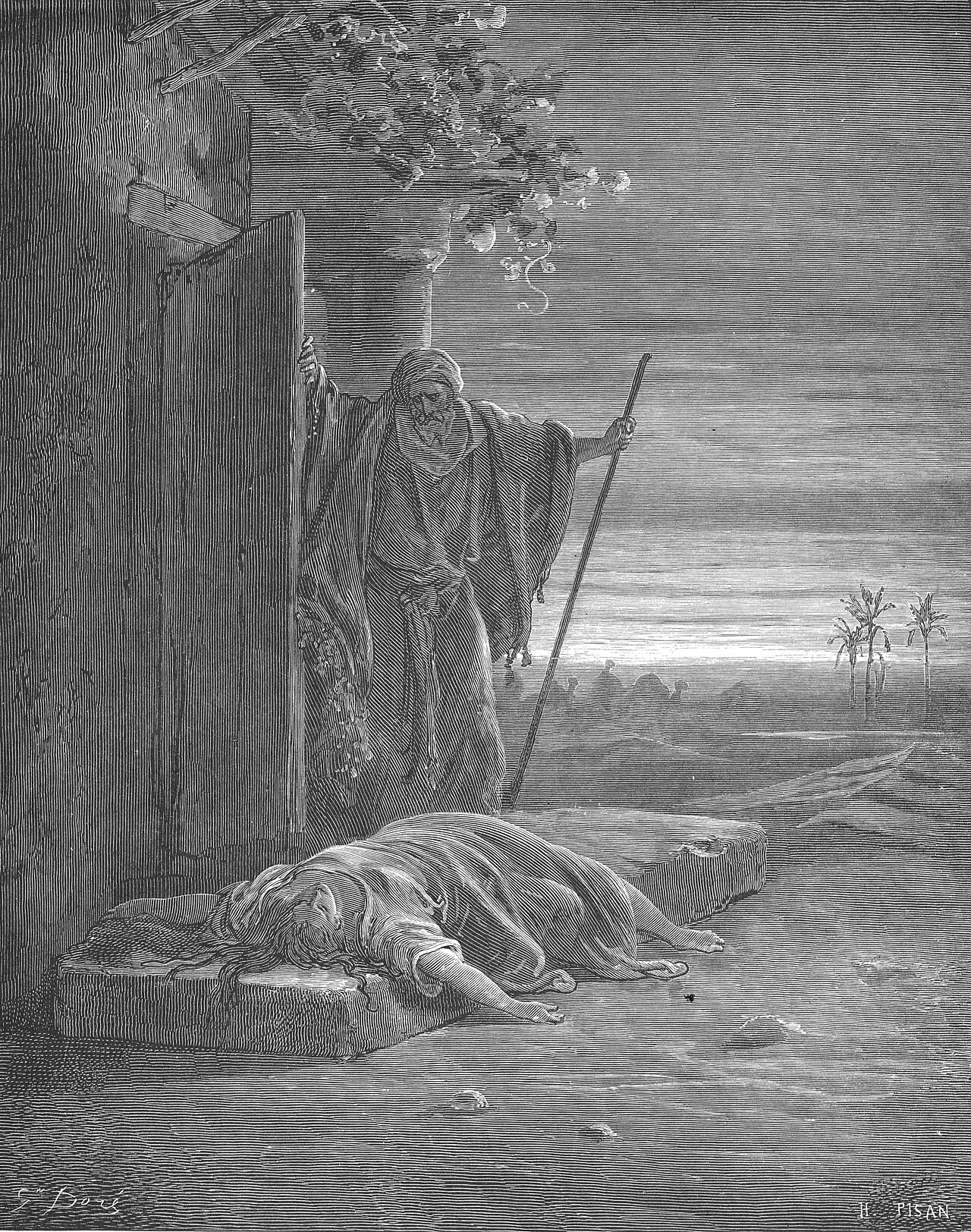
“26 Then came the woman in the dawning of the day, and fell down at the door of the man's house where her lord was, till it was light. 27 And her lord rose up in the morning, and opened the doors of the house, and went out to go his way: and, behold, the woman his concubine was fallen down at the door of the house, and her hands were upon the threshold.”
Matthew Henry · Commentary on the Whole Bible (1707-1721)puritan
The night at Gibeah, and twelve pieces sent through Israel
Ambrose places the attack after the meal was cleared away. Henry observes that a man's house should be his safe place, and in those days there was no king in Israel to keep the peace.
Judges 19:22
“Sons of Belial - Profligate fellows. See the notes on Deu 13:13. That we may know him - See Gen 19:5. These were genuine sodomites as to their practice; sons of Belial, rascals and miscreants of the deepest dye; worse than brutes, being a compound of beast and devil inseparably blended.”
Adam Clarke · Commentary on the Bible (1810-1826)evangelical
Judges 19:23-24
The old man answers as Lot did at Genesis 19:6 to 8, with “No, my brothers, do not do this wicked thing”, and then offers his own daughter in the guest's place. The narrator reports the offer and records neither approval nor rebuke. Both hosts defend the man under their roof, and both put forward against him a woman of their own household.
Judges 19:23
“This man is come into mine house - He appeals to the sacred rights of hospitality, just as Lot did Gen 19:8. Both cases betray painfully the low place in the social scale occupied by woman in the old world, from which it is one of the glories of Christianity to have raised her.”
The old man offers the women of his house to spare the guest under his roof. Clarke says nothing can excuse the offer, here or in Lot's house at Sodom. Barnes sees how low a place a woman held.
Judges 19:24
“Here is my daughter, a maiden - Such a proposal was made by Lot to the men of Sodom, Gen 19:8, but nothing can excuse either. That the rights of hospitality were sacred in the East, and most highly regarded we know; and that a man would defend, at the expense of his life, the stranger whom he had admitted under his roof, is true; but how a father could make such a proposal relative to his virgin daughter, must remain among those things which are incomprehensible.”
Adam Clarke · Commentary on the Bible (1810-1826)evangelical
Judges 19:25-26
At Sodom the visitors pulled Lot inside and struck the men at the door with blindness at Genesis 19:10 and 19:11, and the guests were never touched. Here nothing intervenes, and the night is told in a single clause that ends “at dawn they let her go”. Verse 26 brings her back to “the house where her master was staying”, where she “collapsed at the doorway” and got no further.
Judges 19:25
“So the man took his concubine - The word יחזק yachazek, which we here translate simply took, signifies rather to take or seize by violence. The woman would not go out to them; but her graceless husband forced her to go, in order that he might save his own body. He could have but little love for her, and this was the cause of their separation before.”
Adam Clarke · Commentary on the Bible (1810-1826)evangelical
Clarke writes that she had strength to reach the doorway and none left to knock. Ambrose writes that she died where her husband had entered.
Judges 19:26
“Overcome by this cruelty or by grief at her wrong, she fell at the door of their host where her husband had entered, and died, with the last effort of her life guarding the feelings of a good wife so as to preserve for her husband at least her mortal remains.”
Ambrose of Milan · written before 397 · On the Duties of the Clergy 3.19.114patristic
1 more voice on this verse
Judges 19:26
“Fell down at the door - She had strength to reach the door, but not to knock for admittance: when she reached the door she fell down dead! The reason of this abominable and horrid catastrophe is strongly signified by the original words, Jdg 19:25: וידעו אותה ויתעללו בה כל הלילה vaiyedu othah, vaiyithallelu bah col hallailah, which we modestly translate, and they knew her, and they abused her all the night. More literally, but still not fully: Illi cum ea rem habuerunt, et alternatim in eam tota nocte ascenderunt.”
Adam Clarke · Commentary on the Bible (1810-1826)evangelical
Judges 19:27-28
The narrator stops on her position, “with her hands on the threshold”, which measures how far she got. His only recorded words to her in the whole chapter are “Get up” and “Let us go”, and the Hebrew says only that “there was no response”. The Septuagint adds that she was dead, where the Hebrew leaves the moment of her death unstated and the chapter does not settle it.
Judges 19:27
“The Levite, coming out, found her lying there and thought that she dared not lift her head for shame. He began comforting her, since she had succumbed to such injury not willingly but unwillingly. He bade her rise and go home with him. Then, as no answer came, he called her loudly as though to rouse her from sleep.”
Ambrose of Milan · written before 397 · LETTER 33patristic
The Levite puts her on his donkey and takes her home, with no court in Israel to go to. Henry observes that there was no king and no great council from which to demand justice. Phinehas the priest kept to the sanctuary.
Judges 19:28
“There was no king in Israel, nor (for aught that appears) any sanhedrim, or great council, to appeal to, and demand justice from. Phinehas is high priest, but he attends closely to the business of the sanctuary, and will be no judge or divider.”
Matthew Henry · Commentary on the Whole Bible (1707-1721)puritan
Judges 19:29-30
The twelve pieces summon the tribes, as Saul's oxen do at 1 Samuel 11:7, sent from Gibeah itself. Verse 30 is the nation's own measure, “Nothing like this has been seen or done from the day the Israelites came out of the land of Egypt”. The chapter ends in three imperatives, “Think it over, take counsel, and speak up”, and chapter 20 is the answer.
Judges 19:29
“A knife - Rather, “the” “knife”. The single household implement used, not like our knives at our meals, but for slaughtering and cutting up the animals into joints for eating Gen 22:6, Gen 22:10; Pro 30:14. Together with her bones ... - Rather, “into her bones”, or “bone by bone, into twelve pieces”. The “pieces” are synonymous with the “bones” (compare Eze 24:4-5). There is something truly terrible in the stern ferocity of grief and indignation which dictated this desperate effort to arouse his countrymen to avenge his wrong. Compare 1Sa 11:7.”
1 more voice on this verse
Judges 19:29
“He divided it into twelve pieces, according to the bones, so some read it, that is, by the joints, sending one to each tribe, even to Benjamin among the rest, with the hope that some among them would be moved to join in punishing so great a villany, and the more warmly because committed by some of their own tribe.”
Matthew Henry · Commentary on the Whole Bible (1707-1721)puritan
Clarke renders think it over as put it to yourselves, and he reads take counsel and speak up as the call to the council of chapter 20. All Israel took it as a disgrace.
Judges 19:30
“There was no such deed done nor seen - They were all struck with the enormity of the crime; and considered it a sovereign disgrace to all the tribes of Israel. Consider of it - Literally, Put it to yourselves; take counsel upon it; and speak. This was the prelude to the council held, and the subsequent operations, which are mentioned in the following chapter. I Have passed over the abominable transactions of this chapter as lightly as I could, and shall make no apology to the learned or unlearned reader for leaving some things untranslated.”
Adam Clarke · Commentary on the Bible (1810-1826)evangelical
How this psalm is built
The form: A narrative built on the account of Sodom at Genesis 19, with the same demand at the door and the same offer of a substitute, opening the second appendix, as Keil and Delitzsch classes it.
The patterns in this chapter
| Device | What it does | Where to see it |
|---|---|---|
| There was no king in Israel | The third of the four statements stands at verse 1. This one and 18:1 carry the first half only. The four together bracket the closing block of the book at 17:6, 18:1, 19:1 and 21:25.Keil and Delitzsch, Biblical Commentary on the Old Testament: Joshua, Judges, Ruth, 1863, on Judges 19:1. | Judges 19:1 |
| Sodom, told again in Israel | Verse 22 repeats Genesis 19:4 and 19:5 closely: the house surrounded, the door beaten, and the demand for the man who came in. Verses 23 and 24 run along Lot's answer at Genesis 19:6 to 8, the plea at the door and the daughter offered in the guest's place. What Genesis has and this chapter does not is the rescue, since at Genesis 19:10 and 19:11 the visitors pull Lot inside and strike the men at the door with blindness. Here nothing intervenes.Keil and Delitzsch, Biblical Commentary on the Old Testament: Joshua, Judges, Ruth, 1863, on Judges 19:22 to 25. | Judges 19:22, Judges 19:23, Judges 19:24, Judges 19:25 |
| Comfort your heart | The same words run through the chapter and then turn. The father presses his guest to strengthen his heart at verses 5 and 8 and to let his heart be merry at verses 6 and 9. Verse 22 uses the same phrase of the men in the house at the moment it is surrounded. Five verses of eating and drinking slow the telling down to the hour, and hospitality is the thing Gibeah withholds at verse 15.Matthew Henry, Commentary on the Whole Bible, 1708 to 1710, on Judges 19:5 to 9. | Judges 19:5, Judges 19:6, Judges 19:8, Judges 19:9, Judges 19:22 |
| The town chosen for being Israelite | At verse 11 the servant proposes lodging in Jebus, and the Levite refuses on one ground, that it does not belong to the Israelites. He turns to a town of his own people instead. What follows happens in Benjamin, among Israelites, in the place chosen for being Israelite. Jerusalem stays a Jebusite town until David takes it at 2 Samuel 5:6 to 9, which Joshua 15:63 and Judges 1:21 both record.Matthew Henry, Commentary on the Whole Bible, 1708 to 1710, on Judges 19:11 to 12. | Judges 19:11, Judges 19:12, Judges 19:15 |
The structure
10 more paragraphs on the patterns
Four movements. The delay at Bethlehem at verses 1 to 10, where five days are counted out and the father presses for each one. The road and the refusal at verses 11 to 15. The old man's house and the night at verses 16 to 26. The morning, the twelve pieces and Israel's own verdict at verses 27 to 30.
The hour is the chapter's clock. The father's plea at verse 9 counts it twice over, and verse 14 reports what the delay cost, that the sun went down on them near Gibeah.
The word Belial
The word enters Scripture at Deuteronomy 13:13, of men drawing a whole city into idolatry. It falls here at verse 22, returns at Judges 20:13 of these same men, and is used once in the New Testament at 2 Corinthians 6:15. Deuteronomy 13 is also the chapter whose sentence Israel carries out at 20:48.
Where the chapter reaches
Gibeah is where Saul lives when the kingdom begins, called Gibeah of Saul at 1 Samuel 11:4, 1 Samuel 15:34 and 2 Samuel 21:6.
The twelve pieces sent through all the territory of Israel work as a summons to the tribes. Saul does the same thing with a yoke of oxen at 1 Samuel 11:7, sending them through Israel from this same town.
Hosea measures Israel by these days twice, at Hosea 9:9 and Hosea 10:9, so the prophets read this stretch as the low mark of the period.
The verse the witnesses divide over
At verse 18 the Levite names his destination as the house of the LORD, where the Septuagint reads to my house, which is where verse 29 has him arrive. Both readings are old and the chapter settles neither. The house of God stood at Shiloh through this period, which Judges 18:31 states outright and 21:19 assumes, and the road from Bethlehem up to the hill country of Ephraim runs by it.
Keep studying
Sources for this chapter
The summary
Jamieson, Fausset & Brown, Commentary Critical and Explanatory; John Wesley, Notes on the Old Testament and Matthew Henry, Complete Commentary.
The form and classifications
Barry G. Webb, The Book of Judges: An Integrated Reading, 1987, and the NICOT commentary, 2012; carried as a proposed structure in the site's Judges dossier and Keil and Delitzsch, Biblical Commentary on the Old Testament: Joshua, Judges, Ruth, 1863, on Judges 19:22 to 24.
The exposition
Adam Clarke, Commentary on the Bible; Albert Barnes; Ambrose of Milan; Jamieson, Fausset & Brown, Commentary Critical and Explanatory on the Whole Bible; John Gill, Exposition of the Old Testament; Keil and Delitzsch, Biblical Commentary on the Old Testament: Joshua, Judges, Ruth and Matthew Henry, Commentary on the Whole Bible.