
Judges 19:23
in Judges 19The owner of the house went out and said to them, “No, my brothers, do not do this wicked thing! After all, this man is a guest in my house. Do not commit this outrage.
BSB
The same verse in ASV and KJV ▾
ASV
And the man, the master of the house, went out unto them, and said unto them, Nay, my brethren, I pray you, do not so wickedly; seeing that this man is come into my house, do not this folly.
KJV
And the man, the master of the house, went out unto them, and said unto them, Nay, my brethren, nay, I pray you, do not so wickedly; seeing that this man is come into mine house, do not this folly.
⋯
This verse in Judges 19
Commentary
7 notes on this verseA commentator
Albert Barnes1798–1870
Notes, Explanatory and Practical, on the Old and New Testaments (1832-1869)
This man is come into mine house - He appeals to the sacred rights of hospitality, just as Lot did Gen 19:8. Both cases betray painfully the low place in the social scale occupied by woman in the old world, from which it is one of the glories of Christianity to have raised her.
This site's exposition
do not do this wicked thing
on Judges 19:23-24
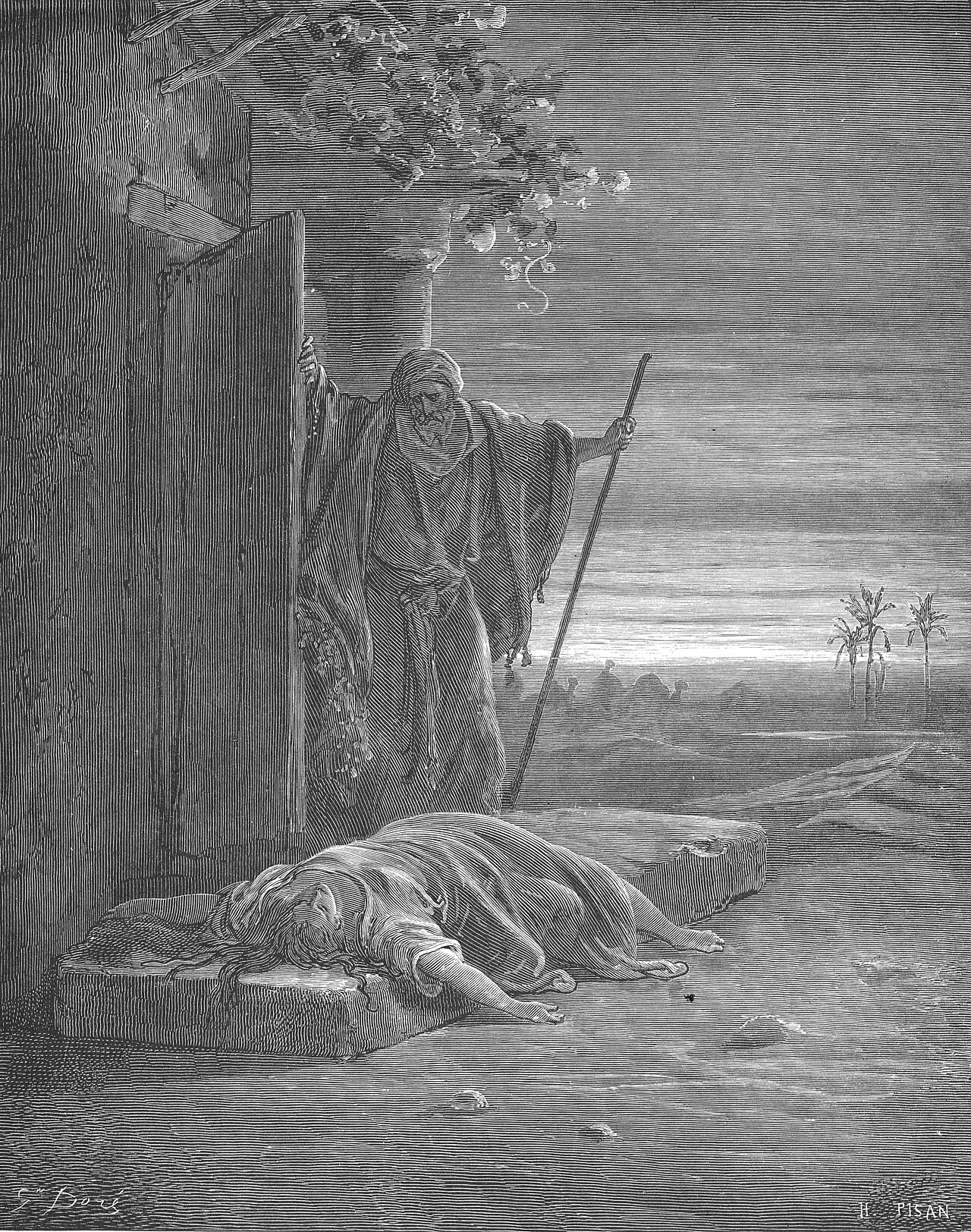
The old man answers as Lot did at Genesis 19:6 to 8, with “No, my brothers, do not do this wicked thing”, and then offers his own daughter in the guest's place. The narrator reports the offer and records neither approval nor rebuke. Both hosts defend the man under their roof, and both put forward against him a woman of their own household.
The record, by era
The Church Fathers1 voice
The old man, going out, begged them not to defile his guest's stay with a base crime, contemplating violation of a privilege reverenced even by savage nations of barbarous peoples; they could not insultingly mistreat a fellow tribesman of his, legitimately born, a married man, without causing wrath in their heavenly judge.
The Puritans and the Awakening3 voices
And the man, the master of the house, went out unto them,....
But in one thing he conformed too far to Lot's example (as we are apt in imitating good men to follow them even in their false steps), in offering them his daughter to do what they would with.
Those that are guilty of it are ranked in the New Testament among the worst and vilest of sinners ( 1 Tim. i. 10 ), and such as shall not inherit the kingdom of God, 1 Cor. vi. Now, (1.) This was the sin of Sodom, and is thence called Sodomy.
The Nineteenth Century1 voice
A commentator
Jamieson, Fausset & Brown1802–1910
Commentary Critical and Explanatory on the Whole Bible (1871)
proposed
certain sons of Belial beset the house--The narrative of the horrid outrage that was committed; of the proposal of the old man; the unfeeling, careless, and in many respects, inexplicable conduct of the Levite towards his wife, disclose a state of morality that would have appeared incredible, did it not rest on the testimony of the sacred historian.
quarantine:debris (2026-07-29) — starts-lowercase
The words behind it
24 Hebrew wordsEvery Hebrew word of this verse in the order it stands, with what it means and the door to its own study. The last column counts the times a word stands in the whole Bible: the rarer the word, the more the places it appears belong together.
| Hebrew | Sound | Meaning | Word study | In the Bible |
|---|---|---|---|---|
| וַיֵּצֵ֣א | vaiyetze' | and he went out | H3318 → | 1067 times |
| אֲלֵיהֶ֗ם | ʾaleihem | to them | H413 → | 5510 times |
| הָאִישׁ֙ | haish | the man | H376 → | 1663 times |
| בַּ֣עַל | baal | [the] master of | H1167 → | 84 times |
| הַבַּ֔יִת | habayit | the house | H1004 → | 2046 times |
| וַיֹּ֣אמֶר | vaiyomer | and he said | H559 → | 5305 times |
| אֲלֵהֶ֔ם | ʾalehem | to them | H413 → | 5510 times |
| אַל־ | ʾal- | may [you] not | H408 → | 724 times |
| אַחַ֖י | ʾachai | O brothers my | H251 → | 630 times |
| אַל־ | ʾal- | may not | H408 → | 724 times |
| תָּרֵ֣עוּ | tareu | you do evil | H7489 → | |
| נָ֑א | na' | please | H4994 → | 404 times |
| אַ֠חֲרֵי | ʾacharei | after | H310 → | 715 times |
| אֲשֶׁר־ | ʾasher- | that | H834 → | 5497 times |
| בָּ֞א | ba' | he has come | H935 → | 2568 times |
| הָאִ֤ישׁ | haish | the man | H376 → | 1663 times |
| הַזֶּה֙ | hazeh | <the> this | H2088 → | 1180 times |
| אַל־ | ʾal- | may [you] not | H413 → | 5510 times |
| בֵּיתִ֔י | beiti | house my | H1004 → | 2046 times |
| אַֽל־ | ʾal- | may not | H408 → | 724 times |
| תַּעֲשׂ֖וּ | taasu | you do | H6213 → | 2628 times |
| אֶת־ | ʾet- | <obj.> | H853 → | 10935 times |
| הַנְּבָלָ֥ה | hanevalah | the disgraceful folly | H5039 → | 13 times |
| הַזֹּֽאת׃ | hazot | <the> this | H2063 → | 603 times |
וַיֵּצֵ֣אand he went out
vaiyetze'H3318 →1067 times
אֲלֵיהֶ֗םto them
ʾaleihemH413 →5510 times
הָאִישׁ֙the man
haishH376 →1663 times
בַּ֣עַל[the] master of
baalH1167 →84 times
הַבַּ֔יִתthe house
habayitH1004 →2046 times
וַיֹּ֣אמֶרand he said
vaiyomerH559 →5305 times
אֲלֵהֶ֔םto them
ʾalehemH413 →5510 times
אַל־may [you] not
ʾal-H408 →724 times
אַחַ֖יO brothers my
ʾachaiH251 →630 times
אַל־may not
ʾal-H408 →724 times
תָּרֵ֣עוּyou do evil
tareuH7489 →
נָ֑אplease
na'H4994 →404 times
אַ֠חֲרֵיafter
ʾachareiH310 →715 times
אֲשֶׁר־that
ʾasher-H834 →5497 times
בָּ֞אhe has come
ba'H935 →2568 times
הָאִ֤ישׁthe man
haishH376 →1663 times
הַזֶּה֙<the> this
hazehH2088 →1180 times
אַל־may [you] not
ʾal-H413 →5510 times
בֵּיתִ֔יhouse my
beitiH1004 →2046 times
אַֽל־may not
ʾal-H408 →724 times
תַּעֲשׂ֖וּyou do
taasuH6213 →2628 times
אֶת־<obj.>
ʾet-H853 →10935 times
הַנְּבָלָ֥הthe disgraceful folly
hanevalahH5039 →13 times
הַזֹּֽאת׃<the> this
hazotH2063 →603 times
A shaded row is a word that stands 400 times or fewer in the Bible.
The walk
8 stopsEach card is a verse this one points to, and under it the verses that one points to in turn. Where several paths arrive at the same place, that place is listed first: the text keeps returning to it.
Through
Deuteronomy 22:21she shall be brought to the door of her father’s house, and there the men of her city will stone her to death. For she has committed an outrage in Israel by being promiscuous…
it leads to
- Genesis 34:7
When Jacob’s sons heard what had happened, they returned from the field. They were filled with grief and fury, because Shechem had committed an outrage in Israel by lying with Jacob’s daughter—a thing that…
Reached by 3 separate paths from here.
- 2 Samuel 13:12–13
“No, my brother!” she cried. “Do not humiliate me, for such a thing should never be done in Israel. Do not do this disgraceful thing!
Reached by 2 separate paths from here.
- Deuteronomy 13:5
Such a prophet or dreamer must be put to death, because he has advocated rebellion against the LORD your God, who brought you out of the land of Egypt and redeemed you from the…
- Genesis 34:7
Through
2 Samuel 13:12“No, my brother!” she cried. “Do not humiliate me, for such a thing should never be done in Israel. Do not do this disgraceful thing!
it leads to
- Judges 20:6
Then I took my concubine, cut her into pieces, and sent her throughout the land of Israel’s inheritance, because they had committed a lewd and disgraceful act in Israel.
Reached by 3 separate paths from here.
- Leviticus 20:17
If a man marries his sister, whether the daughter of his father or of his mother, and they have sexual relations, it is a disgrace. They must be cut off in the sight of…
- Leviticus 18:9
You must not have sexual relations with your sister, either your father’s daughter or your mother’s daughter, whether she was born in the same home or elsewhere.
- Judges 20:6
Through
Judges 20:6Then I took my concubine, cut her into pieces, and sent her throughout the land of Israel’s inheritance, because they had committed a lewd and disgraceful act in Israel.
it leads to
- Joshua 7:15
The one who is caught with the things devoted to destruction must be burned, along with all that belongs to him, because he has transgressed the covenant of the LORD and committed an outrage…
Reached by 2 separate paths from here.
- Judges 19:29
When he reached his house, he picked up a knife, took hold of his concubine, cut her limb by limb into twelve pieces, and sent her throughout the territory of Israel.
- Joshua 7:15
About Judges
This page draws on Adam Clarke, Commentary on the Bible; Albert Barnes, Notes, Explanatory and Practical, on the Old and New Testaments (1832-1869); Ambrose of Milan, LETTER 33; Jamieson, Fausset & Brown, Commentary Critical and Explanatory on the Whole Bible; John Gill, Exposition of the Old Testament (1748-1763); Keil and Delitzsch, Biblical Commentary on the Old Testament: Joshua, Judges, Ruth and Matthew Henry, Commentary on the Whole Bible.