
Judges 19:29
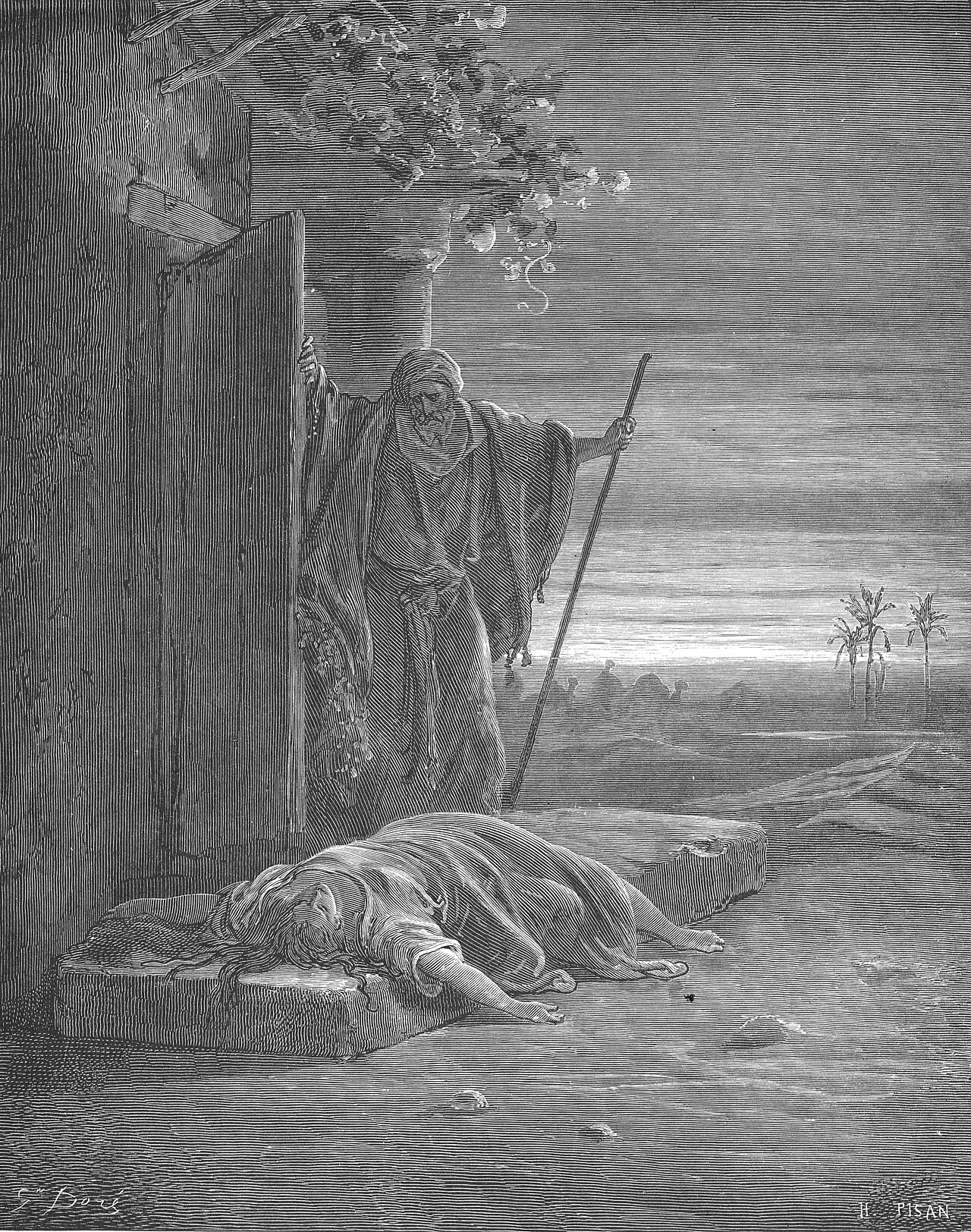
in Judges 19When he reached his house, he picked up a knife, took hold of his concubine, cut her limb by limb into twelve pieces, and sent her throughout the territory of Israel.
BSB
The same verse in ASV and KJV ▾
ASV
And when he was come into his house, he took a knife, and laid hold on his concubine, and divided her, limb by limb, into twelve pieces, and sent her throughout all the borders of Israel.
KJV
And when he was come into his house, he took a knife, and laid hold on his concubine, and divided her, together with her bones, into twelve pieces, and sent her into all the coasts of Israel.
⋯
This verse in Judges 19
Commentary
7 notes on this verseA commentator
Albert Barnes1798–1870
Notes, Explanatory and Practical, on the Old and New Testaments (1832-1869)
A knife - Rather, “the” “knife”. The single household implement used, not like our knives at our meals, but for slaughtering and cutting up the animals into joints for eating Gen 22:6, Gen 22:10; Pro 30:14. Together with her bones ... - Rather, “into her bones”, or “bone by bone, into twelve pieces”. The “pieces” are synonymous with the “bones” (compare Eze 24:4-5). There is something truly terrible in the stern ferocity of grief and indignation which dictated this desperate effort to arouse his countrymen to avenge his wrong. Compare 1Sa 11:7.
This site's exposition
he took a knife, and laid hold
on Judges 19:29-30
The twelve pieces sent into all the coasts of Israel work as a summons to the tribes, and Saul does the same thing with a yoke of oxen at 1 Samuel 11:7, hewing them in pieces and sending them throughout all the coasts of Israel; he sends from Gibeah, this town. Verse 30 is the measure the nation takes for itself, that there was no such deed done nor seen from the day that the children of Israel came up out of the land of Egypt unto this day. The chapter ends by handing the matter over in three imperatives, consider of it, take advice, and speak your minds, and chapter 20 is what the tribes do with it.
The record, by era
The Church Fathers1 voice
Our sufferings have been dreadful beyond endurance, and it is impossible to describe them in suitable terms; but in order that the dreadful nature of the events which have taken place may be more readily apprehended, I have thought it good to remind you of a history out of the Scriptures.
The Puritans and the Awakening3 voices
He divided it into twelve pieces, according to the bones, so some read it, that is, by the joints, sending one to each tribe, even to Benjamin among the rest, with the hope that some among them would be moved to join in punishing so great a villany, and the more warmly because committed by some of their own tribe.
The Levite Benighted at Gibeah. 1 And it came to pass in those days, when there was no king in Israel, that there was a certain Levite sojourning on the side of mount Ephraim, who took to him a concubine out of Beth-lehem-judah. 2 And his concubine played the whore against him, and went away from him unto her father's house to Beth-lehem-judah, and was there four whole months.
quarantine:scripture (2026-07-29) — scripture-overlap:94%@v1-3
And when he was come into his house,....
The Nineteenth Century1 voice
Divided her - into twelve pieces - There is no doubt that with the pieces he sent to each tribe a circumstantial account of the barbarity of the men of Gibeah; and it is very likely that they considered each of the pieces as expressing an execration, “If ye will not come and avenge my wrongs, may ye be hewn in pieces like this abused and murdered woman!” It was a custom among the ancient Highlanders in Scotland, when one clan wished to call all the rest to avenge its wrongs, to take a wooden cross, dip it in blood, and send it by a special messenger through all the clans. This was called the fire cross, because at sight of it each clan lighted a fire or beacon, which gave notice to all the adjoining clans that a general rising was immediately to take place.
The words behind it
17 Hebrew wordsEvery Hebrew word of this verse in the order it stands, with what it means and the door to its own study. The last column counts the times a word stands in the whole Bible: the rarer the word, the more the places it appears belong together.
| Hebrew | Sound | Meaning | Word study | In the Bible |
|---|---|---|---|---|
| וַיָּבֹ֣א | vaiyavo' | and he came | H935 → | 2568 times |
| אֶל־ | ʾel- | to | H413 → | 5510 times |
| בֵּית֗וֹ | beito | house his | H1004 → | 2046 times |
| וַיִּקַּ֤ח | vaiyikach | and he took | H3947 → | 966 times |
| אֶת־ | ʾet- | <obj.> | H853 → | 10935 times |
| הַֽמַּאֲכֶ֙לֶת֙ | hamaakhelet | the knife | H3979 → | |
| וַיַּחֲזֵ֣ק | vaiyachazek | and he took hold | H2388 → | 291 times |
| בְּפִֽילַגְשׁ֔וֹ | befilagsho | on concubine his | H6370 → | 37 times |
| וַֽיְנַתְּחֶ֙הָ֙ | vaynatecheha | and he cut in pieces her | H5408 → | |
| לַעֲצָמֶ֔יהָ | laatzameiha | to bones her | H6106 → | |
| לִשְׁנֵ֥ים | lishneim | into two [plus] | H8147 → | 768 times |
| עָשָׂ֖ר | ʾasar | ten | H6240 → | 338 times |
| נְתָחִ֑ים | netachim | pieces | H5409 → | |
| וַֽיְשַׁלְּחֶ֔הָ | vayshalecheha | and he sent out her | H7971 → | 845 times |
| בְּכֹ֖ל | bekhol | in all | H3605 → | 5413 times |
| גְּב֥וּל | gevul | [the] territory of | H1366 → | 240 times |
| יִשְׂרָאֵֽל׃ | yisrael | Israel | H3478 → | 2507 times |
וַיָּבֹ֣אand he came
vaiyavo'H935 →2568 times
אֶל־to
ʾel-H413 →5510 times
בֵּית֗וֹhouse his
beitoH1004 →2046 times
וַיִּקַּ֤חand he took
vaiyikachH3947 →966 times
אֶת־<obj.>
ʾet-H853 →10935 times
הַֽמַּאֲכֶ֙לֶת֙the knife
hamaakheletH3979 →
וַיַּחֲזֵ֣קand he took hold
vaiyachazekH2388 →291 times
בְּפִֽילַגְשׁ֔וֹon concubine his
befilagshoH6370 →37 times
וַֽיְנַתְּחֶ֙הָ֙and he cut in pieces her
vaynatechehaH5408 →
לַעֲצָמֶ֔יהָto bones her
laatzameihaH6106 →
לִשְׁנֵ֥יםinto two [plus]
lishneimH8147 →768 times
עָשָׂ֖רten
ʾasarH6240 →338 times
נְתָחִ֑יםpieces
netachimH5409 →
וַֽיְשַׁלְּחֶ֔הָand he sent out her
vayshalechehaH7971 →845 times
בְּכֹ֖לin all
bekholH3605 →5413 times
גְּב֥וּל[the] territory of
gevulH1366 →240 times
יִשְׂרָאֵֽל׃Israel
yisraelH3478 →2507 times
A shaded row is a word that stands 400 times or fewer in the Bible.
The walk
8 stopsEach card is a verse this one points to, and under it the verses that one points to in turn. Where several paths arrive at the same place, that place is listed first: the text keeps returning to it.
Through
Romans 10:2For I testify about them that they are zealous for God, but not on the basis of knowledge.
it leads to
- Acts 21:20
When they heard this, they glorified God. Then they said to Paul, “You see, brother, how many thousands of Jews have believed, and all of them are zealous for the law.
- Romans 9:31–32
but Israel, who pursued a law of righteousness, has not attained it.
- Proverbs 19:2
Even zeal is no good without knowledge, and he who hurries his footsteps misses the mark.
- Philippians 3:6
as to zeal, persecuting the church; as to righteousness in the law, faultless.
- Philippians 1:9
And this is my prayer: that your love may abound more and more in knowledge and depth of insight,
- Acts 21:20
Through
1 Samuel 11:7He took a pair of oxen, cut them into pieces, and sent them by messengers throughout the land of Israel, proclaiming, “This is what will be done to the oxen of anyone who does…
it leads to
- Judges 20:1
Then all the Israelites from Dan to Beersheba and from the land of Gilead came out, and the congregation assembled as one man before the LORD at Mizpah.
- Judges 21:5–11
The Israelites asked, “Who among all the tribes of Israel did not come to the assembly before the LORD?” For they had taken a solemn oath that anyone who failed to come up before…
- 2 Chronicles 14:14
and attacked all the cities around Gerar, because the terror of the LORD had fallen upon them. They plundered all the cities, since there was much plunder there.
- Judges 20:1
About Judges
This page draws on Adam Clarke, Commentary on the Bible; Albert Barnes, Notes, Explanatory and Practical, on the Old and New Testaments (1832-1869); Athanasius of Alexandria, ENCYCLICAL LETTER 1; John Gill, Exposition of the Old Testament (1748-1763); Keil and Delitzsch, Biblical Commentary on the Old Testament: Joshua, Judges, Ruth and Matthew Henry, Commentary on the Whole Bible.