
Judges 19:24
in Judges 19Look, let me bring out my virgin daughter and the man’s concubine, and you can use them and do with them as you wish. But do not do such a vile thing to this man.”
BSB
The same verse in ASV and KJV ▾
ASV
Behold, here is my daughter a virgin, and his concubine; them I will bring out now, and humble ye them, and do with them what seemeth good unto you: but unto this man do not any such folly.
KJV
Behold, here is my daughter a maiden, and his concubine; them I will bring out now, and humble ye them, and do with them what seemeth good unto you: but unto this man do not so vile a thing.
⋯
This verse in Judges 19
Commentary
8 notes on this verseHere is my daughter, a maiden - Such a proposal was made by Lot to the men of Sodom, Gen 19:8, but nothing can excuse either. That the rights of hospitality were sacred in the East, and most highly regarded we know; and that a man would defend, at the expense of his life, the stranger whom he had admitted under his roof, is true; but how a father could make such a proposal relative to his virgin daughter, must remain among those things which are incomprehensible.
This site's exposition
do not do this wicked thing
on Judges 19:23-24
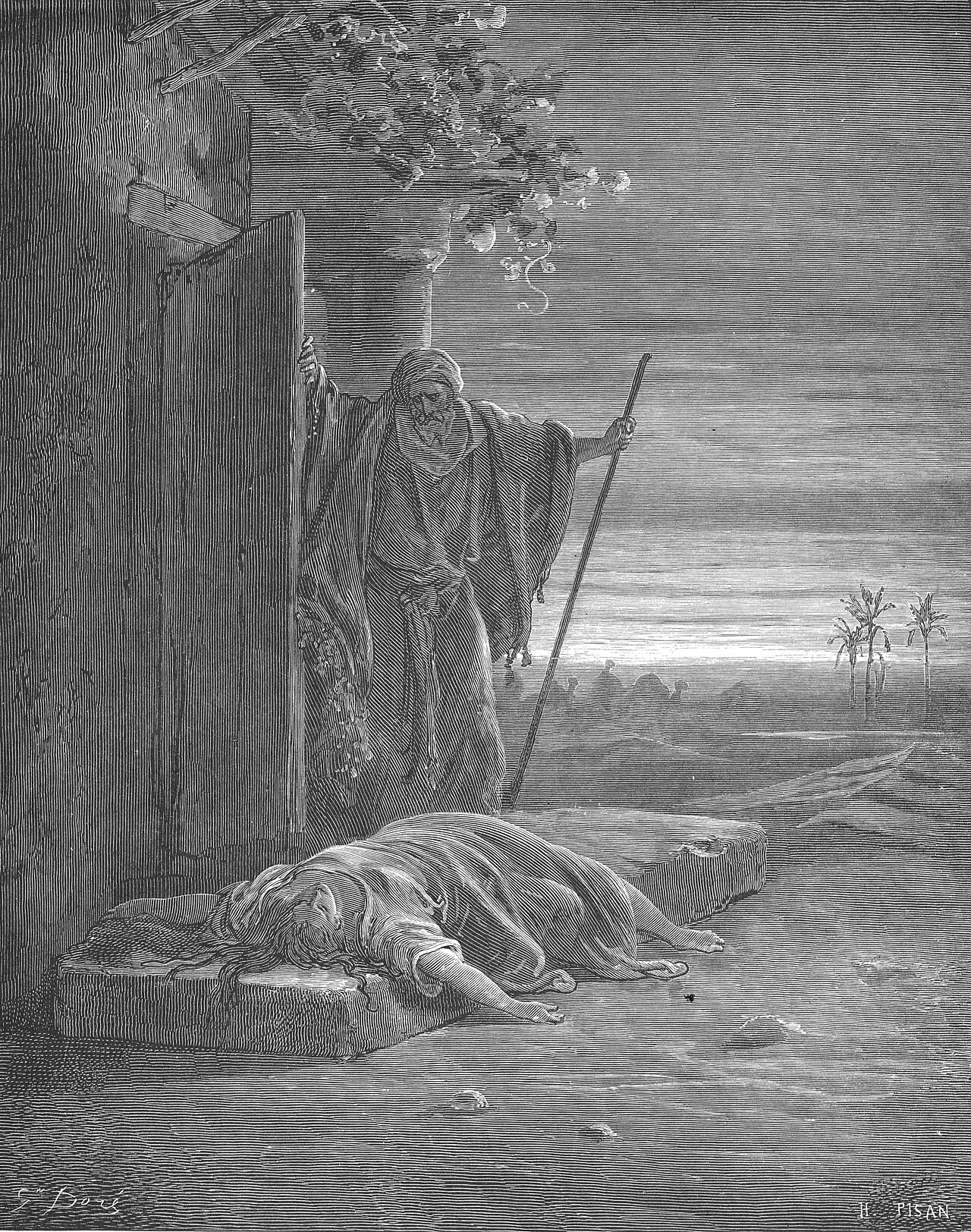
The old man answers as Lot did at Genesis 19:6 to 8, with “No, my brothers, do not do this wicked thing”, and then offers his own daughter in the guest's place. The narrator reports the offer and records neither approval nor rebuke. Both hosts defend the man under their roof, and both put forward against him a woman of their own household.
This site's exposition
let me bring out my virgin daughter
The old man offers the women of his house to spare the guest under his roof. Clarke says nothing can excuse the offer, here or in Lot's house at Sodom. Barnes sees how low a place a woman held.
The record, by era
The Church Fathers2 voices
Then the old man offered these wicked men his daughter, a virgin, and the concubine with whom she shared her bed, only that violence might not be inflicted on his guest.
When he saw that he was making little headway, he added that he had a maiden daughter and he offered her to them, with great sorrow, since he was her parent, but with less damage to the favor he owed his guest. He considered a public crime more tolerable than private disgrace.
The Puritans and the Awakening2 voices
Behold, here is my daughter, a maiden, and his concubine,....
But in one thing he conformed too far to Lot's example (as we are apt in imitating good men to follow them even in their false steps), in offering them his daughter to do what they would with.
The Nineteenth Century1 voice
A commentator
Jamieson, Fausset & Brown1802–1910
Commentary Critical and Explanatory on the Whole Bible (1871)
proposed
certain sons of Belial beset the house--The narrative of the horrid outrage that was committed; of the proposal of the old man; the unfeeling, careless, and in many respects, inexplicable conduct of the Levite towards his wife, disclose a state of morality that would have appeared incredible, did it not rest on the testimony of the sacred historian.
quarantine:debris (2026-07-29) — starts-lowercase
The words behind it
20 Hebrew wordsEvery Hebrew word of this verse in the order it stands, with what it means and the door to its own study. The last column counts the times a word stands in the whole Bible: the rarer the word, the more the places it appears belong together.
| Hebrew | Sound | Meaning | Word study | In the Bible |
|---|---|---|---|---|
| הִנֵּה֩ | hineh | here! | H2009 → | 843 times |
| בִתִּ֨י | viti | daughter my | H1323 → | 588 times |
| הַבְּתוּלָ֜ה | habetulah | the virgin | H1330 → | |
| וּפִֽילַגְשֵׁ֗הוּ | ufilagshehu | and concubine his | H6370 → | 37 times |
| אוֹצִֽיאָה־ | ʾotziah- | let me bring out | H3318 → | 1067 times |
| נָּ֤א | na' | please | H4994 → | 404 times |
| אוֹתָם֙ | ʾotam | <obj.> them | H853 → | 10935 times |
| וְעַנּ֣וּ | veanu | and afflict | H6031 → | 82 times |
| אוֹתָ֔ם | ʾotam | <obj.> them | H853 → | 10935 times |
| וַעֲשׂ֣וּ | vaasu | and do | H6213 → | 2628 times |
| לָהֶ֔ם | lahem | to <the> them | ||
| הַטּ֖וֹב | hatov | the good | H2896 → | 538 times |
| בְּעֵינֵיכֶ֑ם | beeineikhem | in view your | H5869 → | 887 times |
| וְלָאִ֤ישׁ | velaish | and to the man | H376 → | 1663 times |
| הַזֶּה֙ | hazeh | <the> this | H2088 → | 1180 times |
| לֹ֣א | lo' | not | H3808 → | 5168 times |
| תַעֲשׂ֔וּ | taasu | you must do | H6213 → | 2628 times |
| דְּבַ֖ר | devar | [the] thing of | H1697 → | 1440 times |
| הַנְּבָלָ֥ה | hanevalah | <the> disgraceful folly | H5039 → | 13 times |
| הַזֹּֽאת׃ | hazot | <the> this | H2063 → | 603 times |
הִנֵּה֩here!
hinehH2009 →843 times
בִתִּ֨יdaughter my
vitiH1323 →588 times
הַבְּתוּלָ֜הthe virgin
habetulahH1330 →
וּפִֽילַגְשֵׁ֗הוּand concubine his
ufilagshehuH6370 →37 times
אוֹצִֽיאָה־let me bring out
ʾotziah-H3318 →1067 times
נָּ֤אplease
na'H4994 →404 times
אוֹתָם֙<obj.> them
ʾotamH853 →10935 times
וְעַנּ֣וּand afflict
veanuH6031 →82 times
אוֹתָ֔ם<obj.> them
ʾotamH853 →10935 times
וַעֲשׂ֣וּand do
vaasuH6213 →2628 times
לָהֶ֔םto <the> them
lahem
הַטּ֖וֹבthe good
hatovH2896 →538 times
בְּעֵינֵיכֶ֑םin view your
beeineikhemH5869 →887 times
וְלָאִ֤ישׁand to the man
velaishH376 →1663 times
הַזֶּה֙<the> this
hazehH2088 →1180 times
לֹ֣אnot
lo'H3808 →5168 times
תַעֲשׂ֔וּyou must do
taasuH6213 →2628 times
דְּבַ֖ר[the] thing of
devarH1697 →1440 times
הַנְּבָלָ֥ה<the> disgraceful folly
hanevalahH5039 →13 times
הַזֹּֽאת׃<the> this
hazotH2063 →603 times
A shaded row is a word that stands 400 times or fewer in the Bible.
The walk
8 stopsEach card is a verse this one points to, and under it the verses that one points to in turn. Where several paths arrive at the same place, that place is listed first: the text keeps returning to it.
Through
Romans 3:8Why not say, as some slanderously claim that we say, “Let us do evil that good may result”? Their condemnation is deserved!
it leads to
- Romans 6:1
What then shall we say? Shall we continue in sin so that grace may increase?
- Romans 6:15
What then? Shall we sin because we are not under law, but under grace? Certainly not!
- Romans 6:1
Through
Deuteronomy 21:14And if you are not pleased with her, you are to let her go wherever she wishes. But you must not sell her for money or treat her as a slave, since you have…
it leads to
- Deuteronomy 22:29
then the man who lay with her must pay the young woman’s father fifty shekels of silver, and she must become his wife because he has violated her. He must not divorce her as…
- Genesis 34:2
When Shechem son of Hamor the Hivite, the prince of the region, saw her, he took her and lay with her by force.
- Deuteronomy 22:29
Through
Genesis 34:2When Shechem son of Hamor the Hivite, the prince of the region, saw her, he took her and lay with her by force.
it leads to
- Matthew 5:28
But I tell you that anyone who looks at a woman to lust after her has already committed adultery with her in his heart.
- Matthew 5:28
Through
Genesis 19:8Look, I have two daughters who have never slept with a man. Let me bring them to you, and you can do to them as you please. But do not do anything to these…
it leads to
- Genesis 19:31–38
One day the older daughter said to the younger, “Our father is old, and there is no man in the land to sleep with us, as is the custom over all the earth.
- Genesis 18:5
And I will bring a bit of bread so that you may refresh yourselves. This is why you have passed your servant’s way. After that, you may continue on your way.” “Yes,” they replied,…
- Genesis 42:37
Then Reuben said to his father, “You may kill my two sons if I fail to bring him back to you. Put him in my care, and I will return him.”
- Genesis 19:31–38
About Judges
This page draws on Adam Clarke, Commentary on the Bible; Albert Barnes, Notes, Explanatory and Practical, on the Old and New Testaments; Ambrose of Milan, On the Duties of the Clergy 3.19.114; Ambrose of Milan, LETTER 33; Jamieson, Fausset & Brown, Commentary Critical and Explanatory on the Whole Bible; John Gill, Exposition of the Old Testament (1748-1763); Keil and Delitzsch, Biblical Commentary on the Old Testament: Joshua, Judges, Ruth and Matthew Henry, Commentary on the Whole Bible.