
Judges 19:27
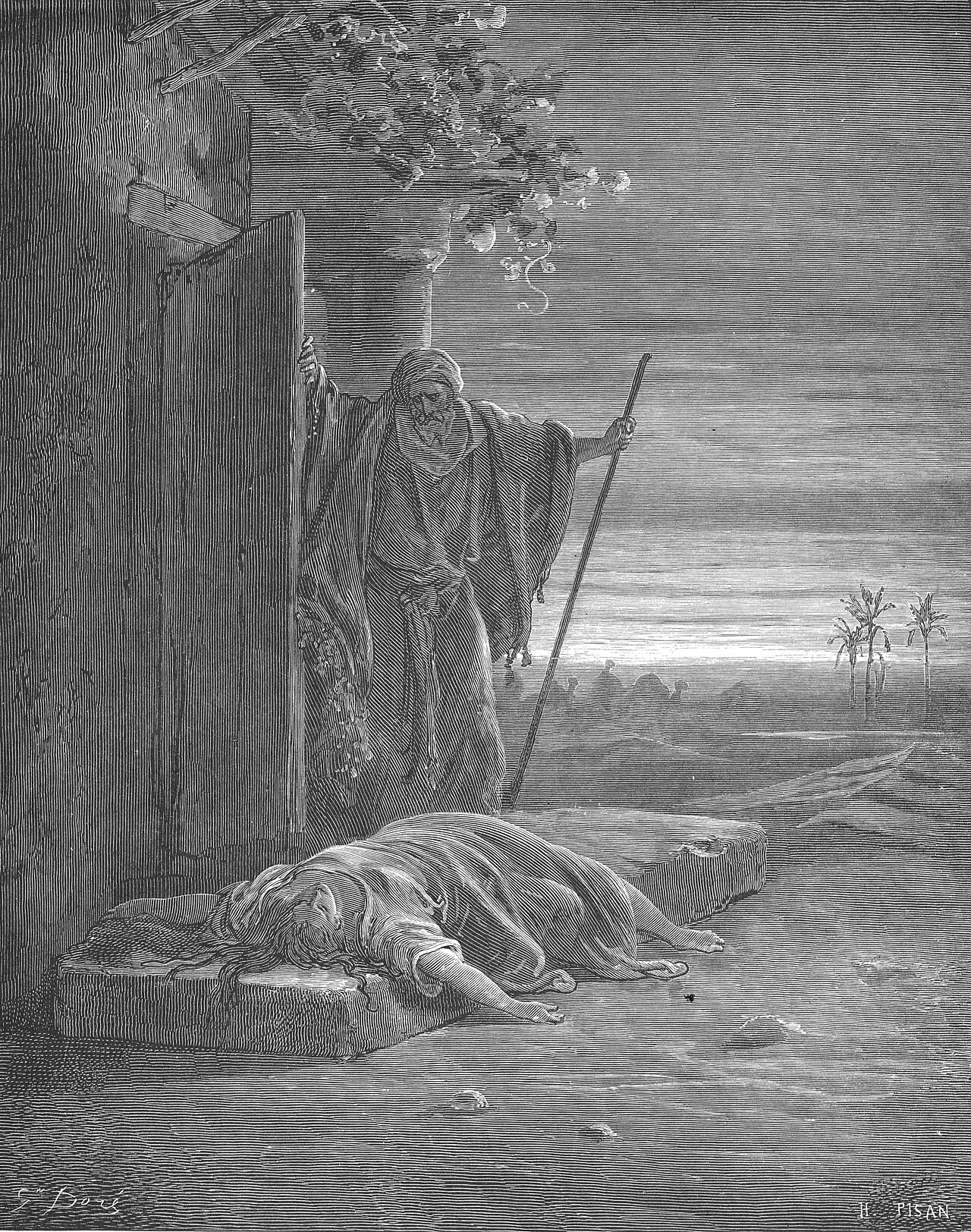
in Judges 19In the morning, when her master got up and opened the doors of the house to go out on his journey, there was his concubine, collapsed in the doorway of the house, with her hands on the threshold.
BSB
The same verse in ASV and KJV ▾
ASV
And her lord rose up in the morning, and opened the doors of the house, and went out to go his way; and, behold, the woman his concubine was fallen down at the door of the house, with her hands upon the threshold.
KJV
And her lord rose up in the morning, and opened the doors of the house, and went out to go his way: and, behold, the woman his concubine was fallen down at the door of the house, and her hands were upon the threshold.
⋯
This verse in Judges 19
Commentary
3 notes on this verseThis site's exposition
when her master got up
on Judges 19:27-28
The narrator stops on her position, “with her hands on the threshold”, which measures how far she got. His only recorded words to her in the whole chapter are “Get up” and “Let us go”, and the Hebrew says only that “there was no response”. The Septuagint adds that she was dead, where the Hebrew leaves the moment of her death unstated and the chapter does not settle it.
The record, by era
The Church Fathers1 voice
The Levite, coming out, found her lying there and thought that she dared not lift her head for shame. He began comforting her, since she had succumbed to such injury not willingly but unwillingly. He bade her rise and go home with him. Then, as no answer came, he called her loudly as though to rouse her from sleep.
The Puritans and the Awakening1 voice
And her lord rose up in the morning,....
The words behind it
18 Hebrew wordsEvery Hebrew word of this verse in the order it stands, with what it means and the door to its own study. The last column counts the times a word stands in the whole Bible: the rarer the word, the more the places it appears belong together.
| Hebrew | Sound | Meaning | Word study | In the Bible |
|---|---|---|---|---|
| וַיָּ֨קָם | vaiyakom | and he arose | H6965 → | 628 times |
| אֲדֹנֶ֜יהָ | ʾadoneiha | master<s> her | H113 → | 333 times |
| בַּבֹּ֗קֶר | baboker | in the morning | H1242 → | 214 times |
| וַיִּפְתַּח֙ | vaiyiftach | and he opened | H6605 → | 144 times |
| דַּלְת֣וֹת | daltot | [the] doors of | H1817 → | 88 times |
| הַבַּ֔יִת | habayit | the house | H1004 → | 2046 times |
| וַיֵּצֵ֖א | vaiyetze' | and he went out | H3318 → | 1067 times |
| לָלֶ֣כֶת | lalekhet | to go | H1980 → | 1546 times |
| לְדַרְכּ֑וֹ | ledarko | to way his | H1870 → | 707 times |
| וְהִנֵּ֧ה | vehineh | and there! | H2009 → | 843 times |
| הָאִשָּׁ֣ה | haishah | the woman | H802 → | 781 times |
| פִֽילַגְשׁ֗וֹ | filagsho | concubine his | H6370 → | 37 times |
| נֹפֶ֙לֶת֙ | nofelet | [was] falling | H5307 → | 435 times |
| פֶּ֣תַח | petach | [the] entrance of | H6607 → | 164 times |
| הַבַּ֔יִת | habayit | the house | H1004 → | 2046 times |
| וְיָדֶ֖יהָ | veyadeiha | and hands her | H3027 → | 1618 times |
| עַל־ | ʾal- | [were] on | H5921 → | 5755 times |
| הַסַּֽף׃ | hasaf | the threshold | H5592 → |
וַיָּ֨קָםand he arose
vaiyakomH6965 →628 times
אֲדֹנֶ֜יהָmaster<s> her
ʾadoneihaH113 →333 times
בַּבֹּ֗קֶרin the morning
babokerH1242 →214 times
וַיִּפְתַּח֙and he opened
vaiyiftachH6605 →144 times
דַּלְת֣וֹת[the] doors of
daltotH1817 →88 times
הַבַּ֔יִתthe house
habayitH1004 →2046 times
וַיֵּצֵ֖אand he went out
vaiyetze'H3318 →1067 times
לָלֶ֣כֶתto go
lalekhetH1980 →1546 times
לְדַרְכּ֑וֹto way his
ledarkoH1870 →707 times
וְהִנֵּ֧הand there!
vehinehH2009 →843 times
הָאִשָּׁ֣הthe woman
haishahH802 →781 times
פִֽילַגְשׁ֗וֹconcubine his
filagshoH6370 →37 times
נֹפֶ֙לֶת֙[was] falling
nofeletH5307 →435 times
פֶּ֣תַח[the] entrance of
petachH6607 →164 times
הַבַּ֔יִתthe house
habayitH1004 →2046 times
וְיָדֶ֖יהָand hands her
veyadeihaH3027 →1618 times
עַל־[were] on
ʾal-H5921 →5755 times
הַסַּֽף׃the threshold
hasafH5592 →
A shaded row is a word that stands 400 times or fewer in the Bible.
About Judges
This page draws on Adam Clarke, Commentary on the Bible; Ambrose of Milan, LETTER 33; John Gill, Exposition of the Old Testament (1748-1763) and Keil and Delitzsch, Biblical Commentary on the Old Testament: Joshua, Judges, Ruth.