
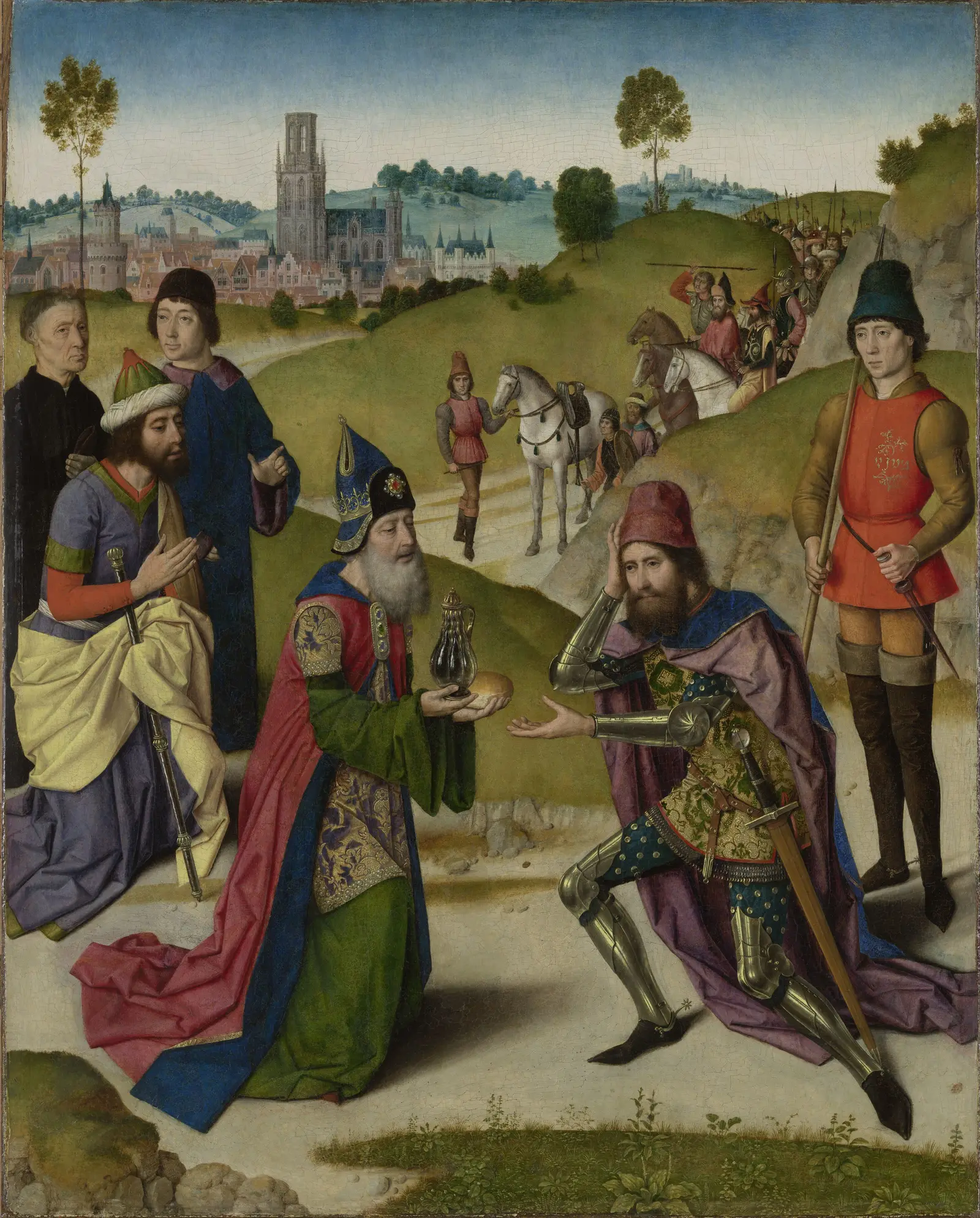
Hebrewschapter 7
28 verses · unknown · AD 60 to 69 · The general letters
Therefore He is able to save completely those who draw near to God through Him, since He always lives to intercede for them.
Introduction
unknown, The general letters, Hebrews Overview.
The writer of this sermon now keeps the promise he made two chapters earlier and explains the priest named in Psalm 110. His hearers could not picture any priest outside the family of Aaron. He answers them from their own Scriptures, from a single meeting in Genesis and a single line in a psalm. The argument moves carefully, one step at a time, and each step weighs one thing as greater than another. Listen for the words forever and oath. Listen also for the difference between priests who die and a priest who lives. The chapter tells a believer why no other priest is needed.
Context
- Who
- Jewish believers for whom priesthood meant descent from Aaron and nothing else
- What
- An explanation of the priest of Genesis 14 and Psalm 110, showing that Jesus holds a priesthood greater than Aaron's and one that never passes to another.
- Where
- Written to a community of Jewish believers, most likely in or near Rome, who traced their priesthood to Levi and their faith to Abraham.
- When
- Most likely in the 60s AD, while priests descended from Aaron still served at the temple in Jerusalem.
- Why
- To show believers drawn back toward the temple that the priesthood of Aaron was never meant to last, and that Jesus lives forever to intercede for them.
Historical context
Israel's priesthood ran on paperwork. Only Levites descended from Aaron could serve, and the records were kept; when the exiles returned, Ezra records priests who could not produce their family register being excluded from the priesthood as unclean. Bloodline was the whole qualification.
Show the rest of the historical context, 3 more paragraphs
Melchizedek breaks that rule before it exists. He appears in Genesis with no father, mother, or genealogy given, as both king and priest of Salem, a combination Israel's own law forbade, since kings came from Judah and priests from Levi.
Tithing was the argument's hinge, and it worked on a rule everyone accepted: the lesser is blessed by the greater, and the inferior pays the tithe. Abraham handed a tenth of the spoils of battle to this priest, and Levi, as the sermon puts it, was still in Abraham's body at the time.
Psalm 110, a psalm the hearers sang, has God swearing an oath about a priest forever in Melchizedek's order. The sermon presses the oath: the Levitical priesthood was set up without one, this one was established with one, and God does not swear about temporary arrangements.
Significance
The hearers were being drawn back toward a temple whose priests they could see working every day. The chapter tells them those priests keep dying and being replaced, and that a priesthood requiring constant replacement is by definition unfinished.
Show the rest of the significance, 1 more paragraph
The line that would have caught them hardest is the quiet one: a change of priesthood means a change of law. That is the sermon admitting how much is at stake in its own argument.
The heads below are this chapter's scenes. The numbered points under each are its verses.
Melchizedek: King, Priest, Without Genealogy
Hebrews 7:1-2
priest of God Most High: Genesis 14 has Melchizedek meet Abraham as king of Salem and priest of God Most High, two offices Israel never joined again until Christ. His name means king of righteousness, and Salem makes him king of peace. Abraham gave him a tenth of everything.
Hebrews 7:1
Also in the priest Melchizedek we see prefigured the sacrament of the sacrifice of the Lord, according to what divine Scripture testifies and says, "And Melchizedek, king of Salem, brought out bread and wine." Now he was a priest of the Most High God and blessed Abraham. And that Melchizedek bore a type of Christ, the Holy Spirit declares in the psalms, saying from the person of the Father to the Son, "Before the morning star I begat you; you are a priest forever, after the order of Melchizedek."
Cyprian · written before 258 · Epistle LXII.4patristic
2 more voices on this verseWhat preachers and commentators have said about this verse, in their own words.
Hebrews 7:1
“For this Melchisedek; - compare the notes on Heb 5:6. The name Melchizedek, from which the apostle derives a portion of his argument here, is Hebrew, מלכי־צדק Malkiy-Tsedeq, and is correctly explained as meaning “king of righteousness” - being compounded of two words - “king and righteousness.” Why this name was given to this man is unknown. Names, however, were frequently given on account of some quality or characteristic of the man: see the notes on Isa 8:18. This name may have been given on account of his eminent integrity.”
Hebrews 7:1
“The sum of this chapter is, Christ, as appears from his type, Melchisedec, who was greater than Abraham himself, from whom Levi descended, has a priesthood altogether excellent, new, firm, perpetual.”
John Wesley · Explanatory Notes upon the New Testament (1755)evangelical
Cross references
Hebrews 7:1
- QuotingGenesis 14:18“Then Melchizedek king of Salem brought out bread and wine—since he was priest of God Most High—”
'Melchizedek, king of Salem, priest of the most high God' (Melchizedek typology)
ConnectionsGenesis 14:18
apportioned to him a tenth of everything: The Greek verb behind apportioned means to assign as a portion. The priest who received the tenth had just blessed Abraham, so the gift went to God through the one who brought God's blessing. Tithe and priesthood belong together.
Hebrews 7:2
“Hebrew "Malchi" means king: "Tzedek," righteousness. King of Salem--not only his own name, but that of the city which he ruled, had a typical significance, namely, peace. Christ is the true Prince of peace.”
Jamieson, Fausset & Brown · Commentary Critical and Explanatory on the Whole Bible (1871)reformed
2 more voices on this verse
Hebrews 7:2
“Using the principles of pastoral science, he gathers us into his heavenly fold. He is called "sheep," because he was sacrificed, a "Lamb," because he was without blemish. He is the "high priest" because he presented the offering. "Melchizedek," because on the transcendent level he had no mother, on the human level no father, and his high estate is without genealogy. "Who," it says, "can recount his generation?" He is "Melchizedek" too, as king of Salem or peace, as king of righteousness, and because he tithes the patriarchs who prevailed over evil powers.”
Gregory of Nazianzus · written before 390 · On the Son, Theological Oration 4(30).21patristic
Hebrews 7:2
“Gave a tenth part of all - It was an ancient custom, among all the nations of the earth, to consecrate a part or tenth of the spoils taken in war to the objects of their worship. Many examples of this kind occur. This however was not according to any provision in law, but merely ad libitum, and as a eucharistic offering to those to whom they imagined they owed the victory. But neither Abraham’s decimation, nor theirs, had any thing to do, either with tithes as prescribed under the Mosaic dispensation, or as claimed under the Christian.”
Adam Clarke · Commentary on the Bible (1810-1826)evangelical
Without father or mother or genealogy: Genesis 14 is silent on his birth, parents and death, and the writer argues from that silence: Without father or mother or genealogy. The record makes him like the Son of God, and he remains a priest for all time.
Hebrews 7:3
Let no one claim Divinity resides in an order established by human beings when he encounters such an order. For the church does not consider even Melchizedek, by whose office Abraham offered sacrifice, an angel (as some Jewish interpreters do). It rather considers him a holy man and priest of God who, prefiguring our Lord, is described as "without father or mother, without history of his descent, without beginning and without end."
Ambrose of Milan · written before 397 · Exposition of the Christian Faith 3. [88-89]patristic
2 more voices on this verse
Hebrews 7:3
“This must not be understood according to the letter; but the scripture has chosen to set him forth as an extraordinary person, without giving us his genealogy, that he might be a fitter type of Christ, who as man was without father, as God without mother; whose priesthood is without descent, did not descend to him from another, nor from him to another, but is personal and perpetual.”
Matthew Henry · Commentary on the Whole Bible (1707-1721)puritan
Hebrews 7:3
“Without father - The phrase “without father” - ἀπάτωρ apatōr - means literally one who has no father; one who has lost his father; one who is an orphan. Then it denotes one who is born after the death of his father; then one whose father is unknown - “spurious. Passow.” The word occurs often in these senses in the classic writers, for numerous examples of which the reader may consult Wetstein in loc.”
Consider how great Melchizedek was: The writer pauses on the plain fact of Genesis 14:20: Even the patriarch Abraham gave him a tenth of the plunder. The title patriarch names the nation's father. The whole tithe argument that follows rests on this one act.
Hebrews 7:4
“The greatness of Melchisedec is described in all the preceding and following particulars. But the most manifest proof of it was, that Abraham gave him tithes as to a priest of God and a superior; though he was himself a patriarch, greater than a king, and a progenitor of many kings.”
John Wesley · Explanatory Notes upon the New Testament (1755)evangelical
Hebrews 7:5-6
sons of Levi who become priests: The Levites collect a tenth from their brothers, and they too are descended from Abraham. Melchizedek, who did not trace his descent from Levi, took a tenth from Abraham himself and blessed him who had the promises. Rank here follows the tithe and the blessing.
Hebrews 7:5
“The sons of Levi take tithes of their brethren -- sprung from Abraham as well as themselves. The Levites therefore are greater than they; but the priests are greater than the Levites, the patriarch Abraham than the priests, and Melchisedec than him.”
John Wesley · Explanatory Notes upon the New Testament (1755)evangelical
1 more voice on this verse
Hebrews 7:5
“Thus compare the "consider," Heb 7:4, in the case of Melchisedec, the type, with the "consider" (Greek, "contemplate attentively," see on Heb 3:1, a stronger word than here) in the case of Christ, the archetype.”
Jamieson, Fausset & Brown · Commentary Critical and Explanatory on the Whole Bible (1871)reformed
blessed him who had the promises: Both Greek verbs, collected and blessed, stand in the perfect tense, so the tithe and the blessing keep their force. The promises Abraham already held were of a great seed and of the land of Canaan.
Hebrews 7:6
“Blessed him that had the promises - This is a continuation of the same argument, namely, to show the superiority of Melchisedec; and, in consequence, to prove the superiority of the priesthood of Christ beyond that of Aaron. As in the seed of Abraham all the nations of the earth were to be blessed, Abraham received a sacerdotal blessing from Melchisedec, who was the representative of the Messiah, the promised seed, to show that it was through him, as the high priest of the human race, that this blessing was to be derived on all mankind.”
Adam Clarke · Commentary on the Bible (1810-1826)evangelical
1 more voice on this verse
Hebrews 7:6
“Paul exalts Abraham in order still more to exalt Melchisedec. When Christ is the subject, the singular "promise" is used. "The promises" in the plural, refer to God's promise of greatness to himself and his seed, and of the possession of Canaan, twice repeated before the blessing of Melchisedec.”
Jamieson, Fausset & Brown · Commentary Critical and Explanatory on the Whole Bible (1871)reformed
lesser is blessed by the greater: The writer calls the principle beyond dispute: the lesser is blessed by the greater. In the act of blessing, the one who blesses is the greater. Melchizedek's rank over Abraham is proved before Levi enters the argument.
mortal men collect the tenth: Under the law mortal men collect the tenth, and the office passes on because each holder dies. Of Melchizedek it is affirmed that he lives on, since Genesis 14 is silent on his death. The contrast looks ahead to Christ's unending priesthood later in the chapter.
Hebrews 7:8
“Here men that die receive tithes - The apostle is speaking of the ecclesiastical constitution of the Jews, which was standing at the time this epistle was written. Under the Jewish dispensation, though the priests were successively removed by death, yet they were as duly replaced by others appointed from the same family, and the payment of tithes was never interrupted.”
Adam Clarke · Commentary on the Bible (1810-1826)evangelical
1 more voice on this verse
Hebrews 7:8
Christ, on the other hand, is, in His own person, "ever living after the power of an endless life" (Heb 7:16, 25). Melchisedec's death not being recorded, is expressed by the positive term "liveth," for the sake of bringing into prominence the antitype, Christ, of whom alone it is strictly and perfectly true, "that He liveth."
Jamieson, Fausset & Brown · Commentary Critical and Explanatory on the Whole Bible (1871)reformed
Hebrews 7:9-10
paid the tenth through Abraham: Levi, who collects the tenth, paid the tenth through Abraham, since he was still in the loin of his ancestor. The writer marks this with so to speak, treating the nation as present in its forefather. Levi's whole priesthood is then placed beneath Melchizedek's.
Hebrews 7:9
“And as I may so say - So to speak - ὡς ἔπος εἰπεῖν hōs epos eipein. For numerous examples in the classic writers of this expression, see Wetstein in loc.”
1 more voice on this verse
Hebrews 7:9
“We were in Adam's loins when he sinned, and the guilt and depravity contracted by the human nature when it was in our first parents are equitably imputed and derived to the same nature as it is in all other persons naturally descended from them. They justly adhere to the nature, and it must be by an act of grace if ever they be taken away.”
Matthew Henry · Commentary on the Whole Bible (1707-1721)puritan
Levi was still in the loin of his ancestor: Levi paid the tithe because Levi was still in the loin of his ancestor. Jamieson, Fausset and Brown, following Alford, note that Christ, conceived without a human father, was never in an earthly father's loins. The promise that held Him came later, at Genesis 15:1.
Hebrews 7:10
“For he was yet in the loins of his father - Abraham is here called the father of Levi, by a common use of the word, referring to a more remote ancestor than the literal father. The meaning of the apostle is, that he was even then, in a certain sense, in the loins of Abraham, when Melchizedek met him; or it was all the same as if he were there, and had then an existence.”
1 more voice on this verse
Hebrews 7:10
“BENGEL remarks, The blessings which Abraham had before meeting Melchisedec were the general promises, and the special one of a natural seed, and so of Levi; but the promises under which Christ was comprehended, and the faith for which Abraham was so commended, followed after Abraham's meeting Melchisedec, and being blessed by him: to which fact.”
Jamieson, Fausset & Brown · Commentary Critical and Explanatory on the Whole Bible (1871)reformed
A New Priesthood Requires a New Law
if perfection could have been attained: If perfection, teleiosis, came through the Levitical priesthood, why was there still need for another priest to appear? Psalm 110:4 names that other order, Melchizedek's, centuries after Aaron. That shows the law's priesthood left its work unfinished.
Hebrews 7:11
“If therefore perfection were by the Levitical priesthood - As the Jews supposed. They were accustomed to regard the system as perfect. It was an appointment of God, and they were tenacious of the opinion that it was to be permanent, and that it needed no change. But Paul says that this could not be. Even from their own Scriptures it was apparent that a priest was to arise of another order, and of a more permanent character, and this he says was full proof: that there was defect of some kind in the previous order.”
1 more voice on this verse
Hebrews 7:11
“That therefore another priest must be raised up, after the order of Melchisedec, by whom, and his law of faith, perfection might come to all who obey him; and, blessed be God, that we may have perfect holiness and perfect happiness by Christ in the covenant of grace, according to the gospel, for we are complete in him.”
Matthew Henry · Commentary on the Whole Bible (1707-1721)puritan
Hebrews 7:12-14
when the priesthood is changed: The law tied the priesthood to Levi, so when the priesthood is changed, the law must be changed as well. Christ belonged to a different tribe, Judah, a tribe as to which Moses said nothing about priests.
Hebrews 7:12
“For the priesthood being changed,.... Not translated from one tribe, family, or order, to another, but utterly abolished; for though it is called an everlasting priesthood, yet that is to be understood with a limitation, as the word "everlasting" often is, as relating to things under that dispensation; for nothing is more certain than that it is done away: it was of right abrogated at the death of Christ, and it is now in fact; since the destruction of Jerusalem, the daily sacrifice has ceased, and the children of Israel have been many days without one, and without an ephod.”
1 more voice on this verse
Hebrews 7:12
“For--the reason why Paul presses the words "after the order of Melchisedec" in Ps 110:4, namely, because these presuppose a change or transference of the priesthood, and this carries with it a change also of the law (which is inseparably bound up with the priesthood, both stand and fall together, Heb 7:11). This is his answer to those who might object, What need was there of a new covenant?”
Jamieson, Fausset & Brown · Commentary Critical and Explanatory on the Whole Bible (1871)reformed
belonged to a different tribe: The things said are the words of Psalm 110:4, and Albert Barnes notes the writer takes it as beyond dispute that they speak of Jesus. Jamieson, Fausset and Brown render the verb as has partaken of a tribe. The perfect tense marks that His manhood continues.
Hebrews 7:13
“Confirming the truth that a change is made of the law (Heb 7:12), by another fact showing the distinctness of the new priesthood from the Aaronic. these things-- (Ps 110:4). pertaineth--Greek, "hath partaken of" (the perfect tense implies the continuance still of His manhood). another--"a different tribe" from that of Levi.”
Jamieson, Fausset & Brown · Commentary Critical and Explanatory on the Whole Bible (1871)reformed
descended from Judah: The title our Lord stands here without Jesus or Christ, as elsewhere only at 2 Peter 3:15. The Greek verb behind descended pictures a branch springing up. The genealogies in Matthew and Luke record that descent from Judah.
Hebrews 7:14
“For it is evident - As the apostle speaks here with so much confidence, it follows that our Lord’s descent from the tribe of Judah was incontrovertible. The genealogical tables, both in Matthew and Luke, establish this point; and whatever difficulties we may find in them now, there were none apprehended in those days, else the enemies of the Gospel would have urged these as a chief and unanswerable argument against Christ and his Gospel.”
Adam Clarke · Commentary on the Bible (1810-1826)evangelical
Hebrews 7:15-17
another priest like Melchizedek appears: The case grows even more clear when another priest like Melchizedek appears. Aaron's priests served by descent, and this one serves by the power of an indestructible life, which His resurrection shows. Psalm 110:4 seals it: You are a priest forever in the order of Melchizedek.
Hebrews 7:15
“And it is yet far more evident - Not that our Lord would spring out of Judah, but the point which he was endeavoring to establish that there must be a change of the priesthood, was rendered still more evident from another consideration.”
1 more voice on this verse
Hebrews 7:15
“Another proof that the law, or economy, is changed, namely, forasmuch as Christ is appointed Priest, "not according to the law of a carnal (that is, a mere outward) commandment," but "according to the power of an indissoluble (so the Greek) life." The hundred tenth Psalm appoints Him "for ever" (Heb 7:17).”
Jamieson, Fausset & Brown · Commentary Critical and Explanatory on the Whole Bible (1871)reformed
the power of an indestructible life: Adam Clarke takes the law of succession as an ordinance for frail men, each priest filling a seat that death had emptied. Jamieson, Fausset and Brown set commandment against life. A law can give a command, but it has no life to give, and Christ holds that life in Himself.
Hebrews 7:16
“Some thing the law of the carnal commandment refers to the external rites of consecration, and the carnal offerings that were made; but the power of an endless life to the spiritual living sacrifices proper to the gospel, and the spiritual and eternal privileges purchased by Christ, who was consecrated by the eternal Spirit of life that he received without measure.”
Matthew Henry · Commentary on the Whole Bible (1707-1721)puritan
2 more voices on this verse
Hebrews 7:16
"Carnal," as being only outward and temporary, is contrasted with "endless," or, as Greek, "indissoluble." Commandments is contrasted with "life." The law can give a commandment, but it cannot give life (Heb 7:19).
Jamieson, Fausset & Brown · Commentary Critical and Explanatory on the Whole Bible (1871)reformed
Hebrews 7:16
“Who is made - Appointed to this high office by God himself, not succeeding one that was disabled or dead, according to that law or ordinance directed to weak and perishing men, who could not continue by reason of death. This is probably all that the apostle intends by the words carnal commandment, εντολης σαρκικης· for carnal does not always mean sinful or corrupt, but feeble, frail, or what may be said of or concerning man in his present dying condition.”
Adam Clarke · Commentary on the Bible (1810-1826)evangelical
For it is testified: The testimony is Psalm 110:4, You are a priest forever in the order of Melchizedek, and its weight falls on the word forever. It is quoted as proof of the indestructible life of verse 16.
Hebrews 7:17
“Just as the people of old, who were called the people of God, were divided into twelve tribes plus the levitical order, and this order itself, which engaged in service of the Divine, was divided into additional priestly and levitical orders, so, I think, all the people of Christ according to "the hidden person of the heart," who bear the name "Jew inwardly" and who have been circumcised "in spirit," possess the characteristics of the tribes in a more mystical manner.…Most of us who approach the teachings of Christ, since we have much time for the activities of life and…”
Origen of Alexandria · written before 253 · Commentary on the Gospel of John 1.1, 1.10-11patristic
2 more voices on this verse
Hebrews 7:17
“For he testifieth - That is, either the Scripture, in the place so often quoted, or God by that Scripture. Thou art a priest for ever - This is the proof that he was not appointed according to the carnal commandment, but according to the power of an endless life, because he is a priest for ever; i.e. one that never dies, and is never disabled from performing the important functions of his office; for if he be a priest for ever, he ever lives.”
Adam Clarke · Commentary on the Bible (1810-1826)evangelical
Hebrews 7:17
“For he testifieth - “That this is the true account of it is proved by the testimony of God himself, that he was to be a priest for ever;” see the note on Heb 5:6.”
Cross references
Hebrews 7:17
- QuotingPsalms 110:4The LORD has sworn and will not change His mind: “You are a priest forever in the order of Melchizedek.”
'Thou art a priest for ever after the order of Melchisedec' (eternal priesthood)
Hebrews 7:18-19
the former commandment is set aside: because it was weak and useless, for the law made nothing perfect. In its place a better hope is introduced, by which we draw near to God. Drawing near is the access the old order, with its curtain, kept closed.
Hebrews 7:18
“For there is verily a disannulling - There is a total abrogation, προαγουσης εντολης, of the former law, relative to the Levitical priesthood. See Heb 7:19. For the weakness - It had no energy; it communicated none; it had no Spirit to minister; it required perfect obedience, but furnished no assistance to those who were under it. And unprofitableness - No man was benefited by the mere observance of its precepts: it pardoned no sin, changed no heart, reformed no life; it found men dead in trespasses and sins, and it consigned them to eternal death.”
Adam Clarke · Commentary on the Bible (1810-1826)evangelical
2 more voices on this verse
Hebrews 7:18
We may also ask what it means when it says in the law that Moses' face was shining with glory, though covered with a veil, while his hand when put "into his bosom" became "leprous as snow." In this it seems to me the form of the whole law is quite fully described. For his "face" is the word of the law, and by "hand" are described the works of the law. "For no human being will be justified by works of the law." Nor could the law lead anyone to "perfection."
Origen of Alexandria · written before 253 · Homilies on Exodus 12.3patristic
Hebrews 7:18
“The Levitical priesthood brought nothing to perfection: it could not justify men's persons from guilt; it could not sanctify them from inward pollution; it could not cleanse the consciences of the worshippers from dead works; all it could do was to lead them to the antitype.”
Matthew Henry · Commentary on the Whole Bible (1707-1721)puritan
a better hope is introduced: Jamieson, Fausset and Brown note that the Greek word for introduced means a bringing in over and above the law, something new added to it. John Chrysostom says Israel also had a hope, of holding the land in safety. This hope is to stand near to God Himself.
Hebrews 7:19
“For the law - Taken by itself, separate from the gospel. Made nothing perfect - Could not perfect its votaries, either in faith or love, in happiness or holiness. But the bringing in of a better hope - Of the gospel dispensation, which gives us a better ground of confidence, does.”
John Wesley · Explanatory Notes upon the New Testament (1755)evangelical
1 more voice on this verse
Hebrews 7:19
“The access through the legal sacrifices was only symbolical and through the medium of a priest; that through Christ is immediate, perfect, and spiritual.”
Jamieson, Fausset & Brown · Commentary Critical and Explanatory on the Whole Bible (1871)reformed
Sworn With an Oath, Able to Save to the Uttermost
Hebrews 7:20-22
others became priests without an oath: Aaron's line became priests without an oath, and Jesus became priest by the oath of Psalm 110:4: The Lord has sworn. Because of this oath, Jesus has become the guarantee of a better covenant, engguos, a legal surety.
Hebrews 7:20
“And inasmuch as not without an oath,.... Our version supplies as follows, he was made priest; which well agrees with what is said in the next verse; the Syriac version renders it, "and which he confirmed to us by an oath"; that is, the better hope, Christ and his priesthood, said to be brought in, and by which men draw nigh to God; this is established by the oath of God himself referring to Psa 110:4 afterwards cited in proof of it.”
1 more voice on this verse
Hebrews 7:20
“Not without an oath - “The apostle’s reasoning here is founded on this, that God never interposed his oath, except to show the certainty and immutability of the thing sworn. Thus he sware to Abraham, Gen 22:16-18, that in his seed all the nations of the earth should be blessed; and to the rebellious Israelites, Deu 1:34, Deu 1:35, that they should not enter into his rest; and to Moses, Deu 4:21, that he should not go into Canaan; and to David, Psa 89:4, that his seed should endure for ever, and his throne unto all generations.”
Adam Clarke · Commentary on the Bible (1810-1826)evangelical
The One who swears is God, and the One addressed is the Son, the Lord of Psalm 110:1. The oath adds that God will not change His mind, so this priesthood stands unchanged. The Levitical priests were appointed without any oath.
Hebrews 7:21
“Translate in the Greek order, "For they indeed (the existing legal priests) without the (solemn) promise on oath (so the Greek [TITTMANN]) are made priests." by him--God. unto him--the Lord, the Son of God (Ps 110:1). not repent--never change His purpose. after the order of Melchisedec--omitted in some oldest manuscripts, contained in others.”
Jamieson, Fausset & Brown · Commentary Critical and Explanatory on the Whole Bible (1871)reformed
2 more voices on this verse
Hebrews 7:21
“Here God has upon oath declared the immutability, excellency, efficacy, and eternity, of the priesthood of Christ. There is a change in that covenant of which the priesthood was a security and the priest a surety; that is, a change in the dispensation of that covenant. The gospel dispensation is more full, free, perspicuous, spiritual, and efficacious, than that of the law.”
Matthew Henry · Commentary on the Whole Bible (1707-1721)puritan
Hebrews 7:21
“For those priests were made without an oath - The Levitical priests were set apart and consecrated without their office being confirmed to them by an oath on the part of God. They received it by regular descent, and when they arrived at a suitable age they entered on it of course. Jesus received his office by special appointment, and it was secured to him by an oath. The word rendered “oath” is in the margin “swearing of an oath.” This is the proper meaning of the Greek word, but the sense is not materially varied.”
the guarantee of a better covenant: The Greek word for covenant, diatheke, can also mean a last will, as John Wesley notes, and the letter later uses it in both senses. Theodoret of Cyrus reads the covenant as a promise of resurrection and life, which Jesus, the guarantee, confirmed by His own resurrection.
Hebrews 7:22
“By so much - This solemn, unchangeable oath of God, was Jesus made a surety, εγγυος, a mediator, one who brings the two parties together, witnesses the contract, and offers the covenant sacrifice on the occasion. See at the end of the chapter.”
Adam Clarke · Commentary on the Bible (1810-1826)evangelical
Hebrews 7:23-24
there have been many other priests: Aaron's house needed many other priests, since death prevented them from continuing in office. Jesus lives forever, so He has a permanent priesthood, aparabatos, a priesthood that stays with Him. The chapter's contrast of many priests and one closes here.
Hebrews 7:23
“And they truly were many priests,.... There were many common priests at a time; and though there was but one high priest at a time, yet there were many of them in a line of succession from Aaron down to the apostle's time.”
2 more voices on this verse
Hebrews 7:23
“And they truly - Under the Jewish dispensation. The object of this verse and the following is, to state one more reason of the excellence of the priesthood of Christ. It is, that owing to the frailty of human nature, and the shortness of life, the office of priest there was continually changing. But here there was no such change. Christ, being exalted to the heavens to live forever there, has now an unchangeable priesthood, and everything in regard to his office is permanent.”
Hebrews 7:23
“Christ dies not, and so hath a priesthood which passes not from one to another. were--Greek, "are made." many--one after another; opposed to His "unchangeable (that does not pass from one to another) priesthood" (Heb 7:24). not suffered to continue--Greek, "hindered from permanently continuing," namely, in the priesthood.”
Jamieson, Fausset & Brown · Commentary Critical and Explanatory on the Whole Bible (1871)reformed
He has a permanent priesthood: Thomas Aquinas points to Numbers 20:28, where Eleazar succeeded Aaron at his death, because every priest of that line had to die. Theophylact of Ohrid calls this a priesthood shared with no one. It rises above Aaron's as far as the immortal rises above the mortal.
Hebrews 7:24
“But this - Ὁ δε, But he, that is, Christ, because he continueth ever - is eternal, hath an unchangeable priesthood, απαραβατον ἱερωσυνην, a priesthood that passeth not away from him; he lives for ever, and he lives a priest for ever.”
Adam Clarke · Commentary on the Bible (1810-1826)evangelical
able to save completely: He is able to save completely, panteles, those who draw near to God through Him. The ground is a present work: He always lives to intercede for them. That intercession is constant and stays in His hands.
Hebrews 7:25
“Wherefore he is able also - As he ever lives, and ever intercedes, he has power to save. He does not begin the work of salvation, and then relinquish it by reason of death, but he lives on as long as it is necessary that anything should be done for the salvation of his people. We need a Saviour who has power, and Christ has shown that he has all the power which is needful to rescue man from eternal death.”
3 more voices on this verse
Hebrews 7:25
“Petition does not imply here, as it does in popular parlance, a desire for legal satisfaction; there is something humiliating in the idea. No, it means interceding for us in his role of mediator, in the way that the Spirit too is spoken of as "making petition" on our behalf. "For there is one God, and there is one mediator between God and men, the man Christ Jesus." Even at this moment he is, as human, interceding for my salvation, until he makes me divine by the power of his incarnate humanity.”
Gregory of Nazianzus · written before 390 · On the Son, Theological Oration 4(30).14patristic
Hebrews 7:25
“So that here is a manifest alteration much for the better. There is a remarkable difference in the moral qualifications of the priests. Those who were of the order of Aaron were not only mortal men, but sinful men, who had their sinful as well as natural infirmities; they needed to offer up sacrifices first for their own sins and then for the people.”
Matthew Henry · Commentary on the Whole Bible (1707-1721)puritan
Hebrews 7:25
“Therefore, He has become not only a sacrifice, but an intercessor; His intercession being founded on His voluntary offering of Himself without spot to God. We are not only then in virtue of His sacrifice forgiven, but in virtue of the intercession admitted to favor and grace [ARCHBISHOP MAGEE].”
Jamieson, Fausset & Brown · Commentary Critical and Explanatory on the Whole Bible (1871)reformed
ConnectionsExodus 30:1
Hebrews 7:26-27
The fitting priest is holy, innocent, undefiled, set apart from sinners, and exalted above the heavens. The other high priests sacrificed daily for their own sins and for the people's. He sacrificed for sin once for all when He offered up Himself.
Hebrews 7:26
“Such a high priest became us - Such a high priest was in every respect suitable to us, every way qualified to accomplish the end for which he came into the world. There is probably here an allusion to the qualifications of the Jewish high priest: - 1. He was required to be holy, ὁσιος, answering to the Hebrew חסיד chasid, merciful. Holiness was his calling; and, as he was the representative of his brethren, he was required to be merciful and compassionate.”
Adam Clarke · Commentary on the Bible (1810-1826)evangelical
2 more voices on this verse
Hebrews 7:26
“For to this end had He come, that, being Himself pure from sin, and in all respects holy, He might undergo death on behalf of sinners.”
Tertullian · written before 220 · On Modestypatristic
Hebrews 7:26
“Though justifying through faith the ungodly, He hath no contact with them as such. He is lifted above our sinful community, being "made higher than the heavens," at the same time that He makes believers as such (not as sinners), "to sit together (with Him) in heavenly places" (Eph 2:6). Just as Moses on the mount was separated from and above the people, and alone with God.”
Jamieson, Fausset & Brown · Commentary Critical and Explanatory on the Whole Bible (1871)reformed
offered up Himself: The word daily fits the ordinary priests, who offered every day, and the high priest stood for their whole order. His own task was the yearly Day of Atonement, a bull for himself and a goat for the people.
Hebrews 7:27
Who needeth not to offer up sacrifices daily - That is, on every yearly day of expiation; for he offered once for all: not for his own sins, for he then offered up himself "without spot to God."
John Wesley · Explanatory Notes upon the New Testament (1755)evangelical
1 more voice on this verse
Hebrews 7:27
“Who needeth not daily, as those high priests - As the Jewish priests. This is an additional circumstance introduced to show the superior excellency of the High Priest of the Christian profession, and to show also how he was suited to our wants. The Jewish high priest was a sinful man. He had the same fallen and corrupt nature as others. He needed an expiatory sacrifice for his own sins as really as they did for theirs.”
the law appoints as high priests: men who are weak, and the oath, which came after the law, appointed the Son, made perfect forever. The chapter's strands meet in that closing title.
Hebrews 7:28
“The law maketh men high priests that have infirmity - That are both weak, mortal, and sinful. But the oath which was since the law - Namely, in the time of David. Maketh the son, who is consecrated forever - Who being now free, both from sin and death, from natural and moral infirmity, remaineth a priest forever.”
John Wesley · Explanatory Notes upon the New Testament (1755)evangelical
1 more voice on this verse
Hebrews 7:28
“For the law maketh men high priests - The Jewish priests have need of these repeated offerings and sacrifices, because they are fallible, sinful men: but the word of the oath (still referring to Psa 110:4) which was since the law; for David, who mentions this, lived nearly 500 years after the giving of the law, and consequently that oath, constituting another priesthood, abrogates the law; and by this the Son is consecrated, τετελειωμενον, is perfected, for evermore.”
Adam Clarke · Commentary on the Bible (1810-1826)evangelical
How this psalm is built
The form: A more particular account of Melchizedek at verses 1 to 3, the superiority of his priesthood to Aaron's at verses 4 to 10, and the application of all to Christ to show the excellence of His person, office and covenant, from verse 11 to the end, as Henry classes it.
The patterns in this chapter
| Device | What it does | Where to see it |
|---|---|---|
| A scene from Genesis read closely | Verses 1 and 2 retell Genesis 14:18 to 20, where Melchizedek met Abraham returning from the slaughter of the kings, blessed him and received a tenth. Verses 3 to 10 then draw out what the scene says and what it leaves unsaid. Matthew Henry names the passage in Genesis and notes that Melchizedek gave as a king and blessed as a priest.Matthew Henry, Complete Commentary, on Hebrews 7:1 to 3. | Hebrews 7:1, Hebrews 7:2, Hebrews 7:3 |
| The meaning of the names | Verse 2 explains the name Melchizedek as king of righteousness and the title king of Salem as king of peace. John Chrysostom traces the name to its two parts, Melchi for king and Sedec for righteousness, and points to the exactness of the writer even in names.John Chrysostom, Homilies on Hebrews 12, on Hebrews 7:2. | Hebrews 7:2 |
| The lesser and the greater | Verses 4 to 10 argue from the tenth and the blessing. The word tenth appears seven times in the Berean text of verses 2 to 9. The one who gives the tenth and receives the blessing is the lesser, so Abraham, and Levi within him, stand below Melchizedek. John Chrysostom notes that verse 7 appeals to what all people already hold, that the inferior is blessed by the superior.John Chrysostom, Homilies on Hebrews 12, on Hebrews 7:4 to 10. | Hebrews 7:4, Hebrews 7:6, Hebrews 7:7, Hebrews 7:9, Hebrews 7:10 |
| One psalm verse weighed twice | Psalm 110:4 is quoted at verse 17 and again at verse 21, where its opening words about the Lord's oath are added. The word forever appears four times in the chapter, at verses 17, 21, 24 and 28, and the word oath five times, at verses 20, 21, 22 and 28. Thomas Aquinas shows the writer drawing one argument from the oath and another from the word forever.Thomas Aquinas, Commentary on Hebrews, on Hebrews 7:20 and 7:23, sections 364 and 367. | Hebrews 7:17, Hebrews 7:20, Hebrews 7:21, Hebrews 7:24, Hebrews 7:28 |
Where the chapter stands in the letter
7 more paragraphs on the patterns
Chapter 5 named Melchizedek twice and broke off, and 6:20 brought the hearers back to him. John Calvin notes that the writer quoted the psalm again at the end of chapter 6 to return from his digression, and now enters fully into what he had touched on before (Commentaries, on Hebrews 7:1). Matthew Henry divides the chapter into the account of Melchizedek at verses 1 to 3, the superiority of his priesthood at verses 4 to 10, and its application to Christ from verse 11 (Complete Commentary, on Hebrews 7).
Who speaks
The writer argues throughout, and he reads Genesis closely enough to draw meaning from names and from what the account leaves out. God speaks in Psalm 110:4, quoted at verse 17 and again with its oath at verse 21. At verse 9 the writer softens his own boldness with the words so to speak.
The debated reading: who Melchizedek was
Jerome reports that the Hebrews identify Melchizedek with Shem, the son of Noah (Hebrew Questions on Genesis 14.18 to 19), and Ephrem the Syrian held the same (Commentary on Genesis 11.2). Epiphanius of Salamis rejected the identification with Shem and wrote against a sect that honored Melchizedek as a great heavenly power (Panarion, Against the Melchizedekians). Matthew Henry records three opinions, that he was Shem, that he was Christ Himself appearing to Abraham, and that he was a Canaanite king who kept the worship of the true God, and calls the last the most general (Complete Commentary, on Hebrews 7:1 to 3). John Chrysostom read without father or mother as the silence of Scripture, meaning that his father, mother, beginning and death are not known (Homilies on Hebrews 12, on Hebrews 7:3). Charles Spurgeon declined the question and was content to believe that he worshipped God after the primitive fashion, as Job did (The Metropolitan Tabernacle Pulpit, Sermon 1768).
What the chapter hands forward
Verse 22 names Jesus the guarantee of a better covenant, and chapter 8 opens by saying that we have such a high priest, seated in heaven. Verse 27 says He sacrificed for sin once for all, and the phrase returns at 9:12, 9:26 and 10:10.
Keep studying
Studies31
Show the next 6 titles
People and groups4
Words12
Subjects1
Sources for this chapter
The summary
Jamieson, Fausset & Brown, Commentary Critical and Explanatory; John Calvin, Commentaries; John Wesley, Explanatory Notes Upon the New Testament and Matthew Henry, Complete Commentary.
The context
Jamieson, Fausset and Brown, Commentary Critical and Explanatory on the Whole Bible; Matthew Henry, Commentary on the Whole Bible and Sir Robert Anderson, Types in Hebrews.
The form and classifications
Jamieson, Fausset & Brown, Commentary Critical and Explanatory, on Hebrews 7, the chapter heading; Matthew Henry, Complete Commentary, on Hebrews 7, the chapter summary and Theodoret of Cyrus, Interpretation of Hebrews 7, on Hebrews 7:2.
The exposition
Adam Clarke, Commentary on the Bible; Albert Barnes; Jamieson, Fausset & Brown; John Calvin, Commentary on Hebrews; John Chrysostom, Homily on Hebrews 13; John Gill; John Wesley; Matthew Henry, Commentary on the Whole Bible; Oecumenius, The Pseudo-Oecumenian Catena on Hebrews; Sir Robert Anderson, Types in Hebrews; Theodoret of Cyrus, INTERPRETATION OF HEBREWS 7; Theophylact of Ohrid, Commentary on Hebrews and Thomas Aquinas, Commentary on Hebrews.