
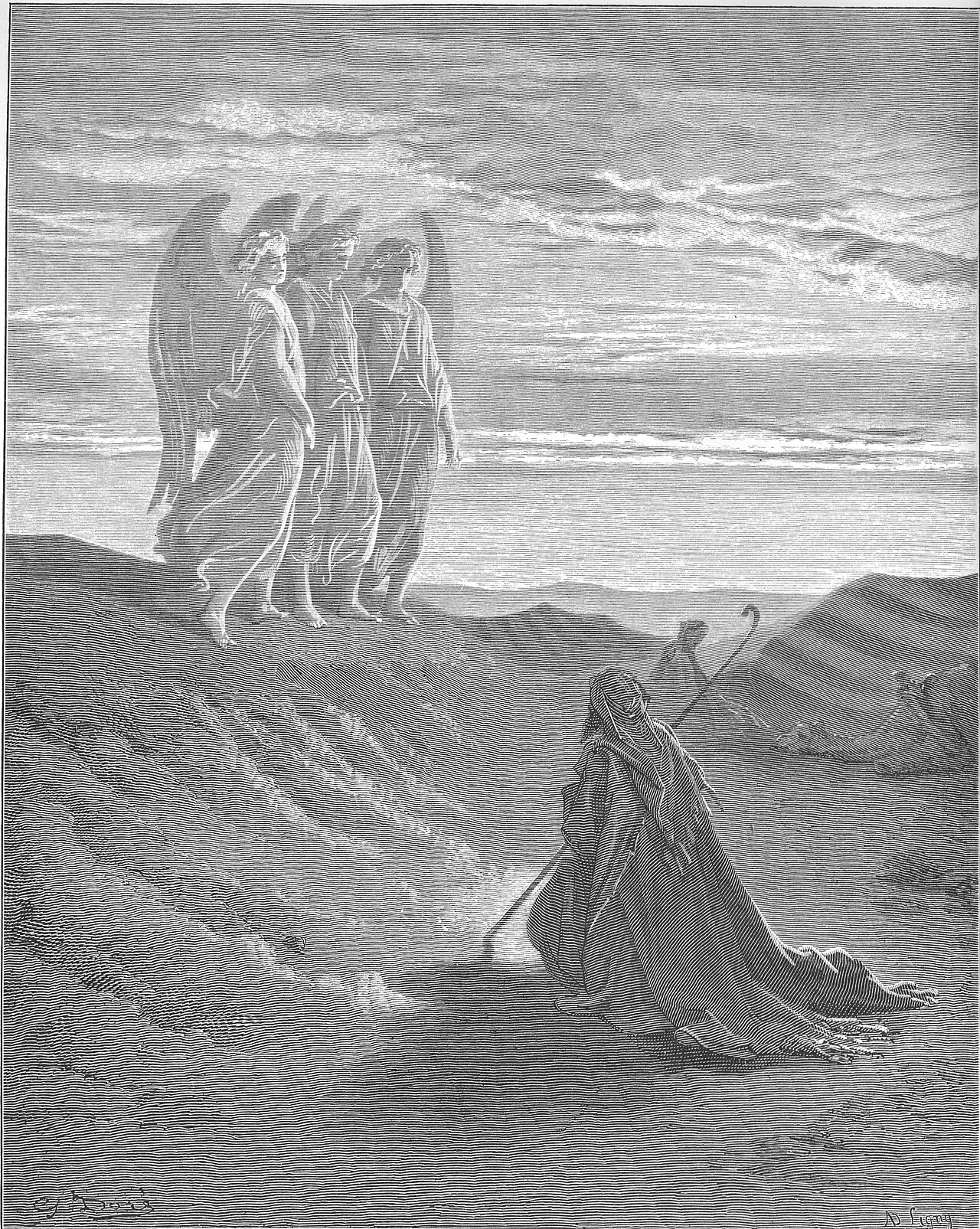
Genesischapter 18
33 verses · Moses, by tradition · 15th to 13th century BC · The Law
“Where is your wife Sarah?” they asked. “There, in the tent,” he replied.
Introduction
Moses, by tradition, The Law, Genesis Overview.
Moses wrote this chapter, by tradition, for Israel in the wilderness, a people living in tents who were commanded to love the stranger. It stands between the covenant sign of chapter 17 and the fall of the cities in chapter 19, and it joins the two. The first half is a meal and the second half is a conversation. Listen for how an old man treats guests he has never met, and for who the guests turn out to be. Then listen to the questions he dares to put to God. The chapter teaches what a friend of God may say to Him.
Context
- Who
- Israel in the wilderness, a people commanded to love the stranger and taught how to plead for a city
- What
- A narrative in two halves, a meal at Abraham's tent where a son is promised to Sarah and a conversation in which Abraham pleads with the LORD for Sodom.
- Where
- The Oaks of Mamre near Hebron, and the heights above the tent that look out over the plain toward Sodom.
- When
- The patriarchal age in the year before Isaac's birth, about 2067 BC on the traditional dating, a date the chapter itself does not give.
- Why
- To show the LORD as a guest who keeps His word and as a Judge who listens to the man He has chosen.
Historical context
The chapter is Abraham's, at ninety nine, living in a tent at Mamre with a household that can produce a feast at short notice. Sarah is inside the tent throughout the first half.
Show the rest of the historical context, 5 more paragraphs
The date is about 2067 BC on the traditional reckoning, and the chapter fixes itself against the birth of Isaac, promised here for the same season a year on.
The place is the Oaks of Mamre near Hebron, and then the higher ground from which Sodom could be seen.
The occasion is a visit. Three men stand near the tent at noon, are fed, and turn out to be carrying two errands, a promise for Sarah and a judgment on a city.
A first hearer recognised every courtesy in the first half as ordinary practice and knew how far Abraham went beyond it. A guest was met at a run, given water for his feet, seated in shade and fed, and a host who promised a morsel of bread was expected to serve more than that. What he served is the measure: three seahs of fine flour is bread for many more than three men, and a calf killed and dressed was a rare extravagance in a world where meat was uncommon.
The hearer also knew why Sarah is behind the door rather than at the table, since women did not sit with male guests, and he knew the shape of the second half, which follows the manners of a petitioner before a ruler: self abasement, small steps, and permission asked before each new request.
Significance
Israel was a nation of tent dwellers under a command to love the stranger, and this chapter showed their father doing it at noon in the heat for three men he did not know.
Show the rest of the significance, 1 more paragraph
The second half told them what a friend of God was permitted to do, which was to stand in front of Him and argue about a wicked city and receive an answer at every step.
This chapter in Jewish lifeWhat this chapter is in Jewish life and reading.
What is done
This chapter opens the fourth portion of the annual cycle, and the portion runs from its first verse to the end of Genesis 22 (src/lib/hebraic/readings.ts). A congregation hears the visit at the oaks, the destruction of Sodom, the birth of Isaac and the binding on one Sabbath. The card above carries the portion and the prophetic reading set beside it.
How it is read
The corpus holds no English text for any comment on this chapter, so nothing of the classical commentary is quoted here. Rashi comments on every one of the first twenty four verses, and each comment is cited and linked and read at the source. They run from Rashi on Genesis 18:1:1 on the appearing at the oaks to Rashi on Genesis 18:24:1 on the fifty righteous men.
Those comments cover the three visitors in the second verse, and the running to meet them and the meal in the fourth to the eighth. They cover the word about Sarah in the tenth verse, her laughter in the twelfth and the question of whether anything is too hard for God in the fourteenth. They cover the reason God tells Abraham what He will do, in the seventeenth to the nineteenth, and the pleading over the city from the twenty third verse on.
The licence Sefaria reports for that English version of Rashi keeps the text out of this corpus, and this site holds no other checked edition of his comment on this chapter. The references stand here, and the comment is read at Sefaria.
What the rabbis say
The corpus records forty places where the Midrash and the Talmud cite this chapter, twenty seven under Midrash and thirteen under Talmud. It carries the locator for each one with no text, so the references stand here and the sayings are read at the source.
The Talmud weight of the chapter is the second heaviest of these twenty five, and it falls on the welcome Abraham gave the three men. Six of the thirteen locators stand on the second to the seventh verses, at Bava Metzia 86b:19, 86b:18, 86b:14 and 87a:4, at Avot DeRabbi Natan 13:3, and at its second recension 45:2. The tractate is cited again at Bava Metzia 86b:13 on the sixteenth verse.
Avot DeRabbi Natan carries the rest of the Talmud locators. It reads the ninth verse at 34:5, the twenty first at 34:6 and the twenty sixth at 37:12. Its second recension reads the twelfth verse at 37:1, the twentieth at 37:9 and the last at 40:5.
Bereshit Rabbah reads the second verse at 44:11, the third at 48:10, the eleventh at 56:5 and the thirteenth at 20:6. It reads the fourteenth verse at 48:19, the fifteenth at 48:20, the eighteenth at 49:3 and the twenty second at 49:7. It reads the twenty fourth verse at 49:9, the twenty eighth at 49:12 and the thirtieth at 49:13.
Aggadat Bereshit reads the first verse at 19:1 and 19:2, the sixth at 34:1 and the tenth at 28:3. It reads the seventeenth verse at 21:1, the nineteenth at 24:1, the twenty third at 18:1 and the twenty fifth at 22:1. Bamidbar Rabbah reads the fourth verse at 14:2, the fifth at 20:17, the seventh at 13:14 and the twenty seventh at 13:3. Midrash Sekhel Tov reads the twenty ninth and thirty first verses at the locators of the same names, and Midrash Lekach Tov reads the thirty second at Genesis 18:32:1.
Sources: Rashi, his twenty four comments on Genesis 18, cited by reference; the licence Sefaria reports for the English version keeps the text out of the corpus, about 1090; The Midrash and the Talmud, the forty locators on Genesis 18 in scripts/data/sources/sefaria/genesis/18.json; MannaFest, the annual cycle table at src/lib/hebraic/readings.ts, 2026.
The heads below are this chapter's scenes. The numbered points under each are its verses.
Three Visitors at Mamre
Genesis 18:1-2
in the heat of the day: The text says the LORD appeared, and what Abraham sees is three men standing nearby. Clarke reads the Hebrew to mean they stood off at a distance, so a man of ninety-nine runs to meet them. He bows to the ground before a word is said. Hebrews 13:2 speaks of entertaining angels without knowing it.
Genesis 18:1
“The appearance of God to Abraham seems to have had in it more of freedom and familiarity, and less of grandeur and majesty, than those we have hitherto read of; and therefore more resembles that great visit which, in the fullness of time, the Son of God was to make to the world, when the Word would be flesh, and appear as one of us.”
Matthew Henry · Commentary on the Whole Bible (1707-1721)puritan
1 more voice on this verseWhat preachers and commentators have said about this verse, in their own words.
Genesis 18:1
“It is also possible that the promise was repeated for the sake of Sarah. What shall we say, if in this manner, he chose to do honor to the greatness of his grace? For the promise concerning Isaac, from whom, at length, redemption and salvation should shine forth to the world, cannot be extolled in terms adequate to its dignity.”
John Calvin · Commentaries (1554)reformed
ConnectionsGenesis 32:30
three men standing nearby: Abraham saw three men standing nearby and took them for travellers in the heat of the day. John Calvin held that he received them as men, so his welcome was real hospitality given to strangers. Who they are comes out slowly.
Genesis 18:2
“Three men stood by him - נצבים עליו nitstsabim alaiv, were standing over against him; for if they had been standing by him, as our translation says, he needed not to have “run from the tent door to meet them.” To Abraham these appeared at first as men; but he entertained angels unawares, see Heb 13:2.”
Adam Clarke · Commentary on the Bible (1810-1826)evangelical
2 more voices on this verse
Genesis 18:2
“And this was done designedly, in order that he, receiving them as men, might give proof of his charity. For angels do not need those services of ours, which are the true evidences of charity. Moreover, hospitality holds the chief place among these services; because it is no common virtue to assist strangers, from whom there is no hope of reward.”
John Calvin · Commentaries (1554)reformed
Genesis 18:2
“Hospitality is good, it has its reward, first the gratitude of man, and then, what is greater, the reward of God. We are all guests in this abode; for a time we have a place to stay: we are emigrating soon. Let us beware that if we have been harsh or negligent in receiving guests, even the holy hostels may be denied to us after the course of this life. Hence in the Gospel the Savior says: Make friends for yourselves with unjust wealth, so that they may receive you into eternal dwellings.”
Ambrose of Milan · written before 397 · On Abrahampatristic
Genesis 18:3-5
Abraham addresses him as lord, Adonai in Hebrew, the word for a man of rank. Clarke takes that as a sign he still did not know who stood there. The offer is small, a little water, a bit of bread, a wash for their feet and rest under the tree. He calls himself their servant twice.
Genesis 18:3
“And said, My Lord, etc. - The word is אדני Adonai, not יהוה Yehovah, for as yet Abraham did not know the quality of his guests. For an explanation of this word, See note on Gen 15:8.”
Adam Clarke · Commentary on the Bible (1810-1826)evangelical
wash your feet: Water for the feet comes first in the offer. Adam Clarke explains that travellers then wore only soles strapped to the foot, so a day on the road in that heat left the feet caked with dust. Rest under the tree is the second courtesy.
Genesis 18:4
“Let a little water - be fetched, and wash your feet, etc. - In these verses we find a delightful picture of primitive hospitality. In those ancient times shoes such as ours were not in use; and the foot was protected only by sandals or soles, which fastened round the foot with straps. It was therefore a great refreshment in so hot a country to get the feet washed at the end of a day’s journey; and this is the first thing that Abraham proposes.”
Adam Clarke · Commentary on the Bible (1810-1826)evangelical
1 more voice on this verse
Genesis 18:4
“But how does he continue again as if speaking to men: "Let water be received," the text says, "and your feet be washed"?Abraham, the father and teacher of nations, is indeed teaching you by these things how you ought to receive guests and that you should wash the feet of guests. Nevertheless even this is said mysteriously. For he knew that the mysteries of the Lord were not to be completed except in the washing of feet.”
Origen of Alexandria · written before 253 · HOMILIES ON GENESIS 4.2patristic
a bit of bread: Bread is the third courtesy, after the washing and the rest. Adam Clarke notes that a traveller of that age counted on refreshment at the first tent he came to on his road. Abraham speaks as though their path had been set to pass his door.
Genesis 18:5
“I will fetch a morsel of bread - This was the third requisite, and is introduced in its proper order; as eating immediately after exertion or fatigue is very unwholesome. The strong action of the lungs and heart should have time to diminish before any food is received into the stomach, as otherwise concoction is prevented, and fever in a less or greater degree produced. For therefore are ye come - In those ancient days every traveler conceived he had a right to refreshment, when he needed it, at the first tent he met with on his journey.”
Adam Clarke · Commentary on the Bible (1810-1826)evangelical
Genesis 18:6-8
three seahs of fine flour: comes to something near a bushel. A tender and choice calf is the top of that table, so the bit of bread arrives as a feast. Sarah works the flour, a servant prepares the calf, and Abraham hurries twice in three verses. He stands by them under the tree while they eat, where a servant stands.
Genesis 18:6
“Three measures of fine meal - The סאה seah, which is here translated measure, contained, according to Bishop Cumberland, about two gallons and a half; and Mr. Ainsworth translates the word peck. On this circumstance the following observations of the judicious and pious Abbe Fleury cannot fail to be acceptable to the reader. Speaking of the frugality of the patriarchs he says: “We have an instance of a splendid entertainment in that which Abraham made for the three angels. He set a whole calf before them, new bread, but baked on the hearth, together with butter and milk.”
Adam Clarke · Commentary on the Bible (1810-1826)evangelical
1 more voice on this verse
Genesis 18:6
“He says, sprinkle three measures of flour, and make it ash-colored. In Greek, they are called ἐγκρύφια, that is, hidden; because every mystery should be hidden and covered with faithful silence, lest it be rashly divulged to profane ears. The divine majesty is nourished by this, and it feasts on this affection, which is sparing in speech and does not bring sacred things into the open.”
Ambrose of Milan · written before 397 · On Abrahampatristic
a tender and choice calf: Abraham ran to the herd himself, selected the calf, and a servant hurried to prepare it. Jamieson, Fausset and Brown note that meat was prepared only for guests of high rank, and a calf was a greater honour than a kid or a lamb. Nothing was held back.
Genesis 18:7
“Abraham ran unto the herd, and fetched a calf--Animal food is never provided, except for visitors of a superior rank when a kid or lamb is killed. A calf is still a higher stretch of hospitality, and it would probably be cooked as is usually done when haste is required--either by roasting it whole or by cutting it up into small pieces and broiling them on skewers over the fire.”
Jamieson, Fausset & Brown · Commentary Critical and Explanatory on the Whole Bible (1871)reformed
curds and milk: join the bread and the calf, the food of a household that lived off its herds. Adam Clarke passes on the Abbe Fleury's reading of the meal as a splendid entertainment from men whose daily fare was plain. The eating is told in one clause.
Genesis 18:8
“An inquiry about his wife, so surprising in strangers, the subject of conversation, and the fulfilment of the fondly cherished promise within a specified time, showed Abraham that he had been entertaining more than ordinary travellers (Heb 13:2).”
Jamieson, Fausset & Brown · Commentary Critical and Explanatory on the Whole Bible (1871)reformed
Sarah Laughs Behind the Tent
Genesis 18:9-10
They ask for Sarah by name. Jamieson, Fausset and Brown read the question as the moment Abraham knew he had more than travellers at his table. The LORD promises that Sarah will have a son at this time next year. Sarah listens from the tent entrance behind him.
Genesis 18:9
“Care is taken that Sarah should be within hearing. She must conceive by faith, and therefore the promise must be made to her, Heb. xi. It was the modest usage of that time that the women did not sit at meat with men, at least not with strangers, but confined themselves to their own apartments; therefore Sarah is here out of sight: but she must not be out of hearing.”
Matthew Henry · Commentary on the Whole Bible (1707-1721)puritan
at this time next year: The LORD Himself now speaks, and Sarah hears the promise of a son from behind the tent door. Adam Clarke reads next year as either a full year or the nine months a child is carried, and Isaac was born when Abraham was a hundred. Romans 9:9 quotes the promise.
Genesis 18:10
“I will certainly return - Abraham was now ninety-nine years of age, and this promise was fulfilled when he was a hundred; so that the phrase according to the time of life must mean either a complete year, or nine months from the present time, the ordinary time of pregnancy. Taken in this latter sense, Abraham was now in the ninety-ninth year of his age, and Isaac was born when he was in his hundredth year.”
Adam Clarke · Commentary on the Bible (1810-1826)evangelical
Cross references
Genesis 18:10
- Quoted inRomans 9:9For this is what the promise stated: “At the appointed time I will return, and Sarah will have a son.”
'At this time will I come, and Sara shall have a son' (word of promise)
Genesis 18:11-12
well along in years: The narrator stops to state the physical fact, that Sarah had passed the age of childbearing. Her barrenness was announced at 11:30, and twenty-five years stand between the promise of 12:2 and the birth at 21:2. She laughed to herself and said nothing aloud. Peter picks up her words, my master is old, at 1 Peter 3:6.
Genesis 18:11
“It ceased to be with Sarah after the manner of women - And consequently, naturally speaking, conception could not take place; therefore if she have a son it must be in a supernatural or miraculous way.”
Adam Clarke · Commentary on the Bible (1810-1826)evangelical
she laughed to herself: Sarah laughed to herself at the promise of a son in her old age. Adam Clarke reads the laugh as pleasure at the thought mixed with doubt that it could happen, like the exiles of Psalm 126 who laughed at news too good to be true. She is worn out, and her master is old.
Genesis 18:12
“Sarah laughed - Partly through pleasure at the bare idea of the possibility of the thing, and partly from a conviction that it was extremely improbable. She appears to have been in the same spirit, and to have had the same feelings of those who, unexpectedly hearing of something of great consequence to themselves, smile and say, “The news is too good to be true;”, see Gen 21:6. There is a case very similar to this mentioned Psa 126:1, Psa 126:2. On Abraham’s laughing, See note on Gen 17:17.”
Adam Clarke · Commentary on the Bible (1810-1826)evangelical
2 more voices on this verse
Genesis 18:12
“Sarah laughed within herself - It was not a laughter of faith, like Abraham's, chap. xvii, 17, but a laughter of doubting and distrust. The great objection which Sarah could not get over was her age. I am waxed old, and past child-bearing in a course of nature, especially having been hitherto barren, and which magnifies the difficulty, My Lord is old also.”
John Wesley · Explanatory Notes upon the Old Testament (1765)evangelical
Genesis 18:12
“Therefore Sarah laughed within herself--Long delay seems to have weakened faith. Sarah treated the announcement as incredible, and when taxed with the silent sneer, she added falsehood to distrust. It was an aggravated offense (Ac 5:4), and nothing but grace saved her (Ro 9:18).”
Jamieson, Fausset & Brown · Commentary Critical and Explanatory on the Whole Bible (1871)reformed
Genesis 18:13-14
The LORD repeats her thought back to her husband, and she learns who is at the tent. Abraham had laughed at the same promise in 17:17, and the son is to be named Isaac, which is laughter. Is anything too difficult for the LORD is the question the chapter turns on. Jeremiah asks it again at 32:27.
Genesis 18:13
"Wherefore did I laugh?" Again, Our unbelief and distrust are a great offence to the God of heaven. He justly takes it ill to have the objections of sense set up in contradiction to his promise, as Luke i. Here is a question asked which is enough to answer all the cavils of flesh and blood: Is any thing too hard for the Lord?
Matthew Henry · Commentary on the Whole Bible (1707-1721)puritan
1 more voice on this verse
Genesis 18:13
“And the Lord (Jehovah) said, etc. - So it appears that one of those three persons was Jehovah, and as this name is never given to any created being, consequently the ever-blessed God is intended; and as he was never seen in any bodily shape, consequently the great Angel of the covenant, Jesus Christ, must be meant. See note on Gen 16:7.”
Adam Clarke · Commentary on the Bible (1810-1826)evangelical
Is anything too difficult for the LORD?: John Gill notes that the Hebrew word for difficult can mean too wonderful, and he gives a second reading, whether anything is hidden from the LORD, which answers Sarah's laugh. The LORD then sets the time again. Sarah will have a son in about a year.
Genesis 18:14
“Is anything too hard for the Lord?.... Whose power is infinite; or "too wonderful" (x), so wonderful and beyond all belief, that it can never be thought it will be done by him; and why then should it be thought incredible or impossible that Sarah should have a child, though she is old? Or, is "anything hidden from the Lord" (y)? Nothing can be, not Sarah's laughter.”
she denied it and said: Sarah denied the laugh because she was afraid. The LORD answers her denial in three words, you did laugh. Henry observes that it is a shame to do wrong and a greater shame to deny it. Hebrews 11:11 sets her in the roll of faith, counting Him faithful who had promised.
Genesis 18:15
“Now she perceived, by laying circumstances together, that it was a divine promise which had been made concerning her, she renounced all doubting distrustful thoughts about it. There was withal a sinful attempt to cover a sin with a lie. It is a shame to do amiss, but a greater shame to deny it; for thereby we add iniquity to our iniquity.”
Matthew Henry · Commentary on the Whole Bible (1707-1721)puritan
The Outcry Against Sodom
Genesis 18:16-17
they looked out over Sodom: The meal ends with the three looking out over Sodom, and Abraham walks with them to see them off. Clarke counts that walk as hospitality of its own in a country with no roads. God asks whether He will hide from Abraham what He is about to do. Amos 3:7 makes the same thing a standing rule.
Genesis 18:16
“Abraham went with them to bring them on the way - This was another piece of primitive hospitality - to direct strangers in the way. Public roads did not then exist and guides were essentially necessary in countries where villages were seldom to be met with, and where solitary dwellings did not exist.”
Adam Clarke · Commentary on the Bible (1810-1826)evangelical
hide from Abraham: Adam Clarke reads the LORD's question as a common form in Scripture, asked when the answer is already settled. The LORD will tell Abraham what He is about to do. Verses 18 and 19 give the reasons, a great nation and a household taught to keep His way.
Genesis 18:17
“Shall I hide from Abraham - That is, I will not hide. A common mode of speech in Scripture - a question asked when an affirmative is designed. Do men gather grapes of thorns? Men do not gather grapes of thorns, etc.”
Adam Clarke · Commentary on the Bible (1810-1826)evangelical
1 more voice on this verse
Genesis 18:17
“But God here gives two other reasons:-- (1.) Abraham must know, for he is a friend and a favourite, and one that God has a particular kindness for and great things in store for. He is to become a great nation; and not only so, but in the Messiah, who is to come from his loins, All nations of the earth shall be blessed.”
Matthew Henry · Commentary on the Whole Bible (1707-1721)puritan
Genesis 18:18-19
all the nations of the earth will be blessed: The first ground God gives is the promise itself, which Paul quotes at Galatians 3:8 and calls the gospel announced in advance to Abraham. The second is what Abraham will do at home, commanding his children and his household to keep the way of the LORD. Doing what is right and just is the content of that way. Lot stands beside that sentence in the next chapter.
Genesis 18:18
“Seeing that Abraham shall surely become a great and mighty nation,.... Which was fulfilled in the nation of Israel, so called, not so much for the largeness of the place they dwelt in, and the number of its inhabitants, as for the law of God that was given them, and the worship of God kept up among them; on account of which there was no nation so great, Deu 4:8, and all the nations of the earth shall be blessed in him; in his seed, the Messiah, in whom some of all nations are blessed with all spiritual blessings.”
1 more voice on this verse
Genesis 18:18
“Shall surely become a great and mighty nation - The revelation that I make to him shall be preserved among his posterity; and the exact fulfillment of my promises, made so long before, shall lead them to believe in my name and trust in my goodness.”
Adam Clarke · Commentary on the Bible (1810-1826)evangelical
keep the way of the LORD: The LORD chose Abraham to command his household. Adam Clarke calls the way of the LORD the road God Himself walks, kept in practice as well as in the creed. Doing what is right and just is how the household keeps it, and the LORD brings upon Abraham what He has promised.
Genesis 18:19
“And they shall keep the way of the Lord - The true religion; God’s way; that in which God walks himself, and in which, of course, his followers walk also; to do justice and judgment; not only to preserve the truth in their creed, but maintain it in their practice.”
Adam Clarke · Commentary on the Bible (1810-1826)evangelical
1 more voice on this verse
Genesis 18:19
“For I know him,.... Not only by his omniscience, but with a special knowledge, such as is accompanied with peculiar love and affection; and so Jarchi says, it is expressive of love.”
Genesis 18:20-21
The outcry against Sodom and Gomorrah has reached God. Genesis used that word of Abel's blood crying from the ground at 4:10, and their sin is called grievous. God says He will go down to see whether their actions justify the outcry. Clarke passes on the older reading that this sets a pattern for magistrates, who examine a case before they decide it.
Genesis 18:20
“Note, Some sins, and the sins of some sinners, cry aloud to heaven for vengeance. The iniquity of Sodom was crying iniquity, that is, it was so very provoking that it even urged God to punish.”
Matthew Henry · Commentary on the Whole Bible (1707-1721)puritan
go down to see: The LORD's last words leave either verdict open, and He will find out the truth of the outcry. Adam Clarke reads the two men who turn toward Sodom in verse 22 as the ones sent to see it. Their night at Lot's door gives the answer.
Genesis 18:21
“I will go down now, etc. - A lesson to magistrates, teaching them not to judge according to report, but accurately to inquire into the facts themselves - Jarchi.”
Adam Clarke · Commentary on the Bible (1810-1826)evangelical
1 more voice on this verse
Genesis 18:21
So also now, therefore, it is said of these who live in Sodom, that if indeed, on his examination, "their deeds are completed as the cry" that has ascended to God, they would be considered unworthy. But if there is any conversion among them, if even ten just men might be found among them, so, at last, God would know them. And for this reason the text said, "But if not, that I might know."
Origen of Alexandria · written before 253 · HOMILIES ON GENESIS 4.6patristic
Abraham Bargains for the City
Genesis 18:22-23
Abraham remained standing before the LORD: The two men turned away toward Sodom, and Abraham remained standing before the LORD. Clarke reads those two as the angels who reach Lot's gate in the next chapter. Abraham stepped forward and asked whether God would sweep the righteous away with the wicked. He had rescued this city once already, in chapter 14.
Genesis 18:22
“And the men turned their faces - That is, the two angels who accompanied Jehovah were now sent towards Sodom; while the third, who is called the Lord or Jehovah, remained with Abraham for the purpose of teaching him the great usefulness and importance of faith and prayer.”
Adam Clarke · Commentary on the Bible (1810-1826)evangelical
1 more voice on this verse
Genesis 18:22
“When Abraham stood before the Lord in Genesis 18, he was not having a casual chat. He was engaging in heavenly diplomacy a legislative session in the courts of heaven that would determine the fate of entire cities.”
sweep away the righteous with the wicked?: Abraham speaks for the righteous in the city. Adam Clarke calls his ground an unchanging rule of justice, that the LORD will never sweep away the righteous with the wicked. Every plea from fifty down to ten is built on it.
Genesis 18:23
“Wilt thou also destroy the righteous with the wicked? - A form of speech similar to that in Gen 18:17, an invariable principle of justice, that the righteous shall not be punished for the crimes of the impious. And this Abraham lays down as the foundation of his supplications. Who can pray with any hope of success who cannot assign a reason to God and his conscience for the petitions he offers? The great sacrifice offered by Christ is an infinite reason why a penitent sinner should expect to find the mercy for which he pleads.”
Adam Clarke · Commentary on the Bible (1810-1826)evangelical
1 more voice on this verse
Genesis 18:23
“Whenever we draw near to God, it becomes us reverently to acknowledge the vast distance that there is between us and Him. He is the Lord of glory, we are worms of the earth.”
John Wesley · Explanatory Notes upon the Old Testament (1765)evangelical
Genesis 18:24-26
fifty righteous ones in the city?: Abraham opens the asking at fifty. He asks whether the Judge of all the earth will do what is right. The case rests on justice, that a righteous Judge spares the place for the sake of the righteous ones in it. God grants the whole fifty in one sentence.
the Judge of all the earth: Far be it from You comes twice in the verse. Matthew Henry allows that the righteous may suffer with the wicked in a common calamity, and he holds that they never suffer as the wicked do. He sets the Judge of all the earth beside Paul's argument in Romans 3.
Genesis 18:25
“Though they may suffer with them, yet they do not suffer like them. Common calamities are quite another thing to the righteous than what they are to the wicked, Isa. xxvii. (3.) That the Judge of all the earth will do right; undoubtedly he will, because he is the Judge of all the earth; it is the apostle's argument, Rom. iii.”
Matthew Henry · Commentary on the Whole Bible (1707-1721)puritan
1 more voice on this verse
Genesis 18:25
“Shall not the Judge of all the earth do right? - God alone is the Judge of all men. Abraham, in thus addressing himself to the person in the text, considers him either as the Supreme Being or his representative.”
Adam Clarke · Commentary on the Bible (1810-1826)evangelical
John Gill notes that Sodom is named because Lot lived there and it was the chief city of the plain. The whole place then means all the cities around it. The LORD takes up the number Abraham set.
Genesis 18:26
“If I find in Sodom fifty righteous within the city,.... Sodom is particularly mentioned because Lot dwelt there, and being the metropolis, and the city of greatest note, as Jarchi observes, it is put for the rest; and the sense is, if fifty righteous persons could be found in all the five cities, mercy should be shown them: then will I spare all the place for their sakes; not Sodom only, but the whole country, of which Sodom was the chief; the Lord takes up and agrees to the number Abraham pitched upon, and grants the request he makes.”
1 more voice on this verse
Genesis 18:26
“And in this manner, through a series of questions and answers, even if he finds ten righteous people in the city, he promises impunity to the entire people on account of the righteousness of a few. Where do we learn how great a wall is for our country, a virtuous man, how we should not envy holy men, nor disrespect them lightly. For their faith saves us, their justice defends us from destruction. Even Sodom, if it had ten righteous men, could have not perished.”
Ambrose of Milan · written before 397 · On Abrahampatristic
Genesis 18:27-29
I am but dust and ashes—: He drops from fifty to forty-five and then to forty. At each step he names what he is, dust and ashes. Clarke pairs the two words as the lightest particles of earth and what is left when a thing has burned. Genesis 2:7 says the man was formed from the dust of the ground.
Genesis 18:27
“Which am but dust and ashes - עפר ואפר aphar vaepher, words very similar in sound, as they refer to matters which so much resemble each other. Dust - the lightest particles of earth. Ashes - the residuum of consumed substances. By these expressions he shows how deeply his soul was humbled in the presence of God. He who has high thoughts of himself must have low thoughts of the dignity of the Divine nature, of the majesty of God, and the sinfulness of sin.”
Adam Clarke · Commentary on the Bible (1810-1826)evangelical
the fifty righteous ones lack five: The second plea asks about five missing from the fifty. John Gill reads the smaller step as Abraham's sense, from the answer he had been given, that fifty would be hard to find. He asks a little at a time.
Genesis 18:28
“Peradventure there should lack five of the fifty righteous,.... Or there should be but forty five; for Abraham perceived, by the Lord's answer, that there were not fifty righteous persons in the place: wilt thou destroy all the city for lack of five? Abraham proceeds gradually in his requests, and does not ask too much at once, lest he should not succeed: and he said, if l find there forty and five, I will not destroy it; that is, forty five righteous persons.”
Abraham spoke to the LORD once again and asked about forty. John Gill reads the shorter plea as the boldness of a man encouraged by the gracious answer before it. The LORD will not do it on account of the forty.
Genesis 18:29
“And he spake unto him yet again, and said,.... Being encouraged by such a gracious answer: Peradventure there shall be forty found there; forty righteous persons; and, from preceding passages, it must be supplied,"wilt thou destroy and not spare the place for their sakes?" and he said, I will not do it for forty's sake; but spare them for their sake.”
1 more voice on this verse
Genesis 18:29
“Who could worthily praise the God of all for his marvelous long suffering and considerateness or congratulate the good man for enjoying such great confidence? "He continued to speak," the text goes on. " 'But what if only forty can be found there?' He replied, 'For the sake of the forty I will not destroy it.'”
John Chrysostom · written before 407 · HOMILIES ON GENESIS 42.19patristic
Genesis 18:30-32
Thirty, then twenty, then ten, and God agrees at every number. Abraham sets each number himself. Jerome notes that the Hebrew of the last plea is plainer than the Greek, a straight request that the Lord not be angry at the speaking. Wesley asked why Abraham stopped at ten, and the text leaves it open.
Genesis 18:30
“But he with whom we have to do is God and not man, and he is pleased when he is wrestled with. But why then did Abraham leave off asking when he had prevailed so far as to get the place spared if there were but ten righteous in it?”
John Wesley · Explanatory Notes upon the Old Testament (1765)evangelical
Abraham has again ventured to speak to the Lord, and now he asks about twenty. John Wesley held that God, unlike a man, is pleased when He is wrestled with in prayer. Each answer comes back in the same shape.
Genesis 18:31
“And he said, behold now, I have taken upon me to speak unto the Lord,.... See Gill on Gen 18:27, Peradventure there shall be twenty found there; wouldest thou destroy it, such a number being in it; or, wouldest thou spare it for their sakes? and he said, I will not destroy it for twenty's sake; if there were no more in it, I would spare it for their sake.”
1 more voice on this verse
Genesis 18:31
“He is the Lord of glory, we are worms of the earth. [3.] The access we have to the throne of grace, and the freedom of speech allowed us, are just matter of humble wonder, 2 Sam. vii.”
Matthew Henry · Commentary on the Whole Bible (1707-1721)puritan
Abraham asks once more and stops at ten. Adam Clarke explains the stopping point from Lot's household in Sodom, where Abraham knew the true religion was kept, so he could not think the city held fewer than ten righteous. Clarke notes that the LORD stayed while Abraham spoke.
Genesis 18:32
“Peradventure ten shall be found there - Knowing that in the family of his nephew the true religion was professed and practiced, he could not suppose there could be less than ten righteous persons in the city, he did not think it necessary to urge his supplication farther; he therefore left off his entreaties, and the Lord departed from him. It is highly worthy of observation, that while he continued to pray the presence of God was continued; and when Abraham ended, “the glory of the Lord was lifted up,” as the Targum expresses it.”
Adam Clarke · Commentary on the Bible (1810-1826)evangelical
the LORD had finished speaking with Abraham: The conversation ends when Abraham stops. Henry notes that the LORD stayed until Abraham had said all he had to say. Sodom held fewer than ten righteous, so the terms he settled were never met. At 19:29 God remembered Abraham and brought Lot out of the overthrow.
Genesis 18:33
“But there were not ten "righteous persons." There was only one, and he might without injustice have perished in the general overthrow (Ec 9:2). But a difference is sometimes made, and on this occasion the grace of God was manifested in a signal manner for the sake of Abraham.”
Jamieson, Fausset & Brown · Commentary Critical and Explanatory on the Whole Bible (1871)reformed
1 more voice on this verse
Genesis 18:33
“The visions of God must not be constant in this world, where it is by faith only that we are to set God before us. God did not go away till Abraham had said all he had to say; for he is never weary of hearing prayer, Isa. lix.”
Matthew Henry · Commentary on the Whole Bible (1707-1721)puritan
How this psalm is built
The form: An appearing with more freedom and familiarity in it than the appearings before, and less of grandeur and majesty, as Henry classes it.
The patterns in this chapter
| Device | What it does | Where to see it |
|---|---|---|
| The six pleas, each one lower than the last | Abraham asks the same question six times with a smaller number in it each time, fifty, forty five, forty, thirty, twenty and ten, and each time God answers in the same shape. Abraham sets every number himself and God sets none of them. Adam Clarke reads the stopping point from what Abraham knew, that the true religion was professed and practised in his nephew's family, so he could not suppose there were fewer than ten righteous in the city.Adam Clarke, Commentary on the Bible, 1832, on Genesis 18:32. | Genesis 18:24, Genesis 18:28, Genesis 18:29, Genesis 18:30, Genesis 18:31, Genesis 18:32 |
| Dust and ashes | Adam Clarke reads aphar vaepher as two words very similar in sound, standing for two things that resemble each other, the dust being the lightest particles of earth and the ashes what is left when a thing has burned. Abraham says it at the moment he begins to press, and says it as a man who was formed from the dust at Genesis 2:7. John Wesley reads the line as the reverence that belongs to anyone drawing near to God.Adam Clarke, Commentary on the Bible, 1832, on Genesis 18:27. | Genesis 18:27 |
| The meal, set out in its order | The hospitality comes in a fixed sequence: water for the feet, rest under the tree, then bread, then curds and milk and a tender choice calf. Adam Clarke reads the order as deliberate, since eating straight after exertion is unwholesome, and Jamieson, Fausset and Brown note that animal food was provided only for visitors of superior rank, so a calf is a high compliment. Abraham promises a morsel of bread and serves a feast.Jamieson, Fausset and Brown, Commentary Critical and Explanatory on the Whole Bible, 1871, on Genesis 18:7. | Genesis 18:4, Genesis 18:5, Genesis 18:6, Genesis 18:7, Genesis 18:8 |
| The LORD comes and the LORD departs | Verse 1 has the LORD appearing to Abraham by the Oaks of Mamre and verse 33 has Him departing when the speaking is done, with Abraham returning home. Matthew Henry reads the close carefully, that God did not go away until Abraham had said all he had to say. The frame holds both the meal and the argument inside one visit.Matthew Henry, Commentary on the Whole Bible, 1710, on Genesis 18:33. | Genesis 18:1, Genesis 18:33 |
The New Testament's use
9 more paragraphs on the patterns
The promise of verse 18, that all the nations of the earth will be blessed through Abraham, is quoted by Paul at Galatians 3:8, where he calls it the gospel announced in advance to Abraham. Sarah's line about her master is picked up by Peter at 1 Peter 3:6, and Hebrews 11:11 sets her in the roll of faith as one who counted Him faithful who had promised. Hebrews 13:2 speaks of entertaining angels without knowing it, which is the chapter's first half in one sentence.
The question at the centre, whether anything is too difficult for the LORD, is asked again by Jeremiah at Jeremiah 32:27. Amos 3:7 makes a standing rule out of what God does at verse 17, that He reveals His purpose to His servants.
The debated concept
The first question is who the three men were. Adam Clarke reads verse 13 as decisive, since the narrator gives one of the three the name Jehovah, which is never given to a created being, and reads verse 22 as the other two going on to Sodom as the angels who reach Lot's gate in the next chapter. John Calvin holds that they came in the form of men so that Abraham, receiving them as men, could give proof of his charity, since angels have no need of such services. The two readings agree on the identification and differ on why the appearance took the form it did.
The second question is why Abraham stopped at ten. John Wesley asks it directly and leaves it open, observing that God is pleased when He is wrestled with, so the limit was Abraham's and not God's. Adam Clarke answers from what Abraham knew of Lot's household, that he could not suppose there were fewer than ten righteous people in the city. Jamieson, Fausset and Brown note the outcome, that there were not ten, and that there was only one.
The third is what to make of Sarah's laugh. John Wesley reads it as the laughter of doubt and distrust and sets it against the laughter he finds in Abraham at Genesis 17:17. Jamieson, Fausset and Brown read long delay as having weakened her faith and say that grace alone saved her. Matthew Henry reads verse 15 as the moment she put the doubt away, and Hebrews 11:11 names her among those who believed.
The divine connection
The chapter states the ground of Abraham's standing in God's own words at verses 17 to 19, and it is the only place in Genesis where God explains why He tells a man what He is about to do. Two reasons are given. The first is the promise, that all the nations of the earth will be blessed through him. The second is what Abraham will do at home, commanding his children and his household after him to keep the way of the LORD by doing what is right and just.
The argument that follows rests on the same ground. Abraham does not ask for mercy for Sodom, he asks whether the Judge of all the earth will do what is right, and the case is made on justice rather than on pity. God grants every step. The terms Abraham settled were never met, and Genesis 19:29 records what happened instead, that God remembered Abraham and brought Lot out of the overthrow.
Keep studying
Studies4
Words12
Trails1
Sources for this chapter
The summary
Jamieson, Fausset & Brown, Commentary Critical and Explanatory; John Calvin, Commentaries; John Wesley, Notes on the Old Testament and Matthew Henry, Complete Commentary.
The form and classifications
Adam Clarke, Commentary on the Bible, 1832, on Genesis 18:4; Jamieson, Fausset and Brown, Commentary Critical and Explanatory on the Whole Bible, 1871, on Genesis 18:23; John Calvin, Commentaries, 1554, on Genesis 18:2 and Matthew Henry, Commentary on the Whole Bible, 1710, on Genesis 18:1.
The exposition
Adam Clarke, Commentary on the Bible; Chuck Missler, The Book of Genesis; Jamieson, Fausset & Brown, Commentary Critical and Explanatory on the Whole Bible; Jerome, Hebrew Questions on Genesis; John Calvin, Commentary on Genesis; John Gill, Exposition of the Old Testament; John Wesley, Explanatory Notes upon the Old Testament and Matthew Henry, Commentary on the Whole Bible.