
Genesis 18:2
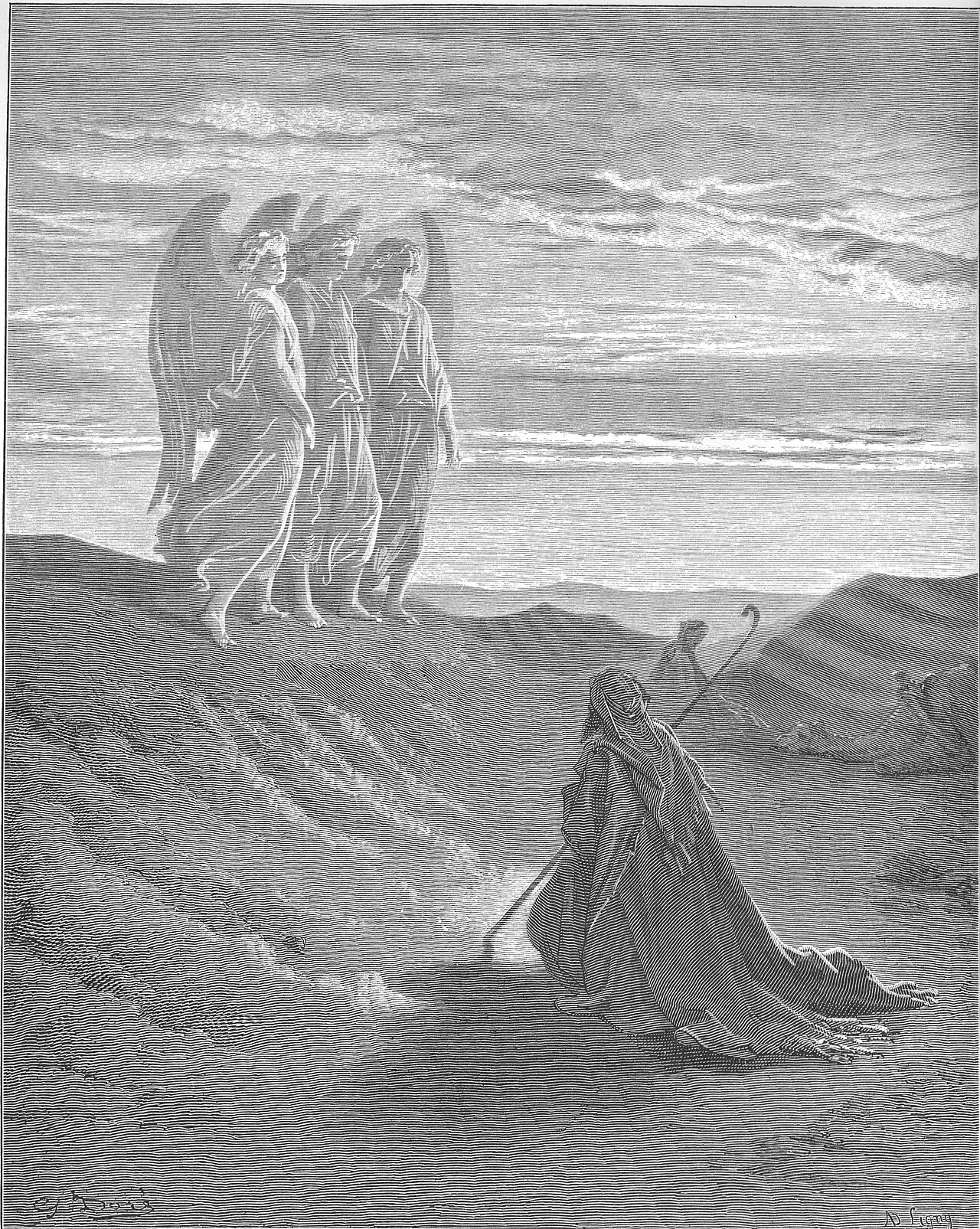
in Genesis 18And Abraham looked up and saw three men standing nearby. When he saw them, he ran from the entrance of his tent to meet them and bowed low to the ground.
BSB
The same verse in ASV and KJV ▾
ASV
and he lifted up his eyes and looked, and, lo, three men stood over against him: and when he saw them, he ran to meet them from the tent door, and bowed himself to the earth,
KJV
And he lift up his eyes and looked, and, lo, three men stood by him: and when he saw them, he ran to meet them from the tent door, and bowed himself toward the ground,
⋯
This verse in Genesis 18
Commentary
15 notes on this verseHospitality is good, it has its reward, first the gratitude of man, and then, what is greater, the reward of God. We are all guests in this abode; for a time we have a place to stay: we are emigrating soon. Let us beware that if we have been harsh or negligent in receiving guests, even the holy hostels may be denied to us after the course of this life. Hence in the Gospel the Savior says: Make friends for yourselves with unjust wealth, so that they may receive you into eternal dwellings.
This site's exposition
in the heat of the day
on Genesis 18:1-2
The text says the LORD appeared, and what Abraham sees is three men standing nearby. Clarke reads the Hebrew to mean they stood off at a distance, so a man of ninety-nine runs to meet them. He bows to the ground before a word is said. Hebrews 13:2 speaks of entertaining angels without knowing it.
This site's exposition
three men standing nearby
Abraham saw three men standing nearby and took them for travellers in the heat of the day. John Calvin held that he received them as men, so his welcome was real hospitality given to strangers. Who they are comes out slowly.
The record, by era
The Church Fathers5 voices
Let us compare, first of all, if you please, this appearance with that one which Lot experienced. "Three men" come to Abraham and stand "before him"; "two" come to Lot and sit "in the street." See if, in the dispensation of the Holy Spirit, these events did not occur as each man deserved. For Lot was far inferior to Abraham. For if he had not been inferior, he would not have been separate from Abraham, nor would Abraham have said to him, "If you go to the right, I will go to the left; if you go to the left, I will go to the right." And if he had not been inferior, the land and habitation of Sodom would not have pleased him.Three men, therefore, come to Abraham at midday; two come to Lot and in the evening. For Lot could not receive the magnitude of midday light, but Abraham was capable of receiving the full brightness of the light. Let us see now how Abraham received those who came and how Lot did, and let us compare each man's preparation of hospitality. First, however, observe that the Lord also was present with Abraham with two angels, but two angels alone proceed to Lot. And what do they say? "The Lord has sent us to consume the city and destroy it." He therefore received those who would give destruction. He did not receive him who would save. But Abraham received him who saves and those who destroy.
But let us now, meanwhile, pursue what Abraham does with the three men who "stood before him." Behold what sort of expression this is itself, that they come "before him," not against him. He had, to be sure, subjected himself to the will of God; therefore God is said to stand "before him."
Now let us see how each man receives his guests. "Abraham saw," the text says, "and ran to meet them." Notice that Abraham immediately is energetic and eager in his duties. He runs to meet them, and when he had met them, "he hastens back to the tent," the text says, "and says to his wife: 'Hasten to the tent.' " Behold in the individual matters how great is his eagerness to receive them. He makes haste in all things; all things are done urgently; nothing is done leisurely.
"Three men came to Abraham and stood over him." Observe how it is that they come upon him but not against him. He had subjected himself to God's will, and for this reason God is said to stand over him.
Although Abraham ran from the tent toward them as if toward strangers, he ran to receive those strangers with love. His love for strangers was thus proved by the haste with which he ran to meet those strangers.
7 more voices on this verse
The Church Fathers1 voice
Notice, brothers, and see how God appeared to Abraham and how he appeared to Lot. The three men came to Abraham and stood over him; two came to Lot and stayed in the street.
The Medieval Church3 voices
A commentator
BonaventureCollations on the Hexaemeron, Collation 2 · Written in the 13th century.
proposed
The other way of anagogy is above the skies, as in the case of Abraham who saw three men and worshiped one, for the Trinity appeared in these three; and in the case of the two angels who were sent to Sodom, the Son and …
And when he had lifted up his eyes, he saw three men standing near him; and when he saw them, he ran to meet them from the door of the tent, and worshipped upon the ground, and said: Lord, if I have found grace in …
A commentator
BonaventureDisputed Questions on the Mystery of the Trinity, Question 1 · Written in the 13th century.
proposed
For testimony is given in the Old Testament concerning the Trinity both in figures and in words. Among the figures, however, that one was especially authoritative which was shown to the father of our faith, Abraham: of whom it is said in Genesis eighteen, that …
The Reformation1 voice
And this was done designedly, in order that he, receiving them as men, might give proof of his charity. For angels do not need those services of ours, which are the true evidences of charity. Moreover, hospitality holds the chief place among these services; because it is no common virtue to assist strangers, from whom there is no hope of reward.
The Puritans and the Awakening1 voice
And he lifted up his eyes and looked,....
The Nineteenth Century1 voice
Three men stood by him - נצבים עליו nitstsabim alaiv, were standing over against him; for if they had been standing by him, as our translation says, he needed not to have “run from the tent door to meet them.” To Abraham these appeared at first as men; but he entertained angels unawares, see Heb 13:2.
How the passage was read
What the Jewish commentators add
On the verses either side of this one
Rashi comments: “To visit the sick man. Said Rabbi Chama the son of Chanina, ‘It was the third day after his circumcision, and the Holy One, blessed be He, came and inquired after him.’ 1 “After him.” In our text of Rashi: “after the state of his health.
This section is reception history: how the passage was read and kept in the Jewish tradition. Where a reading parts from an essential of the Christian faith, the section says so at that point.
Texts and citation data: Sefaria; each excerpt follows its version’s licence. 2 further sources are cited on this chapter that carry no English text this site may quote or only restate the verse.
The words behind it
15 Hebrew wordsEvery Hebrew word of this verse in the order it stands, with what it means and the door to its own study. The last column counts the times a word stands in the whole Bible: the rarer the word, the more the places it appears belong together.
| Hebrew | Sound | Meaning | Word study | In the Bible |
|---|---|---|---|---|
| וַיִּשָּׂ֤א | vaiyisa' | and he lifted up | H5375 → | 656 times |
| עֵינָיו֙ | ʾeinav | eyes his | H5869 → | 887 times |
| וַיַּ֔רְא | vaiyar' | and he saw | H7200 → | 1300 times |
| וְהִנֵּה֙ | vehineh | and there! | H2009 → | 843 times |
| שְׁלֹשָׁ֣ה | sheloshah | three | H7969 → | 432 times |
| אֲנָשִׁ֔ים | ʾanashim | men | H582 → | 566 times |
| נִצָּבִ֖ים | nitzavim | [were] standing | H5324 → | 75 times |
| עָלָ֑יו | ʾalav | with him | H5921 → | 5755 times |
| וַיַּ֗רְא | vaiyar' | and he saw | H7200 → | 1300 times |
| וַיָּ֤רָץ | vaiyarotz | and he ran | H7323 → | 103 times |
| לִקְרָאתָם֙ | likratam | to meet them | H7122 → | 139 times |
| מִפֶּ֣תַח | mipetach | from [the] opening of | H6607 → | 164 times |
| הָאֹ֔הֶל | haohel | the tent | H168 → | 345 times |
| וַיִּשְׁתַּ֖חוּ | vaiyishtachu | and he bowed down | H7812 → | 172 times |
| אָֽרְצָה׃ | ʾaretzah | [the] ground towards | H776 → | 2504 times |
וַיִּשָּׂ֤אand he lifted up
vaiyisa'H5375 →656 times
עֵינָיו֙eyes his
ʾeinavH5869 →887 times
וַיַּ֔רְאand he saw
vaiyar'H7200 →1300 times
וְהִנֵּה֙and there!
vehinehH2009 →843 times
שְׁלֹשָׁ֣הthree
sheloshahH7969 →432 times
אֲנָשִׁ֔יםmen
ʾanashimH582 →566 times
נִצָּבִ֖ים[were] standing
nitzavimH5324 →75 times
עָלָ֑יוwith him
ʾalavH5921 →5755 times
וַיַּ֗רְאand he saw
vaiyar'H7200 →1300 times
וַיָּ֤רָץand he ran
vaiyarotzH7323 →103 times
לִקְרָאתָם֙to meet them
likratamH7122 →139 times
מִפֶּ֣תַחfrom [the] opening of
mipetachH6607 →164 times
הָאֹ֔הֶלthe tent
haohelH168 →345 times
וַיִּשְׁתַּ֖חוּand he bowed down
vaiyishtachuH7812 →172 times
אָֽרְצָה׃[the] ground towards
ʾaretzahH776 →2504 times
A shaded row is a word that stands 400 times or fewer in the Bible.
The walk
8 stopsEach card is a verse this one points to, and under it the verses that one points to in turn. Where several paths arrive at the same place, that place is listed first: the text keeps returning to it.
Through
Hebrews 13:2Do not neglect to show hospitality to strangers, for by so doing some people have entertained angels without knowing it.
it leads to
- Matthew 25:35
For I was hungry and you gave Me something to eat, I was thirsty and you gave Me something to drink, I was a stranger and you took Me in,
- Genesis 18:1
Then the LORD appeared to Abraham by the Oaks of Mamre in the heat of the day, while he was sitting at the entrance of his tent.
- 1 Peter 4:9
Show hospitality to one another without complaining.
- Romans 12:13
Share with the saints who are in need. Practice hospitality.
- Matthew 25:43
I was a stranger and you did not take Me in, I was naked and you did not clothe Me, I was sick and in prison and you did not visit Me.’
- Matthew 25:35
Through
Genesis 18:22And the two men turned away and went toward Sodom, but Abraham remained standing before the LORD.
it leads to
- Genesis 19:1
Now the two angels arrived at Sodom in the evening, and Lot was sitting in the gateway of the city. When Lot saw them, he got up to meet them, bowed facedown,
Reached by 2 separate paths from here.
- Genesis 19:1
Through
Judges 13:3The angel of the LORD appeared to the woman and said to her, “It is true that you are barren and have no children; but you will conceive and give birth to a son.
it leads to
- Luke 1:13
But the angel said to him, “Do not be afraid, Zechariah, because your prayer has been heard. Your wife Elizabeth will bear you a son, and you are to give him the name John.
- Genesis 18:10
Then the LORD said, “I will surely return to you at this time next year, and your wife Sarah will have a son!” Now Sarah was behind him, listening at the entrance to the…
- Luke 1:13
Where this verse is studied
About Genesis
Who and where
1 name in this verse with a page on the site.
This page draws on 14 works. Open the list of works
This page draws on Adam Clarke, Commentary on the Bible; Ambrose of Milan, On Abraham; Bede, Commentary on Genesis (Hexaemeron); Bonaventure, Collations on the Hexaemeron, Collation 2; Bonaventure, Disputed Questions on the Mystery of the Trinity, Question 1; Caesarius of Arles, SERMON 83.4; Caesarius of Arles, SERMON 83.2; Ephrem the Syrian, COMMENTARY ON GENESIS 15:1; John Calvin, Commentary on Genesis; John Calvin, Commentaries; John Gill, Exposition of the Old Testament (1748-1763); Matthew Henry, Commentary on the Whole Bible; Origen of Alexandria, HOMILIES ON GENESIS 4.1 and Origen of Alexandria, HOMILIES ON GENESIS 4.2.