
Genesis 18:1
in Genesis 18Then the LORD appeared to Abraham by the Oaks of Mamre in the heat of the day, while he was sitting at the entrance of his tent.
BSB
The same verse in ASV and KJV ▾
ASV
And Jehovah appeared unto him by the oaks of Mamre, as he sat in the tent door in the heat of the day;
KJV
And the Lord appeared unto him in the plains of Mamre: and he sat in the tent door in the heat of the day;
⋯
This verse in Genesis 18
Commentary
13 notes on this verseIt is also possible that the promise was repeated for the sake of Sarah. What shall we say, if in this manner, he chose to do honor to the greatness of his grace? For the promise concerning Isaac, from whom, at length, redemption and salvation should shine forth to the world, cannot be extolled in terms adequate to its dignity.
This site's exposition
in the heat of the day
on Genesis 18:1-2
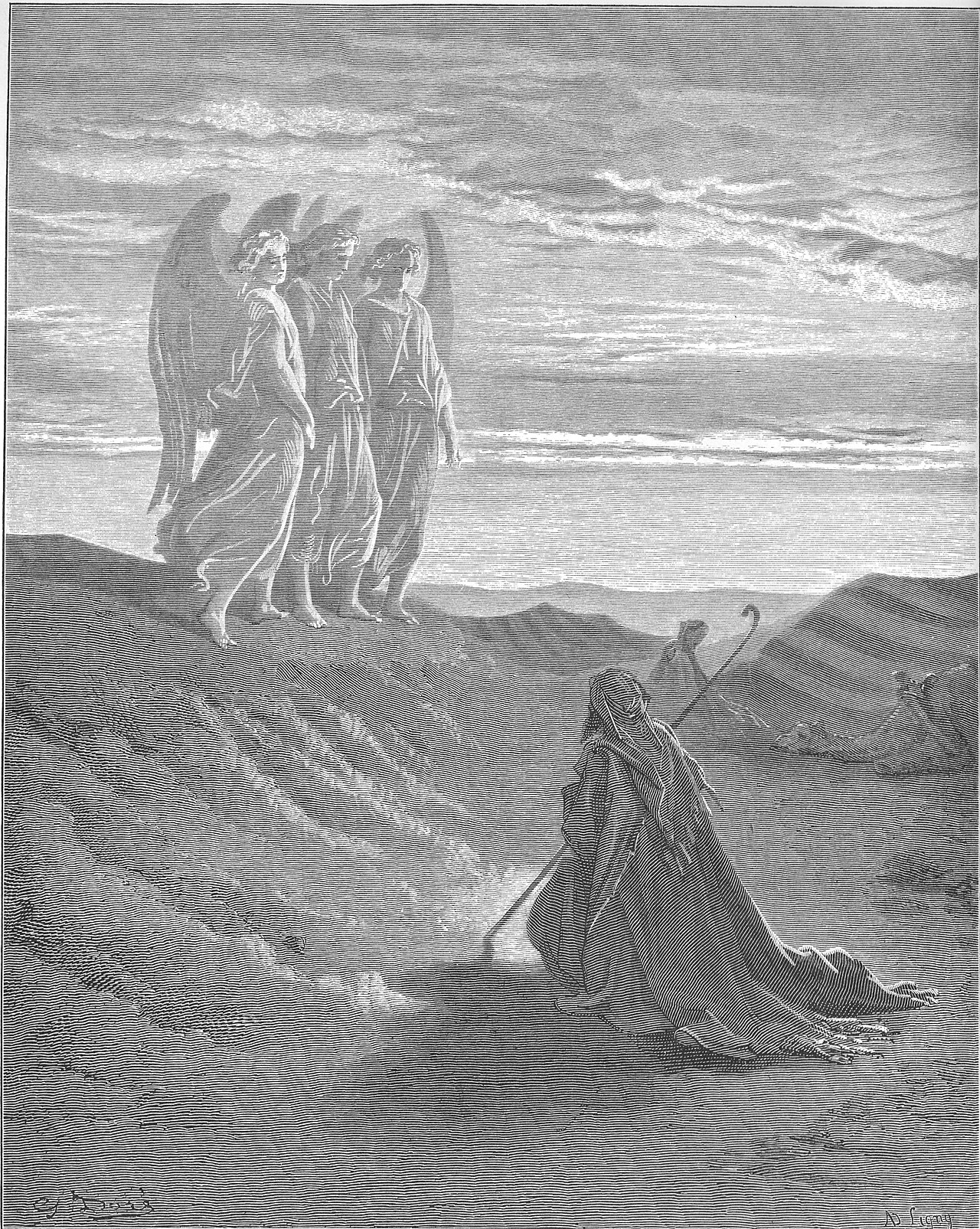
The text says the LORD appeared, and what Abraham sees is three men standing nearby. Clarke reads the Hebrew to mean they stood off at a distance, so a man of ninety-nine runs to meet them. He bows to the ground before a word is said.
The record, by era
The Church Fathers5 voices
Abraham, ready to receive strangers, faithful towards God, devoted in ministering, quick in his service, saw the Trinity in a type; he added religious duty to hospitality, when beholding Three he worshipped One, and preserving the distinction of the Persons, yet addressed one Lord, he offered to Three the honour of his gift, while acknowledging one Power. It was not learning but grace which spoke in him, and he believed better what he had not learnt than we who have learnt. No one had falsified the representation of the truth, and so he sees Three, but worships the Unity. He brings forth three measures of fine meal, and slays one victim, considering that one sacrifice is sufficient, but a triple gift; one victim, an offering of three.
But let us see what this tree represents, under which Abraham stood and provided a meal for the Lord and the angels. "Under the tree of Mamre" the text says. Mamre in our language is translated "vision" or "sharpness of sight." Do you see what kind of place it is where the Lord can have a meal? Abraham's vision and sharpness of sight pleased the Lord. For he was pure in heart so that he could see God. In such a place, therefore, and in such a heart the Lord can have a meal with his angels. In fact, earlier prophets were called seers.
Now where did this happen? "Near the holm-oak of Mamre," which in Latin is interpreted as "vision" or "discernment." Do you see what kind of a place it is in which the Lord can have a feast?
Thus the Lord God is said to have appeared as a common man to Abraham while he was seated by the oak of Mamre. But [Abraham] immediately fell down, although he saw a man with his eyes, and worshiped him as God, besought him as Lord and confessed that he was not ignorant as to who he was, using these very words, "O Lord, judge of all the earth, will you not judge righteously?" For if it should be unreasonable to suppose that the unbegotten and immutable substance of God the Almighty was changed into the form of man and, in turn, that the eyes of the beholders were deceived by the phantasm of something created and that such things were falsely invented by Scripture, who else could be proclaimed God and the Lord who judges all the earth and judges righteously, appearing in the shape of a man—if it be not proper to call him the first cause of all things—than his preexistent Word alone?
God appeared again to Abraham at the oak of Mamre in three men, who it is not to be doubted were angels, although some think that one of them was Christ and assert that he was visible before he put on flesh. Now it belongs to the divine power and invisible, incorporeal and incommunicable nature, without changing itself at all, to appear even to mortals, not by what it is but by what is subject to it. And what is not subject to it? Yet if they try to establish that one of these three was Christ by the fact that although he saw three, he addressed the Lord in the singular, as it is written, "He lifted up his eyes and looked, and behold, three men stood in front of him. When he saw them, he ran from the tent door to meet them, and bowed himself to the earth and said, 'My lord, if I have found favor in your sight.' " Why do they not refer also to this, that when two of them came to destroy the Sodomites, while Abraham still spoke to one, calling him Lord and interceding that he would not destroy the righteous along with the wicked in Sodom, Lot received these two in such a way that he too in his conversation with them addressed the Lord in the singular? For after saying to them in the plural, "My lords, turn aside, I pray you, to your servant's house," yet it is afterward said, "So [the angels] seized him and his hand, [because] the Lord [was] merciful to him, and they brought him forth and set him outside the city.
6 more voices on this verse
The Medieval Church1 voice
The Lord appeared to him in the valley of Mamre as he was sitting at the entrance of his tent in the heat of the day, etc. This appearance of the Lord is considered to be more sacred than all the previous ones, in which …
The Puritans and the Awakening3 voices
The appearance of God to Abraham seems to have had in it more of freedom and familiarity, and less of grandeur and majesty, than those we have hitherto read of; and therefore more resembles that great visit which, in the fullness of time, the Son of God was to make to the world, when the Word would be flesh, and appear as one of us.
When Abraham was thus sitting, he saw three men coming towards him. These three men were three spiritual heavenly beings, now assuming human bodies, that they might be visible to Abraham, and conversable with him.
quarantine:debris (2026-07-29) — unbalanced-parens
And the Lord appeared unto him in the plains of Mamre,....
The Nineteenth Century2 voices
And the Lord appeared - See note on Gen 15:1. Sat in the tent door - For the purpose of enjoying the refreshing air in the heat of the day, when the sun had most power. A custom still frequent among the Asiatics.
A commentator
Albert Barnes1798–1870
Notes, Explanatory and Practical, on the Old and New Testaments (1832-1869)
proposed
- The Visit of the Lord to Abraham 2. השׂתחיה vayı̂śtachû “bow,” or bend the body in token of respect to God or man. The attitude varies from a slight inclination of the body to entire prostration with the forehead touching the ground. 6. סאה se'ah a “seah,” about an English peck, the third part of an ephah. The ephah contained ten omers. The omer held about five pints. This chapter describes Abraham’s fellowship with God.
How the passage was read
What the Jewish commentators add
Rashi comments: “To visit the sick man. Said Rabbi Chama the son of Chanina, ‘It was the third day after his circumcision, and the Holy One, blessed be He, came and inquired after him.’ 1 “After him.” In our text of Rashi: “after the state of his health.
This section is reception history: how the passage was read and kept in the Jewish tradition. Where a reading parts from an essential of the Christian faith, the section says so at that point.
Texts and citation data: Sefaria; each excerpt follows its version’s licence. 2 further sources are cited on this chapter that carry no English text this site may quote or only restate the verse.
The words behind it
11 Hebrew wordsEvery Hebrew word of this verse in the order it stands, with what it means and the door to its own study. The last column counts the times a word stands in the whole Bible: the rarer the word, the more the places it appears belong together.
| Hebrew | Sound | Meaning | Word study | In the Bible |
|---|---|---|---|---|
| וַיֵּרָ֤א | vaiyera' | and he appeared | H7200 → | 1300 times |
| אֵלָיו֙ | ʾelav | to him | H413 → | 5510 times |
| יְהוָ֔ה | yahweh | Yahweh | H3068 → | 6520 times |
| בְּאֵלֹנֵ֖י | beelonei | at [the] great trees of | H436 → | 9 times |
| מַמְרֵ֑א | mamre' | Mamre | H4471 → | 10 times |
| וְה֛וּא | vehu' | and he | H1931 → | 1879 times |
| יֹשֵׁ֥ב | yoshev | [was] sitting | H3427 → | 1079 times |
| פֶּֽתַח־ | petach- | [the] opening of | H6607 → | 164 times |
| הָאֹ֖הֶל | haohel | the tent | H168 → | 345 times |
| כְּחֹ֥ם | kechom | when [the] heat of | H2527 → | |
| הַיּֽוֹם׃ | haiyom | the day | H3117 → | 2304 times |
וַיֵּרָ֤אand he appeared
vaiyera'H7200 →1300 times
אֵלָיו֙to him
ʾelavH413 →5510 times
יְהוָ֔הYahweh
yahwehH3068 →6520 times
בְּאֵלֹנֵ֖יat [the] great trees of
beeloneiH436 →9 times
מַמְרֵ֑אMamre
mamre'H4471 →10 times
וְה֛וּאand he
vehu'H1931 →1879 times
יֹשֵׁ֥ב[was] sitting
yoshevH3427 →1079 times
פֶּֽתַח־[the] opening of
petach-H6607 →164 times
הָאֹ֖הֶלthe tent
haohelH168 →345 times
כְּחֹ֥םwhen [the] heat of
kechomH2527 →
הַיּֽוֹם׃the day
haiyomH3117 →2304 times
A shaded row is a word that stands 400 times or fewer in the Bible.
The walk
8 stopsEach card is a verse this one points to, and under it the verses that one points to in turn. Where several paths arrive at the same place, that place is listed first: the text keeps returning to it.
Through
Genesis 26:2The LORD appeared to Isaac and said, “Do not go down to Egypt. Settle in the land where I tell you.
it leads to
- Genesis 17:1
When Abram was ninety-nine years old, the LORD appeared to him and said, “I am God Almighty. Walk before Me and be blameless.
Reached by 2 separate paths from here.
- Genesis 12:7
Then the LORD appeared to Abram and said, “I will give this land to your offspring.” So Abram built an altar there to the LORD, who had appeared to him.
- Genesis 12:1
Then the LORD said to Abram, “Leave your country, your kindred, and your father’s household, and go to the land I will show you.
- Psalms 37:3
Trust in the LORD and do good; dwell in the land and cultivate faithfulness.
- Genesis 17:1
Through
Genesis 14:13Then an escapee came and reported this to Abram the Hebrew. Now Abram was living near the Oaks of Mamre the Amorite, a brother of Eshcol and Aner, all of whom were bound by…
it leads to
- Genesis 13:18
So Abram moved his tent and went to live near the Oaks of Mamre at Hebron, where he built an altar to the LORD.
- Genesis 13:18
Through
Genesis 13:18So Abram moved his tent and went to live near the Oaks of Mamre at Hebron, where he built an altar to the LORD.
it leads to
- Genesis 35:27
Jacob returned to his father Isaac at Mamre, near Kiriath-arba (that is, Hebron), where Abraham and Isaac had stayed.
- Genesis 8:20
Then Noah built an altar to the LORD. And taking from every kind of clean animal and clean bird, he offered burnt offerings on the altar.
- Genesis 14:13
Then an escapee came and reported this to Abram the Hebrew. Now Abram was living near the Oaks of Mamre the Amorite, a brother of Eshcol and Aner, all of whom were bound by…
- Genesis 35:27
Where this verse is studied
On this page
Studies12
On this verse
On this chapter
About Genesis
Who and where
2 names in this verse with a page on the site.
This page draws on 11 works. Open the list of works
This page draws on Adam Clarke, Commentary on the Bible; Albert Barnes, Notes, Explanatory and Practical, on the Old and New Testaments (1832-1869); Ambrose of Milan, On the Decease of His Brother Satyrus; Augustine of Hippo, City of God 16.29; Bede, Commentary on Genesis (Hexaemeron); Caesarius of Arles, SERMON 83.5; Eusebius of Caesarea, ECCLESIASTICAL HISTORY 1.2.7-8; John Calvin, Commentaries; John Gill, Exposition of the Old Testament (1748-1763); Matthew Henry, Commentary on the Whole Bible and Origen of Alexandria, HOMILIES ON GENESIS 4.3.