
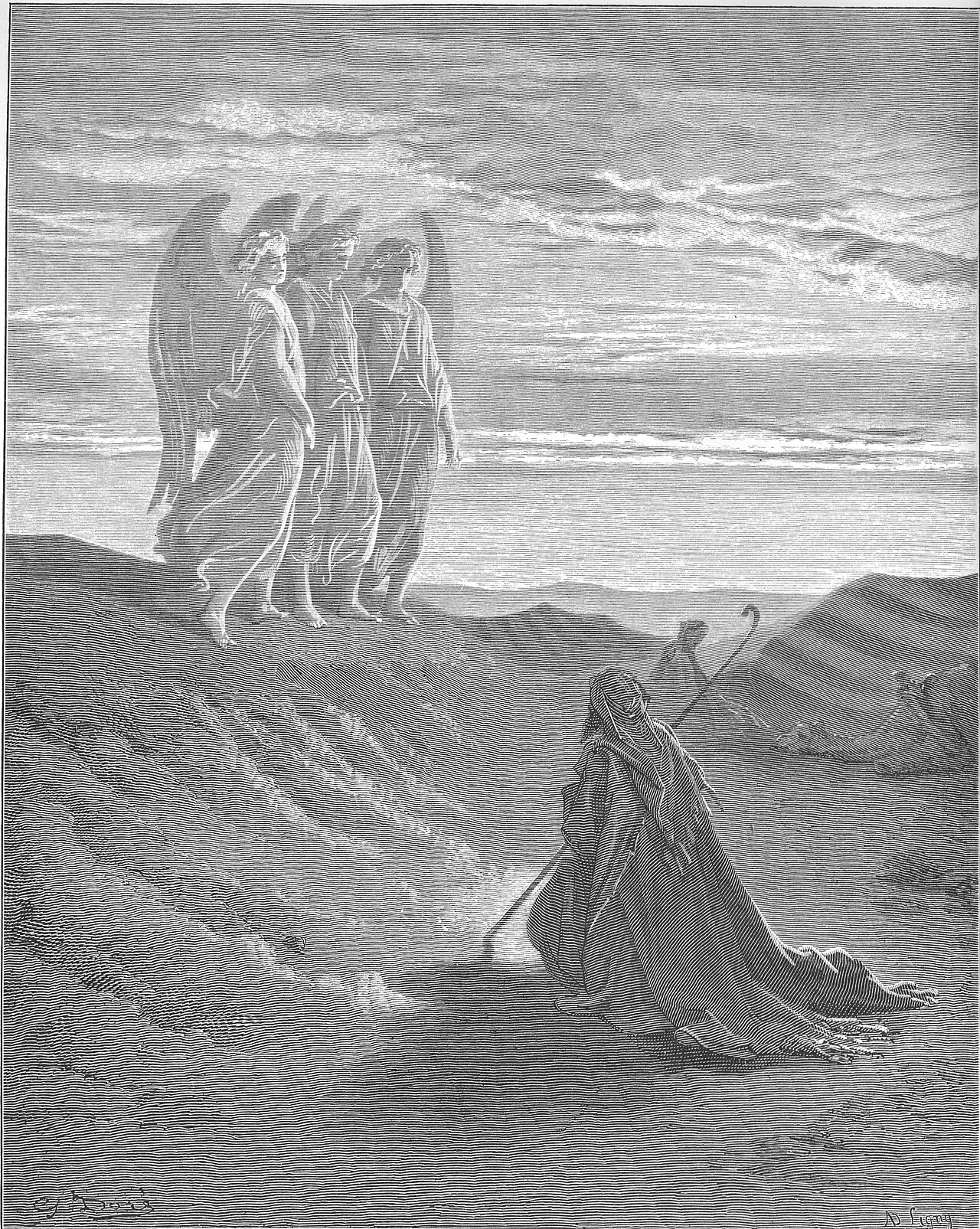
Genesischapter 18
33 verses · Moses, by tradition · 15th to 13th century BC · The Law
In Jewish life
The reading
Weekly portion 4 of 54
וַיֵּרָא Vayera, Genesis 18:1 to 22:24
Read with it: 2 Kings 4:1 to 4:37 in Ashkenazi use, and 2 Kings 4:1 to 4:23 in Sephardi use.
The verse numbers here are the ones a Hebrew Bible carries, which differ from an English Bible by a verse or two in several places. The Sephardi reading is named only where this site records a difference; communities vary beyond what is listed. What these books are, and how a Christian reader meets them →
What is done
This chapter opens the fourth portion of the annual cycle, and the portion runs from its first verse to the end of Genesis 22 (src/lib/hebraic/readings.ts). A congregation hears the visit at the oaks, the destruction of Sodom, the birth of Isaac and the binding on one Sabbath. The card above carries the portion and the prophetic reading set beside it.
How it is read
The corpus holds no English text for any comment on this chapter, so nothing of the classical commentary is quoted here. Rashi comments on every one of the first twenty four verses, and each comment is cited and linked and read at the source. They run from Rashi on Genesis 18:1:1 on the appearing at the oaks to Rashi on Genesis 18:24:1 on the fifty righteous men.
Those comments cover the three visitors in the second verse, and the running to meet them and the meal in the fourth to the eighth. They cover the word about Sarah in the tenth verse, her laughter in the twelfth and the question of whether anything is too hard for God in the fourteenth. They cover the reason God tells Abraham what He will do, in the seventeenth to the nineteenth, and the pleading over the city from the twenty third verse on.
The licence Sefaria reports for that English version of Rashi keeps the text out of this corpus, and this site holds no other checked edition of his comment on this chapter. The references stand here, and the comment is read at Sefaria.
What the rabbis say
The corpus records forty places where the Midrash and the Talmud cite this chapter, twenty seven under Midrash and thirteen under Talmud. It carries the locator for each one with no text, so the references stand here and the sayings are read at the source.
The Talmud weight of the chapter is the second heaviest of these twenty five, and it falls on the welcome Abraham gave the three men. Six of the thirteen locators stand on the second to the seventh verses, at Bava Metzia 86b:19, 86b:18, 86b:14 and 87a:4, at Avot DeRabbi Natan 13:3, and at its second recension 45:2. The tractate is cited again at Bava Metzia 86b:13 on the sixteenth verse.
Avot DeRabbi Natan carries the rest of the Talmud locators. It reads the ninth verse at 34:5, the twenty first at 34:6 and the twenty sixth at 37:12. Its second recension reads the twelfth verse at 37:1, the twentieth at 37:9 and the last at 40:5.
Bereshit Rabbah reads the second verse at 44:11, the third at 48:10, the eleventh at 56:5 and the thirteenth at 20:6. It reads the fourteenth verse at 48:19, the fifteenth at 48:20, the eighteenth at 49:3 and the twenty second at 49:7. It reads the twenty fourth verse at 49:9, the twenty eighth at 49:12 and the thirtieth at 49:13.
Aggadat Bereshit reads the first verse at 19:1 and 19:2, the sixth at 34:1 and the tenth at 28:3. It reads the seventeenth verse at 21:1, the nineteenth at 24:1, the twenty third at 18:1 and the twenty fifth at 22:1. Bamidbar Rabbah reads the fourth verse at 14:2, the fifth at 20:17, the seventh at 13:14 and the twenty seventh at 13:3. Midrash Sekhel Tov reads the twenty ninth and thirty first verses at the locators of the same names, and Midrash Lekach Tov reads the thirty second at Genesis 18:32:1.
The text, verse by verse
Each word shows the Hebrew, the English under it, how it sounds and its Strong’s number. A rule between verses marks where the Hebrew manuscripts end a paragraph.
Three Visitors at Mamre
Ramban on Genesis 18:1
Rashi comments: “To visit the sick man. Said Rabbi Chama the son of Chanina, ‘It was the third day after his circumcision, and the Holy One, blessed be He, came and inquired after him.’ 1 “After him.” In our text of Rashi: “after the state of his health.
Read it in full at Sefaria · Commentary on the Torah by Ramban (Nachmanides). Translated and annotated by Charles B. Chavel. New York, Shilo Pub. House, 1971-1976
Sarah Laughs Behind the Tent
Ramban on Genesis 18:10
Rashi comments, “The angel was not announcing that he would return to him, but he was speaking to him as G-d’s agent, [meaning that G-d would return]. This is similar to the verse: And the angel of the Eternal said to her [Hagar], I will multiply thy seed exceedingly.
Read it in full at Sefaria · Commentary on the Torah by Ramban (Nachmanides). Translated and annotated by Charles B. Chavel. New York, Shilo Pub. House, 1971-1976
Ramban on Genesis 18:11
‘BA’IM BAYAMIM’ (ADVANCED IN DAYS). In his youthful days a man is called “standing in days,” and they are referred to as “his days” because they belong to him, just as in verse The number of thy days will I fulfill. 97 Exodus:26.
Read it in full at Sefaria · Commentary on the Torah by Ramban (Nachmanides). Translated and annotated by Charles B. Chavel. New York, Shilo Pub. House, 1971-1976
Rashbam on Genesis 18:12
עדנה, a form of the skin becoming elastic and the wrinkles straightening out.
Read it in full at Sefaria · Eliyahu Munk, HaChut Hameshulash
Ramban on Genesis 18:13
This is the explanation of Sarah’s words, after I am waxed old. 98 Verse 12 here.
Read it in full at Sefaria · Commentary on the Torah by Ramban (Nachmanides). Translated and annotated by Charles B. Chavel. New York, Shilo Pub. House, 1971-1976
Ramban on Genesis 18:14
IS ANYTHING TOO HARD (‘HAYIPALEI’) FOR THE ETERNAL? Is anything too hard and improbable for G-d to cause to happen? This expression is similar to the verse, For all things come of Thee, and of Thine own have we given Thee. 99 I Chronicles:14.
Read it in full at Sefaria · Commentary on the Torah by Ramban (Nachmanides). Translated and annotated by Charles B. Chavel. New York, Shilo Pub. House, 1971-1976
The Outcry Against Sodom
Abraham Bargains for the City
Hebrew words in this chapter
The 40 most used Hebrew words of the chapter, counted by lemma. The article, the object marker, the negatives and the common prepositions are left out.
| Word | Sense here | Uses | Strong’s |
|---|---|---|---|
| אָמַרʼâmar | to say | 25 | H559 |
| אַבְרָהָםʼAbrâhâm | Abraham | 13 | H85 |
| עָשָׂהʻâsâh | to make | 11 | H6213 |
| יְהֹוָהYᵉhôvâh | yahweh | 10 | H3068 |
| שָׂרָהSârâh | Sarah | 10 | H8283 |
| נָאnâʼ | please | 8 | H4994 |
| מָצָאmâtsâʼ | to find | 8 | H4672 |
| דָבַרdâbar | to speak | 8 | H1696 |
| שָׁםshâm | there | 8 | H8033 |
| צַדִּיקtsaddîyq | righteous | 7 | H6662 |
| אוּלַיʼûwlay | perhaps | 6 | H194 |
| אֹהֶלʼôhel | tent | 5 | H168 |
| הִנֵּהhinnêh | and there | 5 | H2009 |
| בֵּןbên | son | 5 | H1121 |
| רָאָהrâʼâh | to see | 4 | H7200 |
| לָקַחlâqach | let it be brought | 4 | H3947 |
| שׁוּבshûwb | to return | 4 | H7725 |
| צָחַקtsâchaq | to laugh | 4 | H6711 |
| סְדֹםÇᵉdôm | Sodom | 4 | H5467 |
| חֲמִשִּׁיםchămishshîym | fifty | 4 | H2572 |
| Word | Sense here | Uses | Strong’s |
|---|---|---|---|
| עָבוּרʻâbûwr | for the sake of | 4 | H5668 |
| אֲדֹנָיʼĂdônây | Lord | 4 | H136 |
| שָׁחַתshâchath | will you destroy | 4 | H7843 |
| פֶּתַחpethach | opening of | 3 | H6607 |
| נָשָׂאnâsâʼ | to lift | 3 | H5375 |
| אֱנוֹשׁʼĕnôwsh | men | 3 | H582 |
| אֶרֶץʼerets | ground towards | 3 | H776 |
| עָבַרʻâbar | to pass | 3 | H5674 |
| מָהַרmâhar | and he hurried | 3 | H4116 |
| בָּקָרbâqâr | the herd | 3 | H1241 |
| אִשָּׁהʼishshâh | wife your | 3 | H802 |
| בּוֹאbôwʼ | to come | 3 | H935 |
| אַףʼaph | also | 3 | H637 |
| הָלַךְhâlak | went | 3 | H1980 |
| מַעַןmaʻan | so that | 3 | H4616 |
| רָשָׁעrâshâʻ | wicked | 3 | H7563 |
| עִירʻîyr | the city | 3 | H5892 |
| מָקוֹםmâqôwm | place | 3 | H4725 |
| חָמֵשׁchâmêsh | five | 3 | H2568 |
| אַרְבָּעִיםʼarbâʻîym | forty | 3 | H705 |
Keep studying
Studies4
Words12
Trails1
Sources for this chapter
The Hebrew text
STEP Bible, the tagged Hebrew text and its English glosses and James Strong, Strong's Exhaustive Concordance.
In Jewish life
Rashi, his twenty four comments on Genesis 18, cited by reference; the licence Sefaria reports for the English version keeps the text out of the corpus; The Midrash and the Talmud, the forty locators on Genesis 18 in scripts/data/sources/sefaria/genesis/18.json and MannaFest, the annual cycle table at src/lib/hebraic/readings.ts.
The rabbinic texts
Ramban, Commentary on the Torah by Ramban (Nachmanides). Translated and annotated by Charles B. Chavel. New York, Shilo Pub. House, 1971-1976; Rashbam, Eliyahu Munk, HaChut Hameshulash and Sefaria, texts and citation data.