
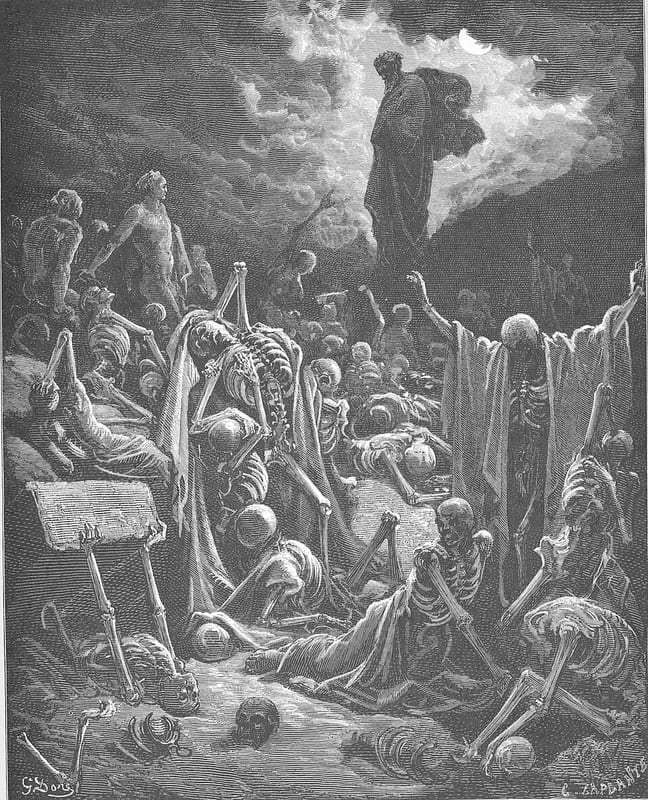
Ezekielchapter 37
28 verses · Ezekiel · 593 to 571 BC · The Prophets
The hand of the LORD was upon me, and He brought me out by His Spirit and set me down in the middle of the valley, and it was full of bones.
Introduction
Ezekiel, The Prophets, Ezekiel Overview.
Ezekiel received this vision as a priest living among the exiles in Babylonia, some years after news came that Jerusalem had fallen. His hearers had lost their city, their temple and their king, and many had stopped expecting anything more from God. The chapter answers a despair they had spoken aloud. It holds two scenes, one seen in a vision and one acted out in front of the people. Listen for the one Hebrew word that English renders as breath, wind and Spirit, and for the order in which life returns. The second scene carries the first into the life of the divided nation and its king.
Context
- Who
- Exiles who had said out loud that their bones were dried up and their hope was gone
- What
- A vision of a valley of dry bones brought to life, followed by a sign of two sticks joined into one.
- Where
- In a valley seen in vision, and then among the exiles at Tel Abib by the River Kebar in Babylonia.
- When
- About 585 BC in the Babylonian exile, after the news of Jerusalem's fall in Ezekiel 33:21, a date inferred from the book's order.
- Why
- To answer the exiles' despair with the promise that God would raise the nation, bring it home and reunite it under one king.
Historical context
The valley is a battlefield left unattended. Armies did not bury enemy dead, and Assyrian and Babylonian royal inscriptions boast of leaving corpses to rot and filling plains with bones. In Israelite thinking an unburied body was the worst dishonour there was, and it also defiled the land. Very dry bones means it happened long ago and nobody ever came back for them.
Show the rest of the historical context, 4 more paragraphs
One Hebrew word carries the whole vision: ruach, which means breath, wind and spirit all at once. It appears throughout the chapter, so when Ezekiel prophesies to the breath and the wind comes from the four winds and the slain live, the same word is doing every job. English needs three words where the vision has one.
The order of the miracle matters. First a rattling and the bones come together, then sinews and flesh and skin, a valley of complete bodies, and still no life in them. The structure can be entirely restored and the thing still be dead. Only the second prophesying, to the breath, makes them stand up as an exceedingly great army.
The second sign uses two wooden staffs. Tribal staffs were emblems of a clan, the Hebrew word for tribe and for staff is the same, and Aaron's rod stood for the house of Levi among twelve rods representing twelve tribes. Ezekiel writes Judah on one and Joseph, that is Ephraim and the northern tribes, on the other, and joins them into one in his hand. The northern kingdom had been gone for over a century and was assumed lost for good.
The promises attached are national and concrete: one nation on the mountains of Israel, one king over them all, no longer two kingdoms, my servant David as their prince forever, an everlasting covenant of peace, and God's sanctuary in their midst forevermore. Read in the house frame, that is a real regathered nation under a real Davidic king in the coming kingdom; others read the whole vision as a picture of spiritual renewal or of the church, and the two readings are named rather than blended.
Significance
The exiles' own words open the interpretation: our bones are dried up, our hope is lost, we are cut off completely. God quotes their despair back to them and then answers it with the bluntest promise in the book, I will open your graves and raise you from your graves, my people, and bring you into the land of Israel.
Show the rest of the significance, 1 more paragraph
For people who had watched a nation die, this said the death was not the end of the story, and that whatever came next would not be a human recovery. Bones do not reassemble themselves. Someone has to speak.
This chapter in Jewish lifeWhat this chapter is in Jewish life and reading.
What is done
The site's own table in src/lib/hebraic/readings.ts, probed for this lane, gives this chapter a public reading. Ezekiel 37:15 to 37:28 is the Haftarah read with the weekly portion Vayigash, which is Genesis 44:18 to 47:27, and the table marks it as the same in the Ashkenazi and the Sephardi rites. The table carries no festival reading from the book.
The corpus joins the chapter to the weeks of the Torah portions through the works arranged by portion. Under the twenty-fifth verse it carries Bereshit Rabbati, Parashat Lech Lecha 28.
How it is read
Rashi is the one commentator on this chapter whose English the corpus carries, quoted here from The Judaica Press complete Tanach with Rashi, translated by A. J. Rosenberg, which Sefaria reports as CC-BY. Every quotation of it is held to fifty words or fewer because the translation is modern.
Rashi opens the valley of bones with a rule for the whole book. "Every “the hand of the Lord” in a prophecy is an expression of compulsion", the spirit moving the prophet to the place it chose (Rashi on Ezekiel 37:1:1). He is led round the valley but not into it, "because he was a priest" (Rashi on Ezekiel 37:2:1).
The order of the rising draws a comparison with Job. There skin and flesh come first and bones and sinews after, and Rashi reconciles the two with a figure of dressing. A man who dresses again puts on first what he took off last. The body is formed the other way, "whereas at the beginning of the creation of the fetus, skin and flesh come first" (Rashi on Ezekiel 37:6:1). The noise is "the commotion of the bones, which were knocking one against the other" (Rashi on Ezekiel 37:7:1). The breath from the four winds gathers the souls from wherever "their souls went to roam" (Rashi on Ezekiel 37:9:1).
At the eleventh verse he gives two readings side by side. In the first the bones are "an intimation and an example of the entire house of Israel in their exile". In the second they were real men of Israel raised then, who feared they would not rise again at the resurrection of the dead. The next verse answers them, "that I am destined to resurrect you a second time" (Rashi on Ezekiel 37:11:1 and 37:12:1).
The two sticks Rashi reads as Judah with Benjamin, "who joined him", and the other tribes. They become one stick "that they shall no longer be two kingdoms" (Rashi on Ezekiel 37:16:1 and 37:19:1).
The corpus carries thirteen further notes on this chapter without an English text, each of them marked linked because Sefaria holds no English version of the ref. They stand cited and unquoted at Radak on Ezekiel 37:4:1, 37:5:1, 37:8:1, 37:10:1, 37:13:1, 37:14:1, 37:15:1, 37:18:1, 37:20:1, 37:21:1, 37:22:1, 37:23:1 and 37:24:1.
What the rabbis say
The corpus carries forty rabbinic locators on this chapter and the text of none, so each is cited and linked here rather than quoted. On the first verse it holds Bereshit Rabbah 13:6, Devarim Rabbah 7:6 and Midrash Sekhel Tov, Shemot 3:20:1. On the second verse it holds Mekhilta DeRabbi Shimon Ben Yochai 15:6 and Sanhedrin 92b:9. On the third verse it holds Bereshit Rabbah 19:11, Midrash Aggadah, Exodus 22:24:3 and Midrash Lekach Tov, Genesis 3:12:1. On the fourth verse it holds Kohelet Rabbah 4:3:1, Megillah 31a:16 and Midrash Aggadah, Numbers 33:1:2.
On the eighth verse it holds Bereshit Rabbah 14:5, Midrash Aggadah, Leviticus 12:2:4 and Otzar Midrashim, Sefer Eliyahu 1:4. On the ninth verse it holds Midrash Sekhel Tov, Shemot 9:8:2, Midrash Tannaim on Deuteronomy 32:2:28 and Pirkei DeRabbi Eliezer 33:15. On the tenth verse it holds Midrash Sekhel Tov, Shemot 9:10:1 and Pirkei DeRabbi Eliezer 33:17. On the eleventh verse it holds Ein Yaakov (Glick Edition), Sanhedrin 11:16, Ein Yaakov, Sanhedrin 11:15 and Midrash Lekach Tov on Lamentations 3:54:1.
On the twelfth verse it holds Bereshit Rabbah 73:4 and Bereshit Rabbah 96:5. On the thirteenth verse it holds Ein Yaakov (Glick Edition), Shabbat 23:11 and Ein Yaakov (Glick Edition), Taanit 1:1. On the fourteenth verse it holds Bereshit Rabbah 14:8 and Bereshit Rabbah 14:9. On the sixteenth verse it holds Bereshit Rabbah 98:2.
On the seventeenth verse it holds Kohelet Rabbah 3:8:2 and Midrash Sekhel Tov, Bereshit 29:20:2. On the nineteenth verse it holds Pirkei DeRabbi Eliezer 40:2. On the twentieth verse it holds Mekhilta DeRabbi Yishmael, Tractate Shirah 3:20. On the twenty-first verse it holds Bamidbar Rabbah 9:49.
On the twenty-fourth verse it holds Avot DeRabbi Natan 41:1. On the twenty-fifth verse it holds Avot DeRabbi Natan, Recension B 43:18 and Bereshit Rabbati, Parashat Lech Lecha 28. On the twenty-seventh verse it holds Ein Yaakov (Glick Edition), Kiddushin 4:7 and Ein Yaakov, Kiddushin 4:6. On the thirty-eighth verse it holds Tanna DeBei Eliyahu Zuta, Additions to Seder Eliyahu Zuta, Pirkei HaYeridot 5. What each of them teaches is a saying of the rabbis, and is reported as theirs wherever this site quotes one. The quotations wait on a fetch that carries the text.
Sources: Rashi, Rashi on Ezekiel 37:1:1 to 37:19:1, The Judaica Press complete Tanach with Rashi, translated by A. J. Rosenberg, reported CC-BY; Radak, Radak on Ezekiel 37:4:1, 37:5:1, 37:8:1, 37:10:1, 37:13:1, 37:14:1, 37:15:1, 37:18:1, 37:20:1, 37:21:1, 37:22:1, 37:23:1 and 37:24:1, cited by ref because the corpus carries no English text; The Sefaria corpus, scripts/data/sources/sefaria/ezekiel/37.json, the 40 Talmud and Midrash locators of this chapter; The site's own files, src/lib/hebraic/readings.ts, probed for this chapter and printing the Haftarah Ezekiel 37:15 to 37:28 with the weekly portion Vayigash.
The heads below are this chapter's scenes. The numbered points under each are its verses.
Can these bones live? Breath from the four winds
Ezekiel 37:1-3
full of bones: The hand of the LORD sets the prophet in a valley “full of bones”. The question comes before any promise, “Son of man, can these bones come to life”. Keil notes that the vision begins from full hopelessness: nothing in the valley is sick or dying, and everything is dead.
Ezekiel 37:1
“The valley - The same word as “the plain” Eze 3:22; Eze 8:4. The “dry bones” represented the Israelites dispersed abroad, destitute of life national and spiritual.”
1 more voice on this verseWhat preachers and commentators have said about this verse, in their own words.
Ezekiel 37:1
THIS vision has been used, from the time of Jerome onwards, as a description of the resurrection and certainly it may be so accommodated with much effect. What a vision of the great day the words picture before the mind's eye! The great army of the quick, who once were dead, seem to start up as we read. Here, too, we have a very fit and appropriate question to be asked in a tomb—"Son of man, can these bones live?"
they were very dry: The prophet is led around among the bones so that he sees their number and their state for himself. Charles Spurgeon observes that readers since Jerome have applied the scene to the resurrection of the body. Verse 11 names its first subject as exiled Israel.
The question tests the prophet before any promise is given. By every human measure the answer is no, and he leaves the outcome with God. Jerome observes that the bones are made to hear the word before they have sinews, flesh or breath, which prepares for the command to prophesy.
Ezekiel 37:3
“It is remarkable how he spoke to dry bones, which before nerves, flesh, and skin, and the life-giving spirit of God, could hear his word. And first, the bones are bound together with the ligaments of the nerves, then they are filled with flesh, and the skin is stretched over them for beauty, which covers the ugliness of the exposed flesh; and then they receive breath, which makes them alive, and after they have lived, then they know that He is the Lord.”
Jerome · written before 420 · Commentary on Ezekielpatristic
Ezekiel 37:4-8
The prophet is told to say, “Dry bones, hear the word of the LORD”, preaching commanded to an audience that cannot hear. As he obeys there is “a noise, a rattling”, then tendons, flesh and skin. The text draws the miracle in two stages, structure first and breath after.
Ezekiel 37:4
“Prophesy--Proclaim God's quickening word to them. On account of this innate power of the divine word to effect its end, prophets are said to do that which they prophesy as about to be done (Jer 1:10).”
Jamieson, Fausset & Brown · Commentary Critical and Explanatory on the Whole Bible (1871)reformed
1 more voice on this verse
Ezekiel 37:4
“In minute detail the holy prophet Ezekiel teaches and describes how strength will be restored to our dry bones, feeling return and motion added; how, with the return of sinews, the whole structure of the human body will grow strong, and how the driest bones will be clothed with restored flesh and the openings of the veins and the streams of the blood will be concealed by a veil of skin drawn tautly over them.”
Ambrose of Milan · written before 397 · On the Death of Satyrus 2.69patristic
I will cause breath to enter you: The Hebrew ruach, translated breath here, also means wind and spirit, and the chapter uses all three senses. Adam Clarke reads it here as the soul. Jerome links the scene to Genesis 2:7, where God breathed life into the man He had formed from dust.
Ezekiel 37:5
“Therefore, the prophet prophesies to the spirit, and says: Thus says the Lord God: Come, O spirit, from the four winds; come, that is, from the four corners of the world, so that just as in the first creation of man God breathed into his face and he became a living soul (Genesis 2:7), so in the second creation, that is, the resurrection of the dead, being breathed upon by the spirit, they may be brought to life again; for when the spirit entered the human bodies, immediately they lived, and stood upon their feet.”
Jerome · written before 420 · Commentary on Ezekielpatristic
1 more voice on this verse
Ezekiel 37:5
Behold, I will cause breath - רוח ruach signifies both soul, breath, and wind; and sometimes the Spirit of God. Soul is its proper meaning in this vision, where it refers to the bones: “I will cause the Soul to enter into you.”
Adam Clarke · Commentary on the Bible (1810-1826)evangelical
The promise lists the order of the rebuilding before it happens: tendons, flesh, skin, then breath. Ambrose of Milan read the sequence as bodily resurrection. The closing clause is the book's recurring refrain, here attached to a promise of life for Israel.
Ezekiel 37:6
“Secondly, That which was immediately done for them was that they were moulded anew into shape. We may well suppose it was with great liveliness and vigour that the prophet prophesied, especially when he found what he said begin to take effect. Note, The opening, sealing, and applying of the promises, are the ordinary means of our participation of a new and divine nature.”
Matthew Henry · Commentary on the Whole Bible (1707-1721)puritan
there was suddenly a noise, a rattling: The rattling comes while the prophet is still speaking, so the word itself sets the bones moving. Matthew Henry draws the lesson for preachers: they must speak and also pray for the Spirit. Justin Martyr applied the vision to Christ's second coming.
Ezekiel 37:7
“For the prophets have proclaimed two advents of His: the one, that which is already past, when He came as a dishonoured and suffering Man; but the second, when, according to prophecy, He shall come from heaven with glory, accompanied by His angelic host, when also He shall raise the bodies of all men who have lived, and shall clothe those of the worthy with immortality, and shall send those of the wicked, endued with eternal sensibility, into everlasting fire with the wicked devils. And that these things also have been foretold as yet to be, we will prove.”
Justin Martyr · written before 165 · The First Apology, Chapter LIIpatristic
1 more voice on this verse
Ezekiel 37:7
“But we call in vain, still they are dead, still they are very dry; we must therefore be earnest with God in prayer for the working of the Spirit with the word: Come, O breath! and breathe upon them. God's grace can save souls without our preaching, but our preaching cannot save them without God's grace, and that grace must be sought by prayer.”
Matthew Henry · Commentary on the Whole Bible (1707-1721)puritan
but there was no breath in them: Bodies now lie whole but lifeless. Jamieson, Fausset and Brown take the pause to suggest that Israel may return before it turns to God, as happened in part after Babylon. Verse 14 supplies the second stage.
Ezekiel 37:8
“So far, they were only cohering in order as unsightly skeletons. The next step, that of covering them successively with sinews, skin, and flesh, gives them beauty; but still "no breath" of life in them. This may imply that Israel hereafter, as at the restoration from Babylon was the case in part, shall return to Judea unconverted at first (Zec 13:8, 9).”
Jamieson, Fausset & Brown · Commentary Critical and Explanatory on the Whole Bible (1871)reformed
Ezekiel 37:9-10
The Hebrew ruach runs through the whole vision as wind, breath and Spirit in one word. Genesis 2:7 stands behind the shape, dust formed first and breath breathed after. The breath enters, and they “stood on their feet”, “a vast army”: the valley of the slain ends as a muster.
Ezekiel 37:9
“The wind - Rather, as in the margin and as in Eze 37:5. The bones are the bones of the “slain,” because the scene was one which was likely to occur in the time of the Chaldaean invasion, and the fact of violent death reminded the prophet of the miserable condition of the people.”
1 more voice on this verse
Ezekiel 37:9
ACCORDING to some commentators, this vision in the valley of dry bones may refer to three forms of resurrection. Holy Scripture is so marvelously full of meaning that one interpretation seldom exhausts its message to us. The chapter before us is an excellent example of this fact and supplies an illustration of several Scriptural Truths of God. Some think they see, here, a parable of the resurrection of the dead. Assuredly, Ezekiel's vision pictures what will happen in the day when "the trumpet shall sound, and the dead shall be raised."
Charles Spurgeon · written before 1892 · The Metropolitan Tabernacle Pulpit, Sermon No. 2246: “Come From the Four Winds, O Breath!” (lightly modernized text, CCEL edition)Particular Baptist
Verse 9 called them the slain, and now they stand on their feet as a vast army. Matthew Henry draws from the two commands that preaching must be joined to prayer for the Spirit, since only God's breath gives life. The dead nation becomes a host again.
Ezekiel 37:10
“The explication of it, ver. 11-14 A type of the happy coalition which would be between Israel and Judah, ver. 15-22. A prediction of the kingdom of Christ, and of the glories and graces of that kingdom, ver.”
John Wesley · Explanatory Notes upon the Old Testament (1765)evangelical
Our hope is lost: I will open your graves
Ezekiel 37:11-14
these bones are the whole house of Israel: The vision interprets itself, “these bones are the whole house of Israel”. The promise answers with opened graves, a return to the land, and “I will put My Spirit in you”. The fathers and many since heard the general resurrection here, and Jerome records the passage read at funerals.
Ezekiel 37:11
“Our bones are dried-- (Ps 141:7), explained by "our hope is lost" (Isa 49:14); our national state is as hopeless of resuscitation, as marrowless bones are of reanimation. cut off for our parts--that is, so far as we are concerned.”
Jamieson, Fausset & Brown · Commentary Critical and Explanatory on the Whole Bible (1871)reformed
I will open your graves: The picture shifts from a valley floor to graves. Adam Clarke hears an allusion to the general resurrection, citing John 5:28 to 29. Jamieson, Fausset and Brown rest the promise on God's claim in the words My people.
Ezekiel 37:12
“I will open your graves - Here is a pointed allusion to the general resurrection; a doctrine properly credited and understood by the Jews, and to which our Lord refers, Joh 5:25, Joh 5:28, Joh 5:29: “The hour is coming when they that are in their graves shall hear his voice, and come forth.” And cause you to come up out of your graves - I am determined that ye shall be restored; so that were ye even in your graves, as mankind at the general resurrection, yet my all-powerful voice shall call you forth.”
Adam Clarke · Commentary on the Bible (1810-1826)evangelical
1 more voice on this verse
Ezekiel 37:12
“The hope that is utterly gone, if looking at themselves, is sure for them in God, because He regards them as His people. Their covenant relation to God ensures His not letting death permanently reign over them. Christ makes the same principle the ground on which the literal resurrection rests.”
Jamieson, Fausset & Brown · Commentary Critical and Explanatory on the Whole Bible (1871)reformed
when I open your graves: The knowledge of the LORD comes through the act of rescue. In verse 11 the exiles said their hope was lost, and the opened graves answer that complaint in their own words. The title My people repeats the covenant claim that the exile seemed to cancel.
Ezekiel 37:13
“And ye shall know that I am the Lord,.... See Gill on Eze 37:6, when I have opened your graves, O my people, and brought you up out of your graves; which is doing that for them which none but the omnipotent God could do; and they seeing his hand and power, his grace and mercy in it, will know, own, and acknowledge him.”
1 more voice on this verse
Ezekiel 37:13
“When I have opened your graves - When I shall have done for you what was beyond your hope, and deemed impossible, then shall ye know that I am Jehovah.”
Adam Clarke · Commentary on the Bible (1810-1826)evangelical
I will put My Spirit in you: The breath is God's Spirit. Adam Clarke marks the shift: the same Hebrew word now means the Holy Spirit, who makes living people holy and obedient. The promise repeats Ezekiel 36:27, and many readers hear both passages behind John 3:5 to 8, where Jesus speaks of birth by the Spirit.
Ezekiel 37:14
“We notice here how the operations of the Spirit of life are again resumed; we know in what way the dead are raised from the opening tombs. And is it in truth a matter of wonder that the sepulchers of the dead are opened at the bidding of the Lord, when the whole earth from its utmost limits is shaken by one thunderclap, the sea overflows its bounds and again checks the course of its waves?”
Ambrose of Milan · written before 397 · On the Death of Satyrus 2.76patristic
Two sticks joined into one in his hand
Ezekiel 37:15-20
the word of the LORD came to me: The chapter's second sign is in wood: one stick for Judah, another for Joseph, joined “so that they become one in your hand”. The schism that began when ten tribes followed Jeroboam is healed in the prophet's fist before it is promised, as Ezekiel's signs precede his sermons.
take a single stick: The two sticks stand for the kingdoms that split after Solomon's death, Judah in the south and the northern tribes led by Ephraim. Adam Clarke dates the division to Rehoboam's reign. John Gill notes the Hebrew word can mean a board or tablet, as the Targum renders it.
Ezekiel 37:16
“Son of man, take thee one stick - The two sticks mentioned in this symbolical transaction represented, as the text declares the two kingdoms of Israel and Judah, which were formed in the days of Rehoboam, and continued distinct till the time of the captivity. The kingdom of Judah was composed of the tribes of Judah and Benjamin, with the Levites; all the rest went off in the schism with Jeroboam, and formed the kingdom of Israel. Though some out of those tribes did rejoin themselves to Judah, yet no whole tribe ever returned to that kingdom.”
Adam Clarke · Commentary on the Bible (1810-1826)evangelical
2 more voices on this verse
Ezekiel 37:16
“Moreover, thou son of man, take thee one stick,.... Or "wood" (a); a stick of wood; or table, as the Targum; a board or plank.”
Ezekiel 37:16
“The union of the two rods was a prophecy in action of the brotherly union which is to reunite the ten tribes and Judah. As their severance under Jeroboam was fraught with the greatest evil to the covenant-people, so the first result of both being joined by the spirit of life to God is that they become joined to one another under the one covenant King, Messiah-David.”
Jamieson, Fausset & Brown · Commentary Critical and Explanatory on the Whole Bible (1871)reformed
one in your hand: The sign is acted before it is explained. John Gill describes the sticks pressed so close that they look like one piece. Matthew Henry extends the sign to the union of Jews and Gentiles in Christ, a reading that goes beyond the text's reference to the tribes.
Ezekiel 37:17
“And join them one to another into one stick,.... Clap the sticks, planks, boards, or tables, to one another; glue them together, or set them so close to one another, that they may seem as one stick, plank, board, or table: and they shall become one in thine hand; they shall look as if they were one. R. Joseph Kimchi, the father of David, thinks they really became one, by means of a miracle wrought; but there is no need to suppose this; it is enough that they appeared to be so.”
Ezekiel's sign acts often provoke a question before the oracle is given, as in 12:9 and 24:19. Jamieson, Fausset and Brown observe that God withholds the meaning until the sign moves the people to ask. The question opens the way for the promise.
Ezekiel 37:18
“God does not explain the symbolical prophecy until the Jews have been stimulated by the type to consult the prophet.”
Jamieson, Fausset & Brown · Commentary Critical and Explanatory on the Whole Bible (1871)reformed
the stick of Joseph, which is in the hand of Ephraim: Adam Clarke explains the phrase in the hand of Ephraim: Jeroboam, the first king of the northern tribes, came from Ephraim. Joseph names the ten tribes as a whole. In verse 17 the sticks became one in the prophet's hand, and here they become one in God's hand.
Ezekiel 37:19
“The stick of Joseph, which is in the hand of Ephraim - Jeroboam, the first king of the ten tribes, was an Ephraimite. Joseph represents the ten tribes in general; they were in the hand of Ephraim, that is, under the government of Jeroboam.”
Adam Clarke · Commentary on the Bible (1810-1826)evangelical
in full view of the people: The sign must be seen, since the exiles are meant to watch the union take place before they hear the promise. Matthew Henry reads the joined sticks as a type of Christ's kingdom gathering divided peoples into one. The next verses give the promise in plain words.
Ezekiel 37:20
“And the sticks whereon thou writest,.... Or art about to write the above things, according to order and direction: shall be in thine hand before their eyes; shall be held up to them to look at for some time, and observe the cement of the two sticks; and learn and lay up in their minds what is meant by this emblem; and be assured that what is hereafter said as a further explication of it shall certainly be fulfilled.”
Ezekiel 37:21-24
I will gather them from all around: The scattered are gathered into “one nation in the land”. The king is named, “My servant David”, with “one shepherd for all of them”, the promise of 34:23 returned. The Targum and the older writers read the Messiah of David's line here, as the church reads John 10's shepherd.
Ezekiel 37:21
“All believers unite in one Lord, one faith, and one baptism. And the uniting of Jews and Gentiles in the gospel church, their becoming one fold under Christ the one great Shepherd, is doubtless the union that is chiefly looked at in this prophecy. By Christ and partition-wall between them was taken down, and the enmity slain, and of them twain was made one new man, Eph. ii.”
Matthew Henry · Commentary on the Whole Bible (1707-1721)puritan
one king will rule over all of them: The promise reverses the split of 1 Kings 12. Jamieson, Fausset and Brown argue the one king cannot be Zerubbabel, who never held the title, and they identify Him as the Messiah. Adam Clarke notes that Israel had no king after the return from Babylon.
Ezekiel 37:22
“I will make them one nation - There was no distinction after the return from Babylon. And one king shall be king to them all - Politically speaking they never had a king from that day to this; and the grand junction and government spoken of here must refer to another time - to that in which they shall be brought into the Christian Church with the fullness of the Gentiles; when Jesus, the King of kings and Lord of lords, shall rule over all.”
Adam Clarke · Commentary on the Bible (1810-1826)evangelical
I will cleanse them: The cleansing repeats Ezekiel 36:25, where God promised to sprinkle clean water and remove idols. John Wesley takes cleanse to cover both justifying and sanctifying. Matthew Henry notes that a people truly cured of idolatry leaves all its sins, since hatred of sin as sin extends to every sin.
Ezekiel 37:23
“Note, When one sin is sincerely parted with all sin is abandoned too, for he that hates sin, as sin, will hate all sin. And those that are cured of their spiritual idolatry, their inordinate affection to the world and the flesh, that no longer make a god of their money or their belly, have a happy blow given to the root of all their transgressions.”
Matthew Henry · Commentary on the Whole Bible (1707-1721)puritan
1 more voice on this verse
Ezekiel 37:23
“I will save - I will bring them safe out of them. And will cleanse - Both justify and sanctify them.”
John Wesley · Explanatory Notes upon the Old Testament (1765)evangelical
One king, one sanctuary, forever in their midst
My servant David will be king over them: David had been dead for about four centuries when Ezekiel wrote, so the name points to a king of his line. John Wesley reads it as the Son of David, and Matthew Henry identifies this David as Christ. The one shepherd repeats Ezekiel 34:23 to 24.
Ezekiel 37:24
“David - The son of David. One shepherd - This king shall be their one chief shepherd, others that feed and rule the flock, are so by commission from him.”
John Wesley · Explanatory Notes upon the Old Testament (1765)evangelical
Ezekiel 37:25-28
They will live in the land: The chapter ends in permanence stacked clause on clause: “My servant David will be their prince forever”, and the sanctuary “among them forever”. “My dwelling place will be with them” carries the vocabulary that John's Gospel and the Revelation take up for God dwelling among His people.
Ezekiel 37:25
“The land that I have given unto Jacob my servant - Jacob means here the twelve tribes; and the land given to them was the whole land of Palestine; consequently, the promise states that, when they return, they are to possess the whole of the Promised Land.”
Adam Clarke · Commentary on the Bible (1810-1826)evangelical
1 more voice on this verse
Ezekiel 37:25
“For ever - 'Till Christ's coming to judgment, the Jews converted to Christ, shall inherit Canaan.”
John Wesley · Explanatory Notes upon the Old Testament (1765)evangelical
a covenant of peace: The covenant of peace was first promised in Ezekiel 34:25. Matthew Henry reads the everlasting covenant as the covenant of grace, which secures an everlasting happiness. John Wesley takes the sanctuary as a spiritual temple begun on earth and completed in heaven, and chapters 40 to 48 describe a sanctuary.
Ezekiel 37:26
“My sanctuary - I will set up a spiritual glorious temple, and worship among you. For evermore - Never to be altered or abolished on earth, but to be consummated in heaven.”
John Wesley · Explanatory Notes upon the Old Testament (1765)evangelical
1 more voice on this verse
Ezekiel 37:26
“The charter by which they hold all their privileges is indefeasible. God's covenant with them shall be an everlasting covenant; so the covenant of grace is, for it secures to us an everlasting happiness.”
Matthew Henry · Commentary on the Whole Bible (1707-1721)puritan
My dwelling place will be with them: The word for dwelling place is mishkan, the term used for the wilderness tabernacle. Jamieson, Fausset and Brown trace the promise to John 1:14 and Revelation 21:3, where God dwells with His people. The covenant formula closes the verse.
Ezekiel 37:27
“My tabernacle - The tabernacle wherein I will shew my presence among them. Their fathers had a tabernacle, but the Messiah shall bring with him a better, a spiritual, and an heavenly. They shall be my people - By my grace I will make them holy, as the people of a holy God; and I will make them happy, as the people of the ever blessed God.”
John Wesley · Explanatory Notes upon the Old Testament (1765)evangelical
ConnectionsRevelation 21:3
the nations will know: God's name had been profaned among the nations through Israel's exile in 36:20. His lasting presence among His people will show that He is the One who makes them holy. Matthew Henry extends these promises beyond the return to the kingdom of the Messiah.
Ezekiel 37:28
“28 And the heathen shall know that I the L ORD do sanctify Israel, when my sanctuary shall be in the midst of them for evermore. Here are more exceedingly great and precious promises made of the happy state of the Jews after their return to their own land; but they have a further reference to the kingdom of the Messiah and the glories of gospel-times.”
Matthew Henry · Commentary on the Whole Bible (1707-1721)puritan
How this psalm is built
The patterns in this chapter
How this chapter is built
1 more paragraph on the patterns
The chapter is two scenes, and each is shown first and explained after. The vision of the bones runs through verses 1 to 10 and its meaning is given in verses 11 to 14, where the bones are named as the whole house of Israel. The sign of the sticks runs through verses 15 to 17 and its meaning is given in verses 18 to 28. Life comes back in two stages in the vision, the bodies first at the first word of prophecy and the breath only at the second, in verses 7 to 10.
Keep studying
Studies8
Places1
Words12
Subjects2
Sources for this chapter
The summary
Jamieson, Fausset & Brown, Commentary Critical and Explanatory; John Wesley, Notes on the Old Testament and Matthew Henry, Complete Commentary.
The exposition
Adam Clarke, Commentary on the Bible; Ambrose of Milan, On the Death of Satyrus 2.69; Carl Friedrich Keil, Biblical Commentary on the Prophecies of Ezekiel; Charles Spurgeon, The Metropolitan Tabernacle Pulpit, Sermon No. 582: “The Restoration And Conversion Of The Jews” (lightly modernized text, CCEL edition); Jamieson, Fausset & Brown, Commentary Critical and Explanatory on the Whole Bible; Jerome, Commentary on Ezekiel; John Gill; John Wesley, Explanatory Notes upon the Old Testament; Justin Martyr, The First Apology, Chapter LII; Matthew Henry, Commentary on the Whole Bible and Patrick Fairbairn, An Exposition of Ezekiel.