
Exoduschapter 9
35 verses · Moses, by tradition · 15th or 13th century BC · The Law
In Jewish life
The reading
Weekly portion 14 of 54
וָאֵרָא Va'era, Exodus 6:2 to 9:35
Read with it: Ezekiel 28:25 to 29:21.
The verse numbers here are the ones a Hebrew Bible carries, which differ from an English Bible by a verse or two in several places. The Sephardi reading is named only where this site records a difference; communities vary beyond what is listed. What these books are, and how a Christian reader meets them →
How it is read
Rashi keeps the plagues consistent with one another. At verse 10 he asks where the cattle struck by boils came from, since the pestilence had already killed the cattle of Egypt. His answer is that the pestilence was decreed only against cattle in the open field, and "everyone who feared the Lord took his cattle in-doors" (Rashi on Exodus 9:10:1). At verse 18 he reads the warning of hail as an appointment kept to the hour. Moses "scratched a mark on the wall", saying that the hail would fall when the sun reached it (Rashi on Exodus 9:18:1). At verse 24 he calls the fire inside the hail "a miracle within a miracle", and holds that the two made peace with one another to do their Maker's will (Rashi on Exodus 9:24:1). Those three are the Rosenbaum and Silbermann Rashi of 1929 to 1934, in the public domain. Ramban reads the absence of the magicians in verse 11 plainly. They were covered in boils and "imprisoned in their homes", so they came neither to the palace nor to the streets (Ramban on Exodus 9:11:1, the Chavel translation, Shilo, 1971 to 1976).
What the rabbis say
The rabbis take up the hand of the LORD on the livestock at Bamidbar Rabbah 9:14 and Avot DeRabbi Natan, Recension B 11:7. On the handfuls of soot thrown toward heaven they taught in Bereshit Rabbah 5:7. On the hail they taught in Bereshit Rabbah 19:7 and Avot DeRabbi Natan, Recension B 24:3. The Mekhilta carries the chapter at Tractate Pischa 13:6 and Tractate Vayehi Beshalach 7:6.
The text, verse by verse
Each word shows the Hebrew, the English under it, how it sounds and its Strong’s number. A rule between verses marks where the Hebrew manuscripts end a paragraph.
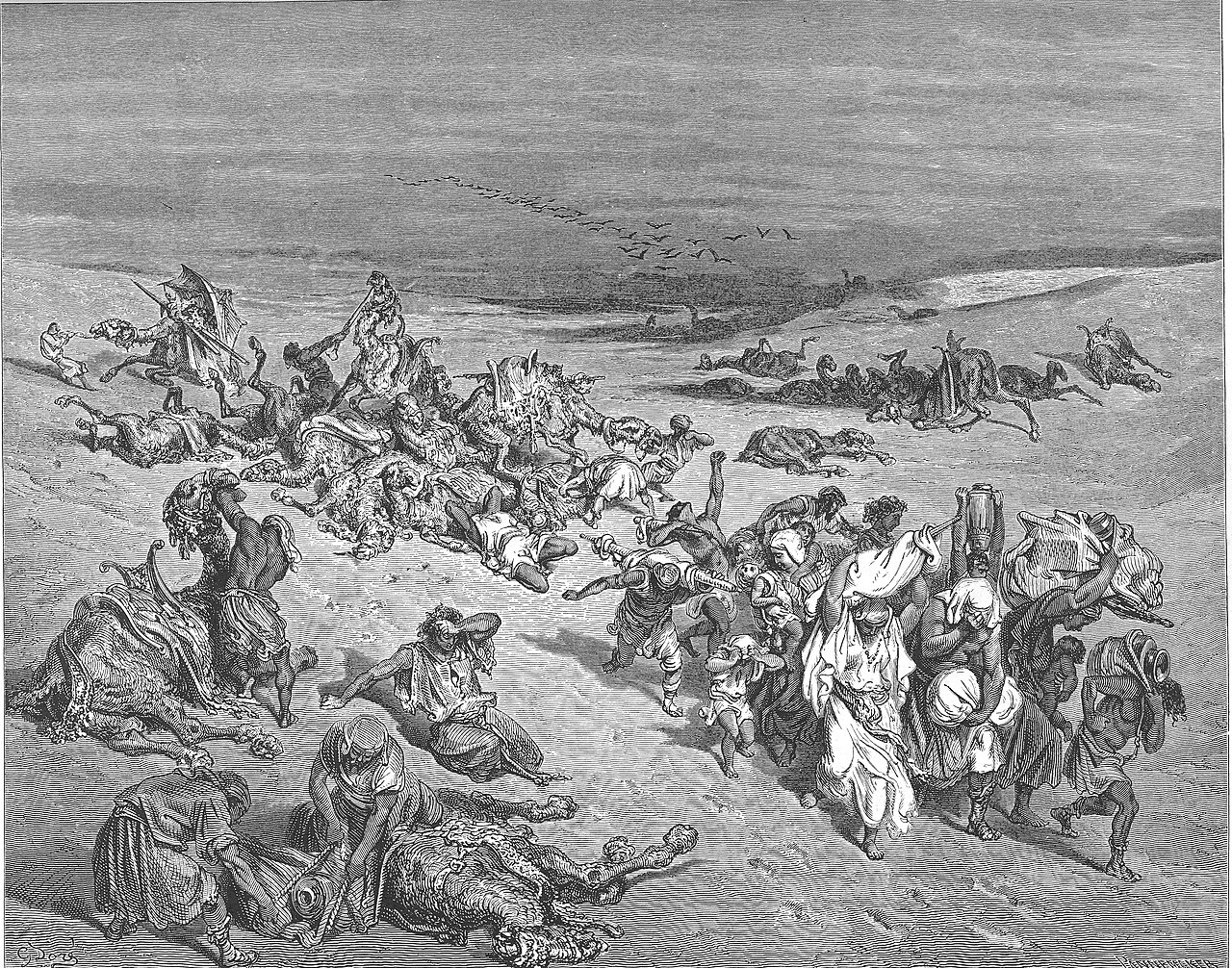
Plague on the Livestock
Boils from a Handful of Ashes
Ibn Ezra on Exodus 9:10
Each as earlier noted took handfuls of soot and Moses threw all of it heavenward. 45 As clearly stated in verse.
Read it in full at Sefaria · Ibn Ezra's commentary on the Pentateuch, tran. and annot. by H. Norman Strickman and Arthur M. Silver. Menorah Pub., 1988-2004
Ramban on Exodus 9:11
They were ashamed, and confounded, and covered their heads. Jeremiah:3. since they were full of boils and could not rescue themselves. Therefore they made no appearance in the royal palace, nor did they appear before Moses in the streets. And so they were imprisoned in their homes.
Read it in full at Sefaria · Commentary on the Torah by Ramban (Nachmanides). Translated and annotated by Charles B. Chavel. New York, Shilo Pub. House, 1971-1976
Ramban on Exodus 9:12
It is possible that during the first plagues, the magicians hardened Pharaoh’s heart in order to pride themselves in their wisdom. But now that they did not come before him and there was none to help him and none to uphold him. See Isaiah:5.
Read it in full at Sefaria · Commentary on the Torah by Ramban (Nachmanides). Translated and annotated by Charles B. Chavel. New York, Shilo Pub. House, 1971-1976
A Warning of Coming Hail
Ibn Ezra on Exodus 9:13
Scripture does not here note that Pharaoh went out unto the water.
Read it in full at Sefaria · Ibn Ezra's commentary on the Pentateuch, tran. and annot. by H. Norman Strickman and Arthur M. Silver. Menorah Pub., 1988-2004
Ibn Ezra on Exodus 9:14
FOR. Scripture reads, all My plagues because thunder, hail, rain, and fire combined in this plague.
Read it in full at Sefaria · Ibn Ezra's commentary on the Pentateuch, tran. and annot. by H. Norman Strickman and Arthur M. Silver. Menorah Pub., 1988-2004
Hail and Fire Running Down
Hebrew words in this chapter
The 40 most used Hebrew words of the chapter, counted by lemma. The article, the object marker, the negatives and the common prepositions are left out.
| Word | Sense here | Uses | Strong’s |
|---|---|---|---|
| יְהֹוָהYᵉhôvâh | yahweh | 24 | H3068 |
| אֶרֶץʼerets | land | 15 | H776 |
| בָּרָדbârâd | hail | 14 | H1259 |
| מֹשֶׁהMôsheh | Moses | 13 | H4872 |
| פַּרְעֹהParʻôh | Pharaoh | 12 | H6547 |
| שָׁלַחshâlach | to send | 12 | H7971 |
| אָמַרʼâmar | to say | 10 | H559 |
| מִקְנֶהmiqneh | livestock | 9 | H4735 |
| מִצְרַיִםMitsrayim | Egypt | 9 | H4714 |
| שָׂדֶהsâdeh | in the field | 8 | H7704 |
| עַםʻam | people | 7 | H5971 |
| יִשְׂרָאֵלYisrâʼêl | Israel | 6 | H3478 |
| לֵבlêb | heart | 6 | H3820 |
| עֶבֶדʻebed | and on servants your | 6 | H5650 |
| מוּתmûwth | to die | 5 | H4191 |
| דָּבָרdâbâr | word | 5 | H1697 |
| אָדָםʼâdâm | humankind | 5 | H120 |
| בְּהֵמָהbᵉhêmâh | the livestock | 5 | H929 |
| נָכָהnâkâh | and I struck | 5 | H5221 |
| קוֹלqôwl | thunder claps | 5 | H6963 |
| Word | Sense here | Uses | Strong’s |
|---|---|---|---|
| אֱלֹהִיםʼĕlôhîym | God | 4 | H430 |
| יָדyâd | hand | 4 | H3027 |
| בֵּןbên | to people of | 4 | H1121 |
| שָׁמַיִםshâmayim | heaven | 4 | H8064 |
| שְׁחִיןshᵉchîyn | boil | 4 | H7822 |
| עָמַדʻâmad | to stand | 4 | H5975 |
| דָבַרdâbar | and you will say | 3 | H1696 |
| עוֹדʻôwd | still | 3 | H5750 |
| חָזַקchâzaq | keeping hold | 3 | H2388 |
| כָּבֵדkâbêd | heavy | 3 | H3515 |
| מְאֹדmᵉʼôd | very | 3 | H3966 |
| לָקַחlâqach | to take | 3 | H3947 |
| עָבוּרʻâbûwr | inorder that | 3 | H5668 |
| יָדַעyâdaʻ | to know | 3 | H3045 |
| כְּמוֹkᵉmôw | like | 3 | H3644 |
| עַתָּהʻattâh | now | 3 | H6258 |
| חָדַלchâdal | to cease | 3 | H2308 |
| כֹּהkôh | thus | 2 | H3541 |
| עִבְרִיʻIbrîy | Hebrew | 2 | H5680 |
| עָבַדʻâbad | to serve | 2 | H5647 |
Keep studying
Sources for this chapter
The Hebrew text
STEP Bible, the tagged Hebrew text and its English glosses and James Strong, Strong's Exhaustive Concordance.
In Jewish life
Rashi, Rashi on Exodus 9:10:1, 9:18:1 and 9:24:1, Pentateuch with Rashi's commentary by M. Rosenbaum and A. M. Silbermann, 1929 to 1934 (public domain); Ramban, Ramban on Exodus 9:11:1, Commentary on the Torah translated by Charles B. Chavel, Shilo, 1971 to 1976 (CC-BY); Ibn Ezra, Ibn Ezra on Exodus 9:12:1 and 9:16:1, cited by ref alone under the corpus licence rule and The Midrash, Bamidbar Rabbah 9:14, Avot DeRabbi Natan, Recension B 11:7 and 24:3, Bereshit Rabbah 5:7 and 19:7, and Mekhilta DeRabbi Yishmael, Tractate Pischa 13:6 and Tractate Vayehi Beshalach 7:6, cited by ref.
The rabbinic texts
Ramban, Commentary on the Torah by Ramban (Nachmanides). Translated and annotated by Charles B. Chavel. New York, Shilo Pub. House, 1971-1976; Ibn Ezra, Ibn Ezra's commentary on the Pentateuch, tran. and annot. by H. Norman Strickman and Arthur M. Silver. Menorah Pub., 1988-2004 and Sefaria, texts and citation data.