
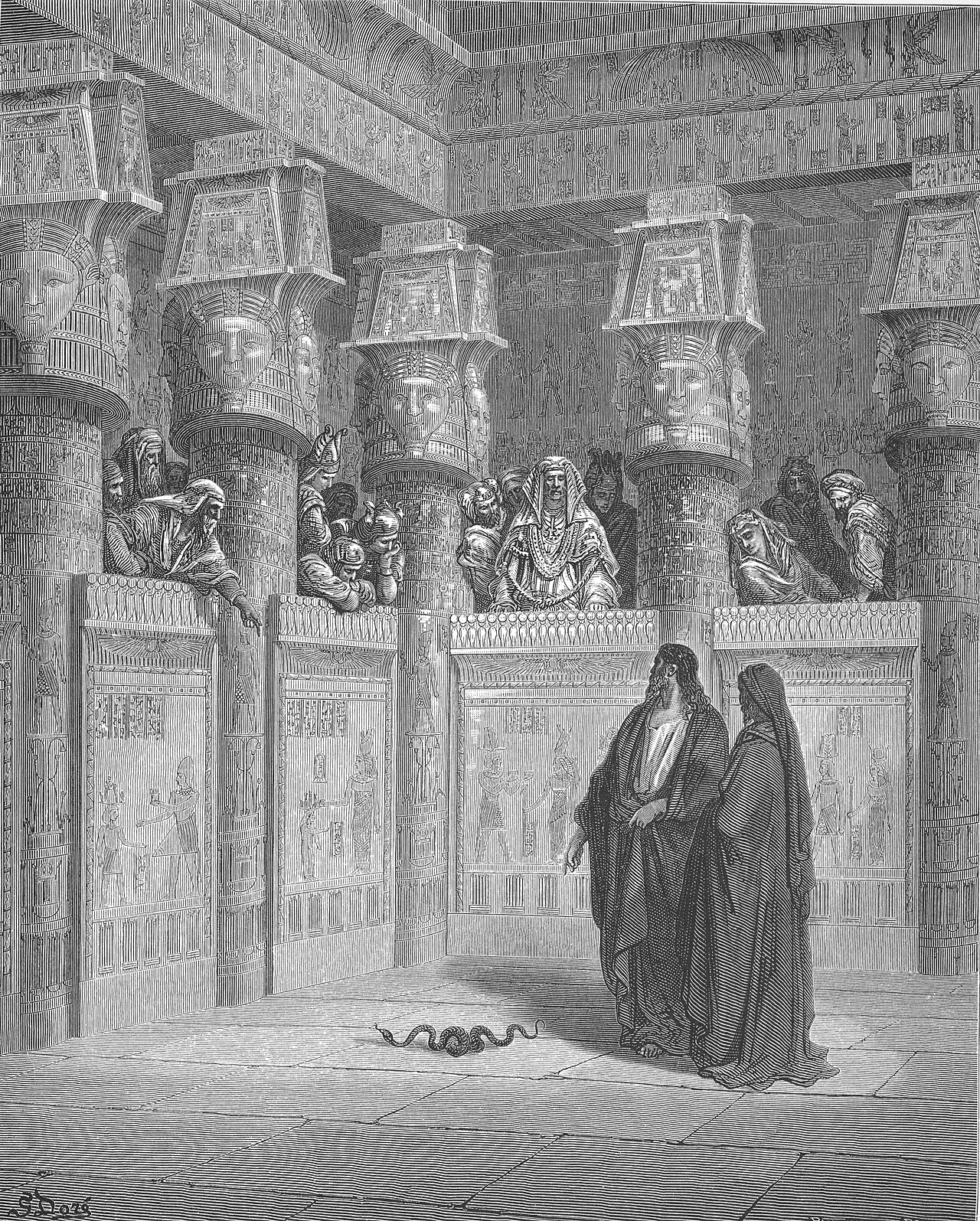
Exoduschapter 7
25 verses · Moses, by tradition · 15th or 13th century BC · The Law
The LORD answered Moses, “See, I have made you like God to Pharaoh, and your brother Aaron will be your prophet.
Introduction
Moses, by tradition, The Law, Exodus Overview.
This chapter begins the contest between the LORD and Egypt that runs to the sea. It was written for a people who had watched it happen and would teach it to their children. Egypt trusted the Nile as the giver of its life, and its court kept learned men who could answer wonders with wonders. Listen for the stated purpose that runs through the plagues, that Egypt should come to know the LORD. Watch the king's heart, because the book reports its condition after every stroke.
Context
- Who
- Israel in the wilderness, who had watched their masters' river struck
- What
- A narrative chapter that sends Moses and Aaron before Pharaoh, shows the sign of the staff, and reports the first plague on the Nile.
- Where
- Pharaoh's court and the banks of the Nile, with the plague reaching the rivers, canals, ponds and vessels of all Egypt.
- When
- About 1446 BC on the traditional early date, in the year of the exodus.
- Why
- To begin the judgments by which Egypt would know that the LORD is God.
Historical context
The book claims Moses as its writer, at Exodus 17:14, Exodus 24:4 and Exodus 34:27, and the dossier records the critical reading that the Pentateuch was compiled from separate sources. The text gives the ages of the two men at this audience, Moses at eighty years and Aaron at eighty three, and neither held any standing in Egypt.
Show the rest of the historical context, 3 more paragraphs
The period is the opening of the plagues, around 1446 BC on the early date, with Kenneth Kitchen and James Hoffmeier placing the exodus in the thirteenth century BC instead. The place is the court in the Delta and the bank of the Nile, where the king went out in the morning.
The occasion is the second sending. Israel had refused to listen, Moses had objected twice, and the brothers were sent back with a sign to perform and a plague to announce.
A first hearer knew what he was watching, since Egypt kept a professional class of lector priests, the men who read the ritual books, and Egyptian tales celebrate the wonders they worked. He knew that the cobra was the emblem of royal power worn on Pharaoh's brow, so a staff turned serpent was a challenge aimed at the crown. He knew what the Nile was to Egypt, whose annual flood laid the silt that made the land farmable and set the calendar of planting and harvest, and which was honoured in the god Hapi. He also knew why a man digs beside a fouled river, because water filtered through the sand at the edge can still be drunk.
Significance
Israel heard the first of the judgments as an argument rather than as a punishment alone. The stated purpose was that Egypt should know who the LORD is, and the first blow fell on the thing Egypt trusted most.
Show the rest of the significance, 1 more paragraph
They also heard that Pharaoh's refusal was announced in advance, so the delay was not a surprise God suffered. For a people who had watched Egyptian religion all their lives, the sequence opened exactly where Egyptian confidence began.
This chapter in Jewish lifeWhat this chapter is in Jewish life and reading.
How it is read
Rashi meets the hardening of Pharaoh's heart at verse 3 and answers it directly. Pharaoh has resisted, he says, so it is better that his heart be hardened "in order that My signs may be multiplied against him". He then points to a distinction the text itself keeps. Through the first five plagues Scripture says that Pharaoh's heart was hardened, rather than that the LORD hardened it (Rashi on Exodus 7:3:1). That reading of the first five is worth setting beside this site's own entry on the question, which carries the positions with their holders. At verse 17 Rashi gives the reason the water was struck first. Egypt had no rain and lived by the river, so "God first smote their deity and afterwards smote them" (Rashi on Exodus 7:17:1). At verse 19 he holds that Aaron struck the river and Moses did not, because the river had sheltered Moses as a child (Rashi on Exodus 7:19:1). At verse 25 he reckons each plague at a quarter of a month, with warning given through the other three quarters (Rashi on Exodus 7:25:1). The text is the Rosenbaum and Silbermann Rashi of 1929 to 1934, in the public domain.
What the rabbis say
The rabbis take up the making of Moses as a god to Pharaoh at Bamidbar Rabbah 14:6 and 15:13. On the staff cast down before Pharaoh they taught at Menachot 85a:3 and Midrash Aggadah, Exodus 7:10:1. On the staff that swallowed the others they taught at Ein Yaakov (Glick Edition), Shabbat 11:2. On the hardening they taught in Midrash Lekach Tov, Exodus 7:3:1.
Sources: Rashi, Rashi on Exodus 7:3:1, 7:17:1, 7:19:1 and 7:25:1, Pentateuch with Rashi's commentary by M. Rosenbaum and A. M. Silbermann, 1929 to 1934 (public domain); Ibn Ezra, Ibn Ezra on Exodus 7:13:1 and 7:20:1, cited by ref alone under the corpus licence rule; The Babylonian Talmud, Menachot 85a:3, cited by ref; The Midrash, Bamidbar Rabbah 14:6 and 15:13, Midrash Aggadah, Exodus 7:10:1, Ein Yaakov (Glick Edition), Shabbat 11:2, and Midrash Lekach Tov, Exodus 7:3:1, cited by ref.
The heads below are this chapter's scenes. The numbered points under each are its verses.
Made as God to Pharaoh
Exodus 7:1-2
The arrangement of 4:16 is repeated here in stronger words, where Aaron was to be to Moses instead of a mouth and Moses to Aaron instead of God. The verse gives a working definition of a prophet, which is a man who speaks what he is given by another. Verse 2 spells the chain out, that Moses speaks all that he is commanded and Aaron carries it to Pharaoh.
Exodus 7:1
“Moses again repeats, that consolation was afforded him in his anxiety, and a remedy given for his want of faith; since he was both armed himself with divine authority, and Aaron was appointed as his companion and assistant. For that he was "made a god to Pharaoh," means that he was furnished with supreme authority and power, whereby he should cast down the tyrant's pride.”
John Calvin · Commentaries (1554)reformed
2 more voices on this verseWhat preachers and commentators have said about this verse, in their own words.
Exodus 7:1
“I have made thee a god--"made," that is, set, appointed; "a god"; that is, he was to act in this business as God's representative, to act and speak in His name and to perform things beyond the ordinary course of nature.”
Jamieson, Fausset & Brown · Commentary Critical and Explanatory on the Whole Bible (1871)reformed
Exodus 7:1
“With this chapter begins the series of miracles performed in Egypt. They are progressive. The first miracle is performed to accredit the mission of the brothers; it is simply credential, and unaccompanied by any infliction. Then come signs which show that the powers of nature are subject to the will of Yahweh, each plague being attended with grave consequences to the Egyptians, yet not inflicting severe loss or suffering; then in rapid succession come ruinous and devastating plagues, murrain, boils, hail and lightning, locusts, darkness, and lastly, the death of the firstborn.”
You are to speak all that I command you: The verse sets the chain of speech for the plagues. God commands Moses, Moses speaks to Aaron, and Aaron speaks to Pharaoh, as the LORD arranged in 4:15 and 16. Jamieson, Fausset and Brown, on verse 1, explain that Moses was to act as God's representative, speaking and acting in His name.
Exodus 7:2
“Thou shalt speak all that I command thee,.... That is, to Aaron his prophet, whatever the Lord made known to him in a private manner as his will to be done: and Aaron thy brother shall speak unto Pharaoh; whatsoever should be told him by Moses, as from the Lord: that he send the children of Israel out of his land; this was the principal thing to be insisted upon; and all that was said or done to him was to bring about this end, the dismission of the children of Israel out of Egypt.”
1 more voice on this verse
Exodus 7:2
“He chastiseth his disobedience by a plague, the first of ten, turning the waters into blood; but Pharaoh hardens his heart again, ver. 14-25. Commentary on Chapter VII 1. I have made thee a God to Pharaoh - That is, my representative in this affair, as magistrates are called gods, because they are God's vicegerents.”
John Wesley · Explanatory Notes upon the Old Testament (1765)evangelical
This is the second of two announcements that God will harden Pharaoh, the first at 4:21, and both stand before a single plague has fallen. Through the first five plagues the text then puts the act on Pharaoh or leaves it stative, at 7:13, 7:14, 7:22, 8:15, 8:19, 8:32 and 9:7, and 9:12 is the first place it says the LORD did it. Romans 9:17 quotes Exodus 9:16 and draws from it that whom he will he hardeneth. R. C. Sproul reads the sequence as one act with two true descriptions, holding that divine sovereignty and human responsibility are both real, and the free will reading takes the order of the statements as God confirming a man in the direction he had already taken.
Exodus 7:3
“As the expression is somewhat harsh, many commentators, as I have before said, take pains to soften it. Hence it is that some take the words in connection, "I will harden Pharaoh's heart by multiplying my signs;" as if God were pointing out the external cause of his obstinacy.”
John Calvin · Commentaries (1554)reformed
2 more voices on this verse
Exodus 7:3
“I will harden Pharaoh's heart--This would be the result. But the divine message would be the occasion, not the cause of the king's impenitent obduracy. I may lay mine hand upon Egypt, &c.--The succession of terrible judgments with which the country was about to be scourged would fully demonstrate the supremacy of Israel's God.”
Jamieson, Fausset & Brown · Commentary Critical and Explanatory on the Whole Bible (1871)reformed
Exodus 7:3
“Wonders - A word used only of portents performed to prove a divine interposition; they were the credentials of God’s messengers.”
Exodus 7:4-5
The purpose given for the refusal is that Egypt shall know who the LORD is, which answers the question Pharaoh asked at 5:2, who is the LORD, that I should obey his voice. Genesis 15:14 had promised of Egypt that nation, whom they shall serve, will I judge, and the great judgments named here are the discharge of that promise. The people are called mine armies, a word for a body drawn up in order rather than a crowd, and it returns at 12:41 and 12:51 for the same people walking out.
Exodus 7:4
“Israel is made to know it by the performance of his promises to them ( ch. vi. 3 ), and the Egyptians are made to know it by the pouring out of his wrath upon them. Thus God's name is exalted both in those that are saved and in those that perish.”
Matthew Henry · Commentary on the Whole Bible (1707-1721)puritan
the Egyptians will know that I am the LORD: Pharaoh had asked in 5:2 who the LORD is. This verse answers that the Egyptians will learn who He is by His hand stretched out in judgment and by Israel's departure. The phrase recurs through the plagues as their stated purpose. Adam Clarke argues that Pharaoh's resistance was caused or permitted so the exodus would show the LORD's power over Egypt's king and gods.
Exodus 7:5
“And bring out the children of Israel - Pharaoh’s obstinacy was either caused or permitted in mercy to the Egyptians, that he and his magicians being suffered to oppose Moses and Aaron to the uttermost of their power, the Israelites might be brought out of Egypt in so signal a manner, in spite of all the opposition of the Egyptians, their king, and their gods, that Jehovah might appear to be All-mighty and All-sufficient.”
Adam Clarke · Commentary on the Bible (1810-1826)evangelical
Exodus 7:6-7
The obedience is stated twice in one verse, and Gill takes the repetition as the report that from here on the two of them never argued again, after five chapters in which Moses raised objection after objection. Their ages are given at the moment they walk in, fourscore and fourscore and three. Acts 7:23 and 7:30 divide Moses' life into forty years in Egypt and forty in Midian, so the errand begins when four fifths of it is already spent.
Exodus 7:6
“And Moses and Aaron did as the Lord commanded them,.... After this they never showed any reluctance, or made any objection to any message they were sent with, or any work they were ordered to do, but went about it at once, and performed it with all readiness and cheerfulness: so did they; which is not a superfluous and redundant expression, but very emphatic, showing with what care and diligence they did every thing, and how exactly they conformed in all things to the divine will.”
Moses was eighty years old: The ages mark the moment: Moses at eighty and Aaron at eighty-three. Moses spent forty years in Egypt and forty in Midian, the count Stephen gives in Acts 7, as Adam Clarke notes. Matthew Henry contrasts Joseph, raised to serve Pharaoh at thirty, with Moses, made like God to Pharaoh only at eighty.
Exodus 7:7
“Moses was fourscore years old - He was forty years old when he went to Midian, and he had tarried forty years in Midian; (see Exo 2:11, and Act 7:30); and from this verse it appears that Aaron was three years older than Moses. We have already seen that Miriam their sister was older than either, Exo 2:4.”
Adam Clarke · Commentary on the Bible (1810-1826)evangelical
1 more voice on this verse
Exodus 7:7
“Joseph, who was to be only a servant to Pharaoh, was preferred at thirty years old; but Moses, who was to be a god to Pharaoh, was not so dignified until he was eighty years old.”
Matthew Henry · Commentary on the Whole Bible (1707-1721)puritan
The Rod That Swallowed the Serpents
Exodus 7:8-10
The first sign given at the bush comes back. At 4:2-4 the rod became a serpent and Moses fled from it, and here Aaron casts it down before Pharaoh on command, though the Hebrew noun is not the one used at the bush. Exodus 4:3 has nachash, the ordinary word for a snake, while 7:9, 7:10 and 7:12 have tannin, a word used elsewhere of a great creature of the water. The same rod turns the river at verse 20, divides the sea at 14:16 and strikes the rock at 17:6.
Exodus 7:8
“And the Lord spake unto Moses and unto Aaron,.... After he had given them their commission, and instructions to go to Pharaoh, and a little before they went in to him: saying, as follows.”
1 more voice on this verse
Exodus 7:8
Great indeed was Moses, who afflicted Egypt grievously and saved his people by many signs and prodigies, who went within the cloud and instituted the twofold law: the law of the letter without and the law of the spirit within. Aaron also, the brother of Moses according to the flesh and the spirit, sacrificed and prayed on behalf of the people, as consecrated minister of the great and holy tabernacle, "which the Lord has erected and not man."
Gregory of Nazianzus · written before 390 · ORATION 43, On St. Basil 72patristic
The LORD expects Pharaoh to demand a proof, and He supplies it in advance. The staff is to become a serpent, the Hebrew tannin, a different word from the snake of 4:3. Albert Barnes notes that tannin covers river and sea creatures and is applied to the crocodile as a symbol of Egypt.
Exodus 7:9
“Thy rod - Apparently the rod before described Exo 4:2, which Moses on this occasion gives to Aaron as his representative. A serpent - A word different from that in Exo 4:3. Here a more general term, תנין tannı̂yn, is employed, which in other passages includes all sea or river monsters, and is more specially applied to the crocodile as a symbol of Egypt. It occurs in the Egyptian ritual, nearly in the same form, “Tanem,” as a synonym of the monster serpent which represents the principle of antagonism to light and life.”
1 more voice on this verse
Exodus 7:9
“Notice has already been taken of the rod of Moses (Ex 4:2), but rods were carried also by all nobles and official persons in the court of Pharaoh. It was an Egyptian custom, and the rods were symbols of authority or rank.”
Jamieson, Fausset & Brown · Commentary Critical and Explanatory on the Whole Bible (1871)reformed
Aaron threw his staff down before Pharaoh: Moses and Aaron do exactly as commanded, and the sign is given before Pharaoh and his officials. Aaron handles the staff, in keeping with his role as the prophet of Moses. Ambrose of Milan read the staff that became a serpent as a figure of the Word made flesh, sent to destroy the poison of the serpent.
Exodus 7:10
“He cast down his rod, and it became a serpent which devoured the serpents of Egypt. This signified that the Word should become flesh to destroy the poison of the dread serpent by the forgiveness and pardon of sins. For the rod stands for the Word that is true, royal, filled with power and glorious in ruling. As the rod became a serpent, so he who was the Son of God begotten of the Father became the Son of man born of a woman.”
Ambrose of Milan · written before 397 · On the Duties of the Clergy 3.15.94patristic
Exodus 7:11-12
Egypt's own experts match the sign, and this is the first of three stages the magicians pass through in the book. They duplicate the rod here, the blood at verse 22 and the frogs at 8:7, then they fail at the lice and tell Pharaoh This is the finger of God at 8:19, and by the boils at 9:11 they cannot stand before Moses because the boils are upon them. Aaron's rod swallows their rods, so the first scene is decided by which serpent eats the others. Spurgeon preached this verse as the power of Aaron's rod and refused to settle whether the magicians used sleight of hand or something worse, on the ground that the outcome is the same either way.
Exodus 7:11
“Three names for the magicians of Egypt are given in this verse. The “wise men” are men who know occult arts. The “sorcerers” are they who “mutter magic formulae,” especially when driving away crocodiles, snakes, asps, etc. It was natural that Pharaoh should have sent for such persons. The “magicians” are the “bearers of sacred words,” scribes and interpreters of hieroglyphic writings.”
1 more voice on this verse
Exodus 7:11
“Moses had been originally instructed in the learning of the Egyptians, and was suspected to have improved in magical arts in his long retirement. The magicians are therefore sent for to vie with him.”
John Wesley · Explanatory Notes upon the Old Testament (1765)evangelical
swallowed up the other staffs: The magicians match the first part of the sign, and then Aaron's staff swallows theirs, showing the LORD's power over Egypt's arts. Interpreters differ on how the magicians did it. Charles Spurgeon allowed either sleight of hand or demonic aid and left the question open, and Adam Clarke held that God permitted their skill so His superiority would be clear.
Exodus 7:12
“Aaron’s rod swallowed up their rods - As Egypt was remarkably addicted to magic, sorcery, etc., it was necessary that God should permit Pharaoh’s wise men to act to the utmost of their skill in order to imitate the work of God, that his superiority might be clearly seen, and his powerful working incontestably ascertained; and this was fully done when Aaron’s rod swallowed up their rods. We have already seen that the names of two of the chief of these magicians were Jannes and Jambres; see Clarke on Exo 2:10 (note), and 2Ti 3:8 (note).”
Adam Clarke · Commentary on the Bible (1810-1826)evangelical
1 more voice on this verse
Exodus 7:12
“WE shall not attempt to discuss the question as to whether these magicians actually did turn their rods into serpents or not. It is probable that they, by dexterous sleight of hand, substituted living serpents for dry rods and so deceived the eyes of Pharaoh. On the other hand, it is possible that God was pleased to permit the devil to aid their enchantments, and so the old serpent produced a brood. But into that question, I say, I shall not enter. It is of no importance which opinion we may hold.”
The KJV reads And he hardened Pharaoh's heart, which leaves the subject of the verb open, and the ASV renders the same clause And Pharaoh's heart was hardened. Adam Clarke argued that the Hebrew here is the identical construction the KJV translates as was hardened at verse 22, and that it should have been put the same way in both places. Any reading of the chapter that leans on this verse has to say that the translations differ. The closing clause, as the LORD had said, points back to the refusal foretold at verse 4.
Exodus 7:13
“And he hardened Pharaoh’s heart - ויחזק לב פרעה vaiyechezak leb Paroh, “And the heart of Pharaoh was hardened,” the identical words which in Exo 7:22 are thus translated, and which should have been rendered in the same way here, lest the hardening, which was evidently the effect of his own obstinate shutting of his eyes against the truth, should be attributed to God. See Clarke’s note on Exo 4:21.”
Adam Clarke · Commentary on the Bible (1810-1826)evangelical
The Nile Turned to Blood
The Hebrew word behind the English harden changes here. Verse 13 has chazaq and this verse has kabed, which carries the sense of heavy or dull, and qashah stands behind the same English elsewhere in the book, so no single Hebrew word runs through the nineteen statements. Clarke reads the heaviness as the condition of a man who takes no conviction from evidence however clear the light on it.
Exodus 7:14
“And the Lord said unto Moses, Pharaoh's heart is hardened,.... Or "heavy" (c), dull and stupid, stiff and inflexible, cannot lift up his heart, or find in his heart to obey the will of God: he refuseth to let the people go; which was an instance and proof of the hardness and heaviness of his heart, on which the above miracle had made no impression, to regard what God by his ambassadors had required of him. (c) כבד "grave", Montanus, Drusius. So Ainsworth.”
Exodus 7:15-16
Plague one opens the first of three triads, and the opening line is where the pattern shows: the first plague of each set is warned at the river in the morning, at 7:15, 8:20 and 9:13, the second is warned inside the palace, at 8:1, 9:1 and 10:1, and the third falls with no warning at all, at 8:16, 9:8 and 10:21. Verse 16 gives the demand in the form it keeps for the rest of the book, Let my people go, that they may serve me, which is release for a purpose rather than release on its own. That purpose clause is attached seven times, at 4:23, 7:16, 8:1, 8:20, 9:1, 9:13 and 10:3, and the Hebrew root inside it is the one Exodus 1:13 and 1:14 used five times over for the bondage.
Exodus 7:15
“Get thee unto Pharaoh in the morning,.... The next morning, a time in which the mind is most composed and sedate, and fit to attend to what may be suggested: lo, he goeth out unto the water; the river Nile, either to take his morning's walk, and to refresh himself at the waterside, as the Jerusalem Targum; or to observe divinations upon the water, as a magician, as the Targum of Jonathan. So in the Talmud (d) it is said, that the Pharaoh in the days of Moses was a magician.”
1 more voice on this verse
Exodus 7:15
“He goeth out unto the water - The Nile was worshipped under various names and symbols; at Memphis especially, as Hapi, i. e. Apis, the sacred bull, or living representation of Osiris, of whom the river was regarded as the embodiment or manifestation. If, as is probable, the king went to offer his devotions, the miracle would have special force and suitableness. It was also the season of the yearly overflowing, about the middle of June; and the daily rise of the water was accurately recorded, under the personal superintendence of the king.”
Let My people go, so that they may worship Me: At the riverbank Moses repeats the demand of 5:1 in the LORD's name. The closing words, that Pharaoh has not listened until now, set the first plague as the answer to his refusal. Albert Barnes, on verse 15, suggests Pharaoh went to the Nile to worship it, which gave the plague on the river special force.
Exodus 7:16
“And thou shalt say unto him,.... Upon meeting him: the Lord God of the Hebrews hath sent me unto thee; still appearing in the character of the ambassador of Jehovah, the God of the children of Israel: saying, let my people go, that they may serve me in the wilderness; the demand is once more renewed, before any punishment is inflicted for refusal, that the patience and forbearance of God might be the more visible, and his judgments appear the more righteous when inflicted, as well as Pharaoh be left more inexcusable.”
Exodus 7:17-18
The sign is aimed at Pharaoh's own question. He asked at 5:2 who is the LORD, that I should obey his voice, and the answer given here is in this thou shalt know that I am the LORD. What is struck is the Nile, which is where the Hebrew boys were ordered drowned at 1:22 and where the ark of bulrushes was laid at 2:3. Clarke gathers the traveller accounts of how good the water of the Nile was held to be, and that is what gives the loathing of verse 18 its weight.
Exodus 7:17
“Turned to blood - This miracle would bear a certain resemblance to natural phenomena, and therefore be one which Pharaoh might see with amazement and dismay, yet without complete conviction. It is well known that before the rise the water of the Nile is green and unfit to drink. About the 25th of June it becomes clear, and then yellow, and gradually reddish like ochre; an effect due to the presence of microscopic cryptogams and infusoria.”
The fish in the Nile will die: The LORD names three results in advance: dead fish, a stinking river and water the Egyptians cannot drink. The Nile was Egypt's drinking water and food supply, so the sign struck daily life. Adam Clarke cites a French writer's praise of the sweetness of Nile water to show how bitter the loss would be.
Exodus 7:18
“The Egyptians shall loathe to drink of the water - The force of this expression cannot be well felt without taking into consideration the peculiar pleasantness and great salubrity of the waters of the Nile. “The water of Egypt,” says the Abbe Mascrier, “is so delicious, that one would not wish the heat to be less, or to be delivered from the sensation of thirst. The Turks find it so exquisite that they excite themselves to drink of it by eating salt.”
Adam Clarke · Commentary on the Bible (1810-1826)evangelical
The stroke is widened past the river to the streams, the rivers, the ponds and the pools, and then to the blood standing in vessels of wood and vessels of stone. Aaron holds the rod through the first three plagues as he held it for the serpent, and from the boils at 9:10 onward Moses acts himself. Egypt lived on that water, and the verse leaves nothing holding water untouched.
Exodus 7:19
“The “streams” mean the natural branches of the Nile in Lower Egypt. The word “rivers” should rather be “canals”; they were of great extent, running parallel to the Nile, and communicating with it by sluices, which were opened at the rise, and closed at the subsidence of the inundation. The word rendered “ponds” refers either to natural fountains, or more probably to cisterns or tanks found in every town and village. The “pools”, literally “gathering of waters,” were the reservoirs, always large and some of enormous extent, containing sufficient water to irrigate the country in the dry season.”
Exodus 7:20-21
The third sign given at the bush arrives as the first plague. At 4:9 Moses was told to pour water from the river on the dry land and it would become blood, which was given then as a sign to Israel and is done now to the river itself in the sight of Pharaoh and his servants. Commentators divide over whether the water became blood or the appearance of blood, with Clarke holding the change real because the fish died and the river stank, and Jamieson, Fausset and Brown leaving the question open on the ground that either was within God's power. The text reports the dead fish, the stench and the water no one could drink, and says nothing about the substance.
Exodus 7:20
“All the waters - were turned to blood - Not merely in appearance, but in reality; for these changed waters became corrupt and insalubrious, so that even the fish that were in the river died; and the smell became highly offensive, so that the waters could not be drank; Exo 7:21.”
Adam Clarke · Commentary on the Bible (1810-1826)evangelical
2 more voices on this verse
Exodus 7:20
“Also they had stained the river with the blood of the Hebrew children, and now God made that river all bloody; thus he gave them blood to drink, for they were worthy, Rev. xvi, 6. Every creature is that to us which he makes it to be, water or blood.”
John Wesley · Explanatory Notes upon the Old Testament (1765)evangelical
Exodus 7:20
“Aaron lifted up the rod and smote the waters, &c.--Whether the water was changed into real blood, or only the appearance of it (and Omnipotence could effect the one as easily as the other), this was a severe calamity.”
Jamieson, Fausset & Brown · Commentary Critical and Explanatory on the Whole Bible (1871)reformed
The fish in the Nile died: Each thing foretold in verse 18 comes to pass: the fish die, the river stinks, the water cannot be drunk, and blood fills the land. The fulfilment matches the word given beforehand, which marks the sign as the LORD's work. Albert Barnes notes that Egyptians lived largely on Nile fish, so a mass death of fish was a dreaded plague.
Exodus 7:22-23
The magicians match the plague, and Wesley notes what the match costs Egypt, since turning more water into blood while water is scarce helps nobody and proves only that they can do it. Undoing the plague would have answered Moses, and they do not undo it. The hardening is put in the plain passive here, Pharaoh's heart was hardened, and verse 23 adds that he turned and went into his house and did not set his heart to this also.
Exodus 7:22
“And the magicians - did so - But if all the water in Egypt was turned into blood by Moses, where did the magicians get the water which they changed into blood? This question is answered in Exo 7:24. The Egyptians dug round about the river for water to drink, and it seems that the water obtained by this means was not bloody like that in the river: on this water therefore the magicians might operate.”
Adam Clarke · Commentary on the Bible (1810-1826)evangelical
1 more voice on this verse
Exodus 7:22
“And the magicians did so - By God's permission with their enchantments; and this served Pharaoh for an excuse not to set his heart to this also, (ver. 23,) and a poor excuse it was. Could they have turned the river of blood into water again, it had been something; then they had proved their power, and Pharaoh had been obliged to them as his benefactors.”
John Wesley · Explanatory Notes upon the Old Testament (1765)evangelical
did not take any of this to heart: Pharaoh turns away and goes home without taking the sign to heart. Verse 22 says his heart was hardened; here the refusal is his own act. Adam Clarke, on verse 13, reads the hardening as the effect of Pharaoh's own obstinacy, and John Wesley, on verse 22, says the magicians' copy gave him an excuse to set this sign aside.
Exodus 7:23
“But for them, when there was such scarcity of water, to turn more of it into blood, only to show their art, plainly intimates that the design of the devil is only to delude his devotees and amuse them, not to do them any real kindness, but to keep them from doing a real kindness to themselves by repenting and returning to their God.”
Matthew Henry · Commentary on the Whole Bible (1707-1721)puritan
Exodus 7:24-25
Egypt digs beside the Nile for water it can drink, and Henry reads the digging as mercy inside the judgment, since the people were not left to die of thirst for their king's obstinacy. The plague is given a length, seven days, which the text does for only one other of the nine, the three days of darkness at 10:22. Pharaoh has a week in which to answer and spends it in his house.
Exodus 7:24
“And all the Egyptians digged round about the river,.... On each side of it, in order to get clear water; and Aben Ezra thinks the Hebrews also, who were affected with this, and the two following plagues, the frogs and lice: but it is much more reasonable to conclude that they were free from them all.”
seven full days passed: The plague on the Nile lasted a full week after the LORD struck the river. The verse credits the stroke to the LORD, though Aaron held the staff. John Gill observes that Moses, Aaron and the rod were only instruments of almighty power, and Albert Barnes contrasts this week with the twenty days of the Nile's natural discoloration.
Exodus 7:25
“And seven days were fulfilled,.... Or there were full seven days, a whole week: after that the Lord had smitten the river, and turned it into blood; here the miracle is ascribed to him; Moses and Aaron, and the rod they used, were only instruments, nothing short of almighty power could do such a miracle; it seems this lasted seven days at least. It began, as Bishop Usher (o) computes it, on the eighteen day of the sixth month, or Adar, part of February and part of March, and ended the twenty fifth of the same.”
1 more voice on this verse
Exodus 7:25
“Seven days - This marks the duration of the plague. The natural discoloration of the Nile water lasts generally much longer, about 20 days.”
How this psalm is built
The form: Narrative prose, the first plague account, with the commission restated and a contest of signs set before it, as Keil and Delitzsch classes it.
The patterns in this chapter
| Device | What it does | Where to see it |
|---|---|---|
| The warning pattern that governs all three sets of plagues | Verse 15 sends Moses to meet Pharaoh at the river in the morning, and that is where the pattern shows. The first plague of each set of three is warned at the river, at Exodus 7:15, Exodus 8:20 and Exodus 9:13. The second of each set is warned inside the palace, at Exodus 8:1, Exodus 9:1 and Exodus 10:1. The third falls with no warning at all, at Exodus 8:16, Exodus 9:8 and Exodus 10:21. The published note on verses 15 and 16 cites Keil and Delitzsch and Matthew Henry.Keil and Delitzsch, Biblical Commentary on the Old Testament: The Pentateuch. | Exodus 7:15, Exodus 8:20, Exodus 9:13 |
| Two closing formulas, as the LORD had commanded and as the LORD had said | The first formula reports obedience and stands at verses 6, 10 and 20. The second reports that the refusal was foretold and stands at verses 13 and 22. Every scene in the chapter closes with one of the two. The note on verses 6 and 7 reports that the obedience is stated twice in one verse, and John Gill takes the repetition as the report that the brothers never argued again.John Gill, Exposition of the Old Testament. | Exodus 7:6, Exodus 7:10, Exodus 7:13, Exodus 7:20, Exodus 7:22 |
| The demand in the form it keeps for the rest of the book | Verse 16 gives the demand as release for a stated purpose, that the people may worship God in the wilderness. The purpose clause is attached seven times in the book, at Exodus 4:23, Exodus 7:16, Exodus 8:1, Exodus 8:20, Exodus 9:1, Exodus 9:13 and Exodus 10:3. The published note reports that the Hebrew root inside the clause is the root Exodus 1:13 and 1:14 use five times over for the bondage. | Exodus 7:16, Exodus 8:1, Exodus 9:13, Exodus 10:3 |
| Every kind of water named one at a time | Verse 19 widens the stroke past the river itself. It names the rivers, the canals, the ponds and the reservoirs, and then the blood standing in vessels of wood and stone. Naming each kind is the point, since it leaves nothing that holds water untouched. The note on verse 19 cites Matthew Henry and John Gill. | Exodus 7:19 |
| Three Hebrew words behind the one English word harden | Verse 13 has chazaq, the root the book also uses of God's strong hand at Exodus 6:1. Verse 14 has kabed, which carries the sense of heavy or dull, and qashah stands behind the same English word elsewhere in the book. No single Hebrew word runs through the nineteen statements about Pharaoh's heart. Adam Clarke reads the heaviness of verse 14 as the condition of a man who takes no conviction from evidence, however clear the light on it.Adam Clarke, Commentary on the Bible. | Exodus 7:13, Exodus 7:14, Exodus 7:22 |
The chapter is where the book's question gets its answer in action. Pharaoh asked at Exodus 5:2 who the LORD is that he should obey His voice. Verse 17 gives the sign with the words that by this he will know that He is the LORD, and verse 5 states the same purpose for Egypt as a whole.
13 more paragraphs on the patterns
The promise behind the judgment is older than Egypt's slavery. The note on verses 4 and 5 sets Genesis 15:14 beside them, where God promised to judge the nation Israel would serve. It also reports that the people are called God's own divisions, a word for a body drawn up in order, which returns at Exodus 12:41 and Exodus 12:51 for the same people walking out.
The signs given at the bush come back in order. The staff that became a serpent at Exodus 4:2 to 4:4 is cast down before Pharaoh here. The note records that the Hebrew noun differs, nachash at Exodus 4:3 and tannin at verses 9, 10 and 12. The water poured out as blood at Exodus 4:9 was given then as a sign to Israel, and it arrives here as the first plague against Egypt.
The magicians run a course of three stages through the book. They duplicate the staff here, the blood at verse 22 and the frogs at Exodus 8:7. They fail at the lice and tell Pharaoh that this is the finger of God at Exodus 8:19. By the boils at Exodus 9:11 they cannot stand before Moses, because the boils are upon them.
Aaron holds the staff through the first three plagues, as he held it for the serpent. From the boils at Exodus 9:10 onward Moses acts himself.
The New Testament's use
Romans 9:17 quotes Exodus 9:16 and draws from it that God hardens whom He will. The note on verse 3 reports that use, and it is the New Testament's own handling of the hardening this chapter announces.
The ages in verse 7 are read in the New Testament as well. Acts 7:23 and Acts 7:30 divide Moses' life into forty years in Egypt and forty in Midian, so the errand begins when four fifths of it is already spent.
The debated point
The hardening of Pharaoh's heart is the chapter's contested reading, and the book dossier carries it with its holders. One position holds that Pharaoh hardens his own heart first and repeatedly, and that God's hardening confirms a choice already made. The dossier names this the majority evangelical reading, and notes that the self hardening is named first in the narrative sequence. The other position holds that the hardening is sovereign and purposeful from the start, part of raising Pharaoh up to display God's power. The dossier names it as a reading leaning on Paul's use of Pharaoh at Romans 9:17 and 9:18, held within parts of the Reformed tradition. No verdict is stated here.
The translations themselves differ at verse 13. The King James reads And he hardened Pharaoh’s heart, which leaves the subject open, and the American Standard Version reads And Pharaoh’s heart was hardened. Adam Clarke argued that the Hebrew here is the identical construction the King James renders as was hardened at verse 22, and that the two places should have been put the same way. Any reading of the chapter that leans on verse 13 has to say that the translations differ.
A third question stands at verses 20 and 21. Commentators divide over whether the water became blood or the appearance of blood. Adam Clarke holds the change real, because the fish died and the river stank. Jamieson, Fausset and Brown leave the question open on the ground that either was within God's power. The text reports the dead fish, the stench and the water nobody could drink, and says nothing about the substance.
Where to go deeper
The nine plagues after this one, and what lay behind them all, are argued in full at The Ten Plagues, argued in full. The rescue they serve is set out at The Exodus, and the country they fall on is set out at Egypt.
Keep studying
Studies2
Places1
Sources for this chapter
The summary
Jamieson, Fausset & Brown, Commentary Critical and Explanatory; John Calvin, Commentaries; John Wesley, Notes on the Old Testament and Matthew Henry, Complete Commentary.
The form and classifications
Charles Spurgeon, The Metropolitan Tabernacle Pulpit, Sermon No. 521, The Power of Aaron's Rod; Keil and Delitzsch, Biblical Commentary on the Old Testament: The Pentateuch and Matthew Henry, Commentary on the Whole Bible.
The exposition
Adam Clarke, Commentary on the Bible; Albert Barnes, Notes, Explanatory and Practical, on the Old and New Testaments; Ambrose of Milan, On the Duties of the Clergy; Charles Spurgeon; Jamieson, Fausset & Brown, Commentary Critical and Explanatory on the Whole Bible; John Calvin, Commentary on the Four Last Books of Moses Arranged in the Form of a Harmony; John Gill, Exposition of the Old Testament; John Wesley, Explanatory Notes upon the Old Testament; Keil and Delitzsch, Biblical Commentary on the Old Testament: The Pentateuch and Matthew Henry, Commentary on the Whole Bible.