
Exodus 7:9
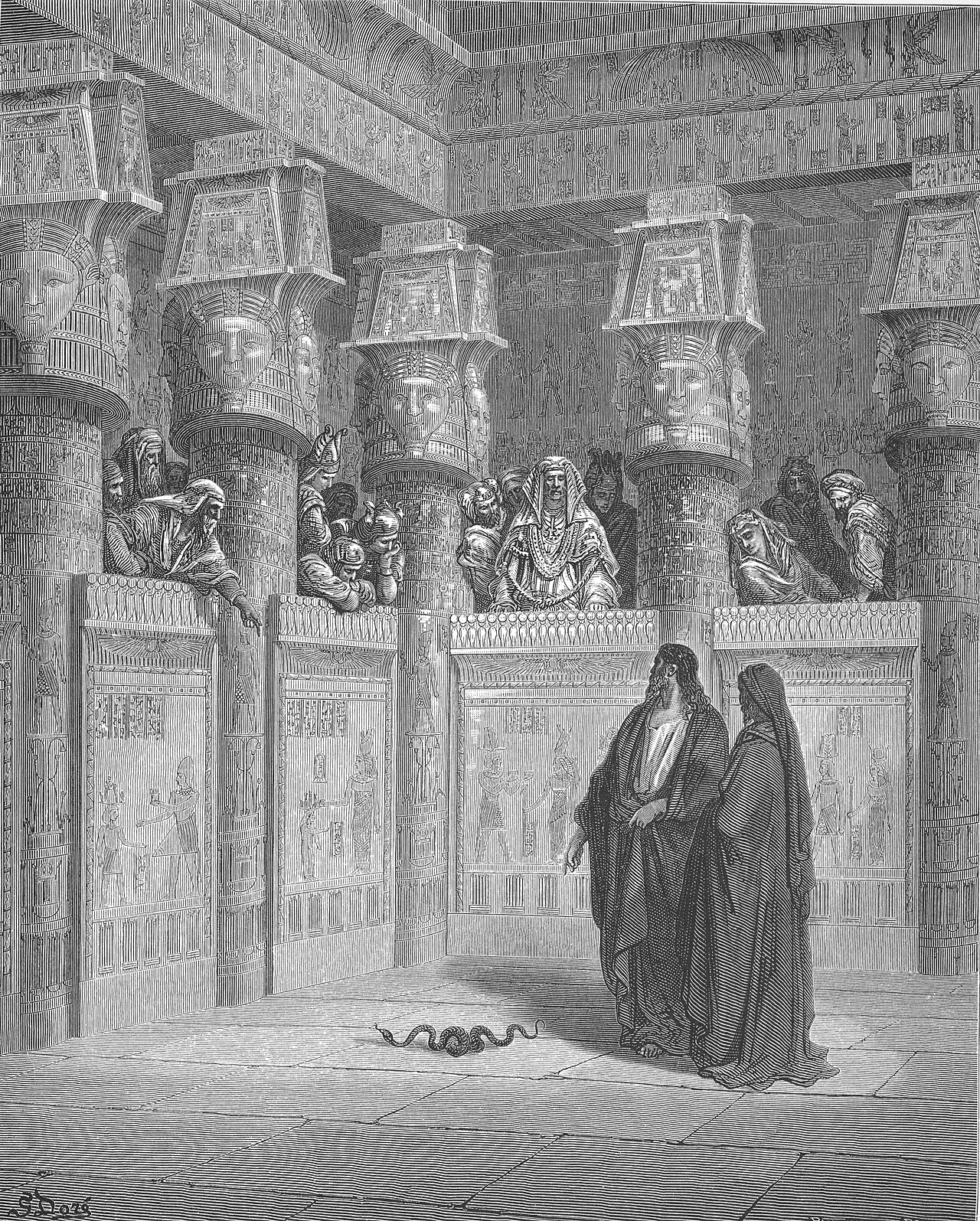
in Exodus 7“When Pharaoh tells you, ‘Perform a miracle,’ you are to say to Aaron, ‘Take your staff and throw it down before Pharaoh,’ and it will become a serpent.”
BSB
The same verse in ASV and KJV ▾
ASV
When Pharaoh shall speak unto you, saying, Show a wonder for you; then thou shalt say unto Aaron, Take thy rod, and cast it down before Pharaoh, that it become a serpent.
KJV
When Pharaoh shall speak unto you, saying, Shew a miracle for you: then thou shalt say unto Aaron, Take thy rod, and cast it before Pharaoh, and it shall become a serpent.
⋯
This verse in Exodus 7
Commentary
9 notes on this verseA commentator
Albert Barnes1798–1870
Notes, Explanatory and Practical, on the Old and New Testaments (1832-1869)
Thy rod - Apparently the rod before described Exo 4:2, which Moses on this occasion gives to Aaron as his representative. A serpent - A word different from that in Exo 4:3. Here a more general term, תנין tannı̂yn, is employed, which in other passages includes all sea or river monsters, and is more specially applied to the crocodile as a symbol of Egypt. It occurs in the Egyptian ritual, nearly in the same form, “Tanem,” as a synonym of the monster serpent which represents the principle of antagonism to light and life.
This site's exposition
spake unto Moses and unto Aaron
on Exodus 7:8-10
The first sign given at the bush comes back. At 4:2-4 the rod became a serpent and Moses fled from it, and here Aaron casts it down before Pharaoh on command, though the Hebrew noun is not the one used at the bush. Exodus 4:3 has nachash, the ordinary word for a snake, while 7:9, 7:10 and 7:12 have tannin, a word used elsewhere of a great creature of the water. The same rod turns the river at verse 20, divides the sea at 14:16 and strikes the rock at 17:6.
This site's exposition
Take your staff and throw it down
The LORD expects Pharaoh to demand a proof, and He supplies it in advance. The staff is to become a serpent, the Hebrew tannin, a different word from the snake of 4:3. Albert Barnes notes that tannin covers river and sea creatures and is applied to the crocodile as a symbol of Egypt.
The record, by era
The Church Fathers2 voices
Here indeed there was no need to use the service of the voice, for which Aaron was provided out of necessity, on account of the weakness of Moses' voice. But the staff was to be cast down so that it would become a serpent. Why did Moses himself not do this, except because that mediation of Aaron himself between Moses and Pharaoh was the symbol of some great matter?
Great indeed was Moses, who afflicted Egypt grievously and saved his people by many signs and prodigies, who went within the cloud and instituted the twofold law: the law of the letter without and the law of the spirit within. Aaron also, the brother of Moses according to the flesh and the spirit, sacrificed and prayed on behalf of the people, as consecrated minister of the great and holy tabernacle, "which the Lord has erected and not man."
The Puritans and the Awakening2 voices
When Pharaoh shall speak unto you, saying, show a miracle for you,....
He chastises his disobedience by a plague, the first of the ten, turning the waters into blood; but Pharaoh hardens his heart against this correction,
The Nineteenth Century1 voice
A commentator
Jamieson, Fausset & Brown1802–1910
Commentary Critical and Explanatory on the Whole Bible (1871)
Notice has already been taken of the rod of Moses (Ex 4:2), but rods were carried also by all nobles and official persons in the court of Pharaoh. It was an Egyptian custom, and the rods were symbols of authority or rank.
1 more voice on this verse
The Nineteenth Century1 voice
Show a miracle for you - A miracle, מופת mopheth, signifies an effect produced in nature which is opposed to its laws, or such as its powers are inadequate to produce. As Moses and Aaron professed to have a Divine mission, and to come to Pharaoh on the most extraordinary occasion, making a most singular and unprecedented demand, it was natural to suppose, if Pharaoh should even give them an audience, that he would require them to give him some proof by an extraordinary sign that their pretensions to such a Divine mission were well founded and incontestable. For it appears to have ever been the sense of mankind, that he who has a Divine mission to effect some extraordinary purpose can give a supernatural proof that he has got this extraordinary commission. Take thy rod - This rod, whether a common staff, an ensign of office, or a shepherd’s crook, was now consecrated for the purpose of working miracles; and is indifferently called the rod of God, the rod of Moses, and the rod of Aaron. God gave it the miraculous power, and Moses and Aaron used it indifferently.
How the passage was read
What the Jewish commentators add
On the verses either side of this one
This too, namely, that the rod became a tannin (serpent), was a wonder.
1 more on this passage, in their own words ▾
Moshe and Aharon came to Pharaoh and they did exactly as Adonoy commanded [them].
This section is reception history: how the passage was read and kept in the Jewish tradition. Where a reading parts from an essential of the Christian faith, the section says so at that point.
Texts and citation data: Sefaria; each excerpt follows its version’s licence. 1 further source is cited on this chapter that carry no English text this site may quote or only restate the verse.
The words behind it
19 Hebrew wordsEvery Hebrew word of this verse in the order it stands, with what it means and the door to its own study. The last column counts the times a word stands in the whole Bible: the rarer the word, the more the places it appears belong together.
| Hebrew | Sound | Meaning | Word study | In the Bible |
|---|---|---|---|---|
| כִּי֩ | ki | that | H3588 → | 4482 times |
| יְדַבֵּ֨ר | yedaber | he will say | H1696 → | 1141 times |
| אֲלֵכֶ֤ם | ʾalekhem | to you | H413 → | 5510 times |
| פַּרְעֹה֙ | paroh | Pharaoh | H6547 → | 274 times |
| לֵאמֹ֔ר | lemor | <to> saying | H559 → | 5305 times |
| תְּנ֥וּ | tenu | give | H5414 → | 2011 times |
| לָכֶ֖ם | lakhem | for <the> yourselves | ||
| מוֹפֵ֑ת | mofet | a wonder | H4159 → | 36 times |
| וְאָמַרְתָּ֣ | veamarta | and you will say | H559 → | 5305 times |
| אֶֽל־ | ʾel- | to | H413 → | 5510 times |
| אַהֲרֹ֗ן | ʾaharon | Aaron | H175 → | 347 times |
| קַ֧ח | kach | take | H3947 → | 966 times |
| אֶֽת־ | ʾet- | <obj.> | H853 → | 10935 times |
| מַטְּךָ֛ | matekha | staff your | H4294 → | 252 times |
| וְהַשְׁלֵ֥ךְ | vehashlekh | and throw [it] | H7993 → | 125 times |
| לִפְנֵֽי־ | lifnei- | <to> before | H6440 → | 2123 times |
| פַרְעֹ֖ה | faroh | Pharaoh | H6547 → | 274 times |
| יְהִ֥י | yehi | it may become | H1961 → | 3559 times |
| לְתַנִּֽין׃ | letanin | <into> a serpent | H8577 → | 28 times |
כִּי֩that
kiH3588 →4482 times
יְדַבֵּ֨רhe will say
yedaberH1696 →1141 times
אֲלֵכֶ֤םto you
ʾalekhemH413 →5510 times
פַּרְעֹה֙Pharaoh
parohH6547 →274 times
לֵאמֹ֔ר<to> saying
lemorH559 →5305 times
תְּנ֥וּgive
tenuH5414 →2011 times
לָכֶ֖םfor <the> yourselves
lakhem
מוֹפֵ֑תa wonder
mofetH4159 →36 times
וְאָמַרְתָּ֣and you will say
veamartaH559 →5305 times
אֶֽל־to
ʾel-H413 →5510 times
אַהֲרֹ֗ןAaron
ʾaharonH175 →347 times
קַ֧חtake
kachH3947 →966 times
אֶֽת־<obj.>
ʾet-H853 →10935 times
מַטְּךָ֛staff your
matekhaH4294 →252 times
וְהַשְׁלֵ֥ךְand throw [it]
vehashlekhH7993 →125 times
לִפְנֵֽי־<to> before
lifnei-H6440 →2123 times
פַרְעֹ֖הPharaoh
farohH6547 →274 times
יְהִ֥יit may become
yehiH1961 →3559 times
לְתַנִּֽין׃<into> a serpent
letaninH8577 →28 times
A shaded row is a word that stands 400 times or fewer in the Bible.
The walk
8 stopsEach card is a verse this one points to, and under it the verses that one points to in turn. Where several paths arrive at the same place, that place is listed first: the text keeps returning to it.
Through
Isaiah 7:11“Ask for a sign from the LORD your God, whether from the depths of Sheol or the heights of heaven.”
it leads to
- Isaiah 37:30
And this will be a sign to you, O Hezekiah: This year you will eat what grows on its own, and in the second year what springs from the same. But in the third…
- Isaiah 38:7–8
This will be a sign to you from the LORD that He will do what He has promised:
- 2 Kings 19:29
And this will be a sign to you, O Hezekiah: This year you will eat what grows on its own, and in the second year what springs from the same. But in the third…
- Isaiah 38:22
And Hezekiah had asked, “What will be the sign that I will go up to the house of the LORD?”
- 2 Kings 20:8–11
Now Hezekiah had asked Isaiah, “What will be the sign that the LORD will heal me and that I will go up to the house of the LORD on the third day?”
- Isaiah 37:30
Through
Exodus 4:2And the LORD asked him, “What is that in your hand?” “A staff,” he replied.
it leads to
- Exodus 4:17
But take this staff in your hand so you can perform signs with it.”
- Exodus 4:20
So Moses took his wife and sons, put them on a donkey, and headed back to Egypt. And he took the staff of God in his hand.
- Isaiah 11:4
but with righteousness He will judge the poor, and with equity He will decide for the lowly of the earth. He will strike the earth with the rod of His mouth and slay the…
- Exodus 4:17
Where this verse is studied
On this page
Studies1
About Exodus
Who and where
1 name in this verse with a page on the site.
This page draws on 9 works. Open the list of works
This page draws on Adam Clarke, Commentary on the Bible; Albert Barnes, Notes, Explanatory and Practical, on the Old and New Testaments (1832-1869); Albert Barnes, Notes, Explanatory and Practical, on the Old and New Testaments; Augustine of Hippo, QUESTIONS ON EXODUS 19; Gregory of Nazianzus, ORATION 43, On St. Basil 72; Jamieson, Fausset & Brown, Commentary Critical and Explanatory on the Whole Bible; John Gill, Exposition of the Old Testament (1748-1763); Keil and Delitzsch, Biblical Commentary on the Old Testament: The Pentateuch and Matthew Henry, Commentary on the Whole Bible.