
Exodus 7:25
in Exodus 7And seven full days passed after the LORD had struck the Nile.
BSB
The same verse in ASV and KJV ▾
ASV
And seven days were fulfilled, after that Jehovah had smitten the river.
KJV
And seven days were fulfilled, after that the Lord had smitten the river.
⋯
This verse in Exodus 7
Commentary
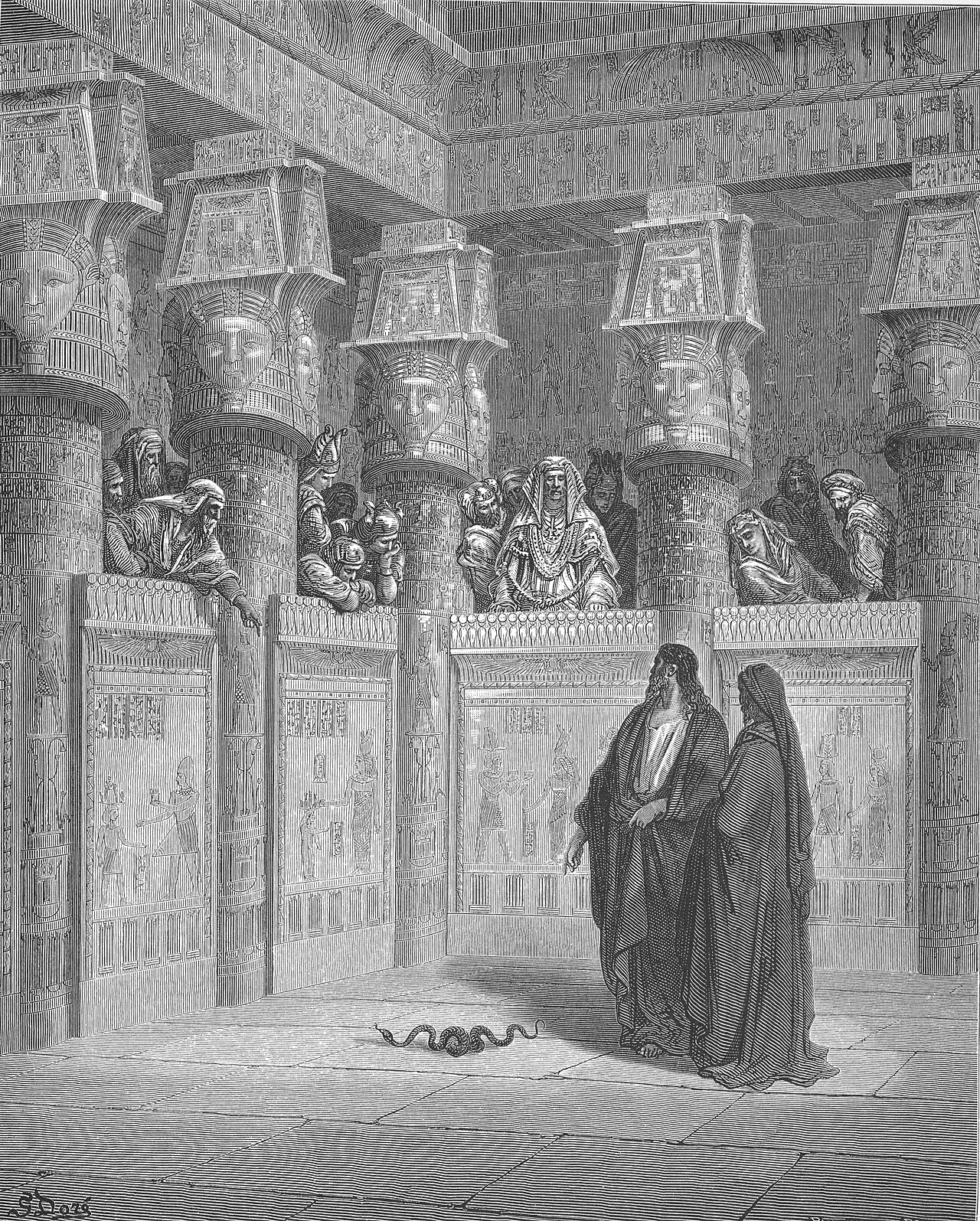
5 notes on this verseAnd seven days were fulfilled,.... Or there were full seven days, a whole week: after that the Lord had smitten the river, and turned it into blood; here the miracle is ascribed to him; Moses and Aaron, and the rod they used, were only instruments, nothing short of almighty power could do such a miracle; it seems this lasted seven days at least. It began, as Bishop Usher (o) computes it, on the eighteen day of the sixth month, or Adar, part of February and part of March, and ended the twenty fifth of the same.
This site's exposition
digged round about the river for water
on Exodus 7:24-25
Egypt digs beside the Nile for water it can drink, and Henry reads the digging as mercy inside the judgment, since the people were not left to die of thirst for their king's obstinacy. The plague is given a length, seven days, which the text does for only one other of the nine, the three days of darkness at 10:22. Pharaoh has a week in which to answer and spends it in his house.
The record, by era
The Puritans and the Awakening1 voice
), and, in all that time, Pharaoh's proud heart would not let him so much as desire Moses to intercede for the removal of it. Thus the hypocrites in heart heap up wrath; they cry not when he binds them ( Job xxxvi. 13 ); and then no wonder that his anger is not turned away, but his hand is stretched out still.
quarantine:debris (2026-07-29) — leading-punctuation+unbalanced-parens
The Nineteenth Century2 voices
A commentator
Albert Barnes1798–1870
Notes, Explanatory and Practical, on the Old and New Testaments (1832-1869)
Seven days - This marks the duration of the plague. The natural discoloration of the Nile water lasts generally much longer, about 20 days.
And seven days were fulfilled - So we learn that this plague continued at least a whole week. The contention between Moses and Aaron and the magicians of Egypt has become famous throughout the world. Tradition in various countries has preserved not only the account, but also the names of the chief persons concerned in the opposition made by the Egyptians to these messengers of God. Though their names are not mentioned in the sacred text, yet tradition had preserved them in the Jewish records, from which St. Paul undoubtedly quotes 2Ti 3:8, where, speaking of the enemies of the Gospel, he compares them to Jannes and Jambres, who withstood Moses. That these names existed in the ancient Jewish records, their own writings show. In the Targum of Jonathan ben Uzziel on this place they are called יניס וימבריס Janis and Jambris; and in the Babylonian Talmud they are named Joanne and Mambre, and are represented as chiefs of the sorcerers of Egypt, and as having ridiculed Moses and Aaron for pretending to equal them in magical arts. And Rabbi Tanchum, in his Commentary, names them Jonos and Jombrus. If we allow the readings of the ancient editions of Pliny to be correct, he refers, in Hist. Nat., l. xxx., c. 2, to the same persons, the names being a little changed: Est et alia magices factio, a Mose et Jamne et Jotape Judaeis pendens, sed multis millibus annorum post Zoroastrem; “There is also another faction of magicians which took its origin from the Jews, Moses, Jamnes, and Jotapes, many thousands of years after Zoroaster;” where he confounds Moses with the Egyptian magicians; for the heathens, having no just notion of the power of God, attributed all miracles to the influence of magic. […]
The words behind it
8 Hebrew wordsEvery Hebrew word of this verse in the order it stands, with what it means and the door to its own study. The last column counts the times a word stands in the whole Bible: the rarer the word, the more the places it appears belong together.
| Hebrew | Sound | Meaning | Word study | In the Bible |
|---|---|---|---|---|
| וַיִּמָּלֵ֖א | vaiyimale' | and it was completed | H4390 → | 249 times |
| שִׁבְעַ֣ת | shivat | seven | H7651 → | 394 times |
| יָמִ֑ים | yamim | days | H3117 → | 2304 times |
| אַחֲרֵ֥י | ʾacharei | after | H310 → | 715 times |
| הַכּוֹת־ | hakot- | struck | H5221 → | 499 times |
| יְהוָ֖ה | yahweh | Yahweh | H3068 → | 6520 times |
| אֶת־ | ʾet- | <obj.> | H853 → | 10935 times |
| הַיְאֹֽר׃ פ | hayor | the River | H2975 → | 65 times |
וַיִּמָּלֵ֖אand it was completed
vaiyimale'H4390 →249 times
שִׁבְעַ֣תseven
shivatH7651 →394 times
יָמִ֑יםdays
yamimH3117 →2304 times
אַחֲרֵ֥יafter
ʾachareiH310 →715 times
הַכּוֹת־struck
hakot-H5221 →499 times
יְהוָ֖הYahweh
yahwehH3068 →6520 times
אֶת־<obj.>
ʾet-H853 →10935 times
הַיְאֹֽר׃ פthe River
hayorH2975 →65 times
A shaded row is a word that stands 400 times or fewer in the Bible.
The walk
8 stopsEach card is a verse this one points to, and under it the verses that one points to in turn. Where several paths arrive at the same place, that place is listed first: the text keeps returning to it.
Through
Exodus 10:23No one could see anyone else, and for three days no one left his place. Yet all the Israelites had light in their dwellings.
it leads to
- Exodus 8:22
But on that day I will give special treatment to the land of Goshen, where My people live; no swarms of flies will be found there. In this way you will know that I,…
- Isaiah 42:16
I will lead the blind by a way they did not know; I will guide them on unfamiliar paths. I will turn darkness into light before them and rough places into level ground. These…
- 1 Peter 2:9
But you are a chosen people, a royal priesthood, a holy nation, a people for God’s own possession, to proclaim the virtues of Him who called you out of darkness into His marvelous light.
- Exodus 9:4
But the LORD will make a distinction between the livestock of Israel and the livestock of Egypt, so that no animal belonging to the Israelites will die.’”
- Exodus 8:22
Through
2 Samuel 24:13So Gad went and said to David, “Do you choose to endure three years of famine in your land, three months of fleeing the pursuit of your enemies, or three days of plague upon…
it leads to
- 1 Chronicles 21:12
between three years of famine, three months of being swept away before your enemies and overtaken by their swords, or three days of the sword of the LORD—days of plague upon the land, with…
- Leviticus 26:25
And I will bring a sword against you to execute the vengeance of the covenant. Though you withdraw into your cities, I will send a plague among you, and you will be delivered into…
- 2 Samuel 21:1
During the reign of David there was a famine for three successive years, and David sought the face of the LORD. And the LORD said, “It is because of the blood shed by Saul…
- 1 Kings 17:1–7
Now Elijah the Tishbite, who was among the settlers of Gilead, said to Ahab, “As surely as the LORD lives—the God of Israel before whom I stand—there will be neither dew nor rain in…
- 1 Chronicles 21:12
Where this verse is studied
On this page
Studies1
About Exodus
This page draws on Adam Clarke, Commentary on the Bible; Albert Barnes, Notes, Explanatory and Practical, on the Old and New Testaments (1832-1869); John Gill, Exposition of the Old Testament (1748-1763); John Gill, Exposition of the Old Testament and Matthew Henry, Commentary on the Whole Bible.