
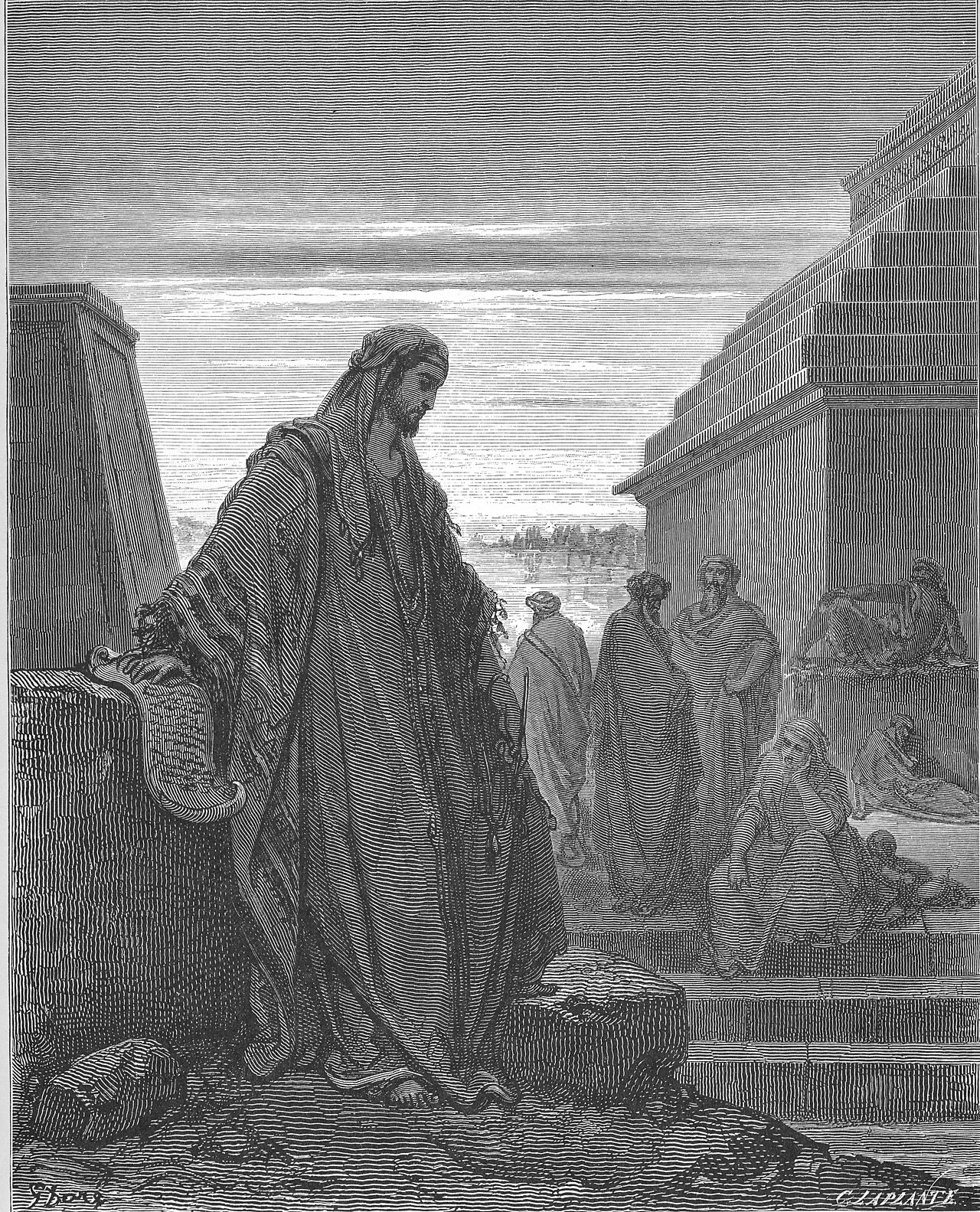
Danielchapter 9
27 verses · Daniel, by tradition · 6th century BC · The Prophets
Seventy weeks are decreed for your people and your holy city to stop their transgression, to put an end to sin, to make atonement for iniquity, to bring in everlasting righteousness, to seal up vision and prophecy, and to anoint the Most Holy Place.
Introduction
Daniel, by tradition, The Prophets, Daniel Overview.
This chapter begins with a man reading Scripture and ends with one of the most discussed prophecies in the Bible. It is set in the first year of Persian rule, when Babylon had fallen and the promised end of the exile was near. It was kept for exiles who expected their return home to finish God's work. Listen to the long prayer at its centre, and notice who Daniel includes when he confesses sin. Then listen to how the answer stretches the hope of his people far beyond the return they were waiting for.
Context
- Who
- Exiles doing the arithmetic on a promise and realizing the number was almost complete
- What
- A prayer of confession for Israel and Jerusalem, followed by Gabriel's revelation of the seventy weeks.
- Where
- Babylon, where Daniel prayed at the time of the evening offering.
- When
- The first year of Darius the Mede, about 539 to 538 BC, within months of Babylon's fall.
- Why
- To show God's people how to pray from His promises, and to set their hope on a redemption that reaches past the return from exile.
Historical context
This chapter starts with a man reading his Bible. Daniel says he "understood by books", he had Jeremiah's scroll, and in it the promise that Babylon's dominion would run seventy years and then the exile would end.
Show the rest of the historical context, 3 more paragraphs
The timing is why he is on his knees. Babylon had just fallen. If the seventy years were counted from the first deportation in 605 BC, the clock was nearly out. Within a year or two Cyrus would issue the decree that sent the first group home.
What he does with a promise about to be fulfilled is the surprise. He does not celebrate. He fasts in sackcloth and ashes and confesses, and he does it in the first person plural. "We have sinned." Daniel, of all people, includes himself in the guilt that caused the exile.
The answer that comes is the passage called the seventy weeks: a span of seventy sevens decreed for Daniel's people and city, running from a decree to restore and build Jerusalem, in which transgression is finished and everlasting righteousness brought in, and in which an anointed one is cut off, and the city and sanctuary are destroyed again. Christians from the earliest centuries have read the cutting off as the crucifixion and the destruction as Rome's sack of Jerusalem in AD 70. How the weeks are counted has been debated for two thousand years and is still debated.
Significance
To the first hearers this said that God keeps calendars. The seventy years were not a mood; they were a number, and the number was running out on schedule.
Show the rest of the significance, 1 more paragraph
It also reset expectations. The exiles were about to go home, and Daniel is told that going home is not the end of the story, a much longer span still had to run before sin was finished and righteousness brought in. The return would be real, and it would not be the redemption itself.
This chapter in Jewish lifeWhat this chapter is in Jewish life and reading.
What is done
Daniel's prayer and the seventy weeks are not read in the synagogue. Probed for this lane, the site's own table in src/lib/hebraic/readings.ts printed parashot total 0 and haftarah uses total 0 for Daniel, and no festival reading. The site's book dossier records that Daniel stands among the Writings in the Hebrew Bible rather than among the Prophets, so no weekly portion is drawn from it and no Haftarah either.
The prayer of this chapter is met in the Talmud and its minor tractates. Under the seventeenth verse the corpus carries Berakhot 7b:2, under the eighteenth Tractate Soferim 7:2, and under the twenty-first Berakhot 4b:23. Daniel's reckoning of Jeremiah's seventy years, in the second verse, is met at Megillah 11b:7, 12a:2 and 12a:3.
How it is read
Rashi is the one commentator on this chapter with English in the corpus, quoted from The Judaica Press complete Tanach with Rashi, translated by A. J. Rosenberg, which Sefaria reports as CC-BY at fifty words or fewer.
He first fixes the king. "This is not the Ahasuerus of the days of Haman, for he was the king of Persia", while this Darius is the Mede crowned when Belshazzar was slain (Rashi on Daniel 9:1:1). Daniel's words at the fourth verse he reads as confession: "and I confessed the sins of my people" (Rashi on Daniel 9:4:1).
The prayer itself Rashi reads as a plea that rests on mercy alone. At the ninth verse the mercies are "that we did not perish for our iniquities, for we rebelled against Him" (Rashi on Daniel 9:9:1). At the eighteenth he says the people come "not upon the support of our righteousness do we cast our supplications to benefit us, but we have come upon Your mercies" (Rashi on Daniel 9:18:1). The curse of the thirteenth verse is the warning of the Law, "that if we transgress the oath, all this evil will befall us" (Rashi on Daniel 9:13:1).
Rashi reads the seventy weeks as weeks of years set on Jerusalem, "from the day of the first destruction in the days of Zedekiah until it will be [destroyed] the second time" (Rashi on Daniel 9:24:1). The corpus stops before Rashi's notes on the anointed one of the verses that follow. The Christian reading of those verses is set out in the site's book dossier on Daniel.
The corpus carries twenty-four commentary entries on this chapter, the cap its fetch sets, and they stop at the twenty-fourth verse, so what the commentators say on the verses after it is not reported here. The corpus carries four further notes on this chapter without an English text, each marked linked because Sefaria holds no English version of the ref. They stand cited and unquoted: Ibn Ezra on Daniel 9:3:1 and Daniel 9:6:1, Metzudat David on Daniel 9:8:1 and Malbim on Daniel 9:10:1.
What the rabbis say
The corpus carries forty rabbinic locators on this chapter. Nine of them stand in the Talmud and its minor tractates and the rest in the Midrash. The corpus carries the text of none, so each is cited by ref here and never quoted.
On the first verse it holds Midrash Lekach Tov on Esther, Introduction 2, Otzar Midrashim, Midrashim on Megilat Esther, Midrash on the Book of Esther 3 and Seder Olam Rabbah 28:1. On the second verse it holds Megillah 11b:7, Megillah 12a:2 and Megillah 12a:3. On the third verse it holds Midrash Tehillim 108:1 and Shemot Rabbah 43:1. On the fourth verse it holds Jerusalem Talmud Berakhot 7:3:9 and Jerusalem Talmud Megillah 3:7:6. On the fifth verse it holds Ein Yaakov (Glick Edition), Yoma 3:6 and Ein Yaakov, Yoma 3:11. On the seventh verse it holds Bamidbar Rabbah 8:5 and Ein Yaakov (Glick Edition), Sanhedrin 11:18.
On the ninth verse it holds Bereshit Rabbati, Parashat Vayechi 44 and Mekhilta DeRabbi Yishmael, Tractate Shirah 1:19. On the tenth verse it holds Midrash Tanchuma Buber, Re'eh 1:1 and Midrash Tanchuma, Re'eh 1:1. On the eleventh verse it holds Bereshit Rabbah 19:9 and Eikhah Rabbah 1:20. On the thirteenth verse it holds Shemot Rabbah 43:3. On the fourteenth verse it holds Bamidbar Rabbah 11:7 and Ein Yaakov (Glick Edition), Gittin 9:2. On the sixteenth verse it holds Ein Yaakov, Megillah 1:23 and Shemot Rabbah 15:17.
On the seventeenth verse it holds Berakhot 7b:2 and Ein Yaakov (Glick Edition), Berakhot 1:35. On the eighteenth verse it holds Tractate Soferim 7:2. On the nineteenth verse it holds Devarim Rabbah 2:17 and Midrash Tanchuma, Vayishlach 9:3. On the span Daniel 9:20 to 21 it holds Aggadat Bereshit 77:1. On the twenty-first verse it holds Berakhot 4b:23 and Ein Yaakov (Glick Edition), Berakhot 1:13. On the twenty-third verse it holds Midrash Tanchuma Buber, Vayera 7:1 and Midrash Tanchuma, Vayera 5:4.
On the twenty-fourth verse it holds Ein Yaakov, Nazir 5:1 and Nazir 32b:6. On the twenty-fifth verse it holds Otzar Midrashim, Chuppah of Eliyahu, Chuppat Eliyahu Rabbah 228. On the twenty-seventh verse it holds Eikhah Rabbah, Petichta 34 and Ein Yaakov, Taanit 4:10.
What each locator teaches is a saying of the rabbis, and it is reported as theirs wherever this site quotes one. The quotations wait on a fetch that carries the text.
Sources: Rashi, Rashi on Daniel 9:1:1 to Daniel 9:24:1, The Judaica Press complete Tanach with Rashi, translated by A. J. Rosenberg, reported CC-BY; Ibn Ezra, Ibn Ezra on Daniel 9:3:1 and Daniel 9:6:1, cited by ref because the corpus carries no English text; Metzudat David, Metzudat David on Daniel 9:8:1, cited by ref because the corpus carries no English text; Malbim, Malbim on Daniel 9:10:1, cited by ref because the corpus carries no English text; The Sefaria corpus, scripts/data/sources/sefaria/daniel/9.json, the 40 Talmud and Midrash locators of this chapter; The site's own files, src/lib/hebraic/readings.ts, probed for this book and printing daniel parashot total 0 and haftarah uses total 0, and src/components/book/dossier-content/daniel.ts on the place of Daniel among the Writings.
The heads below are this chapter's scenes. The numbered points under each are its verses.
Reading Jeremiah: the seventy years are nearly done
Daniel 9:1-2
over the kingdom of the Chaldeans—: Daniel dates this to the first year of Darius, “a Mede by descent,” whom no single monument names. That year Daniel “understood from the sacred books” that the desolation of Jerusalem would last seventy years, as the LORD told Jeremiah (Jeremiah 25:11-12; 29:10).
Daniel 9:1
“In the first year of Darius - See the notes at Dan 5:31, and Introuction to Dan. 6 Section II. The king here referred to under this name was Cyaxares II, who lived between Astyages and Cyrus, and in whom was the title of king. He was the immediate successor of Belshazzar, and was the predecessor of Cyrus, and was the first of the foreign princes that reigned over Babylon. On the reasons why he is called in Daniel Darius, and not Cyaxares, see the Introduction to Dan. 6, Section II.”
1 more voice on this verseWhat preachers and commentators have said about this verse, in their own words.
Daniel 9:1
“Ahasuerus was a name common to many of the kings of Medo-Persia. made king--The phrase implies that Darius owed the kingdom not to his own prowess, but to that of another, namely, Cyrus.”
Jamieson, Fausset & Brown · Commentary Critical and Explanatory on the Whole Bible (1871)reformed
understood from the sacred books: Adam Clarke found the word of the LORD to Jeremiah in Jeremiah 25:12 and 29:10 and thought Daniel had a copy of it. Jamieson, Fausset and Brown rendered the sacred books as letters. Albert Barnes noted that critics had used the word books to question whether Daniel was genuine.
Daniel 9:2
“I Daniel understood by books - The prophecy referred to here is found Jer 25:12; Jer 29:10. The people must have been satisfied of the Divine inspiration of Jeremiah, or his prophecies would not have been so speedily collected nor so carefully preserved. It appears that there was a copy of them then in Daniel’s hands.”
Adam Clarke · Commentary on the Bible (1810-1826)evangelical
Daniel 9:3-6
Daniel seeks the Lord “with fasting, sackcloth, and ashes,” and his confession runs in the key of Ezra 9 and Nehemiah 9. He prays as one of the guilty people, the pattern the older commentators find in Moses and Nehemiah, a righteous man confessing with his nation.
Daniel 9:3
“Nor is it merely a change of nature, or aversion of perils or obliteration of sins but likewise the recognition of mysteries that fasts will merit from God. Look at Daniel's example.… In the first year of King Darius, when, after careful and repeated meditation on the times predicted by Jeremiah, he set his face to God in fasts and sackcloth and ashes. An angel was sent to him and immediately stated this had been the cause of the divine honor; he said, "I came to show you, wretched as you are," namely, because he had been fasting.”
Tertullian · written before 220 · On Fasting 7patristic
1 more voice on this verse
Daniel 9:3
“And I set my face unto the Lord God - Probably the meaning is, that he turned his face toward Jerusalem, the place where God had dwelt; the place of his holy abode on earth. See the notes at Dan 6:10. The language, however, would not be inappropriate to denote prayer without such a supposition. We turn to one whom we address, and so prayer may be described by “setting the face toward God.” The essential idea here is, that he engaged in a set and formal prayer; he engaged in earnest devotion.”
A confession made for the whole people
the great and awesome God: Jerome read awesome as terrible toward those who despise the commandments, and noted God keeps His covenant toward those who love Him and obey. Jamieson, Fausset and Brown held that God is feared for His justice and trusted for His mercy. Albert Barnes thought Daniel recorded the prayer's substance afterward.
Daniel 9:4
“So weak and sinful is man that any covenant for good on God's part with him, to take effect, must depend solely on His grace. If He be a God to be feared for His justice, He is one to be trusted for His "mercy." love . . . keep his commandments--Keeping His commandments is the only sure test of love to God (Joh 14:15).”
Jamieson, Fausset & Brown · Commentary Critical and Explanatory on the Whole Bible (1871)reformed
We have acted wickedly and rebelled: John Gill and Jamieson, Fausset and Brown saw a rising scale: sinned for ignorance, acted wickedly for wilful wickedness, and rebelled for open revolt. Jerome observed that Daniel confessed as one of the people. He compared Paul in Romans.
Daniel 9:5
“Erred in ignorance . . . sinned by infirmity . . . habitually and wilfully done wickedness . . . as open and obstinate rebels set ourselves against God.”
Jamieson, Fausset & Brown · Commentary Critical and Explanatory on the Whole Bible (1871)reformed
Your servants the prophets: Matthew Henry counted the broken law of Moses as one aggravation of Israel's sin, and this verse adds the prophets they refused. Theodoret of Cyrus saw God's constant care in it. Albert Barnes stressed that the prophets addressed every class, from kings to the common people.
Daniel 9:6
“Neither have we hearkened unto thy servants the prophets - Who called upon us to turn from our sins; who made known the will of God, and who proclaimed that these judgments would come upon us if we did not repent. Which spake in thy name to our kings ... - To all classes of the people, calling on kings and rulers to turn from their idolatry, and the people to forsake their sins, and to seek the Lord.”
1 more voice on this verse
Daniel 9:6
“This confession of sin is repeated here, and much insisted on; penitents should again and again accuse and reproach themselves till they find their hearts thoroughly broken.”
Matthew Henry · Commentary on the Whole Bible (1707-1721)puritan
Daniel 9:7-14
To You, O Lord, belongs righteousness: Daniel accepts the charge: “To You, O Lord, belongs righteousness, but this day we are covered with shame”. The curse “written in the Law of Moses” falls, and the covenant sanctions of Leviticus 26 and Deuteronomy 28 come due. He confesses that God “is righteous in all He does”.
Daniel 9:7
“O Lord, righteousness belongeth unto thee - Margin, “or, thou hast.” The Hebrew is, “to thee is righteousness, to us shame, etc.” The state of mind in him who makes the prayer is that of ascribing righteousness or justice to God. Daniel feels and admits that God has been right in his dealings. He is not disposed to blame him, but to take all the shame and blame to the people.”
Albert Barnes observed that the shame falls on the whole people, rulers and ruled alike, since all had shared the guilt. Matthew Henry singled out the kings and leaders. They should have set a better example and checked the flood of vice.
Daniel 9:8
“O Lord, to us belongeth confusion ... - To all of us; to the whole people, high and low, rich and poor, the rulers and the ruled. All had been partakers of the guilt; all were involved in the calamities consequent on the guilt. As all had sinned, the judgments had come upon all, and it was proper that the confession should be made in the name of all.”
1 more voice on this verse
Daniel 9:8
“Daniel was despondent and in pain. It was not merely the present troubles alone that bothered him but also the troubles to come, since he had not yet been allowed to learn those things through his prophetic eyes. When he saw that the Jews had not yet been freed from their earlier servitude, he was compelled to see another captivity falling on them, and he saw the city that had not yet been rebuilt being captured again. He saw the temple defiled by sacrifices and made desolate and the Holy of Holies overturned.”
John Chrysostom · written before 407 · To Stagirius 1-3patristic
compassion and forgiveness: Jamieson, Fausset and Brown and Matthew Henry set this verse beside verse 7: righteousness belongs to God, and so do compassion and forgiveness. Albert Barnes added that God alone can forgive. Adam Clarke traced the order: from God's goodness flows compassion, and from compassion, forgiveness.
Daniel 9:9
“As it is humbling to recollect "righteousness belongeth unto God," so it is comforting, that "mercies belong to the Lord OUR God." though we have rebelled--rather, "since," &c. [Vulgate], (Ps 25:11). Our punishment is not inconsistent with His "mercies," since we have rebelled against Him.”
Jamieson, Fausset & Brown · Commentary Critical and Explanatory on the Whole Bible (1871)reformed
obeyed the voice of the LORD: Albert Barnes took the voice of the Lord as His commands made known through the prophets of verse 6. Matthew Henry observed that sin is the breaking of God's law. Nothing worse can be said of it, he held.
Daniel 9:10
“Neither have we obeyed the voice of the Lord - The commands of God as made known by the prophets, Dan 9:6.”
the oath and the curse: Adam Clarke noted that the Hebrew verb for poured out is used of melted metal. Jerome's text read that the curse came drop by drop, and he took it as mercy: God poured out only part of His wrath. Albert Barnes took all Israel as the whole people.
nothing has ever been done like: Matthew Henry heard the lament of Jeremiah here and paired it with the question whether any sin was like the sin of Jerusalem. Albert Barnes observed that Daniel saw every threatened disaster carried out, and so could not complain. John Wesley noted that the rulers shared the disaster.
Daniel 9:12
“And he hath confirmed his words ... - By bringing upon the people all that he had threatened in case of their disobedience. Daniel saw that there was a complete fulfillment of all that he had said would come upon them. As all this had been threatened, he could not complain; and as he had confirmed his words in regard to the threatening, he had the same reason to think that he would in regard to his promises.”
2 more voices on this verse
Daniel 9:12
“Judged us - Whose duty it was to govern the people, and to judge their causes; wherein if there was a failure, it was a sin, and judgment upon the people, and upon the rulers and Judges themselves also.”
John Wesley · Explanatory Notes upon the Old Testament (1765)evangelical
Daniel 9:12
“It is Jeremiah's lamentation in the name of the church, Was ever sorrow like unto my sorrow? which must suppose another similar question, Was ever sin like unto my sin?”
Matthew Henry · Commentary on the Whole Bible (1707-1721)puritan
giving attention to Your truth: Jamieson, Fausset and Brown, following Calvin, took Your truth as God's faithfulness to His promises and His threats alike. Jerome held that prayer without turning from iniquities is not genuine. Albert Barnes traced the Hebrew for seeking the favor of the LORD to a root meaning to be polished.
Daniel 9:13
“As it is written in the law of Moses - The word law was given to all the writings of Moses. See the notes at Luk 24:44. Yet made we not our prayer before the Lord our God - Margin, “entreated we not the face of.” The Hebrew word used here (חלה châlâh) means, properly, “to be polished;” then to be worn down in strength, to be weak; then to be sick, or diseased; then in Piel (the form used here), to rub or stroke the face of anyone, to soothe or caress, and hence, to beseech, or supplicate.”
1 more voice on this verse
Daniel 9:13
“Diseased, we spurn the healing medicine. that we might turn, &c.--Prayer can only be accepted when joined with the desire to turn from sin to God (Ps 66:18; Pr 28:9). understand thy truth--"attentively regard Thy faithfulness" in fulfilling Thy promises, and also Thy threats [CALVIN].”
Jamieson, Fausset & Brown · Commentary Critical and Explanatory on the Whole Bible (1871)reformed
kept the calamity in store: Albert Barnes noted that the Hebrew verb for kept in store means to stay awake and watch, the word used in Jeremiah 1:12. Jerome drew the lesson that the calamity God brought shows He is watching over His people. Jamieson, Fausset and Brown added that true penitents call God righteous.
O Lord, hear; O Lord, forgive; do not delay
out of the land of Egypt: Albert Barnes drew from this verse that it is proper to bring arguments to God in prayer. Jerome and Jamieson, Fausset and Brown saw the reasoning: the mighty hand that brought the people out of Egypt gives hope that God will act. Matthew Henry saw penitents who call God righteous.
Daniel 9:15-19
brought Your people out of: Daniel recalls how God brought His people out of Egypt “with a mighty hand”, and asks Him to act again for His own sake. The plea rises to the fourfold cry of verse 19, which the older writers set beside the plea of Moses at the golden calf.
Daniel 9:15
“And now, O Lord our God, that hast brought thy people forth out of the land of Egypt - In former days. The reference to this shows that it is proper to use “arguments” before God when we plead with him (compare the notes at Job 23:4); that is, to suggest considerations or reasons why the prayer should be granted.”
1 more voice on this verse
Daniel 9:15
“Egypt--a proof to all ages that the seed of Abraham is Thy covenant-people. That ancient benefit gives us hope that Thou wilt confer a like one on us now under similar circumstances (Ps 80:8-14; 23:7, 8). as at this day--is known.”
Jamieson, Fausset & Brown · Commentary Critical and Explanatory on the Whole Bible (1871)reformed
all Your righteous acts: Jamieson, Fausset and Brown and Matthew Henry took them as God's faithfulness to His promises of compassion. Albert Barnes took the phrase to cover all that is excellent in God's character. Henry also allowed a plea for justice against the peoples around who made Jerusalem a reproach.
Daniel 9:16
“O Lord, according to all thy righteousness - The word righteousness here seems to refer to all that was excellent and glorious in the character of God. The eye of Daniel is fixed upon what he had formerly done; upon his character of justice, and mercy, and goodness; upon the faithfulness of God to his people, and, in view of all that was excellent and lovely in his character, he pleaded that he would interpose and turn away his anger from his people now.”
cause Your face to shine: Adam Clarke read the shining face as proof of reconciliation. Matthew Henry held that the desolate sanctuary could be rebuilt on no other foundation. Jerome heard Daniel asking God to fulfil in deed what He had promised in word, for the seventy years of desolation had run their course.
Daniel 9:17
“Now, therefore, O our God, hear the prayer of thy servant - In behalf of the people. He pleaded for his people and country, and earnestly entreated the Lord to be merciful. His argument is based on the confession of sin; on the character of God; on the condition of the city and temple; on the former Divine interpositions in behalf of the people; and by all these considerations, he pleads with God to have mercy upon his people and land. And cause thy face to shine upon thy sanctuary - Upon the temple.”
because of Your great compassion: Jerome and Albert Barnes observed that the words incline Your ear and open Your eyes are figures drawn from human pleading. Matthew Henry noted that the petitions rest on God's great compassion alone. God's reasons to hear come from within Himself.
Daniel 9:18
“We cannot now expect that God should send us answers to our prayer by angels, but, if we pray with fervency for that which God has promised, we may by faith take the promise as an immediate answer to the prayer; for he is faithful that has promised. [2.] He had a discovery made to him of a far greater and more glorious redemption which God would work out for his church in the latter days.”
Matthew Henry · Commentary on the Whole Bible (1707-1721)puritan
O Lord, forgive!: Jamieson, Fausset and Brown read the short, broken cries to listen, forgive, hear and act as a mark of intense fervour. They took the plea against delay as a sign that the seventy years were nearly complete. Albert Barnes denied that this is vain repetition.
Daniel 9:19
“The short broken ejaculations and repetitions show the intense fervor of his supplications. defer not--He implies that the seventy years are now all but complete. thine own sake--often repeated, as being the strongest plea (Jer 14:21).”
Jamieson, Fausset & Brown · Commentary Critical and Explanatory on the Whole Bible (1871)reformed
Gabriel comes swiftly to the greatly beloved
confessing my sin and that: Jerome observed that Daniel confessed his own sins as well as the people's, counting himself among them. Jamieson, Fausset and Brown noted that the words while I was speaking recur in verse 21. The repetition marks an answer given before the prayer ended.
Daniel 9:20-23
confessing my sin: While Daniel is still praying, Gabriel, the messenger of chapter 8, comes “in swift flight about the time of the evening sacrifice”. That offering had not been made for decades, yet it still marks the hour, and the answer “went out” at the beginning of his petitions.
the time of the evening sacrifice: Jamieson, Fausset and Brown placed it at three o'clock. Daniel still kept the temple's hour of prayer after its rites had ceased, they observed. Hippolytus of Rome read the swift flight as the nimbleness of angels, and Adam Clarke as the speed of God's answer.
Daniel 9:21
“The evening oblation was a type of the great sacrifice which Christ was to offer in the evening of the world, and it was in the virtue of that sacrifice that Daniel's prayer was accepted when he prayed for the Lord's sake; and for the sake of that this glorious discovery of redeeming love was made to him.”
Matthew Henry · Commentary on the Whole Bible (1707-1721)puritan
1 more voice on this verse
Daniel 9:21
“From all these passages are revealed to us, not merely the particulars of the apostasy, and [the doings] of him who concentrates in himself every satanic error, but also, that there is one and the same God the Father, who was declared by the prophets, but made manifest by Christ.”
Irenaeus · written before 202 · Against Heresies 5:25.5patristic
to give you insight and understanding: Albert Barnes rendered it literally: to make you skilful in understanding. Matthew Henry noted that Gabriel spoke familiarly, as friend to friend, so that Daniel would lose his fear. Jerome said the vision was so obscure that the prophet needed an angel to teach him.
Daniel 9:22
“And he informed me - Hebrew, Gave me intelligence or understanding. That is, about the design of his visit, and about what would be hereafter. And talked with me - Spake unto me. O Daniel, I am now come forth to give thee skill - Margin, “make thee skillful of.” The Hebrew is, literally, “to make thee skillful, or wise, in understanding.” The design was to give him information as to what was to occur.”
you are highly precious: Jerome's text calls Daniel a man of desires. Jamieson, Fausset and Brown, reading greatly beloved, compared John, the disciple whom Jesus loved, who received the visions of the New Testament. Matthew Henry observed that the answer went out at the beginning of Daniel's petitions, before his words could move God.
Daniel 9:23
“As the apocalyptic prophet of the New Testament was "the disciple whom Jesus loved," so the apocalyptic prophet of the Old Testament was "greatly beloved" of God. the vision--the further revelation as to Messiah in connection with Jeremiah's prophecy of seventy years of the captivity.”
Jamieson, Fausset & Brown · Commentary Critical and Explanatory on the Whole Bible (1871)reformed
1 more voice on this verse
Daniel 9:23
“In the first seven weeks, or forty-nine years, the temple and city were built; and in the last single week Christ preached his gospel, by which the Jewish economy was taken down, and the foundations were laid of the gospel city and temple, which were to be built upon the ruins of the former.”
Matthew Henry · Commentary on the Whole Bible (1707-1721)puritan
Seventy weeks, the Anointed cut off, the covenant confirmed
Seventy weeks are decreed: “Seventy weeks are decreed” for the people and city of Daniel, with six purposes. The traditional and dispensational reading hears in them the finished work of the cross and the kingdom still to come in full. An older line and a critical line confine the span to the Maccabean crisis.
Daniel 9:24
“Seventy weeks are determined - This is a most important prophecy, and has given rise to a variety of opinions relative to the proper mode of explanation; but the chief difficulty, if not the only one, is to find out the time from which these seventy weeks should be dated. What is here said by the angel is not a direct answer to Daniel’s prayer. He prays to know when the seventy weeks of the captivity are to end.”
Adam Clarke · Commentary on the Bible (1810-1826)evangelical
2 more voices on this verse
Daniel 9:24
“To make reconciliation: all which words are very expressive in the original, and signify to pardon, to blot out, to destroy. To bring in everlasting righteousness - To bring in justification by the free grace of God in Christ, and sanctification by his spirit: called everlasting, because Christ is eternal, and so are the acceptance and holiness purchased for us.”
John Wesley · Explanatory Notes upon the Old Testament (1765)evangelical
Daniel 9:24
“The propitiatory in the temple (the same Greek word expresses the mercy seat and propitiation, Ro 3:25), which the Jews looked for at the restoration from Babylon, shall have its true realization only in Messiah. For it is only when sin is "made an end of" that God's presence can be perfectly manifested.”
Jamieson, Fausset & Brown · Commentary Critical and Explanatory on the Whole Bible (1871)reformed
until the Messiah, the Prince: From “the decree to restore and rebuild Jerusalem” to “the Messiah, the Prince” are “seven weeks and sixty-two weeks”. The traditional reading dates the decree to Artaxerxes, and Missler's Daniel's Seventy Weeks counts sixty-nine sevens in prophetic years to the presentation of the Messiah.
Daniel 9:25
“Know, therefore, and understand - Hengstenberg renders this, “and thou wilt know and understand;” and supposes that the design of Gabriel is to awaken the attention and interest of Daniel by the assurance that, if he would give attention, he would understand the subject by the explanation which he was about to give. So also Theodotion renders it in the future tense. The Hebrew is in the future tense, and would probably convey the idea that he might, or would know and understand the matter.”
1 more voice on this verse
Daniel 9:25
“Indeed it says, "and to return and a street and wall shall be built." [Daniel 9:25] And it really happened. For the people returned and built this city and temple and its wall in a circle.”
Hippolytus of Rome · written before 235 · Commentary on Daniel 4.35.1patristic
the Messiah will be cut off: After the sixty-two weeks “the Messiah will be cut off and will have nothing”. Nearly all take “the people of the prince who is to come” as the legions of Titus. The older writers read the flood as the trouble from the cross to the fall of the temple.
Daniel 9:26
“And the people of the prince that shall come shall destroy the city and the sanctuary - By the “prince” Titus, the son of Vespasian, is plainly intended; and “the people of that prince” are no other than the Romans, who, according to the prophecy, destroyed the sanctuary, הקדש hakkodesh, the holy place or temple, and, as a flood, swept away all, till the total destruction of that obstinate people finished the war.”
Adam Clarke · Commentary on the Bible (1810-1826)evangelical
2 more voices on this verse
Daniel 9:26
“Now you hesitate to believe what we have stated, although you see that these things have happened. Therefore we ought to seek again the times that were foretold, both as pertaining to the birth and suffering of Christ and the removal of the city Jerusalem, that is, its destruction. Daniel says that the holy city and its sanctuary will be removed when the prince comes and that its pinnacle would be utterly destroyed. The times for the coming of the Christ must be sought again, as we found out in Daniel.”
Tertullian · written before 220 · An Answer to the Jews 8patristic
Daniel 9:26
“And after - After the seven and the sixty two that followed them. Not for himself - But for our sakes, and for our salvation. And the people - The Roman under the conduct of Titus.”
John Wesley · Explanatory Notes upon the Old Testament (1765)evangelical
confirm a covenant with many: The last week opens with “a covenant with many”, and “in the middle of the week” sacrifice ends and “the abomination that causes desolation” comes. The phrase returns at Daniel 11:31 and 12:11, and Jesus cites it as still future in Matthew 24:15.
Daniel 9:27
“And he shall confirm the covenant - literally, “he shall make strong” - והגביר vehı̂gebı̂yr. The idea is that of giving strength, or stability; of making firm and sure.”
1 more voice on this verse
Daniel 9:27
“He shall confirm - Christ confirmed the new covenant, 1. By the testimony of angels, of John baptist, of the wise men, of the saints then living, of Moses and Elias. By his resurrection and ascension.”
John Wesley · Explanatory Notes upon the Old Testament (1765)evangelical
Cross references
Daniel 9:27
- Quoted inMatthew 24:15“So when you see standing in the holy place ‘the abomination of desolation,’ described by the prophet Daniel (let the reader understand),”
'the abomination of desolation, spoken of by Daniel the prophet'
How this psalm is built
The form: A prayer of confession answered by a revelation of seventy weeks, divided in the text into seven, sixty-two and one, as The text of the chapter, counted classes it.
The patterns in this chapter
| Device | What it does | Where to see it |
|---|---|---|
| Seventy weeks, divided as seven, sixty-two and one | Verse 24 names seventy weeks as the whole span. Verse 25 counts seven weeks and sixty-two weeks from the decree to the Anointed One, and verse 27 speaks of one week more, split at its middle. The division is in the text itself, and how the weeks are dated is the question the readings dispute. | Daniel 9:24, Daniel 9:25, Daniel 9:26, Daniel 9:27 |
| The prayer answered while it is spoken | Daniel prays from verse 4 to verse 19, and Gabriel arrives while he is still speaking at verse 21. The angel says the answer went out at the beginning of the prayer. The chapter sets the promise read, the prayer made and the answer given in one sequence. | Daniel 9:2, Daniel 9:21, Daniel 9:23 |
How this chapter is built
1 more paragraph on the patterns
The chapter moves in three parts. Verses 1 and 2 show Daniel reading the promise of seventy years in Jeremiah, verses 3 to 19 give his prayer of confession and request, and verses 20 to 27 give Gabriel's answer. The prayer confesses the sin of the whole people and asks God to act for the sake of His own name. The answer counts seventy weeks and divides them as seven, sixty-two and one, with the last week split at its middle. The chapter itself states the division, and the readings disagree over where the count begins and ends.
Keep studying
Studies20
Words12
Trails1
Sources for this chapter
The summary
Jamieson, Fausset & Brown, Commentary Critical and Explanatory; John Calvin, Commentaries; John Wesley, Notes on the Old Testament and Matthew Henry, Complete Commentary.
The form and classifications
The text of the chapter, counted, Daniel 9:24 to 27.
The exposition
Adam Clarke, Commentary on the Bible; Albert Barnes; Carl Friedrich Keil, Biblical Commentary on the Book of Daniel; Hippolytus of Rome, Commentary on Daniel 4.30.1; Jamieson, Fausset & Brown, Commentary Critical and Explanatory on the Whole Bible; Jerome, St. Jerome, Commentary on Daniel, CHAPTER NINE; John Calvin, Commentary on the Prophet Daniel; John Gill; John Wesley, Explanatory Notes upon the Old Testament; Matthew Henry, Commentary on the Whole Bible and Theodoret of Cyrus, COMMENTARY ON DANIEL 9:6.