
Actschapter 1
26 verses · Luke · about AD 62 · Acts
But you will receive power when the Holy Spirit comes upon you, and you will be My witnesses in Jerusalem, and in all Judea and Samaria, and to the ends of the earth.”
Introduction
Luke, Acts, Acts Overview.
Luke, the physician who travelled with Paul, wrote this book as the second half of a work addressed to a man named Theophilus. His Gospel ended at the ascension, and this chapter picks up the story at the same point so the two books read as one. The chapter sets out the plan the rest of Acts follows. Listen for the places Jesus names, because the book is built on them. Notice also how much of the chapter is spent waiting and praying. Read it as the doorway into the life of the early church.
Context
- Who
- Theophilus and Gentile readers picking up the second half of a two-part work, wanting to know what happened after the empty tomb.
- What
- The opening of Acts, with the risen Jesus' final teaching, His ascension, and the choosing of Matthias to replace Judas.
- Where
- The Mount of Olives outside Jerusalem and an upper room in the city.
- When
- The forty days after the resurrection and the days before Pentecost, about AD 30 or 33; the exact year of the crucifixion is debated.
- Why
- To show that the church's mission came as a command from the risen Lord and waited on the promised Spirit before it began.
Historical context
The Mount of Olives sits across a narrow valley from the temple, close enough that the walk back into the city counted as a "sabbath day's journey", the roughly half-mile a rabbi's rule allowed a man to travel on a Sabbath without breaking it. Luke uses that measurement because his readers would recognize it as the distance of an ordinary walk home.
Show the rest of the historical context, 2 more paragraphs
The "upper room" was the second story of a city house, reached by an outside stair. In crowded Jerusalem such rooms were rented out to pilgrims and used for meetings and meals. A room holding a hundred and twenty people means a household with money behind it.
Choosing Matthias by lot was not a coin flip. Casting lots was the old Israelite way of letting God decide a matter that men could not, the priests had used it for centuries. It is the last time in Scripture anyone does it, and after the next chapter the church never uses it again.
Significance
For a reader who knew that Jesus had gone, this chapter answered the obvious worry: were the disciples now leaderless? The answer is that the risen Jesus gave orders before he left, promised power, and left a witness list, Jerusalem, Judea, Samaria, and the ends of the earth, that turns out to be the outline of everything that follows.
Show the rest of the significance, 1 more paragraph
Replacing Judas mattered because twelve was not a random number. Twelve apostles stood for the twelve tribes; the movement was presenting itself as the true continuation of Israel, not a breakaway sect.
The heads below are this chapter's scenes. The numbered points under each are its verses.
Forty Days, a Promise, and a Cloud Receives Him
Acts 1:1-3
In my first book, O Theophilus: Luke opens by naming his first volume, the Gospel, as the book about all that Jesus began to do and to teach. Acts therefore presents itself as the continuation of that work.
Acts 1:1
“The former treatise - In that important season which reached from the resurrection of Christ to his ascension, the former treatise ends, and this begins: this describing the Acts of the Holy Ghost, (by the apostles,) as that does the acts of Jesus Christ.”
John Wesley · Explanatory Notes upon the New Testament (1755)evangelical
through the Holy Spirit: Jamieson, Fausset and Brown observe that no other passage says the risen Christ gave His instructions through the Holy Spirit. Clarke links the phrase to the days when Jesus opened the disciples' minds to the Scriptures and breathed on them (Luke 24:45 and John 20:22).
Acts 1:2
“After that he, through the Holy Ghost, etc. - This clause has been variously translated: the simple meaning seems to be this - that Christ communicated the Holy Spirit to his disciples, after his resurrection, as he had not done before. In Luk 24:45, it is said that he opened their understanding, that they might understand the Scriptures; and in Joh 20:22, that he breathed on them, and said, receive ye the Holy Ghost.”
Adam Clarke · Commentary on the Bible (1810-1826)evangelical
1 more voice on this verse
Acts 1:2
“It is worthy of notice that nowhere else are such communications of the risen Redeemer said to have been given "through the Holy Ghost." In general, this might have been said of all He uttered and all He did in His official character; for it was for this very end that God "gave not the Spirit by measure unto Him" (Joh 3:34).”
Jamieson, Fausset & Brown · Commentary Critical and Explanatory on the Whole Bible (1871)reformed
many convincing proofs: Albert Barnes calls the resurrection the fact on which the gospel was established, so Luke states its evidence at the start of Acts. Origen grants that the risen Jesus did not show Himself publicly to all. Oecumenius explains that a crowd would have taken Him for a ghost.
Acts 1:3
“He showed himself - The resurrection of Jesus was the great fact on which the truth of the gospel was to be established. Hence, the sacred writers so often refer to it, and establish it by so many arguments. As the fact of his resurrection lay at the foundation of all that Luke was about to record in his history, it was of importance that he should state clearly the sum of the evidence of it in the beginning of his work. After his passion - After he suffered, referring particularly to his death as the consummation of his sufferings.”
1 more voice on this verse
Acts 1:3
“After these points, Celsus proceeds to bring against the Gospel narrative a charge which is not to be lightly passed over, saying that "if Jesus desired to show that his power was really divine, he ought to have appeared to those who had ill-treated him, and to him who had condemned him, and to all men universally." For it appears to us also to be true, according to the Gospel account, that He was not seen after His resurrection in the same manner as He used formerly to show Himself — publicly, and to all men.”
Origen of Alexandria · written before 253 · Contra Celsum, Book II, Chapter 63patristic
Acts 1:4-5
Jesus sets John's baptism with water beside a baptism with the Holy Spirit, the contrast Peter recalls at Cornelius's house (11:16). The words in a few days set the timetable, and chapter 2 keeps it ten days later at Pentecost.
Acts 1:4
“Now in these diverse activities that Gift is set forth in no uncertain light of which our Lord had spoken to the apostles when He taught them not to depart from Jerusalem; but wait, said He, for the promise of the Father which ye heard from My lips: for John indeed baptized with water, but ye shall be baptized with the Holy Ghost, which ye shall also receive not many days hence.”
Hilary of Poitiers · written before 367 · On the Trinity 8.30patristic
2 more voices on this verse
Acts 1:4
“And, being assembled together - Instead of συναλιζομενος, being assembled together, several good MSS. and versions read συναυλιζομενος, living or eating together, which refers the conversation reported here to some particular time, when he sat at meat, with his disciples. See Mar 16:14: Luk 24:41-44. But probably the common reading is to be preferred; and the meeting on a mountain of Galilee is what is here meant. The promise of the Father - The Holy Spirit, which indeed was the grand promise of the New Testament, as Jesus Christ was of the Old.”
Adam Clarke · Commentary on the Bible (1810-1826)evangelical
Acts 1:4
“First, The Spirit was given by promise, and it was at this time the great promise, as that of the Messiah was before ( Luke i. 72 ), and that of eternal life is now, 1 John ii. Temporal good things are given by Providence, but the Spirit and spiritual blessings are given by promise, Gal. iii.”
Matthew Henry · Commentary on the Whole Bible (1707-1721)puritan
Matthew Henry notes that ministers dispense the means of grace, while giving the Spirit belongs to Christ alone. Theophylact reads this as Jesus stating His distinction from John more plainly than before.
Acts 1:5
“This grace was not in part, but his power was in full perfection; for as he who plunges into the waters and is baptized is encompassed on all sides by the waters, so were they also baptized completely by the Holy Spirit. The water, however, flows round the outside only, but the Spirit baptizes also the soul within, and that completely. And why do you wonder at this? Take an example from matter, a simple and common example, but one that helps the ordinary person.”
Cyril of Jerusalem · written before 386 · Catechetical Lecture 17.14patristic
2 more voices on this verse
Acts 1:5
“Ye shall be baptized with the Holy Ghost - And so are all true believers to the end of the world. But the extraordinary gifts of the Holy Ghost also are here promised.”
John Wesley · Explanatory Notes upon the New Testament (1755)evangelical
Acts 1:5
“But Christ can do more than any of his ministers. It is an honour to them to be employed in dispensing the means of grace, but it his prerogative to give the Spirit of grace. He shall baptize you with the Holy Ghost, shall teach you by his Spirit, and give his Spirit to make intercession in you, which is more than the best ministers preaching with us.”
Matthew Henry · Commentary on the Whole Bible (1707-1721)puritan
Acts 1:6-7
will You at this time restore: The disciples ask whether Jesus will at this time restore the kingdom to Israel. His answer concerns the date alone: It is not for you to know times or seasons that the Father has fixed by His own authority.
Acts 1:6
“When they therefore were come together,.... That is, Christ, and his eleven apostles; for not the hundred and twenty disciples hereafter mentioned, nor the five hundred brethren Christ appeared to at once, are here intended, but the apostles, as appears from Act 1:2. they asked of him, saying, wilt thou at this time restore again the kingdom to Israel? The kingdom had been for some time taken away from the Jews, Judea was reduced to a Roman province, and was now actually under the power of a Roman governor.”
1 more voice on this verse
Acts 1:6
“When they therefore were come together - It is very likely that this is to be understood of their assembling on one of the mountains of Galilee, and there meeting our Lord. At this time restore again the kingdom - That the disciples, in common with the Jews, expected the Messiah’s kingdom to be at least in part secular, I have often had occasion to note. In this opinion they continued less or more till the day of pentecost; when the mighty outpouring of the Holy Spirit taught them the spiritual nature of the kingdom of Christ.”
Adam Clarke · Commentary on the Bible (1810-1826)evangelical
times or seasons: Albert Barnes notes that the apostles asked about the timing of the restoration, and Jesus answers that question alone. Jamieson, Fausset and Brown add that the question had no bearing on the work now given them. Bede reads the date as known to the Father alone.
Acts 1:7
The apostle says: "The day of the Lord shall so come as a thief in the night. When they shall say, Peace and security, then on them shall come sudden destruction." Also in the Acts of the Apostles: "No one can know the times or the seasons which the Father has placed in His own power."
Cyprian · written before 258 · Treatise 12, Third Book, Section 89patristic
2 more voices on this verse
Acts 1:7
“It is not for you to know - The question of the apostles respected the time of the restoration; it was not whether he would do it. Accordingly, his answer meets precisely their inquiry; and he tells them in general that the time of the great events of God’s kingdom was not to be understood by them.”
Acts 1:7
“But neither is the Father deceived nor does the Son deceive. It is the custom of the holy Scriptures to speak thus, as the examples I have already given, and many others testify, so that God feigns not to know what he does know. In this then a unity of Godhead and a unity of character is proved to exist in the Father and in the Son; seeing that, as God the Father hides what is known to him, so also the Son, who is the image of God in this respect, hides what is known to him.”
Ambrose of Milan · written before 397 · Exposition of the Christian Faith 5.17.218patristic
But you will receive power: Jesus promises that you will receive power when the Holy Spirit comes upon you, and the verse gives the book its outline. Jerusalem fills chapters 1 to 7, all Judea and Samaria chapters 8 to 12, and the ends of the earth chapters 13 to 28.
Acts 1:8
“But ye shall receive power - and shall be witnesses to me - That is, ye shall be empowered to witness my Gospel, both by your preaching and suffering.”
John Wesley · Explanatory Notes upon the New Testament (1755)evangelical
2 more voices on this verse
Acts 1:8
“And so, when the Lord appointed his servants the apostles, that we might recognize that the creature was one thing and the grace of the Spirit another, he appointed them to different places, because all could not be everywhere at once. But he gave the Holy Spirit to all, to shed upon the apostles though separated the gift of indivisible grace.”
Ambrose of Milan · written before 397 · On the Holy Spirit 1.7.81-82patristic
Acts 1:8
“But ye shall receive power - Ληψεσθε δυναμιν. Translating different terms of the original by the same English word is a source of misapprehension and error. We must not understand δυναμις which we translate power in this verse, as we do εξουσια, translated by the same word in the preceding verse.”
Adam Clarke · Commentary on the Bible (1810-1826)evangelical
Acts 1:9-11
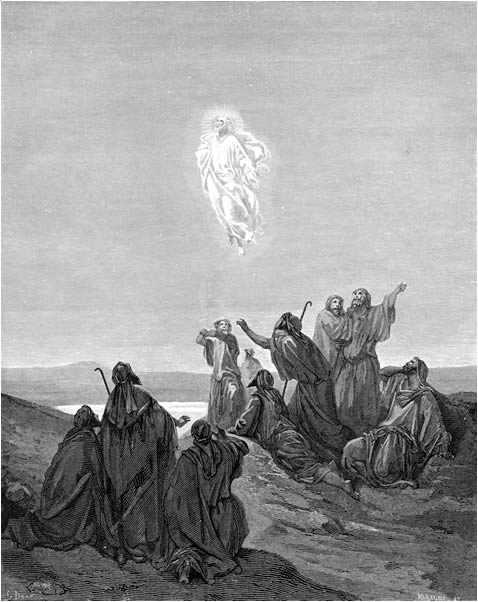
as He was taken up: Luke tells the ascension briefly: they watched as He was taken up, and a cloud hid Him from their sight. The cloud recalls the pillar of cloud in Exodus and the cloud of the transfiguration.
Acts 1:9
“By the clouds there is a sort of communication kept up between the upper and lower world; in them the vapours are sent up from the earth, and the dews sent down from heaven. Fitly therefore does he ascend in a cloud who is the Mediator between God and man, by whom God's mercies come down upon us and our prayers come up to him.”
Matthew Henry · Commentary on the Whole Bible (1707-1721)puritan
1 more voice on this verse
Acts 1:9
“While they beheld - While they saw him. It was of importance to state that circumstance, and to state it distinctly. It is not affirmed in the New Testament that they “saw him rise” from the dead, because the evidence of that fact could be better established by their seeing him after he was risen. But the truth of his “ascension to heaven” could not be confirmed in that manner.”
two men dressed in white: Adam Clarke takes the two men to be angels in human shape, their white clothing a sign of purity and glory. Bede observes that the angels at the Lord's birth are given no white garments, and he reads the white here as fitting for exaltation.
Acts 1:10
“Looked steadfastly - Keeping their eyes intensely fixed on their ascending Lord; continuing to look even after he had ascended above the region of the inferior clouds. Two men stood by them - Doubtless, angels in human shape. In white apparel - As emblematical of their purity, happiness, and glory.”
Adam Clarke · Commentary on the Bible (1810-1826)evangelical
This same Jesus: The angels promise that the Jesus who left is the one who returns. Theophylact stresses that He will come with a body, in the same way He went. Bede adds that He returns as judge in that same flesh.
Acts 1:11
“Ye men of Galilee, why stand ye gazing up into heaven, &c.--"as if your now glorified Head were gone from you never to return: He is coming again; not another, but 'this same Jesus'; and 'as ye have seen Him go, in the like manner shall He come'--as personally, as visibly, as gloriously; and let the joyful expectation of this coming swallow up the sorrow of that departure." Ac 1:12-26.”
Jamieson, Fausset & Brown · Commentary Critical and Explanatory on the Whole Bible (1871)reformed
2 more voices on this verse
Acts 1:11
“After that, Pentecost is a most joyous space for conferring baptisms; wherein, too, the resurrection of the Lord was repeatedly proved among the disciples, and the hope of the advent of the Lord indirectly pointed to, in that, at that time, when He had been received back into the heavens, the angels told the apostles that "He would so come, as He had withal ascended into the heavens; " at Pentecost, of course.”
Tertullian · written before 220 · On Baptismpatristic
Acts 1:11
“Ye men of Galilee - Galilee was the place of their former residence, and they were commonly known by the name of Galileans. Why stand ye ... - There is doubtless a slight degree of censure implied in this, as well as a design to call their attention away from a vain attempt to see the departed Saviour. The impropriety may have been: (1) In the feeling of disappointment, as if he would not restore the kingdom to Israel.”
The Upper Room: Continuing Steadfastly in Prayer
Acts 1:12-14
a Sabbath day’s journey away: The eleven, the women, Mary the mother of Jesus and His brothers wait together in the upper room. With one accord they all continued in prayer, and prayer is named before any of the growth the book describes.
Acts 1:12
“A Sabbath day’s journey - See the difficulties in this verse explained in the note on Luk 24:50 (note). A Sabbath day’s journey was seven furlongs and a half. Olivet was but five furlongs from Jerusalem; and Bethany was fifteen. The first region or tract of Mount Olivet, which was called Bethany, was distant from the city a Sabbath day’s journey, or seven furlongs and a half; and the same distance did that tract called Bethphage extend from the city.”
Adam Clarke · Commentary on the Bible (1810-1826)evangelical
the upper room: John Wesley describes upper rooms as chambers at the top of a house, set apart for private prayer. Theophylact observes that Luke names the eleven to show all were present except the betrayer, including the one who denied and the one who doubted.
Acts 1:13
“They went up into the upper room - The upper rooms, so frequently mentioned in Scripture, were chambers in the highest part of the house, set apart by the Jews for private prayer.”
John Wesley · Explanatory Notes upon the New Testament (1755)evangelical
1 more voice on this verse
Acts 1:13
“Here was the beginning of the Christian church: this hundred and twenty was the grain of mustard-seed that grew into a tree, the leaven that leavened the whole lump.”
Matthew Henry · Commentary on the Whole Bible (1707-1721)puritan
With one accord: Cyprian points to this unanimity among the apostles as the pattern for the new assembly of believers. John Gill lists what they asked for: the promised Spirit, protection from their enemies, and fitness to preach the gospel. Scripture never names Mary again, Matthew Henry notes.
Acts 1:14
“These all continued, with one accord, in prayer and supplication,.... For the promise of the Spirit Christ had given them reason to expect; and that they might be preserved from their enemies, and kept faithful to their Lord; and be abundantly qualified for the preaching of the Gospel, and succeeded in it; and that their hearts might be comforted, and knit together in love: and they were unanimous in their requests, and so were under the promise of being heard; and in this work they were constant, and assiduous, and followed it with importunity.”
2 more voices on this verse
Acts 1:14
“These - continued - in prayer and supplication - Waiting for the promise of the Father, according to the direction of our Lord, Luk 24:49. The words και τῃ δεησει, and in supplication, are omitted by ABC*DE, both the Syriac, the Coptic, Ethiopic, Armenian, Vulgate, Itala, and some of the primitive fathers. On this evidence, Griesbach has left them out of the text; and others contend for the propriety of this omission, because, say they, τῃ προσευχῃ and τῃ δεησει, prayer and supplication, mean the same thing. Whether the reading be genuine or spurious, this inference is not just.”
Adam Clarke · Commentary on the Bible (1810-1826)evangelical
Acts 1:14
"Blessed," says He, "are the peacemakers; for they shall be called the sons of God." [Matthew 5:9] It behooves the sons of God to be peacemakers, gentle in heart, simple in speech, agreeing in affection, faithfully linked to one another in the bonds of unanimity. This unanimity formerly prevailed among the apostles; and thus the new assembly of believers, keeping the Lord's commandments, maintained its charity.
Cyprian · written before 258 · Treatise 1, Sections 24-25patristic
Matthias Chosen to Take Judas's Place
Acts 1:15-17
Peter stood up among the brothers: , about a hundred and twenty, to speak of Judas. He says the Scripture had to be fulfilled, placing the betrayal within what the Holy Spirit foretold through the mouth of David.
Acts 1:15
“In those days - On one of the days intervening between the ascension of Jesus and the day of Pentecost. Peter stood up - Peter standing up, or rising. This is a customary expression in the Scriptures when one begins to do a thing, Luk 15:18. The reason why Peter did this may be seen in the notes on Mat 16:16-17. It is not improbable, besides, that Peter was the most aged of the apostles; and from his uniform conduct we know that he was the most ardent.”
through the mouth of David: Peter credits the psalm to the Holy Spirit speaking through David, which Adam Clarke takes as a strong witness to the inspiration of the Psalms. Oecumenius notes that Peter comforts the disciples with prophecy. Chrysostom remarks that Peter calls Judas a guide and states the fact without heaping scorn.
Acts 1:16
“The Apostle Peter, therefore, after the resurrection of the Lord, and His assumption into the heavens, being desirous of filling up the number of the twelve apostles, and in electing into the place of Judas any substitute who should be chosen by God, thus addressed those who were present: "Men [and] brethren, this Scripture must needs have been fulfilled, which the Holy Ghost, by the mouth of David, spake before concerning Judas, which was made guide to them that took Jesus. For he was numbered with us: ...”
Irenaeus · written before 202 · Against Heresies (Book III), Chapter 12, Section 1patristic
1 more voice on this verse
Acts 1:16
“The Holy Ghost by the mouth of David - Thus is a strong attestation to the Divine inspiration of the book of Psalms. They were dictated by the Holy Spirit, and spoken by the mouth of David.”
Adam Clarke · Commentary on the Bible (1810-1826)evangelical
Clarke explains that the Greek word for Judas's share means a lot or portion, an office assigned by God's providence. Albert Barnes holds that Judas was counted among the apostles without being a true Christian, since Jesus called him a devil (John 6:70). Ambrosiaster holds that Judas was once good.
Acts 1:17
“What will it avail us to be added to the number of Christians, if we partake not of the spirit and nature of Christians? Judas's having obtained part of this ministry was but an aggravation of his sin and ruin, as it will be of theirs who prophesied in Christ's name, and yet were workers of iniquity.”
Matthew Henry · Commentary on the Whole Bible (1707-1721)puritan
Acts 1:18-19
the reward for his wickedness: Peter says Judas bought a field with the reward for his wickedness. Matthew 27:3 to 10 says the priests bought it with the silver Judas returned, so the money was his. Matthew tells of the hanging and Peter of the fall.
Acts 1:18
“This man purchased a field with the reward of iniquity - That is, a field was purchased with the reward of his iniquity; though very possibly Judas might design the purchase.”
John Wesley · Explanatory Notes upon the New Testament (1755)evangelical
Akeldama, that is, Field of Blood.): Albert Barnes and Adam Clarke identify the language as the Syro-Chaldaic speech of Jerusalem, in which Akeldama means Field of Blood. Theophylact observes that the city itself gave the name, so Peter's opponents became his witnesses. Wesley thinks Luke added the translation for Theophilus.
Acts 1:19
“It was known ... - , Mat 27:8. The scene in the temple; the acts of the priests in purchasing the field, etc., would make it known; and the name of the field would preserve the memory of the guilt of Judas. Their proper tongue - The language spoken by the Jews the Syro-Chaldaic. Aceldama - This is composed of two Syro-Chaldaic words, and means literally, the field of blood.”
1 more voice on this verse
Acts 1:19
“In their own tongue - This expression, That is, the field of blood, St. Luke seems to have added to the words of St. Peter, for the use of Theophilus and other readers who did not understand Hebrew.”
John Wesley · Explanatory Notes upon the New Testament (1755)evangelical
it is written in the book of Psalms: Peter joins two psalms as one citation: Psalm 69:25, May his place be deserted, and Psalm 109:8, May another take his position. The Greek word behind position is episkope, the word Paul uses of the overseer's office in 1 Timothy 3:1.
Acts 1:20
“For it is written in the book of Psalms,.... In Psa 69:25. These are the words of Peter, citing the Scripture he had said must be fulfilled, which the Holy Ghost, by David, had spoke concerning Judas: let his habitation be desolate. The Arabic and Ethiopic versions render it, "his city"; meaning, perhaps, the city of Jerusalem; and which afterwards did become desolate, and was utterly destroyed: and let no man dwell therein; in his habitation.”
1 more voice on this verse
Acts 1:20
“Not only does the saying hold true in the time of Judas, but even today. If Judas lost his office of apostle, let priest and bishop be on guard lest they, too, lose their ministry. If an apostle fell, more easily is it possible for a monk to fall. Virtue is not lost, even though man falls and perishes. The Lord continues to lend out his money at interest; if anyone who receives it does not double it, it is taken away and given to another who already has some. The Lord's money cannot lie idle.”
Jerome · written before 420 · HOMILIES ON THE PSALMS 35 (Psalm 108)patristic
Cross references
Acts 1:20
- QuotingPsalms 109:8“May his days be few; may another take his position.”
'his bishoprick let another take' (replacing Judas)
- QuotingPsalms 69:25“May their place be deserted; let there be no one to dwell in their tents.”
'Let his habitation be desolate', on Judas ('it is written in the book of Psalms')
ConnectionsPsalms 109:8, Psalms 69:25
Acts 1:21-22
Therefore it is necessary to choose: A candidate must have walked with the Twelve beginning from John’s baptism until the day Jesus was taken up from us. The one chosen must become a witness with us of His resurrection, the first sounding of a witness formula that recurs through the book.
Acts 1:21
“Wherefore of these men - Of those who had witnessed the life and works of Christ, and who were therefore qualified to discharge the duties of the office from which Judas fell. Probably Peter refers to the seventy disciples, Luk 10:1-2. Went in and out - A phrase signifying that he was their constant companion. It expresses in general all the actions of the life, Psa 121:8; Deu 28:19; Deu 31:2.”
a witness with us: Albert Barnes explains that the candidate had to have been with Jesus from His baptism by John to the ascension, to witness the whole ministry. Theophylact notes that the office is named for one fact above all, the resurrection. Barnes traces the need to Jesus' first choice of twelve.
Acts 1:22
“Beginning from the baptism of John - From the time that Christ was baptized by John in Jordan; for it was at that time that his public ministry properly began. Must one be ordained - This translation misleads every reader who cannot examine the original text. There is no term for ordained in the Greek: γενεσθαι, to be, is the only word in the verse to which this interpretation can be applied.”
Adam Clarke · Commentary on the Bible (1810-1826)evangelical
Acts 1:23-26
So they proposed two men: The prayer asks the Lord, who knows everyone’s heart, to show which of the two He has chosen, leaving the choice with God. The lot, a practice rooted in Proverbs 16:33, fell to Matthias, and Acts records no lot cast after this chapter.
Acts 1:23
“And they appointed two - They proposed, or, as we should say, nominated two. Literally, they placed two, or made them to stand forth, as persons do who are candidates for office. These two were probably-more distinguished by prudence, wisdom, piety, and age than the others, and they were so nearly equal in qualifications that they could not determine which was the best suited for the office. Joseph called Barsabas ... - It is not certainly known what the name Barsabas denotes.”
2 more voices on this verse
Acts 1:23
“And they appointed two,.... The motion made by Peter was attended to by the whole company; they approved of it, and accordingly proposed two persons by name; one of which was to be chosen, not by the apostles, but by the whole assembly.”
Acts 1:23
“And they appointed two - So far the faithful could go by consulting together, but no further. Therefore here commenced the proper use of the lot, whereby a matter of importance, which cannot be determined by any ordinary method, is committed to the Divine decision.”
John Wesley · Explanatory Notes upon the New Testament (1755)evangelical
Show us which of these two: Jamieson, Fausset and Brown call this the first prayer offered to the exalted Christ, since He sends the apostles. Theophylact notes that they ask the Lord to show whom He has already chosen, because God decides before human thought. Chrysostom notes that the heart-knower must make the choice.
Acts 1:24
“Thou Lord, which knowest the hearts - Συ, κυριε, καρδιογνωστα. The word καρδιογνωστης, the searcher of hearts, seems to be used here as an attribute of God; he knows the hearts, the most secret purposes, intentions, and dispositions of all men; and because he is the knower of hearts, he knew which of these men he had qualified the best, by natural and gracious dispositions and powers, for the important work to which one of them was now to be appointed.”
Adam Clarke · Commentary on the Bible (1810-1826)evangelical
Albert Barnes notes that the Greek word behind this ministry means a lot or portion, the same word used for lots in the next verse. Oecumenius reads Judas's rightful place as the gallows he prepared by betrayal, while others cited by Adam Clarke take it as his punishment in hell.
Acts 1:25
“That he may take part of this ministry - The word rendered “part” - κλῆρον klēron - is the same which in the next verse is rendered lots. It properly means a lot or portion the portion divided to a man, or assigned to him by casting lots; and also the instrument or means by which the lot is determined. The former is its meaning here; the office, or portion of apostolic work, which would fall to him by taking the place of Judas.”
the lot fell to Matthias: Adam Clarke describes the simplest method, names written on stones or slips and drawn from an urn after prayer. He grants that the exact manner is unknown. Theophylact recalls that God chose the Levites by lot.
How this psalm is built
The form: The opening of Luke's second book, which takes up where the Gospel ended and tells what the Holy Spirit did through the apostles, as Wesley classes it.
The patterns in this chapter
| Device | What it does | Where to see it |
|---|---|---|
| Two halves, on the mountain and in the upper room | Verses 1 to 11 stay with the risen Jesus, and they end when a cloud hid Him from their sight and two men in white promise His return. Verse 12 brings the apostles back from the Mount of Olives, and verses 12 to 26 stay in the upper room with the believers. The first half ends with Jesus taken up, and the second ends when Matthias was added to the eleven apostles. The words taken up come three times, in verses 2, 9 and 22, and each time they point to the ascension.Counted from the Berean Standard Bible text of Acts 1, The chapter's own text, verses 1 to 26. | Acts 1:2, Acts 1:9, Acts 1:12, Acts 1:22, Acts 1:26 |
| The programme of verse 8 | Verse 8 joins a promise to an order. The power comes first, when the Holy Spirit comes upon you, and the witness follows, in Jerusalem, and in all Judea and Samaria, and to the ends of the earth. The places widen from one city to the whole world. Ambrose of Milan observes that the Lord sent the apostles to different places, because no one of them could be everywhere at once, and gave the one Spirit to them all.Counted from the Berean Standard Bible text of Acts 1, The chapter's own text, verses 4 to 8. | Acts 1:4, Acts 1:5, Acts 1:8 |
| The Psalms behind the choice of Matthias | Peter's speech in verses 16 to 22 rests on Scripture. He begins by saying the Scripture had to be fulfilled, and in verse 20 he quotes two lines from the book of Psalms, May his place be deserted and May another take his position. Epiphanius of Salamis reads the scene as the apostles bringing to fulfilment what David had said was to be done. The speech then sets the test for the new apostle, a man who had been with them from the baptism of John and could be a witness of the resurrection.Epiphanius of Salamis, Commentary (church-history corpus). | Acts 1:16, Acts 1:20, Acts 1:21, Acts 1:22 |
How this chapter is built
1 more paragraph on the patterns
Acts 1 falls into two halves. Verses 1 to 11 stay with the risen Jesus through His last teaching and His ascension, and verses 12 to 26 follow the apostles back to the upper room. Verse 8 gives the order of places the witness will reach, from Jerusalem to the ends of the earth. Prayer marks the scenes in the room, with the company praying with one accord in verse 14 and praying again before the lot in verse 24. The second half is built on two lines from the Psalms, and it ends when the lot falls to Matthias.
Keep studying
Studies16
Words12
Subjects1
Sources for this chapter
The summary
Jamieson, Fausset & Brown, Commentary Critical and Explanatory; John Calvin, Commentaries; John Wesley, Explanatory Notes Upon the New Testament and Matthew Henry, Complete Commentary.
The form and classifications
Cassiodorus, Complexiones on the Acts of the Apostles and John Wesley, Explanatory Notes upon the New Testament.
The exposition
Adam Clarke, Commentary on the Bible; Albert Barnes; Ambrosiaster, Commentary (church-history corpus); Bede; Cyprian, Treatise 1, Sections 24-25; Cyril of Jerusalem, Catechetical Lecture 17.14; J. A. Alexander, The Acts of the Apostles Explained; Jamieson, Fausset & Brown, Commentary Critical and Explanatory on the Whole Bible; John Calvin, Commentary upon the Acts of the Apostles; John Chrysostom; John Gill; John Wesley, Explanatory Notes upon the New Testament; Matthew Henry, Commentary on the Whole Bible; Oecumenius, Commentary on Acts; Origen of Alexandria, Contra Celsum, Book II, Chapter 63 and Theophylact of Ohrid, Commentary on Acts.
The painting
The Ascension, Gustave Doré (engraving), public domain