
Acts 1:2
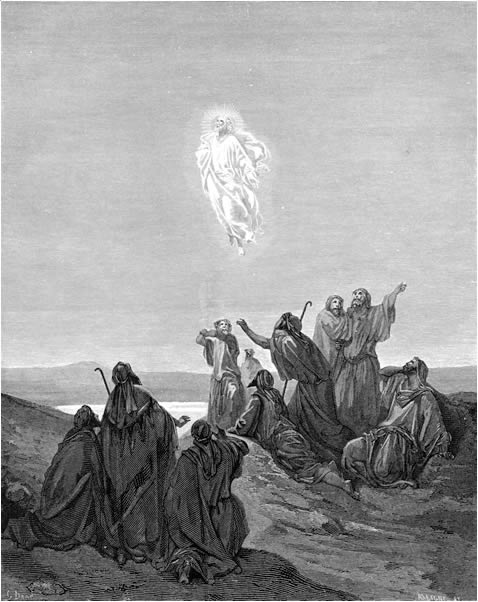
in Acts 1until the day He was taken up to heaven, after giving instructions through the Holy Spirit to the apostles He had chosen.
BSB
The same verse in ASV and KJV ▾
ASV
until the day in which he was received up, after that he had given commandment through the Holy Spirit unto the apostles whom he had chosen:
KJV
Until the day in which he was taken up, after that he through the Holy Ghost had given commandments unto the apostles whom he had chosen:
⋯
This verse in Acts 1
Commentary
15 notes on this verseAfter that he, through the Holy Ghost, etc. - This clause has been variously translated: the simple meaning seems to be this - that Christ communicated the Holy Spirit to his disciples, after his resurrection, as he had not done before. In Luk 24:45, it is said that he opened their understanding, that they might understand the Scriptures; and in Joh 20:22, that he breathed on them, and said, receive ye the Holy Ghost.
This site's exposition
In my first book, O Theophilus
on Acts 1:1-3
Luke opens by naming his first volume, the Gospel, as the book about all that Jesus began to do and to teach. Acts therefore presents itself as the continuation of that work.
This site's exposition
through the Holy Spirit
Jamieson, Fausset and Brown observe that no other passage says the risen Christ gave His instructions through the Holy Spirit. Clarke links the phrase to the days when Jesus opened the disciples' minds to the Scriptures and breathed on them (Luke 24:45 and John 20:22).
The record, by era
The Church Fathers4 voices
The following: Until the day he was taken up; the rest are inserted by way of parenthesis. As for, Having commanded the apostles through the Holy Spirit, either because the commands are spiritual, showing nothing worldly; or, so that the Spirit also may show itself …
"Until the day in which He was taken up, after that He, through the Holy Spirit, had given commandments unto the Apostles whom He had chosen. After He had given commandments through the Spirit;" i.e. they were spiritual words that He spake unto them, nothing human; either this is the meaning, or, that it was by the Spirit that He gave them commandments. Do you observe in what low terms he still speaks of Christ, as in fact Christ had spoken of Himself? "But if I by the Spirit of God cast out devils;" for indeed the Holy Ghost wrought in that Temple. Well, what did He command? "Go ye therefore," He says, "make disciples of all the nations, baptizing them into the Name of the Father, and of the Son, and of the Holy Ghost; teaching them to observe all things whatsoever I have commanded you." A high encomium this for the Apostles; to have such a charge entrusted to them, I mean, the salvation of the world! words full of the Spirit! And this the writer hints at in the expression, "through the Holy Ghost" (and, "the words which I spake unto you," saith the Lord, "are Spirit") thus leading the hearer on to a desire of learning what the commands were, and establishing the authority of the Apostles, seeing it is the words of the Spirit they are about to speak, and the commandments of Christ. "After He had given commandments," he says, "He was taken up." He does not say, "ascended;" he still speaks as concerning a man. It appears then that He also taught the Disciples after His resurrection, but of this space of time no one has related to us the whole in detail. St. John indeed, as also does the present writer, dwells at greater length on this subject than the others; but none has clearly related every thing (for they hastened to something else); however, we have learnt these things through the Apostles, for what they heard, that did they tell.
The main order: He commanded the apostles to first teach all nations, then to immerse them in the sacrament of faith, and after faith and baptism, to command what should be observed. And lest we think that what has been commanded is light and few, he added: All things whatsoever I have commanded you. So that whoever believes, who has been baptized in the Trinity, may do all the things that are commanded.
He spoke first of the word, not the Gospel, although Paul calls his own the gospel when he says: According to my gospel (2 Tim. 2:8); for the splendid flee everywhere; just as Matthew also, saying Book, of the genealogy (Matt. 1:1). But if Mark …
The Medieval Church1 voice
"Having given commandments through the Holy Spirit," that is, having spoken spiritual words to them; there was nothing human in this, because He gave commandments through the Spirit. Just as the Lord Himself, out of humility and in accommodation to His listeners, said: "If I …
7 more voices on this verse
The Medieval Church1 voice
Until the day on which he was taken up, after giving instructions through the Holy Spirit to the apostles whom he had chosen. By hyperbaton it is to be read until the day on which he was taken up, commanding before the assumption, that is, …
The Puritans and the Awakening4 voices
19 ), and so does St. Luke's, Luke xxiv. Christ continued doing and teaching to the last, till he was taken up to the other work he had to do within the veil. The truth of Christ's resurrection is maintained and evidenced,
quarantine:debris (2026-07-29) — leading-citation-number+unbalanced-parens
After having given commandment - In the 3rd verse St. Luke expresses in general terms what Christ said to his apostles during those forty days. But in the 4th and following verses he declares what he said on the day of his ascension.
Until the day in which he was taken up,.... That is, into heaven.
With a summary of the proofs of Christ's resurrection, his conference with his disciples, and the instructions he gave them during the forty days, of his continuance on earth,
The Nineteenth Century2 voices
A commentator
Jamieson, Fausset & Brown1802–1910
Commentary Critical and Explanatory on the Whole Bible (1871)
It is worthy of notice that nowhere else are such communications of the risen Redeemer said to have been given "through the Holy Ghost." In general, this might have been said of all He uttered and all He did in His official character; for it was for this very end that God "gave not the Spirit by measure unto Him" (Joh 3:34).
A commentator
Albert Barnes1798–1870
Notes, Explanatory and Practical, on the Old and New Testaments (1832-1869)
proposed
Until the day - The 40th day after the resurrection, Act 1:3. See Luk 24:51. In which he was taken up - In which he ascended to heaven. He was taken up into a cloud, and is represented as having been borne or carried to heaven, Act 1:9. After that ... - This passage has been variously rendered. The Syriac translates it, “After he had given commandment unto the apostles whom he had chosen by the Holy Spirit.” So also the Ethiopic version. Others have joined the words “through the Holy Spirit” to the phrase “was taken up,” making it mean that he was taken up by the Holy Spirit. But the most natural and correct translation seems to be what is in our King James Version. Through the Holy Ghost - To understand this, it is necessary to call to mind the promise that Jesus made before his death, that after his departure, the Holy Spirit would descend to be a guide to his apostles. See Joh 16:7-11, and the notes on that place. It was to be his office to carry forward the work of redemption in applying it to the hearts of people. Whatever was done, therefore, after the death and resurrection of Jesus, was to be regarded as under the unique influence and direction of the Holy Spirit. Even the instructions of Jesus and his commission to the apostles, were to be regarded as coming within the department of the sacred Spirit, or within the province of his unique work. The instructions were given by divine authority, by infallible guidance, and as a part of the work which the Holy Spirit was sent down to accomplish. Under the direction and guidance of that Spirit the apostles were to go forth; by his aid they were to preach the gospel, to organize the church, to establish its order and its doctrines; and hence, the entire work was declared to be by his direction. […]
The words behind it
12 Greek wordsEvery Greek word of this verse in the order it stands, with what it means and the door to its own study. The last column counts the times a word stands in the whole Bible: the rarer the word, the more the places it appears belong together.
| Greek | Sound | Meaning | Word study | In the Bible |
|---|---|---|---|---|
| ἄχρι | achri | until | G891 → | 48 times |
| ἧς | hes | the | G3739 → | 1405 times |
| ἡμέρας | hemeras | day | G2250 → | 389 times |
| ἐντειλάμενος | enteilamenos | having given orders | G1781 → | |
| τοῖς | tois | to the | G3588 → | 19766 times |
| ἀποστόλοις | apostolois | apostles | G652 → | 79 times |
| διὰ | dia | through | G1223 → | 664 times |
| πνεύματος | pneumatos | [the] Spirit | G4151 → | 378 times |
| ἁγίου | hagiou | Holy | G40 → | 220 times |
| οὓς | hous | whom | G3739 → | 1405 times |
| ἐξελέξατο | exelexato | He had chosen | G1586 → | 22 times |
| ἀνελήμφθη. | anelemphthe | He was taken up. | G353 → | 12 times |
ἄχριuntil
achriG891 →48 times
ἧςthe
hesG3739 →1405 times
ἡμέραςday
hemerasG2250 →389 times
ἐντειλάμενοςhaving given orders
enteilamenosG1781 →
τοῖςto the
toisG3588 →19766 times
ἀποστόλοιςapostles
apostoloisG652 →79 times
διὰthrough
diaG1223 →664 times
πνεύματος[the] Spirit
pneumatosG4151 →378 times
ἁγίουHoly
hagiouG40 →220 times
οὓςwhom
housG3739 →1405 times
ἐξελέξατοHe had chosen
exelexatoG1586 →22 times
ἀνελήμφθη.He was taken up.
anelemphtheG353 →12 times
A shaded row is a word that stands 400 times or fewer in the Bible.
The walk
8 stopsEach card is a verse this one points to, and under it the verses that one points to in turn. Where several paths arrive at the same place, that place is listed first: the text keeps returning to it.
Through
Acts 10:38how God anointed Jesus of Nazareth with the Holy Spirit and with power, and how Jesus went around doing good and healing all who were oppressed by the devil, because God was with Him.
it leads to
- Luke 4:18
“The Spirit of the Lord is on Me, because He has anointed Me to preach good news to the poor. He has sent Me to proclaim liberty to the captives and recovery of sight…
- Isaiah 61:1–3
The Spirit of the Lord GOD is on Me, because the LORD has anointed Me to preach good news to the poor. He has sent Me to bind up the brokenhearted, to proclaim liberty…
- Acts 2:22
Men of Israel, listen to this message: Jesus of Nazareth was a man certified by God to you by miracles, wonders, and signs, which God did among you through Him, as you yourselves know.
- Isaiah 11:2
The Spirit of the LORD will rest on Him—the Spirit of wisdom and understanding, the Spirit of counsel and strength, the Spirit of knowledge and fear of the LORD.
- John 3:34
For the One whom God has sent speaks the words of God, for God gives the Spirit without limit.
- Luke 4:18
Through
Hebrews 9:24For Christ did not enter a man-made copy of the true sanctuary, but He entered heaven itself, now to appear on our behalf in the presence of God.
it leads to
- Hebrews 12:2
Let us fix our eyes on Jesus, the author and perfecter of our faith, who for the joy set before Him endured the cross, scorning its shame, and sat down at the right hand…
- Hebrews 9:11–12
But when Christ came as high priest of the good things that have come, He went through the greater and more perfect tabernacle that is not made by hands and is not a part…
- Hebrews 9:23
So it was necessary for the copies of the heavenly things to be purified with these sacrifices, but the heavenly things themselves with better sacrifices than these.
- Hebrews 12:2
Where this verse is studied
On this page
Studies16
On this verse
On this chapter
About Acts
This page draws on 12 works. Open the list of works
This page draws on Adam Clarke, Commentary on the Bible; Albert Barnes, Notes, Explanatory and Practical, on the Old and New Testaments (1832-1869); Bede, Commentary on Acts; J. A. Alexander, The Acts of the Apostles Explained; Jamieson, Fausset & Brown, Commentary Critical and Explanatory on the Whole Bible; Jerome, Commentary on Matthew, 28:20; John Chrysostom, Homily on Acts 1; John Gill, Exposition of the New Testament (1746-1748); John Wesley, Explanatory Notes upon the New Testament; Matthew Henry, Commentary on the Whole Bible; Oecumenius, Commentary on Acts and Theophylact of Ohrid, Commentary on Acts.