
Acts 1:10
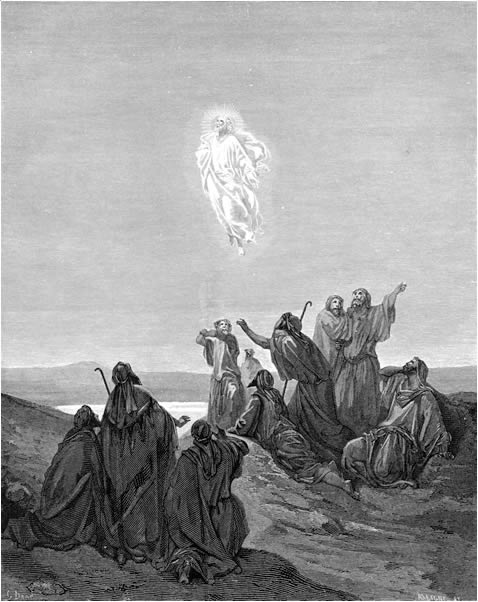
in Acts 1They were looking intently into the sky as He was going, when suddenly two men dressed in white stood beside them.
BSB
The same verse in ASV and KJV ▾
ASV
And while they were looking stedfastly into heaven as he went, behold two men stood by them in white apparel;
KJV
And while they looked stedfastly toward heaven as he went up, behold, two men stood by them in white apparel;
⋯
This verse in Acts 1
Commentary
19 notes on this verseLooked steadfastly - Keeping their eyes intensely fixed on their ascending Lord; continuing to look even after he had ascended above the region of the inferior clouds. Two men stood by them - Doubtless, angels in human shape. In white apparel - As emblematical of their purity, happiness, and glory.
This site's exposition
as He was taken up
on Acts 1:9-11
Luke tells the ascension briefly: they watched as He was taken up, and a cloud hid Him from their sight. The cloud recalls the pillar of cloud in Exodus and the cloud of the transfiguration.
This site's exposition
two men dressed in white
Adam Clarke takes the two men to be angels in human shape, their white clothing a sign of purity and glory. Bede observes that the angels at the Lord's birth are given no white garments, and he reads the white here as fitting for exaltation.
The record, by era
The Church Fathers5 voices
Men, appearing as angels because of the vision, speak through the experience, according to the kindred nature of the vision, so that they do not completely astonish those already struck by the uniqueness of the ascension.
The Passover affords a more than usually solemn day for baptism; when, withal, the Lord's passion, in which we are baptized, was completed. Nor will it be incongruous to interpret figuratively the fact that, when the Lord was about to celebrate the last Passover, He said to the disciples who were sent to make preparation, "You will meet a man bearing water." He points out the place for celebrating the Passover by the sign of water. After that, Pentecost is a most joyous space for conferring baptisms; wherein, too, the resurrection of the Lord was repeatedly proved among the disciples [Acts 1:3], and the hope of the advent of the Lord indirectly pointed to, in that, at that time, when He had been received back into the heavens [Acts 1:9], the angels told the apostles that "He would so come, as He had withal ascended into the heavens;" [Acts 1:11] at Pentecost, of course. But, moreover, when Jeremiah says, "And I will gather them together from the extremities of the land in the feast-day," he signifies the day of the Passover and of Pentecost, which is properly a "feast-day." However, every day is the Lord's; every hour, every time, is apt for baptism: if there is a difference in the solemnity, distinction there is none in the grace.
Any one who takes into view the ascension into Heaven of our Lord Christ, and the angels clothed in white raiment announcing to the Apostles his second coming, would never cease magnifying Jesus who showed and opened up to men the ascent into the future …
And to speak briefly they were trained by wars and miracles and dreams and their sacred books, and were thus taught to know Him who was truly God, Him whom the Jews revere and worship, in order that they also might be the better prepared …
"And while they looked stedfastly," it is said, "toward heaven, as he went up, behold, two men stood by them in white apparel; which also said, Ye men of Galilee, why stand ye gazing up into heaven? This same Jesus, which is taken up from you into heaven" - they used the expression "This" demonstratively, saying, "this Jesus, which is taken up from you into heaven, shall thus" - demonstratively, "in this way" - "come in like manner as ye have seen Him going into heaven." Again, the outward appearance is cheering - "in white apparel." They were Angels, in the form of men. And they say, "Ye men of Galilee:" they showed themselves to be trusted by the disciples, by saying, "Ye men of Galilee." For this was the meaning: else, what needed they to be told of their country, who knew it well enough? By their appearance also they attracted their regard, and showed that they were from heaven.
11 more voices on this verse
The Church Fathers1 voice
"Behold, two men stood by them." That they may vent no sorrowful exclamations, and that it might not be with them as it was with Elisha, who, when his master was taken up, rent his mantle (2 Kings ii. 12). And what say they? "This Jesus, which is taken up from you into heaven, shall thus come." And, "Behold, two men stood by them." With good reason: for "in the mouth of two witnesses shall every word be established" (Deut. xvii. 6): and these utter the same things. And it is said, that they were "in white apparel." In the same manner as they had already seen an Angel at the sepulchre, who had even told them their own thoughts; so here also an Angel is the preacher of His Ascension; although indeed the Prophets had frequently foretold it, as well as the Resurrection.
The Medieval Church4 voices
But first we must inquire what it means that when the Lord was born, angels appeared, yet they are not recorded as having appeared in white garments, whereas when the Lord ascended, angels who were sent are recorded as having appeared in white garments. For it is written thus: "While they were watching, he was lifted up, and a cloud received him from their sight. And while they were gazing into heaven as he went, behold, two men stood beside them in white garments." In white garments, joy and festivity of mind are shown. What does it mean, then, that when the Lord was born, angels appear not in white garments, but when the Lord ascended, angels appear in white garments, unless that then a great festivity was made for the angels, when God as man entered heaven? For when the Lord was being born, divinity seemed to be humbled; but when the Lord ascended, humanity was exalted. For white garments are more fitting for exaltation than for humiliation. Therefore at his assumption, angels ought to have been seen in white garments, because he who at his nativity appeared as humble God, at his Ascension was shown as exalted man.
Behold, two men stood by them in white apparel. White garments are more fitting for exaltation than for humiliation. And so, as the Lord ascends, angels appear in white garments, who are not said to appear in white clothing at the Lord's birth, because he …
While they were looking on as he went into heaven. In Greek, it is thus: And while they were gazing into heaven as he went; that is, they were gazing into heaven, where he was going. Hence, the angels say to them: Why do you …
Having said, "Why do you stand gazing into heaven?" — they did not allow them to remain any longer in that place and hope to see Him again, but urged them to return at last to Jerusalem for the work of preaching. Angels everywhere serve …
The Puritans and the Awakening3 voices
You have seen all that you were called together to see, and why do you look any further? Why stand you gazing, as men frightened and perplexed, as men astonished and at their wits' end?" Christ's disciples should never stand at a gaze, because they have a sure rule to go by, and a sure foundation to build upon. To confirm their faith concerning Christ's second coming.
quarantine:debris (2026-07-29) — odd-straight-quotes
And while they looked steadfastly toward heaven,....
With a general idea of the embryo of the Christian church, and its state from Christ's ascension to the pouring out of the Spirit,
The Nineteenth Century3 voices
A commentator
Jamieson, Fausset & Brown1802–1910
Commentary Critical and Explanatory on the Whole Bible (1871)
Lest it should be thought He had disappeared when they were looking in some other direction, and so was only concluded to have gone up to heaven, it is here expressly said that "while they were looking He was taken up, and a cloud received Him out of their sight." So Elijah, "If thou see me when I am taken from thee" (2Ki 2:10);
A commentator
Jamieson, Fausset & Brown1802–1910
Commentary Critical and Explanatory on the Whole Bible (1871)
proposed
while they looked steadfastly toward heaven--following Him with their eager eyes, in rapt amazement. Not, however, as a mere fact is this recorded, but as a part of that resistless evidence of their senses on which their whole subsequent testimony was to be borne. two men in white apparel--angels in human form, as in Lu 24:4.
quarantine:debris (2026-07-29) — starts-lowercase
A commentator
Albert Barnes1798–1870
Notes, Explanatory and Practical, on the Old and New Testaments (1832-1869)
proposed
Looked stedfastly - They fixed their eyes, or gazed intently toward heaven. Luk 4:20, “and the eyes of all them in the synagogue were fastened (Greek: the same word as here) on him.” It denotes the intense gaze when we are deeply interested, and wish to see clearly and distinctly. They were amazed and confounded; what had occurred was unlocked for; for they had just been inquiring whether he would not, at that time, restore the kingdom to Israel. With this mingled amazement, disappointment, and curiosity, and with an earnest desire to catch the last glimpse of their beloved master, they naturally continued to gaze on the distant clouds where he had mysteriously disappeared from their view. Never was a scene more impressive, grand, and solemn than this. Toward heaven - Toward the distant clouds or sky which had received him. As he went up - Literally, upon him going up; that is, they gazed on him as he ascended, and doubtless they continued to gaze after he had disappeared from their view. Two men - From the raiment of these “men,” and the nature of their message, it seems clear that they were angelic beings, who were sent to meet and comfort the disciples on this occasion. They appeared in human form, and Luke describes them as they appeared. Angels are not infrequently called people. Luk 24:4, “two men stood by them in shining garments,” etc. Compare Joh 20:12; Mat 28:5. As two angels are mentioned only as addressing the apostles after the resurrection of Jesus Joh 20:12; Luk 24:4, it is no unnatural supposition that these were the same who had been designated to the honorable office of bearing witness to his resurrection, and of giving them all the information about that resurrection, and of his ascension, which their circumstances needed. In white apparel - Angels are commonly represented as clothed in white. See the Joh 20:12 note; Mat 28:3 note; Mar 16:5 note. […]
The words behind it
18 Greek wordsEvery Greek word of this verse in the order it stands, with what it means and the door to its own study. The last column counts the times a word stands in the whole Bible: the rarer the word, the more the places it appears belong together.
| Greek | Sound | Meaning | Word study | In the Bible |
|---|---|---|---|---|
| καὶ | kai | And | G2532 → | 9120 times |
| ὡς | hos | as | G5613 → | 500 times |
| ἀτενίζοντες | atenizontes | looking intently | G816 → | 14 times |
| ἦσαν | esan | they were | G1510 → | 2333 times |
| εἰς | eis | into | G1519 → | 1755 times |
| τὸν | ton | the | G3588 → | 19766 times |
| οὐρανὸν | ouranon | heaven | G3772 → | 272 times |
| πορευομένου | poreuomenou | as is going | G4198 → | 147 times |
| αὐτοῦ, | autou | He, | G846 → | 5565 times |
| καὶ | kai | then | G2532 → | 9120 times |
| ἰδοὺ | idou | behold | G2400 → | 200 times |
| ἄνδρες | andres | men | G435 → | 216 times |
| δύο | duo | two | G1417 → | 133 times |
| παρειστήκεισαν | pareistekeisan | had stood by | G3936 → | 41 times |
| αὐτοῖς | autois | them | G846 → | 5565 times |
| ἐν | en | in | G1722 → | 2738 times |
| ἐσθήσεσι | esthesesi | garments | G2066 → | 8 times |
| λευκαῖς, | leukais | white, | G3022 → |
καὶAnd
kaiG2532 →9120 times
ὡςas
hosG5613 →500 times
ἀτενίζοντεςlooking intently
atenizontesG816 →14 times
ἦσανthey were
esanG1510 →2333 times
εἰςinto
eisG1519 →1755 times
τὸνthe
tonG3588 →19766 times
οὐρανὸνheaven
ouranonG3772 →272 times
πορευομένουas is going
poreuomenouG4198 →147 times
αὐτοῦ,He,
autouG846 →5565 times
καὶthen
kaiG2532 →9120 times
ἰδοὺbehold
idouG2400 →200 times
ἄνδρεςmen
andresG435 →216 times
δύοtwo
duoG1417 →133 times
παρειστήκεισανhad stood by
pareistekeisanG3936 →41 times
αὐτοῖςthem
autoisG846 →5565 times
ἐνin
enG1722 →2738 times
ἐσθήσεσιgarments
esthesesiG2066 →8 times
λευκαῖς,white,
leukaisG3022 →
A shaded row is a word that stands 400 times or fewer in the Bible.
The walk
8 stopsEach card is a verse this one points to, and under it the verses that one points to in turn. Where several paths arrive at the same place, that place is listed first: the text keeps returning to it.
Through
Revelation 7:14“Sir,” I answered, “you know.” So he replied, “These are the ones who have come out of the great tribulation; they have washed their robes and made them white in the blood of the…
it leads to
- 1 John 1:7
But if we walk in the light as He is in the light, we have fellowship with one another, and the blood of Jesus His Son cleanses us from all sin.
- Revelation 22:14
Blessed are those who wash their robes, so that they may have the right to the tree of life and may enter the city by its gates.
- Hebrews 13:12
And so Jesus also suffered outside the city gate, to sanctify the people by His own blood.
- Revelation 1:5
and from Jesus Christ, the faithful witness, the firstborn from the dead, and the ruler of the kings of the earth. To Him who loves us and has released us from our sins by…
- Revelation 12:11
They have conquered him by the blood of the Lamb and by the word of their testimony. And they did not love their lives so as to shy away from death.
- 1 John 1:7
Through
Matthew 17:2There He was transfigured before them. His face shone like the sun, and His clothes became as white as the light.
it leads to
- Matthew 28:3
His appearance was like lightning, and his clothes were white as snow.
Reached by 2 separate paths from here.
- Psalms 104:2
He wraps Himself in light as with a garment; He stretches out the heavens like a tent,
- Matthew 28:3
Through
Mark 16:5When they entered the tomb, they saw a young man dressed in a white robe sitting on the right side, and they were alarmed.
it leads to
- John 20:11–12
But Mary stood outside the tomb weeping. And as she wept, she bent down to look into the tomb,
Reached by 2 separate paths from here.
- John 20:11–12
Where this verse is studied
On this page
Studies16
On this verse
On this chapter
About Acts
This page draws on 16 works. Open the list of works
This page draws on Adam Clarke, Commentary on the Bible; Albert Barnes, Notes, Explanatory and Practical, on the Old and New Testaments (1832-1869); Bede, Commentary on Acts; Bede, Retractions on Acts; Cosmas Indicopleustes, The Christian Topography, Book 6; Cosmas Indicopleustes, The Christian Topography, Book 12; Gregory the Dialogist, Forty Gospel Homilies, Homily 29; Jamieson, Fausset & Brown, Commentary Critical and Explanatory on the Whole Bible; John Calvin, Commentary upon the Acts of the Apostles; John Chrysostom, Homilies on the Acts of the Apostles; John Chrysostom, Homily on Acts 2; John Gill, Exposition of the New Testament (1746-1748); Matthew Henry, Commentary on the Whole Bible; Oecumenius, Commentary on Acts; Tertullian, On Baptism, Chapter 19 and Theophylact of Ohrid, Commentary on Acts.