
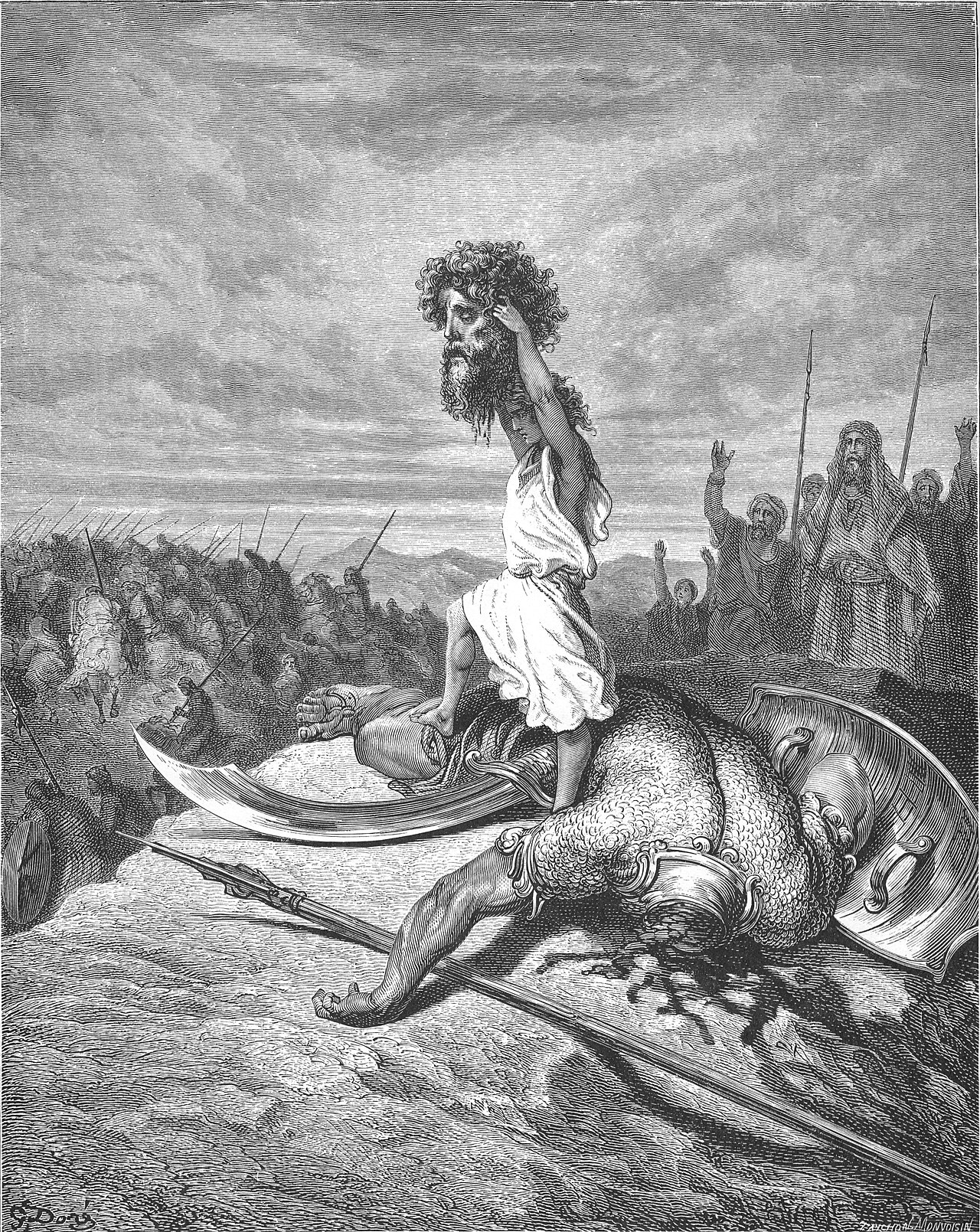
1 Samuelchapter 17
58 verses · Samuel, Nathan and Gad, by tradition · 10th century BC · History
And there went out a champion out of the camp of the Philistines, named Goliath, of Gath, whose height was six cubits and a span.
Introduction
Samuel, Nathan and Gad, by tradition, History, 1 Samuel Overview.
This chapter is the best known battle story in the Old Testament, told for a people who fought the Philistines for generations. The shepherd anointed in secret now comes into public view. It turns on an ancient custom of war, the fight between chosen champions. Listen for how each speaker measures the danger, the soldiers, the brothers, the king and the shepherd. Listen for what David says about the LORD before he says anything about the fight. The chapter makes him known to all Israel.
Context
- Who
- Israelites who knew what a champion's challenge meant and what a sling could do
- What
- An account of Goliath's challenge in the valley of Elah and David's victory over him with a sling and a stone.
- Where
- The valley of Elah in the Judean foothills, between Socoh and Azekah, with the armies on facing ridges.
- When
- About 1023 BC on the traditional reckoning; the chapter counts its own time as forty days of challenge.
- Why
- To show that the battle is the LORD's and that He saves without sword or spear.
Historical context
Goliath is the champion of Gath, one of the three towns where Joshua 11:22 records that a remnant of the Anakim stayed. David is the eighth son of Jesse of Bethlehem, anointed in secret one chapter earlier and still keeping his father's sheep, going back and forth between the court and the flock at verse 15.
Show the rest of the historical context, 3 more paragraphs
The place is the valley of Elah, which runs west out of the Judean hill country toward Philistine land, with Socoh, Azekah and Ephes-dammim along it. The Philistines have pushed some twelve miles inside Judah's own territory. The occasion is an offer of single combat renewed morning and evening for forty days, on terms that bind the losing nation to serve the winner.
A first hearer knew that combat between champions was a recognised way of settling a battle without destroying two armies, and that the terms Goliath sets were the standard ones. He knew the armour: a bronze helmet, a coat of scale mail at five thousand shekels, bronze greaves, a bronze javelin between the shoulders, and a spear with an iron head of six hundred shekels. He knew that a man with a shield bearer walking in front of him could not carry his own protection and move.
He knew the sling, since slingers were a specialist arm of ancient armies and a smooth stream stone from a whirled leather pouch travels fast enough to kill at over a hundred yards. A man who has used a sling knows he may need a second stone, which is why five come out of the brook.
Significance
Saul and the army measure the champion against themselves and reach the right answer about him. David measures him against God and says out loud that the battle is the LORD's, and that He saves without sword and spear.
Show the rest of the significance, 1 more paragraph
First hearers also caught the irony in the king's tent. Saul stood a head taller than anyone in Israel, which is the reason the people had wanted him. He stayed on his own ridge and offered his armour to a shepherd instead of wearing it down into the valley himself.
This chapter in Jewish lifeWhat this chapter is in Jewish life and reading.
How it is read
Rashi works this chapter as the record of one enemy and one duel, detail by detail. On the place name at its head he hands on Radak's reading, that it means no more blood (Rashi on I Samuel 17:1:1, the Metsudah Tanach series, Lakewood, N.J., CC-BY). The bloodshed between Israel and the Philistines ceased there, and the name records it (same ref). On the word for the champion he gives the plain sense first, a mighty man standing between the two battalions. He then gives the reading of Maseches Sotah 42b, which takes the word from the root to build and makes him as sturdy as a building (Rashi on I Samuel 17:4:1, same edition). The armour he reads as fish scales of iron spread over the coat, a scale covering each hole (Rashi on I Samuel 17:5:1, same edition). The spear's shaft he renders with Targum Yonoson as a weaver's beam (Rashi on I Samuel 17:7:1, same edition). On the challenge he supplies what the Philistine means, that one man fight for all of them on the terms just set (Rashi on I Samuel 17:8:1, same edition). On the twice-daily taunt he hands on the Rabbis' reading, that it came morning and evening "to prevent them from reciting 'shema'", citing Maseches Sotah 42b (Rashi on I Samuel 17:16:1, same edition). He notes that David had already played music in Saul's palace (Rashi on I Samuel 17:14:1, same edition). David went back and forth between the king and his father's sheep, so he held no permanent post at court (Rashi on I Samuel 17:15:1, same edition). Four commentators stand as citations here, because the corpus holds no English version of them. They are Malbim on I Samuel 17:2:1 and 17:11:1, Radak on I Samuel 17:3:1, 17:13:1 and 17:17:1, and Metzudat David on I Samuel 17:9:1, 17:10:1 and 17:19:1.
What the rabbis say
The tradition the rabbis are best known for here concerns the Philistine's parentage, and the corpus carries it inside Rashi. On the word for the Philistine camp he reports that the Rabbis expounded it from a root meaning uncovering. On that reading a hundred men had relations with Goliath's mother Orpah after she left Ruth and Naomi, and the Rabbis cite Maseches Sotah 42b. Goliath was born of those relations, and no one knew who had fathered him, which is why he was called the man from between them (Rashi on I Samuel 17:23:1, same edition). This site carries the same tradition with its Talmud reference and its gloss at /featured/david-and-goliath. That page also gives both readings of the giant's height, and a row on this chapter points there rather than arguing either. The corpus records forty rabbinic locators on the chapter, thirty-one of them Midrash and nine Talmud, and every one is a locator without text. The champion's size draws Midrash Aggadah, Deuteronomy 3:11:5 and Midrash Aggadah, Numbers 13:32:2. His armour draws Chullin 66b:4 and Jerusalem Talmud Peah 5:7:2. The spear draws Midrash Lekach Tov, Deuteronomy 3:11:1 and Midrash Tanchuma Buber, Chayei Sara 1:1. The taunt and Israel's fear draw Bamidbar Rabbah 18:12, Midrash Tehillim 34:1 and Esther Rabbah 5:4. David's answer to Saul draws Kohelet Rabbah 1:16:1 and Midrash Aggadah, Leviticus 21:15:1. The lion and the bear draw Bamidbar Rabbah 7:5, Midrash Tehillim 144:1 and Midrash Tanchuma, Beshalach 28:3. Saul's armour on the boy draws Midrash Shmuel 21:1, and the five stones draw Yalkut Shimoni on Nach 127:3. The name David answers in draws Aggadat Bereshit 12:1 and Bamidbar Rabbah 14:1. The stone striking home draws Jerusalem Talmud Yoma 7:3:6. Saul's question about whose son the boy is draws Yevamot 76b:17 and Midrash Tehillim 116:11. The rabbis teach in these places, and this site reports them as their teaching rather than as a rule of the text.
Sources: Rashi, Rashi on I Samuel 17:1:1, 17:4:1, 17:5:1, 17:7:1, 17:8:1, 17:14:1, 17:15:1, 17:16:1 and 17:23:1, the Metsudah Tanach series, Lakewood, N.J., CC-BY; Radak, Radak on I Samuel 17:3:1, 17:13:1 and 17:17:1, cited only, no English version in the corpus; Metzudat David, Metzudat David on I Samuel 17:9:1, 17:10:1 and 17:19:1, cited only; Malbim, Malbim on I Samuel 17:2:1 and 17:11:1, cited only; MannaFest, the David and Goliath page, src/app/featured/david-and-goliath/page.tsx, for the Sotah tradition as this site already carries it, 2026; MannaFest, the readings table, src/lib/hebraic/readings.ts, for the yearly cycle's silence on this chapter, 2026.
The heads below are this chapter's scenes. The numbered points under each are its verses.
The champion of Gath defies the armies of Israel
1 Samuel 17:1-2
The Philistines have pushed twelve miles into Judah's hill country, and their camp ground, Ephes-dammim, means boundary of blood. Israel answers from the Valley of Elah, the terebinth valley, ground a visitor can still walk. Goliath's city was one of those Joshua 11:22 names where the Anakim remained, Gaza, Gath and Ashdod, so the war is fought inside the tribe his city was left to trouble.
1 Samuel 17:1
“The narrative reverts to the Philistine wars 1Sa 14:52; the other introductory details concerning Saul’s rejection, and David’s introduction upon the stage of the history, having been disposed of in the intermediate chapters. Shochoh which belongeth to Judah - See the marginal reference which places Shochoh and Azekah in the “Shephelah” or maritime plain, and 2Ch 28:18, “Shochoh” now “Shuweikeh,” “nine miles from Eleutheropolis,” Jerome. Ephes-dammim - Called “Happas-dammim” (Pas-dammim, 1Ch 11:13), “the end of bloodshed,” now “Damun,” about 4 miles northeast of Shuweikeh.”
Adam Clarke gives the name of the valley three ways: the turpentine tree, the terebinth, or the oak, and he calls its site well known. The two armies face each other here for most of the chapter. The battle cry comes when David arrives.
1 Samuel 17:2
“The valley of Elah - Some translate this the turpentine valley, or the valley of the terebinth trees; and others, the valley of oaks. The situation of this valley is well known.”
Adam Clarke · Commentary on the Bible (1810-1826)evangelical
Two armies hold two mountainsides with the valley floor between, and neither will cross. Surveyors of the Elah valley describe a deep ravine down its middle with vertical sides and a bed strewn with water-worn stones, a valley within the valley, which explains both the long stalemate and where David's stones came from.
1 Samuel 17:3
“And the Philistines stood on a mountain on the one side, and Israel stood on a mountain on the other side, Before the Israelites are said to encamp in or by the valley; but here they are said to take the higher ground, and face the Philistines, who were on a mountain or hill on the other side over against them, which Kimchi reconciles thus; the whole or the grand army lay encamped in the valley, and, they that were set in array, or the first ranks, the first battalion, ascended the mountain to meet the Philistines.”
1 Samuel 17:4-5
Goliath comes from Gath, where Joshua left a remnant of the Anakim, and the thread runs from Genesis 6:4 and Numbers 13:33 to the four giants of 2 Samuel 21. The Hebrew text gives "six cubits and a span," about nine feet nine, while the Septuagint, a Qumran scroll and Josephus read four cubits and a span. Either way the coat of mail alone weighs "five thousand shekels."
1 Samuel 17:4
“There went out a champion - Our word champion comes from campus, the field; Campio est enim ille qui pugnat in campo, hoc est, in castris, “Champion is he, properly, who fights in the field; i.e., in camps.” A man well skilled in arms, strong, brave, and patriotic. But is this the meaning of the original איש הבנים ish habbenayim, a middle man, the man between two; that is, as here, the man who undertakes to settle the disputes between two armies or nations.”
Adam Clarke · Commentary on the Bible (1810-1826)evangelical
1 more voice on this verse
1 Samuel 17:4
“Six cubits - At least, nine feet, nine inches high. And this is not strange; for besides the giants mentioned in Scripture, Herodotus, Diodourus Siculus, and Pliny, make mention of persons seven cubits high.”
John Wesley · Explanatory Notes upon the Old Testament (1765)evangelical
Albert Barnes describes the bronze coat of mail as scale armor that guarded back and breast. John Wesley weighs the five thousand shekels at seventy-eight pounds, and Barnes at one hundred fifty-seven. Matthew Henry notes a reading of the figure as its price.
1 Samuel 17:5
“Coat of mail - Or “breastplate of scales.” A kind of metal shirt, protecting the back as well as the breast, and made of scales like those of a fish; as was the corselet of Rameses III, now in the British Museum. The terms, helmet, coat, and clothed (armed the King James Version) are the same as those used in Isa 59:17. Five thousand shekels - Probably about 157 pounds avoirdupois (see Exo 38:12).”
3 more voices on this verse
1 Samuel 17:5
“Coat of mail - Made of brass plates laid over one another, like the scales of a fish. The weight, &c. - The common shekel contained a fourth part of an ounce; and so five thousand shekels made one thousand two hundred and fifty ounces, or seventy- eight pounds: which weight is not unsuitable to a man of such vast strength as his height speaks him to be.”
John Wesley · Explanatory Notes upon the Old Testament (1765)evangelical
1 Samuel 17:5
“And a bronze helmet on his head, etc. If you inquire what a chain mail is, read in Virgil, a coat linked with hooks, and triple with gold.”
Bede · written before 735 · Commentary on Samuelpatristic
1 Samuel 17:5
“The coat is said to weigh 5000 shekels, and a shekel was half an ounce avoirdupois, a vast weight for a man to carry, all the other parts of his armour being proportionable. But some think it should be translated, not the weight of the coat, but the value of it, was 5000 shekels; so much it cost.”
Matthew Henry · Commentary on the Whole Bible (1707-1721)puritan
1 Samuel 17:6-7
The armor is described piece by piece, bronze at every point a stone might land, and a shield bearer walks in front. A spear shaft "like a weaver’s beam" and an iron point of six hundred shekels mark him as a one-man siege engine. The narrator gives this equipment more words than any armor in Scripture, so that its uselessness in verse 50 lands with full weight.
1 Samuel 17:6
“Greaves of brass upon his legs - This species of armor may be seen on many ancient monuments. It was a plate of brass (though perhaps sometimes formed of laminae or plates, like the mail) which covered the shin or fore part of the leg, from the knee down to the instep, and was buckled with straps behind the leg. From ancient monuments we find that it was commonly worn only on one leg.”
Adam Clarke · Commentary on the Bible (1810-1826)evangelical
Albert Barnes gives the Hebrew for the spear's point as its flame, the metal that flashed, and puts its weight near eighteen pounds. Matthew Henry and John Wesley both read the shield bearer as ceremony. A man armored in bronze had little need of a shield.
1 Samuel 17:7
“Spear’s-head - literally, “the flame of his spear,” the metal part which flashed like a flame. Six hundred shekels - i. e., between seventeen and eighteen pounds avoirdupois.”
2 more voices on this verse
1 Samuel 17:7
“It was like a weaver's beam. His arm could manage that which an ordinary man could scarcely heave. His shield only, which was the lightest of all his accoutrements, was carried before him by his esquire, probably for state; for he that was clad in brass little needed a shield.”
Matthew Henry · Commentary on the Whole Bible (1707-1721)puritan
1 Samuel 17:7
“It was like this for thickness. And though the whole weight of Goliath's armour may seem prodigious; yet it is not so much by far as one Athanatus did manage: of whom Pliny relates, That he saw him come into the theatre with arms weighing twelve thousand ounces. A shield - Probably for state: for he that was clad in brass, little needed a shield.”
John Wesley · Explanatory Notes upon the Old Testament (1765)evangelical
1 Samuel 17:8-9
Goliath proposes representative combat: one man from each side, and the losing nation serves the winner. The proposal frames the whole chapter, because whoever fights him fights for all Israel, and his victory or fall is counted to the people he stands for. Gill observes that the Philistines never honored the terms after their champion fell, which is what such offers were worth.
1 Samuel 17:8
“I defy the armies of Israel . . .; give me a man, that we may fight together--In cases of single combat, a warrior used to go out in front of his party, and advancing towards the opposite ranks, challenge someone to fight with him.”
Jamieson, Fausset & Brown · Commentary Critical and Explanatory on the Whole Bible (1871)reformed
1 more voice on this verse
1 Samuel 17:8
“I a Philistine - The Targum adds much to this speech. This is the substance: “I am Goliath the Philistine of Gath, who killed the two sons of Eli, Hophni and Phinehas the priests; and led into captivity the ark of the covenant of Jehovah, and placed it in the temple of Dagon my god; and it remained in the cities of the Philistines seven months.”
Adam Clarke · Commentary on the Bible (1810-1826)evangelical
John Gill doubts that Goliath held any authority to bind the Philistines to these terms. The offer stakes a whole nation's freedom on one man's arm. David takes up that stake for Israel at verse 32.
1 Samuel 17:9
“If he be able to fight with me, and to kill me, then will we be your servants,.... For which it does not appear he had any commission or authority to say; nor did the Philistines think themselves obliged to abide by what he said, since, when he was slain, they did not yield themselves servants to the Israelites: but if I prevail against him, and kill him, then shall ye be our servants, and serve us; to which terms also the Israelites did not consent; nor did David, who engaged with him, enter the fray on such conditions.”
1 Samuel 17:10-11
The word rendered defy means to reproach, and it becomes the chapter's refrain, taken up by David at verse 26 and answered at verse 45. Saul and all Israel are "dismayed and greatly afraid," and the tallest man in Israel will not go, since the Spirit of the LORD departed from him at 16:14. Henry notes that the Saul of chapter 11 would have answered this challenge before nightfall.
1 Samuel 17:10
“I defy - אני חרפתי ani cheraphti, “I strip and make bare,” the armies of Israel; for none dared to fight him. From the Dhunoor Veda Shastra it appears that, among the Hindoos, it was common, before the commencement of an engagement, to challenge the enemy by throwing out some terms of abuse, similar to those used by Goliath. We find this also in Homer: his heroes scold each other heartily before they begin to fight. See on 1Sa 17:43 (note).”
Adam Clarke · Commentary on the Bible (1810-1826)evangelical
Matthew Henry asks where Jonathan was, the son who had crossed to a Philistine outpost with only his armor-bearer in chapter 14. This chapter never names him. He appears again at 18:1, knit in soul to David.
1 Samuel 17:11
“We found before, when the Spirit of the Lord came upon Saul ( ch. xi. 6 ), none could be more daring nor forward to answer the challenge of Nahash the Ammonite, but now that the Spirit of the Lord had departed from him even the big looks and big words of a single Philistine make him change colour. But where was Jonathan all this while?”
Matthew Henry · Commentary on the Whole Bible (1707-1721)puritan
David comes with bread and cheeses, and hears the taunt
1 Samuel 17:12-15
The narrative starts over from Bethlehem, as if to say that the answer to Gath was already growing in Ruth's town. David is the eighth son, keeper of the sheep, and verse 15 has him going back and forth between Saul's court and his father's flock, which is how the anointed of chapter 16 can arrive at this battle as an errand boy. Bethlehem carries the thread that began at Ruth 4:17 and runs to Micah 5:2.
1 Samuel 17:12
“The 12th verse, to the 31st inclusive, are wanting in the Septuagint; as also the 41st verse; and from the 54th to the end; with the first five verses of 1 Samuel 18, and the 9th, 10th, 11th, 17th, 18th, and 19th of the same. All these parts are found in the Codex Alexandrinus; but it appears that the MS. from which the Codex Alexandrinus was copied, had them not. See observations at the end of this chapter, 1Sa 17:58 (note). Dr. Kennicott has rendered it very probable that these portions are not a genuine part of the text.”
Adam Clarke · Commentary on the Bible (1810-1826)evangelical
The three sons at the front are the three Samuel passed over at 16:6 to 9, named in the same order. John Gill notes that only these three followed Saul. The rejected brothers carry the spears, and the anointed one keeps the sheep.
1 Samuel 17:13
“But his three eldest sons went off, etc. The teachers of that people, whose three orders we have previously explained, always waged spiritual war, either girded against the allurements of their own flesh and mind, or concerned with instructing others.”
Bede · written before 735 · Commentary on Samuelpatristic
And David was the youngest: Matthew Henry reads the plain line as David's humility. After serving the king with his harp, he went back from the court to the obscurity of his father's house. John Gill says the three brothers are named again to set the youngest apart.
1 Samuel 17:14
“And David was the youngest,.... For the sake of whom this account is given of Jesse and his family, and who after this makes a considerable figure in the camp and court of Saul: and the three eldest followed Saul; as before related, and which is repeated, that it might be observed that they only of Jesse's sons followed Saul; not David particularly, but who was providentially sent to the army at the time the Philistine was defying it.”
John Gill cites Josephus, who says Saul's physicians sought a singer to stand over the king's head. Once Saul recovered, Gill reasons, David was sent home. He may also have left when the king marched out to war.
1 Samuel 17:15
“Now concerning this champion observe, 1. He was of the sons of Anak, who at Gath kept their ground in Joshua's time ( Josh. xi. 22 ), and kept up a race of giants there, of which Goliath was one, and, it is probable, one of the largest.”
Matthew Henry · Commentary on the Whole Bible (1707-1721)puritan
Morning and evening for forty days the reproach is renewed, and no man in Israel moves. Forty is Scripture's number of testing, the days of the spies and the years of the wilderness, and here it measures how long a nation can hear its God defied while its king stands silent.
1 Samuel 17:16
“And the Philistine drew near morning and evening,.... Twice a day he came near the camp, within the hearing of it. The Jews (w) say, he took those seasons on purpose to disturb them in reading their "Shema", or "hear, O Israel", &c. and saying their prayers morning and evening: and presented himself forty days; Successively, before the armies of Israel, daring them to send down a man to fight with him, and reproaching them for their cowardice in not doing it. (w) T. Bab. Sotah, fol. 42. 2.”
1 Samuel 17:17-19
Jesse sends bread to his sons and cheeses to their captain, and asks for their pledge, some token that they are alive and well. The father sends the youngest to the battle with provisions for the brethren, and the older writers loved the picture without forcing it: the errand is ordinary, and providence rides on it.
Adam Clarke explains the ten portions of cheese as pressed curd, highly salted and carried in rush baskets. Matthew Henry notes that David carried the whole load himself. Henry thinks Jesse kept his anointed son low to hide him from envy.
1 Samuel 17:18
“Carry these ten cheeses - Cheeses of milk, says the margin. In the East they do not make what we call cheese: they press the milk but slightly, and carry it in rush baskets. It is highly salted, and little different from curds.”
Adam Clarke · Commentary on the Bible (1810-1826)evangelical
1 more voice on this verse
1 Samuel 17:18
“He had not so much as an ass at command to carry his load, but must take it on his back, and yet run to the camp. Jesse, we thought, was privy to his being anointed, and yet industriously kept him thus mean and obscure, probably to hide him from the eye of suspicion and envy, knowing that he was anointed to a crown in reversion.”
Matthew Henry · Commentary on the Whole Bible (1707-1721)puritan
Jesse speaks of a battle. John Gill reads it as two armies drawn up for one, with no blows yet struck. Caesarius of Arles took the low valley as the vale of sins and tears, where Christ, the true David, comes down to lift the human race.
1 Samuel 17:19
“Now Saul, and they,.... That is, the sons of Jesse, and brethren of David: and all the men of Israel; the soldiers in the army: were in the valley Elah; or "by" it, near unto it; for they were set in array on the mountain on the side of it: fighting with the Philistines; not actually engaged in battle, but drawn up for it; prepared and in readiness to engage whenever it was necessary, or they were obliged to it; and perhaps there might be now and then some skirmishes in the outer parts of the camp.”
1 more voice on this verse
1 Samuel 17:19
“Fighting with the Philistines - See at the end of the chapter, 1Sa 17:58 (note).”
Adam Clarke · Commentary on the Bible (1810-1826)evangelical
1 Samuel 17:20-22
David leaves the flock with a keeper, a detail that answers Eliab's sneer at verse 28 before it is spoken. He arrives as the army is "shouting the battle cry," timing no one planned but God. Henry reads the diligence as the lesson, since the man faithful with a few sheep and a supply errand is the one in the right place when the kingdom needs him.
1 Samuel 17:20
“David left the sheep with a keeper--This is the only instance in which the hired shepherd is distinguished from the master or one of his family. trench--some feeble attempt at a rampart. It appears (see Margin) to have been formed by a line of carts or chariots, which, from the earliest times, was the practice of nomad people.”
Jamieson, Fausset & Brown · Commentary Critical and Explanatory on the Whole Bible (1871)reformed
1 more voice on this verse
1 Samuel 17:20
“The trench - Rather, “the wagons,” which were all put together in the camp so as to form a kind of bulwark or fortification (see 1Sa 26:5, 1Sa 26:7). Here David left his “carriage” 1Sa 17:22, i. e., the things which he had carried, “his things” as we should say, or baggage (translated stuff in 1Sa 10:22; 1Sa 25:13; 1Sa 30:24). There seems to have been an officer (“the keeper,” 1Sa 17:22) in the Hebrew army whose charge it was to guard the baggage.”
John Gill pictures the lines in full order, rank facing rank and wing facing wing. Forty days of challenge had come to this. Matthew Henry notes that Jesse knew nothing of the timing when he sent his son.
David runs three times in this chapter: here to the battle line, at verse 48 toward Goliath, and at verse 51 to stand over the fallen giant. Matthew Henry notes that he first left the supplies with the baggage keeper. He greets his brothers before he hears the challenge.
1 Samuel 17:22
“What articles he brought he honestly took care of, and left them with those that had the charge of the bag and baggage; but, though he had come a long journey with a great load, he ran into the army, to see what was doing there, and to pay his respects to his brethren. Seest thou a man thus diligent in his business, he is in the way of preferment, he shall stand before kings.”
Matthew Henry · Commentary on the Whole Bible (1707-1721)puritan
1 Samuel 17:23-24
David hears with fresh ears what Israel has heard eighty times, and the men around him flee at the sight of the man. The contrast is the point: the army sees a giant and measures itself against him, and David hears a reproach and measures it against God.
1 Samuel 17:23
“Now that the armies were drawn out into a line of battle he appeared first to renew his challenge, vainly imagining that he was in the eager chase of his own glory and triumph, whereas really he was but courting his own destruction.”
Matthew Henry · Commentary on the Whole Bible (1707-1721)puritan
Bede read the flight of the whole army as the human race before the enemy, for all have sinned, as Paul writes in Romans 3. Only Christ could say that the prince of this world had no claim on him, in John 14. David stands here as the figure of that one man.
1 Samuel 17:25-27
Saul has posted a price, great riches, his daughter, and his father’s house exempt from taxation. David’s question turns the camp’s words inside out, the soldiers saying "this man" and David saying "this uncircumcised Philistine," and the armies of Israel become "the armies of the living God" in his mouth. It is the first theological sentence spoken in the chapter, and it comes from its youngest man.
1 Samuel 17:25
“Free in Israel - In all the other passages (fifteen) where this word occurs, it means free, as opposed to being a slave (Deu 15:12-13, Deu 15:18, etc.) Here it may imply a freedom from all such services and burdens as are spoken of in 1Sa 8:11-17.”
the armies of the living God?: Albert Barnes traces the title the living God from Deuteronomy through Joshua 3:10 and 2 Kings 19:4 to Psalms 42:2 and 84:2. He notes that it usually stands against false gods. Goliath curses David by his gods at verse 43.
1 Samuel 17:26
“The living God - This fine expression occurs first in Deuteronomy (marginal reference), and next in Jos 3:10, and 2Ki 19:4. We find it twice in the Psalms of David Psa 42:2; Psa 84:2, four times in the prophets, and frequently in the New Testament. It is generally in contrast to false gods (1Th 1:9, etc.).”
John Gill lists what the people repeated to David: riches, the king's daughter and a father's house set free, as verse 25 gave it. David hears the same answer twice, here and at verse 30. The promise is public, and Saul is bound by it.
1 Samuel 17:27
“And the people answered him after this manner,.... Told him what was proposed to be done in honour to the man that should attempt to kill him, and succeed: saying, so shall it be done to the man that killeth him; as before related, that he should be enriched, marry the king's daughter, and his family be ennobled, 1Sa 17:25.”
1 Samuel 17:28-30
Eliab is the brother Samuel looked on at 16:6, when the LORD said He sees the heart. Now the rejected eldest accuses the chosen youngest of "pride and wickedness of heart," the very heart God had examined. David answers with a question of his own and turns to another rather than quarrel, the chapter’s quiet middle, since he will fight Goliath and not Eliab.
1 Samuel 17:28
“Why camest thou down? - From the heights of Bethlehem to the valley of Elah. Thy pride, and the naughtiness of thine heart - See the similar expression, Jer. 49. Compare the envy of Jacob’s sons toward Joseph, and of the slanders heaped upon the Son of David in the days of His flesh.”
1 more voice on this verse
1 Samuel 17:28
“Naughtiness - Thy false-confidence, and vain gloried curiosity. See the folly and wickedness of envy! How groundless its jealousies are, how unjust its censures, how unfair it representations?”
John Wesley · Explanatory Notes upon the Old Testament (1765)evangelical
Matthew Henry counts David's mastery of his temper as in some ways a greater victory than the one over Goliath. He cites the proverb that the one who rules his own spirit is better than the mighty. The Philistines stood across the valley.
1 Samuel 17:29
“Is there not a cause? - i. e., is not Saul’s promise, and the insolence of Goliath, a sufficent cause for what I am about to do?”
1 more voice on this verse
1 Samuel 17:29
“This conquest of his own passion was in some respects more honourable than his conquest of Goliath. He that hath rule over his own spirit is better than the mighty. It was no time for David to quarrel with his brother when the Philistines were upon them.”
Matthew Henry · Commentary on the Whole Bible (1707-1721)puritan
he turned from him toward another: David turns away from Eliab and asks again. Matthew Henry reads the repeated question as deliberate, asked in the expectation that his words would come to Saul. Verse 31 records that they did.
Armor refused; five smooth stones from the brook
1 Samuel 17:31-33
David's words travel up the chain of command because no one else in the camp is saying anything like them. Saul's objection is arithmetic, "You are just a boy, and he has been a warrior from his youth," and by the camp's arithmetic Saul is right. The chapter is built to show that the camp's arithmetic is the wrong ledger.
1 Samuel 17:31
“And when the words were heard which David spake,.... To one, and to another, and these reported to other persons, and so they went from one to another through many hands: they rehearsed them before Saul; coming to the ears of some of his courtiers and counsellors, or officers about him, they told him what such an one had said: and he sent for him; to his tent or pavilion where he was, to talk with him on this subject.”
John Gill reports the medieval Jewish commentator David Kimchi, who read the first words as spoken within David himself after he saw every heart in the camp fail. To Saul he offers himself as your servant. The offer answers the terms of verse 9, one man to fight for all.
1 Samuel 17:32
“And David said to Saul, let no man's heart fail because of him,.... The Philistine, though so gigantic, mighty, and blustering: this he said within himself, so Kimchi; as David perceived the hearts of most, if not all, did, since none dared to go out and fight him, but on the contrary fled from him: thy servant will go and fight with this Philistine; and therefore there need be no thought, care, or concern to look out for another man.”
Adam Clarke puts David's age here at twenty-two or twenty-three. Matthew Henry notes that David answers Saul's fear with faith, as he had just answered his brother's anger with meekness.
1 Samuel 17:33
“Thou art but a youth - Supposed to be about twenty-two or twenty-three years of age.”
Adam Clarke · Commentary on the Bible (1810-1826)evangelical
1 Samuel 17:34-37
David’s argument is testimony, that "The LORD, who delivered me from the claws of the lion and the bear, will deliver me from the hand of this Philistine" as well. Past deliverance is the ground of present faith, and the shepherd’s unseen faithfulness was the training of a king. Saul’s blessing, "may the LORD be with you," gives official leave in words whose weight he no longer carries.
1 Samuel 17:34
“Thy servant kept his father’s sheep - He found it necessary to give Saul the reasons why he undertook this combat; and why he expected to be victorious. 1. I have courage to undertake it, and strength to perform it. 2. Both have been tried in a very signal manner: (1). A lion came upon my flock, and seized a lamb; I ran after him, he attacked me, I seized hold of him by his shaggy locks, smote and slew him, and delivered the lamb. (2). A bear came in the same way, and I attacked and slew him.”
Adam Clarke · Commentary on the Bible (1810-1826)evangelical
1 more voice on this verse
1 Samuel 17:34
“It was the praise of this humility that it came after he had the honour of a courtier, and the reward of it that it came before the honour of a conqueror. Before honour is humility. Now he had that opportunity of mediation and prayer, and other acts of devotion, which fitted him for what he was destined to more than all the military exercises of that inglorious camp could do.”
Matthew Henry · Commentary on the Whole Bible (1707-1721)puritan
Adam Clarke reads the two kills as two separate times, the lion chased down and the bear taken when it reared up. Origen of Alexandria saw Christ, the spiritual David, taking hold of the lion. The shepherd risked himself for one lamb.
1 Samuel 17:35
“The slaying of the lion and the bear mentioned here, must have taken place at two different times; perhaps the verse should be read thus: I went out after him, (the lion). and smote him, etc. And when he (the bear) rose up against me, I caught him by the beard and slew him.”
Adam Clarke · Commentary on the Bible (1810-1826)evangelical
1 more voice on this verse
1 Samuel 17:35
“But as David who took hold of the beard seized the lion, so let us beg the spiritual David, Christ, when taking hold of the lion, to abolish also every Sanhedrin of beasts.”
Origen of Alexandria · written before 253 · FRAGMENTS ON JEREMIAH 28.1patristic
Charles Spurgeon counted the argument with Eliab and Saul a harder battle than the one with Goliath, calling for thought, prudence and patience. He traced David's courage to solitary days with God among the hills of Judah. David ranks the Philistine with the beasts.
1 Samuel 17:36
“WE have all thought a great deal of the courage of David in meeting giant Goliath, but probably we have not given him credit for his conduct in a previous contest. We have not sufficiently noticed that immediately before the encounter with the Philistine he fought a battle which cost him far more thought, prudence and patience. The battle of words in which he had to engage with his brothers and with King Saul was a more trying ordeal to him than going forth in the strength of the Lord to smite the uncircumcised boaster.”
Matthew Henry hears this verse behind Paul's words at 2 Timothy 4:17 and 18, where Paul was delivered from the lion's mouth and trusts the Lord for the next rescue. Henry also thinks David had Samson in mind. Samson began with a lion and went on to fight the Philistines alone.
1 Samuel 17:37
“Paul seems to allude to this of David ( 2 Tim. iv. 17, 18 ), I was delivered out of the mouth of the lion, and therefore, I trust, the Lord shall deliver me. And perhaps David here thought of the story of Samson, and encouraged himself with it; for his slaying a lion was a happy presage of his many illustrious victories over the Philistines in single combat.”
Matthew Henry · Commentary on the Whole Bible (1707-1721)puritan
1 more voice on this verse
1 Samuel 17:37
“It is probable that Saul's coat of mail, or corslet, was a loose shirt, otherwise it could not have fitted both a stripling and a man of the colossal stature of the king.”
Jamieson, Fausset & Brown · Commentary Critical and Explanatory on the Whole Bible (1871)reformed
1 Samuel 17:38-39
Saul dresses David in his own tunic and armor, the only way Saul knows to fight a giant, and David takes them off with a workman’s reason, that "I am not accustomed to them" yet. Saul’s way of meeting Goliath is Goliath’s way, bronze against bronze, and it has kept him on his hillside for forty days. David goes with what God has proved in his hand.
1 Samuel 17:38
“Those that aim at things above their education and usage, and covet the attire and armour of princes, forget that that is the best for us which we are fit for and accustomed to; if we had our desire, we should wish to be in our own coat again, and should say, "We cannot go with these;" we had therefore better go without them.”
Matthew Henry · Commentary on the Whole Bible (1707-1721)puritan
1 more voice on this verse
1 Samuel 17:38
“We sometimes see a bad example drawn from good things. For if someone presumes to do the same things but not with the same disposition and orientation or with unlike virtue, he easily falls into the snares of deception and death on account of those very things from which others acquire the fruits of eternal life.”
John Cassian · written before 435 · CONFERENCE 24.8.1-2patristic
Adam Clarke explains that heavy armor needed long training before a man could move in it. David had carried a sling and a staff. Bede read Saul's sword as the law given through Moses and David's own garment as the grace and truth that came through Jesus Christ.
1 Samuel 17:39
“I cannot go with these - In ancient times it required considerable exercise and training to make a man expert in the use of such heavy armor; armor which in the present day scarcely a man is to be found who is able to carry; and so it must have been then, until that practice which arises from frequent use had made the proprietor perfect. I have not proved them says David: I am wholly unaccustomed to such armor and it would be an encumbrance to me.”
Adam Clarke · Commentary on the Bible (1810-1826)evangelical
The text counts the stones and never says why five, and one was enough. A widely taught modern connection points to the kinsmen of Goliath born to the giant in Gath at 2 Samuel 21:22, one stone for each of his house. Chuck Missler taught it in Return of the Nephilim, and that arithmetic is the teacher’s and not the narrator’s.
1 Samuel 17:40
“He took his staff - What we would call his crook. Five smooth stones - 1. Had they been rough or angular, they would not have passed easily through the air, and their asperities would, in the course of their passage, have given them a false direction. 2. Had they not been smooth, they could not have been readily despatched from the sling. A shepherd’s bag - That in which he generally carried his provisions while keeping the sheep in the open country.”
Adam Clarke · Commentary on the Bible (1810-1826)evangelical
The battle is Jehovah's: a stone in the forehead
1 Samuel 17:41-44
Goliath sees a boy with sticks, never reckoning the sling, and curses David by his gods, which makes the duel a contest of deities. His taunt, "I will give your flesh to the birds of the air," is the sentence David hands back at verse 46, enlarged to the carcasses of the whole Philistine army. The mockery is recorded at length because the reversal is measured against it.
1 Samuel 17:41
“And the Philistine came on, and drew near unto David,.... By slow paces, because of the weight of his armour, and bulk of his body, yet with a haughty air, and a proud gait: and the man that bare the shield went before him; See Gill on 1Sa 17:7.”
1 more voice on this verse
1 Samuel 17:41
“The man that bare the shield - See on 1Sa 17:7 (note).”
Adam Clarke · Commentary on the Bible (1810-1826)evangelical
Adam Clarke says Goliath took the ruddy, handsome face for softness. Philoxenus of Mabbug noted the warrior's custom of laughing at a weak man's advance, and Jamieson, Fausset and Brown found the same trading of insults among Arab fighters of their own day.
1 Samuel 17:42
“He disdained him - He held him in contempt; he saw that he was young, and from his ruddy complexion supposed him to be effeminate.”
Adam Clarke · Commentary on the Bible (1810-1826)evangelical
1 more voice on this verse
1 Samuel 17:42
“This kind of abusive dialogue is common among the Arab combatants still. David's speech, however, presents a striking contrast to the usual strain of these invectives. It was full of pious trust, and to God he ascribed all the glory of the triumph he anticipated.”
Jamieson, Fausset & Brown · Commentary Critical and Explanatory on the Whole Bible (1871)reformed
Am I a dog: David carries one staff, yet Goliath speaks of sticks. Adam Clarke reads the cursing as a prayer to the Philistine gods against David, and he compares the threats traded in Indian quarrels of his own day.
1 Samuel 17:43
“Am I a dog, that thou comest to me with staves? - It is very likely that Goliath did not perceive the sling, which David might have kept coiled up within his hand. Cursed David by his gods - Prayed his gods to curse him. This long parley between David and Goliath is quite in the style of those times. A Hindoo sometimes in a fit of anger says to his enemy, The goddess Kalee shall devour thee! May Doorga destroy thee!”
Adam Clarke · Commentary on the Bible (1810-1826)evangelical
Goliath calls David to come to him, and Adam Clarke reads the threat against his flesh as a plan to tear the boy apart once in reach. The sling needed no reach. Matthew Henry writes that the security and presumption of fools destroy them.
1 Samuel 17:44
“Come to me, and I will give thy flesh - He intended, as soon as he could lay hold on him, to pull him to pieces.”
Adam Clarke · Commentary on the Bible (1810-1826)evangelical
1 Samuel 17:45-47
The title "the LORD of Hosts" entered Scripture at 1:3 in this book, and David gives it its battle sense, "the God of the armies of Israel" whom Goliath defied. The aim widens until "the whole world will know that there is a God in Israel" and its saving is not by sword or spear. The words "the battle is the LORD’s" come from the man with no sword.
1 Samuel 17:45
“Thou comest to me with a sword - I come to thee with the name (בשם beshem) of Jehovah of hosts; the God of the armies of Israel. What Goliath expected from his arms, David expected from the ineffable name.”
Adam Clarke · Commentary on the Bible (1810-1826)evangelical
Matthew Henry finds David's assurance equal to Goliath's in boldness and resting on better ground. Adam Clarke calls it a direct prophecy. John Wesley reads a God in Israel as the one true God, standing on Israel's side.
1 Samuel 17:46
“David speaks with as much assurance as Goliath had done, but upon better ground; it is his faith that says, " This day will the Lord deliver thee into my hand, and not only thy carcase, but the carcases of the host of the Philistines, shall be given to the birds and beasts of prey." (3.) He devotes the praise and glory of all to God.”
Matthew Henry · Commentary on the Whole Bible (1707-1721)puritan
2 more voices on this verse
1 Samuel 17:46
“This day will the Lord deliver thee into mine hand - This was a direct and circumstantial prophecy of what did take place.”
Adam Clarke · Commentary on the Bible (1810-1826)evangelical
1 Samuel 17:46
“A God - Hebrew. that God, the only true God, is for Israel; or on Israel's side, and against you. Or, that Israel hath a God, a God indeed, one who is able to help them; and not such an impotent idol as you serve.”
John Wesley · Explanatory Notes upon the Old Testament (1765)evangelical
Albert Barnes sets the verse beside Jonathan's word at 14:6, Moses at the Red Sea in Exodus 14, and Gideon's shrinking army in Judges 7. Each teaches Israel to trust God and distrust its own strength. John Wesley reads it as the LORD saving without sword or spear, the outcome of war held wholly in His power.
1 Samuel 17:47
“The Lord saveth not with sword ... - Observe the consistent teaching of such passages as 1Sa 14:6; Exo 14:13-18; Jdg 7:2, Jdg 7:4,Jdg 7:7; Psa 44:6, etc., and their practical use to the Church as lessons of trust in God, and distrust of ourselves.”
1 more voice on this verse
1 Samuel 17:47
“Saveth - That is, that he can save without these arms, and with the most contemptible weapons. The battle - That is, the events of war are wholly in his power.”
John Wesley · Explanatory Notes upon the Old Testament (1765)evangelical
1 Samuel 17:48-49
David runs toward what all Israel has run from, and the stone sinks into the forehead, the one unarmored inch the long inventory left exposed. The older writers read the head wound with Genesis 3:15 in view, a tradition Bede’s commentary on Samuel carries, and Michael Heiser argued the Rephaim line behind Goliath at book length. The text says a shepherd’s stone ended what bronze could not.
1 Samuel 17:48
“This is intimated in the manner of expression: He arose, and came, and drew nigh, like a stalking mountain, overlaid with brass and iron, to meet David. David advanced with no less activity and cheerfulness, as one that aimed more to do execution than to make a figure: He hasted, and ran, being lightly clad, to meet the Philistine.”
Matthew Henry · Commentary on the Whole Bible (1707-1721)puritan
Ambrose of Milan praised the prudence in the throw. David kept his distance to put more force behind the stone and ended the fight with one cast. The giant who fell facedown had come armed for a fight at close quarters.
1 Samuel 17:49
“Smote the Philistine in his forehead - Except his face, Goliath was everywhere covered over with strong armor. Either he had no beaver to his helmet, or it was lifted up so as to expose his forehead; but it does not appear that the ancient helmets had any covering for the face.”
Adam Clarke · Commentary on the Bible (1810-1826)evangelical
1 more voice on this verse
1 Samuel 17:49
“David never waged war unless he was driven to it. Thus prudence was combined in him with fortitude in the battle. For even when about to fight single-handed against Goliath, the enormous giant, he rejected the armor with which he was laden. His strength depended more on his own arm than on the weapons of others. Then, at a distance, to get a stronger throw, with one cast of a stone, he killed his enemy.”
Ambrose of Milan · written before 397 · On the Duties of the Clergy 1.35.177patristic
1 Samuel 17:50-51
The narrator gives it its own clause, David prevailed "with a sling and a stone" and no sword in his hand. He then takes Goliath’s own sword and cuts off his head with it, and the sword surfaces at Nob in chapter 21, where David says none is like it. The champion’s death breaks the army’s nerve, as the representative terms of verse 9 promised.
1 Samuel 17:50
“So David prevailed over the Philistine with a sling and with a stone,.... And with them only, without any other warlike weapon: and smote the Philistine, and slew him; smote him with the stone, which brought him to the ground, and then slew him with his own sword, as afterwards related: but there was no sword in the hand of David; when he engaged with the Philistine, and smote him, for he had put off all his armour, 1Sa 17:39.”
John Wesley draws a fact about David from the sword. A youth able to draw and swing a giant's blade was a man of real size and strength. The common picture of a small boy, Wesley says, is mistaken.
1 Samuel 17:51
“When the Philistines saw their champion was dead, they fled - They were panic-struck; and not being willing to fulfill the condition which was stipulated by Goliath, they precipitately left the field. The Israelites took a proper advantage of these circumstances, and totally routed their enemies.”
Adam Clarke · Commentary on the Bible (1810-1826)evangelical
1 more voice on this verse
1 Samuel 17:51
“David took - Hence it appears, that David was not a little man, as many fancy; but a man of considerable bulk and strength, because he was able to manage a giant's sword.”
John Wesley · Explanatory Notes upon the Old Testament (1765)evangelical
1 Samuel 17:52-54
The men who fled from one man now pursue an army "to the entrance of Gath and to the gates of Ekron," the dead strewn along the Shaaraim road. David brings the head to Jerusalem, then a Jebusite fortress, a strangeness the commentators note honestly. The trophy goes ahead of the king to the city he will one day take, while the weapons go into his tent.
1 Samuel 17:52
“The men of Israel and Judah - See 1Sa 15:4 note. Shaaraim - A town of Judah in the Shephelah (see the marginal reference), at this time probably in the possession of the Philistines.”
John Gill lists what the abandoned tents held: armor, goods, money and provisions. Chapter 15 put everything of Amalek under the ban. This chapter lays no ban on the Philistine camp, and the army that fled at verse 24 returns loaded with its spoil.
1 Samuel 17:53
“And the children of Israel returned from chasing after the Philistines,.... The remainder that escaped having got into their fortified cities: and they spoiled their tents; which they left in their camp, all their armour, goods, money, and provisions, they found there, they seized upon as their prey and booty; these they did not stay to meddle with as soon as the Philistines fled, but first pursued them, and slew as many of them as they could, and then returned to the spoil; which was wisely done.”
brought it to Jerusalem: Matthew Henry reads the head in Jerusalem as a warning to the Jebusites who held the stronghold of Zion. He thinks David also carried it through other towns in triumph.
1 Samuel 17:54
“He brought the head of the Philistine to Jerusalem, to be a terror to the Jebusites, who held the strong-hold of Sion: it is probable that he carried it in triumph to other cities. His armour he laid up in his tent; only the sword was preserved behind the ephod in the tabernacle, as consecrated to God, and a memorial of the victory to his honour, ch. xxi.”
Matthew Henry · Commentary on the Whole Bible (1707-1721)puritan
Whose son is this youth?
1 Samuel 17:55-58
Saul asks Abner whose son the young man is, a real difficulty beside 16:21, where David was already his armor-bearer. Some read Saul as asking after the family his promise at verse 25 would exempt, others as memory loosened by affliction, and the old Greek text lacks verses 12 to 31 and 55 to 58. Keil and Delitzsch defend the Hebrew and the family reading.
1 Samuel 17:55
“Besides the distemper of Saul's mind might make him forgetful; and that David might be now much changed, both in his countenance and in his habit. I cannot tell - Abner's employment was generally in the camp, when David was at the court; and when Abner was there, he took little notice of a person so much inferior to him as David was.”
John Wesley · Explanatory Notes upon the Old Testament (1765)evangelical
Jamieson, Fausset and Brown note that in many Eastern lands a young man is known by his father's name more than his own. They add that David had grown a beard since he played the harp for Saul at 16:23. The king sends Abner to find out his father.
1 Samuel 17:56
“And the king said, inquire thou whose son the stripling is. Still the question is the same, being very desirous of knowing of what family he was, for the reason before given; see Gill on 1Sa 17:55.”
Abner, who could give the king no answer at verse 55, now brings the young man himself. John Gill pictures David returning in triumph with the camp's acclaim around him. The answer can come from David's own mouth.
1 Samuel 17:57
“And as David returned from the slaughter of the Philistine,.... Carrying his head in triumph, and no doubt accompanied with the acclamations of the people: Abner took him and brought him before Saul, with the head of the Philistine in his hand; to give an answer to the king's question concerning him, who could best do it himself; and that Saul might have the opportunity of rewarding him, according to his merit, for so great a piece of service he had done for Israel, of which the head in his hand was a sufficient proof.”
Adam Clarke calls Saul's failure to know David exceedingly strange and doubts that Warburton's reordering solves it. John Gill holds that the question asks for the family, and David's answer brought the harper back to Saul's mind. Gill sets the meeting at Gibeah.
1 Samuel 17:58
“And Saul said unto him, whose son art thou, thou young man?.... Still the question was such as did not necessarily imply ignorance of his person, but of his family: and David answered, I am the son of thy servant Jesse the Bethlehemite; which doubtless refreshed the memory of Saul, and he quickly called to mind who he was. This interview was very probably at Gibeah of Saul, which was the place of his birth and residence, 1Sa 10:26, and where he kept his court, and to which he returned after the above victory was obtained.”
1 more voice on this verse
1 Samuel 17:58
“Whose son art thou, thou young man? - That Saul should not know David with whom he had treated a little before, and even armed him for the combat, and that he should not know who his father was, though he had sent to his father for permission to David to reside constantly with him, (1Sa 16:22), is exceedingly strange! I fear all Bishop Warburton’s attempts to rectify the chronology by assumed anticipations, will not account for this.”
Adam Clarke · Commentary on the Bible (1810-1826)evangelical
How this psalm is built
The form: A battle narrative in prose, built on an offer of representative single combat and closed by a shepherd's stone, as 9 classes it.
The patterns in this chapter
| Device | What it does | Where to see it |
|---|---|---|
| The reproach renewed morning and evening | The word rendered defy at verse 10 means to reproach, and it becomes the chapter's refrain. Verse 16 has the challenge repeated morning and evening for forty days while no man in Israel moves. David picks the word up at verse 26 and answers it at verse 45.The site's drafted exposition notes on 1 Samuel 17:10 to 11 and 17:16, data/commentary/1-samuel-17-exposition.json, catchwords "I defy the armies of Israel" and "presented himself forty days", citing Matthew Henry, Commentary on the Whole Bible, and John Gill, Exposition of the Old Testament. | 1 Samuel 17:10, 1 Samuel 17:16, 1 Samuel 17:26, 1 Samuel 17:45 |
| The armour listed piece by piece | The equipment is described item by item, brass at every point a stone might land, with a shield bearer walking in front. The spear shaft is likened to a weaver's beam and the spearhead weighs six hundred shekels of iron. The narrator spends more words on this armour than on any other suit in Scripture, so that its failure at verse 50 lands with full weight.The site's drafted exposition note on 1 Samuel 17:6 to 7, data/commentary/1-samuel-17-exposition.json, catchword "greaves of brass", citing Adam Clarke, Commentary on the Bible, and W. G. Blaikie, The First Book of Samuel (Expositor's Bible). | 1 Samuel 17:5, 1 Samuel 17:6, 1 Samuel 17:7, 1 Samuel 17:50 |
| The camp's words and David's words | The soldiers at verse 25 speak of this man who has come up. David at verse 26 calls him this uncircumcised Philistine, and turns the armies of Israel into the armies of the living God. One question changes every term the camp had been using, and it comes from the youngest man there.The site's drafted exposition note on 1 Samuel 17:25 to 27, data/commentary/1-samuel-17-exposition.json, catchword "the king will enrich him", citing Matthew Henry, Commentary on the Whole Bible, and W. G. Blaikie, The First Book of Samuel (Expositor's Bible). | 1 Samuel 17:25, 1 Samuel 17:26 |
| The taunt handed back and enlarged | Goliath curses David by his gods at verse 43 and promises to give his flesh to the birds of the air at verse 44. David returns that same sentence at verse 46 and widens it from one body to the carcases of the whole host. The mockery is recorded at length because the reversal is measured against it.The site's drafted exposition note on 1 Samuel 17:41 to 44, data/commentary/1-samuel-17-exposition.json, catchword "the man that bare the shield", citing Adam Clarke, Commentary on the Bible, and Matthew Henry, Commentary on the Whole Bible. | 1 Samuel 17:43, 1 Samuel 17:44, 1 Samuel 17:46 |
| The lion, the bear and the Philistine | David's argument to Saul sets three deliverances in one line. The LORD who delivered him from the paw of the lion and the paw of the bear will deliver him from the hand of this Philistine. Past deliverance is the ground he stands on, and the shepherd's unseen years turn out to have been the training of a king.The site's drafted exposition note on 1 Samuel 17:34 to 37, data/commentary/1-samuel-17-exposition.json, catchword "there came a lion, and a bear", citing Matthew Henry, Commentary on the Whole Bible, and W. G. Blaikie, The First Book of Samuel (Expositor's Bible). | 1 Samuel 17:34, 1 Samuel 17:36, 1 Samuel 17:37 |
| The narrator's own clause about the sword | At verse 50 the narrator stops to state a fact in its own clause, that David prevailed with a sling and a stone and had no sword in his hand. The story does not need the sentence, since the next verse has David take the giant's sword and cut off his head. The clause is the narrator speaking to the reader over the head of the account.The site's drafted exposition note on 1 Samuel 17:50 to 51, data/commentary/1-samuel-17-exposition.json, catchword "no sword in the hand of David", citing Keil and Delitzsch, Biblical Commentary on the Books of Samuel, and John Gill, Exposition of the Old Testament. | 1 Samuel 17:50, 1 Samuel 17:51 |
The structure of the chapter in the book's argument
16 more paragraphs on the patterns
The guide draws this book as one crossing, three acts with a point where a king falls as a shepherd rises, and it plots Saul's standing against David's from chapter 8 to chapter 31. Chapter 16 is the crossing itself, the secret anointing at Bethlehem. Chapter 17 is the first place the crossing becomes public, and the guide's own note on it reads that Goliath falls and the shepherd gives his first public proof.
The chapter answers the book's running mistake. The dossier's theology states it as judgment by height. Saul stands head and shoulders above Israel at 9:2 and loses the kingdom, and Eliab looks the part at 16:6 and is passed over under the verdict that the LORD sees the heart. The dossier names Goliath as the last and largest example of the same mistake.
What the chapter hands forward is a man the court cannot now ignore. Jonathan's covenant at 18:1 to 4 and the women's song at 18:7 both follow from this victory. The sword taken here surfaces again at Nob in chapter 21, where David says there is none like it.
The historical value
The dossier's archaeology carries Khirbet Qeiyafa in the Elah Valley, excavated from 2007 to 2013 and radiocarbon dated to about 1020 to 980 BC. It is a heavily fortified city with casemate walls and two gates, overlooking the valley where this chapter places the two camps, in the decades the book assigns to Saul and David. The excavators Yosef Garfinkel and Saar Ganor report no pig bones and no cultic images, which they read as Judahite occupation. Israel Finkelstein and others dispute both the identification and what it proves about a centralised kingdom, so the find stands here with its argument attached.
The dossier also carries Tell es-Safi, ancient Gath, excavated by Aren Maeir from 1996 onward, one of the largest Philistine cities of the Iron Age. Among its finds is an inscribed sherd from about 900 BC bearing two non-Semitic personal names, close in form to the name Goliath, published by Maeir and colleagues in 2005. The dossier states plainly that it does not name the Philistine of this chapter, and that it shows names of that form were in use in that city.
The places the chapter names lie along one corridor. Socoh, Azekah and Ephes-dammim stand along the valley of Elah, which runs west toward Philistine country, and the rout of verse 52 runs back down that corridor to Shaaraim, Gath and Ekron.
The witnesses
The dossier's manuscripts section names the Masoretic Text of about AD 900 as the standard Hebrew text behind English translations, and says that Samuel is one of the more damaged books in Masoretic transmission. The Septuagint of about the third to second century BC carries a shorter account of this chapter in Codex Vaticanus, lacking 17:12 to 31 and 17:55 to 18:5. It gives the height as four cubits and a span. The Qumran scroll 4QSam-a of about 50 to 25 BC is the single most important witness for this book and agrees with the Septuagint against the Masoretic Text at many points. Josephus, writing about AD 93 to 94, repeatedly follows a Hebrew text closer to 4QSam-a and the Septuagint. Where the three agree against the Masoretic reading, the dossier holds that they witness together to an older Hebrew form of the book.
Where the chapter reaches
The seed thread this site teaches runs through the champion's town. The reading taught here is that Goliath stands in the line of the giant clans, a product of the corruption Genesis 6:4 reports. The verses that carry it are Genesis 3:15, Genesis 6:4, Numbers 13:33, Joshua 11:22, 2 Samuel 21:20 and 2 Samuel 21:22. The dossier sets out the same chain. Joshua leaves Anakim in Gaza, Gath and Ashdod, and the spies saw the Nephilim in the land. Then 2 Samuel 21 names four more from Gath, one with six fingers on every hand and six toes on every foot, summed up as born to the giant in Gath. The feature page carries the argument in full.
The head wound of verse 49 has been read with Genesis 3:15 in view, the serpent's champion falling by a blow to the head. The drafted exposition marks that reading as tradition rather than as the text's own words, and names Bede's commentary on Samuel as carrying it for the early church.
The chapter starts again from Bethlehem at verse 12, as if the answer to Gath had been growing in Ruth's town. The drafted exposition follows that thread from Ruth 4:17 to Micah 5:2, and the dossier's own entry on the anointed king from Bethlehem runs it forward to the Gospel.
The divine connection
The dossier reads this chapter as the shepherd who fights for the flock. David cites his day job as his warrant at 17:37, goes down alone on Israel's behalf, and Israel takes the spoil of a victory it did not win. The sentence he goes down with at 17:47, that the battle is the LORD's, is the sentence the dossier says holds for every later reading of one representative standing for a whole people. The claim carried here is the shape of the account and the church's long reading of it, and it stands at that tier.
The title the LORD of hosts enters this book at 1:3, and David gives it its battle sense at verse 45, the God of the armies of Israel whom the champion has defied. The drafted exposition records that the aims are stated in widening circles. The first is that all the earth may know there is a God in Israel. The second is that the assembly may know the LORD saves without sword and spear.
Keep studying
Studies8
Places1
Sources for this chapter
The summary
Jamieson, Fausset & Brown, Commentary Critical and Explanatory; John Wesley, Notes on the Old Testament and Matthew Henry, Complete Commentary.
The context
Chuck Missler, Learn the Bible in 24 Hours and Michael Heiser, The Unseen Realm.
The form and classifications
The site's drafted exposition note on 1 Samuel 17:8 to 9, data/commentary/1-samuel-17-exposition.json, catchword "am not I a Philistine", citing John Gill, Exposition of the Old Testament, and Matthew Henry, Commentary on the Whole Bible; The site's published dossier for 1 Samuel, src/components/book/dossier-content/1-samuel.ts, the manuscripts entry for the Septuagint and The site's published guide for the book of 1 Samuel.
The exposition
Adam Clarke, Commentary on the Bible; Albert Barnes; Ambrose of Milan, On the Duties of the Clergy 1.35.177; Bede, Commentary on Samuel; Caesarius of Arles, SERMON 121.5; Charles Spurgeon, The Metropolitan Tabernacle Pulpit, Sermon No. 1253: “The Lion-slayer—the Giant-killer” (lightly modernized text, CCEL edition); Chuck Missler, Return of the Nephilim; Jamieson, Fausset & Brown, Commentary Critical and Explanatory on the Whole Bible; John Gill; John Wesley, Explanatory Notes upon the Old Testament; Keil and Delitzsch, Biblical Commentary on the Books of Samuel; Matthew Henry, Commentary on the Whole Bible; Michael Heiser, The Unseen Realm; Origen of Alexandria, FRAGMENTS ON JEREMIAH 28.1; Philoxenus of Mabbug, 13 Ascetic Discourses, Discourse 11 -- On Abstinence and W. G. Blaikie, The First Book of Samuel (Expositor's Bible).