
1 Samuel 17:29
in 1 Samuel 17“What have I done now?” said David. “Was it not just a question?”
BSB
The same verse in ASV and KJV ▾
ASV
And David said, What have I now done? Is there not a cause?
KJV
And David said, What have I now done? Is there not a cause?
⋯
This verse in 1 Samuel 17
Commentary
8 notes on this verseA commentator
Albert Barnes1798–1870
Notes, Explanatory and Practical, on the Old and New Testaments (1832-1869)
Is there not a cause? - i. e., is not Saul’s promise, and the insolence of Goliath, a sufficent cause for what I am about to do?
This site's exposition
his anger burned against David
on 1 Samuel 17:28-30
Eliab is the brother Samuel looked on at 16:6, when the LORD said He sees the heart. Now the rejected eldest accuses the chosen youngest of "pride and wickedness of heart," the very heart God had examined. David answers with a question of his own and turns to another rather than quarrel, the chapter’s quiet middle, since he will fight Goliath and not Eliab.
This site's exposition
What have I done now?
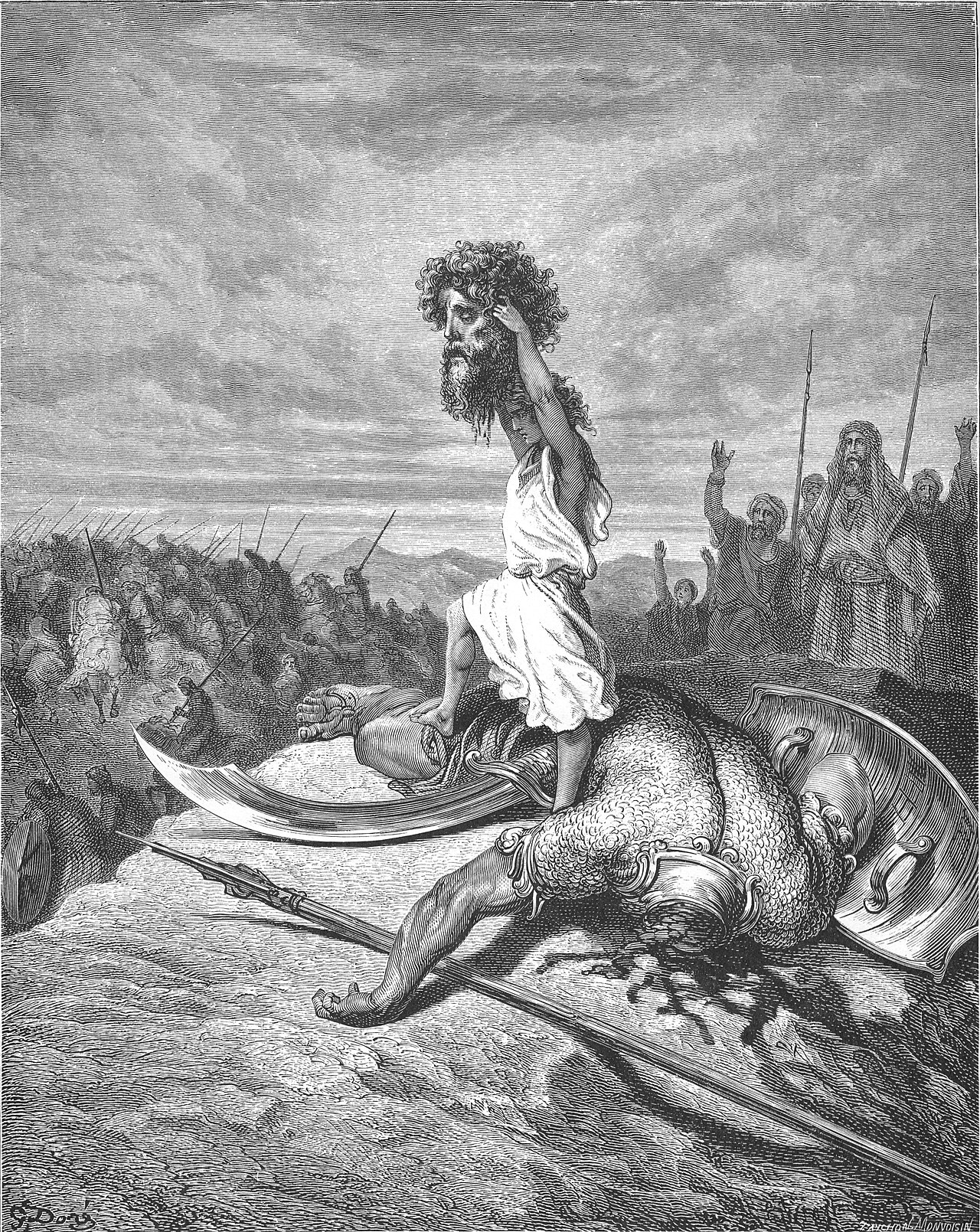
Matthew Henry counts David's mastery of his temper as in some ways a greater victory than the one over Goliath. He cites the proverb that the one who rules his own spirit is better than the mighty. The Philistines stood across the valley.
The record, by era
The Church Fathers1 voice
If you don't mind, however, let us refer to a theme in our preaching earlier, so that by bringing the whole story to mind we may learn that nothing is stronger than the person protected by help from on high, and nothing is more vulnerable than the person deprived of this help, surrounded though he may be with countless armies. So this man David, quite young though he was and living in his father's house on account of his immaturity, heard the call of destiny for his virtue to become conspicuous; he was urged by his father to observe his brothers; he obeyed and was sent off to them. So, after coming on the scene to observe them, he saw the battle line drawn against the foreigner Goliath and the whole people of Saul's company withdrawing in fright and the king himself placed in particular danger. For a while he was happy to be an onlooker and went to see the strange and unusual sight of one person pitted against so many thousands. But his brothers could not tolerate the manliness of his bearing; they were moved to hatred and said to him, "Have you come for no other reason than to see the war." You haven't really come to observe us.Notice, however, his good sense and great restraint. Instead of saying anything rash to them, anything harsh, he extinguished the flame of their hatred; he mollified their hatred by saying, "Isn't it only a word?" I mean, surely you haven't observed me taking position in the ranks? I simply wanted to watch and find out the source of this man's extraordinary frenzy. "After all, who is this foreigner who reproaches the ranks of the living God?" Then, on hearing the man's awful arrogance and the unspeakable cowardice of those who had gone with Saul, he said, "What will be given to the man who cuts off his head?" He showed great boldness of spirit through these words and caused amazement in every one. […]
The Puritans and the Awakening3 voices
This conquest of his own passion was in some respects more honourable than his conquest of Goliath. He that hath rule over his own spirit is better than the mighty. It was no time for David to quarrel with his brother when the Philistines were upon them.
Is this giant invincible? Is our God unable to oppose him, and subdue him? However David is not deterred from his undertaking, by the hard words of Eliab.
And David said, what have I now done?.... That is criminal and blameworthy; as if he should say, I have only expressed an indignation against this uncircumcised Philistine, and a concern for the glory of God, and the honour of the people of Israel: is there not a cause? either for his coming to the camp, being sent by his father; or of his expressing himself with indignation at the Philistine's defiance of the armies of Israel.
The Nineteenth Century1 voice
Is there not a cause? - הלוא דבר הוא halo dabar hu. I believe the meaning is what several of the versions express: I have spoken but a word. And should a man be made an offender for a word?
The words behind it
8 Hebrew wordsEvery Hebrew word of this verse in the order it stands, with what it means and the door to its own study. The last column counts the times a word stands in the whole Bible: the rarer the word, the more the places it appears belong together.
| Hebrew | Sound | Meaning | Word study | In the Bible |
|---|---|---|---|---|
| וַיֹּ֣אמֶר | vaiyomer | and he said | H559 → | 5305 times |
| דָּוִ֔ד | david | David | H1732 → | 999 times |
| מֶ֥ה | meh | what? | H4100 → | 752 times |
| עָשִׂ֖יתִי | ʾasiti | have I done | H6213 → | 2628 times |
| עָ֑תָּה | ʾatah | now | H6258 → | 433 times |
| הֲל֖וֹא | halo' | ¿ not | H3808 → | 5168 times |
| דָּבָ֥ר | davar | a word | H1697 → | 1440 times |
| הֽוּא׃ | hu' | [was] it | H1931 → | 1879 times |
וַיֹּ֣אמֶרand he said
vaiyomerH559 →5305 times
דָּוִ֔דDavid
davidH1732 →999 times
מֶ֥הwhat?
mehH4100 →752 times
עָשִׂ֖יתִיhave I done
ʾasitiH6213 →2628 times
עָ֑תָּהnow
ʾatahH6258 →433 times
הֲל֖וֹא¿ not
halo'H3808 →5168 times
דָּבָ֥רa word
davarH1697 →1440 times
הֽוּא׃[was] it
hu'H1931 →1879 times
A shaded row is a word that stands 400 times or fewer in the Bible.
The walk
8 stopsEach card is a verse this one points to, and under it the verses that one points to in turn. Where several paths arrive at the same place, that place is listed first: the text keeps returning to it.
Through
Proverbs 15:1A gentle answer turns away wrath, but a harsh word stirs up anger.
it leads to
- Proverbs 25:15
Through patience a ruler can be persuaded, and a gentle tongue can break a bone.
- Proverbs 10:12
Hatred stirs up dissension, but love covers all transgressions.
- Proverbs 15:18
A hot-tempered man stirs up strife, but he who is slow to anger calms dispute.
- Proverbs 29:22
An angry man stirs up dissension, and a hot-tempered man abounds in transgression.
- Proverbs 25:15
Through
1 Peter 3:9Do not repay evil with evil or insult with insult, but with blessing, because to this you were called so that you may inherit a blessing.
it leads to
- Romans 12:17
Do not repay anyone evil for evil. Carefully consider what is right in the eyes of everybody.
- Proverbs 20:22
Do not say, “I will avenge this evil!” Wait on the LORD, and He will save you.
- Romans 12:14
Bless those who persecute you. Bless and do not curse.
- Romans 12:19–21
Do not avenge yourselves, beloved, but leave room for God’s wrath. For it is written: “Vengeance is Mine; I will repay, says the Lord.”
- Romans 12:17
Where this verse is studied
About 1 Samuel
Who and where
1 name in this verse with a page on the site.
This page draws on Adam Clarke, Commentary on the Bible; Albert Barnes, Notes, Explanatory and Practical, on the Old and New Testaments (1832-1869); John Chrysostom, HOMILIES ON GENESIS 46.9-10; John Gill, Exposition of the Old Testament; John Gill, Exposition of the Old Testament (1748-1763); John Wesley, Explanatory Notes upon the Old Testament; Matthew Henry, Commentary on the Whole Bible and W. G. Blaikie, The First Book of Samuel (Expositor's Bible).