
1 Samuel 17:15
in 1 Samuel 17but David went back and forth from Saul to tend his father’s sheep in Bethlehem.
BSB
The same verse in ASV and KJV ▾
ASV
Now David went to and fro from Saul to feed his father’s sheep at Beth-lehem.
KJV
But David went and returned from Saul to feed his father’s sheep at Beth–lehem.
⋯
This verse in 1 Samuel 17
Commentary
8 notes on this verseBut David went, and returned from Saul,.... Or "from above Saul"; Josephus (u) says, the physicians of Saul advised to get a man to stand υπερ κεφαλνς, "over his head", and sing psalms and hymns to him; and Saul being recovered from his frenzy and melancholy, by means of David's music, he was dismissed from him, or had leave to go home, or he returned upon Saul's taking the field; though one would think, if he was now his armourbearer, he would have gone with him, see 1Sa 16:
This site's exposition
Now David was the son of a man named Jesse, an Ephrathite
on 1 Samuel 17:12-15
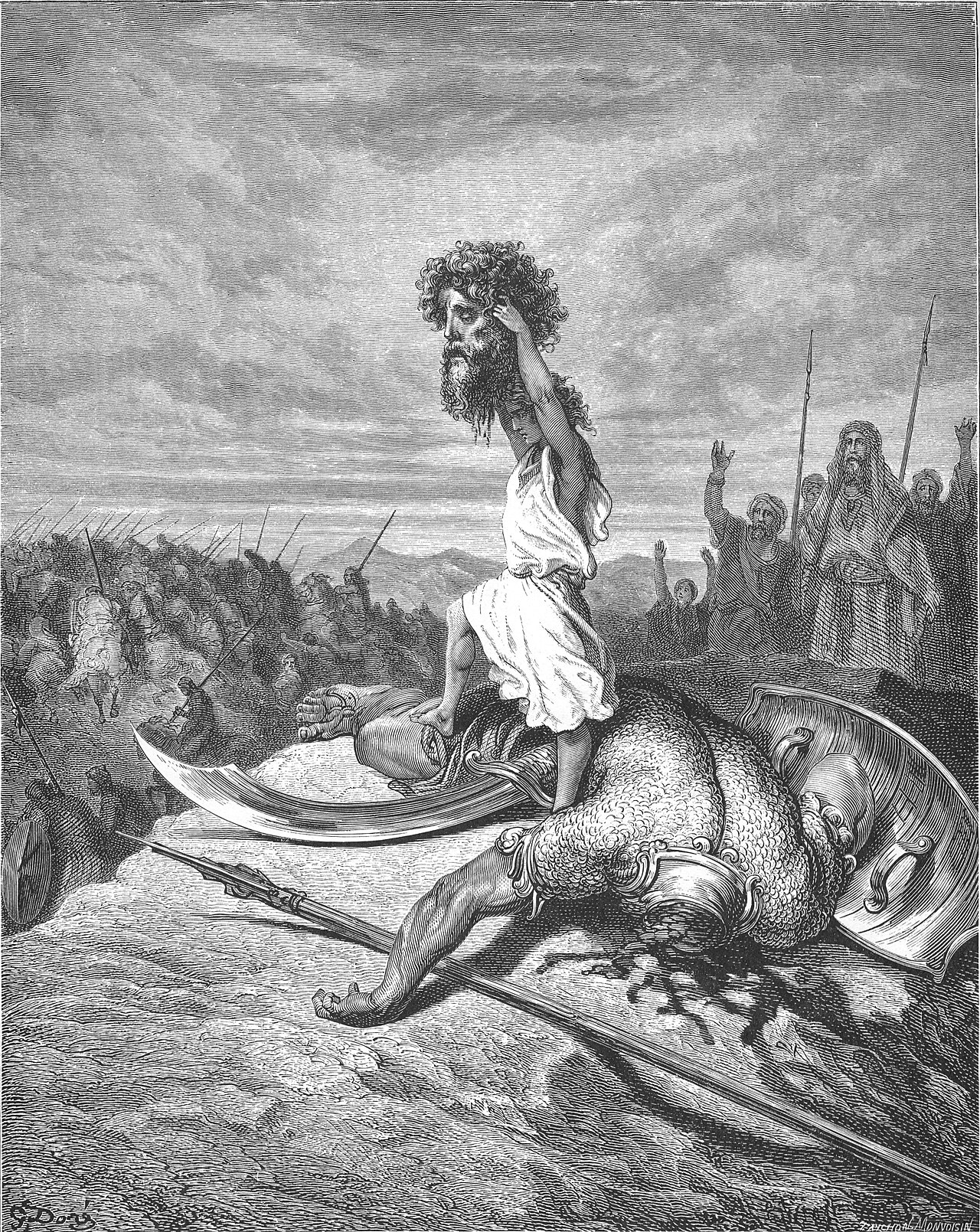
The narrative starts over from Bethlehem, as if to say that the answer to Gath was already growing in Ruth's town. David is the eighth son, keeper of the sheep, and verse 15 has him going back and forth between Saul's court and his father's flock, which is how the anointed of chapter 16 can arrive at this battle as an errand boy. Bethlehem carries the thread that began at Ruth 4:17 and runs to Micah 5:2.
This site's exposition
David went back and forth from Saul
John Gill cites Josephus, who says Saul's physicians sought a singer to stand over the king's head. Once Saul recovered, Gill reasons, David was sent home. He may also have left when the king marched out to war.
The record, by era
The Medieval Church1 voice
Therefore, with three major ones following Saul, David went, etc. Because we all stumble in many ways, the only one conceived in sanctification, (James V), Anamartitos, that is, without sin, could live in the flesh, is rightly understood as God; because even teachers, certain lawgivers …
The Puritans and the Awakening3 voices
Now concerning this champion observe, 1. He was of the sons of Anak, who at Gath kept their ground in Joshua's time ( Josh. xi. 22 ), and kept up a race of giants there, of which Goliath was one, and, it is probable, one of the largest.
), the glory of his elder brethren would be eclipsed and stained; and therefore (such is the nature of jealousy) he would rather that Goliath should triumph over Israel than that David should be the man that should triumph over him.
quarantine:debris (2026-07-29) — leading-punctuation+unbalanced-parens
), Saul had forgotten him, being melancholy and mindless, and little thinking that his musician would have spirit enough to be his champion; and therefore, as if he had never seen him before, he asked whose son he was. Abner was a stranger to him, but brought him to Saul (
quarantine:debris (2026-07-29) — leading-punctuation
The Nineteenth Century1 voice
A commentator
Albert Barnes1798–1870
Notes, Explanatory and Practical, on the Old and New Testaments (1832-1869)
proposed
David went ... - “Was gone,” referring to 1Sa 16:19-20. Had he been Saul’s armour-bearer at this time it is highly improbable that he would have left him to feed sheep.
How the passage was read
What the Jewish commentators add
Dovid would go. Would always go back and forth from Shaul to his father's house. 8 Dovid was not permanently assigned to be with Shaul. Dovid played music for Shaul when the evil spirit rested upon him. At all other times he would return home to tend his father’s sheep.
2 more on this passage, in their own words ▾
Dovid was the youngest. Who had previously been in Shaul's palace to play music before him.
Morning and evening. Our Rabbis said, to prevent them from reciting 'shema.' 9 See Maseches Sotah 42b.
This section is reception history: how the passage was read and kept in the Jewish tradition. Where a reading parts from an essential of the Christian faith, the section says so at that point.
Texts and citation data: Sefaria; each excerpt follows its version’s licence. 3 further sources are cited on this chapter that carry no English text this site may quote or only restate the verse.
The words behind it
11 Hebrew wordsEvery Hebrew word of this verse in the order it stands, with what it means and the door to its own study. The last column counts the times a word stands in the whole Bible: the rarer the word, the more the places it appears belong together.
| Hebrew | Sound | Meaning | Word study | In the Bible |
|---|---|---|---|---|
| וְדָוִ֛ד | vedavid | and David | H1732 → | 999 times |
| הֹלֵ֥ךְ | holekh | [was] going | H1980 → | 1546 times |
| וָשָׁ֖ב | vashav | and [was] returning | H7725 → | 1056 times |
| מֵעַ֣ל | meal | from with | H5921 → | 5755 times |
| שָׁא֑וּל | shaul | Saul | H7586 → | 402 times |
| לִרְע֛וֹת | lirot | to shepherd | H7462 → | 177 times |
| אֶת־ | ʾet- | <obj.> | H853 → | 10935 times |
| צֹ֥אן | tzon | [the] flock of | H6629 → | 274 times |
| אָבִ֖יו | ʾaviv | father his | H1 → | 1212 times |
| בֵּֽית־ | beit- | Beth- | H1035 → | 82 times |
| לָֽחֶם׃ | lachem | -lehem | H1035 → | 82 times |
וְדָוִ֛דand David
vedavidH1732 →999 times
הֹלֵ֥ךְ[was] going
holekhH1980 →1546 times
וָשָׁ֖בand [was] returning
vashavH7725 →1056 times
מֵעַ֣לfrom with
mealH5921 →5755 times
שָׁא֑וּלSaul
shaulH7586 →402 times
לִרְע֛וֹתto shepherd
lirotH7462 →177 times
אֶת־<obj.>
ʾet-H853 →10935 times
צֹ֥אן[the] flock of
tzonH6629 →274 times
אָבִ֖יוfather his
ʾavivH1 →1212 times
בֵּֽית־Beth-
beit-H1035 →82 times
לָֽחֶם׃-lehem
lachemH1035 →82 times
A shaded row is a word that stands 400 times or fewer in the Bible.
The walk
5 stopsEach card is a verse this one points to, and under it the verses that one points to in turn. Where several paths arrive at the same place, that place is listed first: the text keeps returning to it.
Through
1 Samuel 16:11And Samuel asked him, “Are these all the sons you have?” “There is still the youngest,” Jesse replied, “but he is tending the sheep.” “Send for him,” Samuel replied. “For we will not sit…
it leads to
- Psalms 78:70–71
He chose David His servant and took him from the sheepfolds;
- 2 Samuel 7:8
Now then, you are to tell My servant David that this is what the LORD of Hosts says: I took you from the pasture, from following the flock, to be the ruler over My…
- 2 Samuel 13:3
Now Amnon had a friend named Jonadab, the son of David’s brother Shimeah. Jonadab was a very shrewd man,
- 1 Samuel 17:28
Now when David’s oldest brother Eliab heard him speaking to the men, his anger burned against David. “Why have you come down here?” he asked. “And with whom did you leave those few sheep…
- 1 Chronicles 17:7
Now then, you are to tell My servant David that this is what the LORD of Hosts says: I took you from the pasture, from following the flock, to be the ruler over My…
- Psalms 78:70–71
Where this verse is studied
About 1 Samuel
Who and where
3 names in this verse with a page on the site.
- PersonUnited MonarchyDavidSecond king of united Israel, shepherd-turned-monarch, ancestor of the Messiah, and traditional author of many Psalms.
- PersonUnited monarchySaulIsrael's first king, head and shoulders above the people; began in humility, ended in rejection — sparing what God devoted, consul…
- PlaceBethlehemBethlehemDavid’s town, six miles south of Jerusalem, where Ruth gleaned, where Samuel anointed a shepherd boy, and where Jesus was born as…
This page draws on Albert Barnes, Notes, Explanatory and Practical, on the Old and New Testaments (1832-1869); Bede, Commentary on Samuel; John Gill, Exposition of the Old Testament (1748-1763); John Gill, Exposition of the Old Testament; Matthew Henry, Commentary on the Whole Bible and W. G. Blaikie, The First Book of Samuel (Expositor's Bible).