
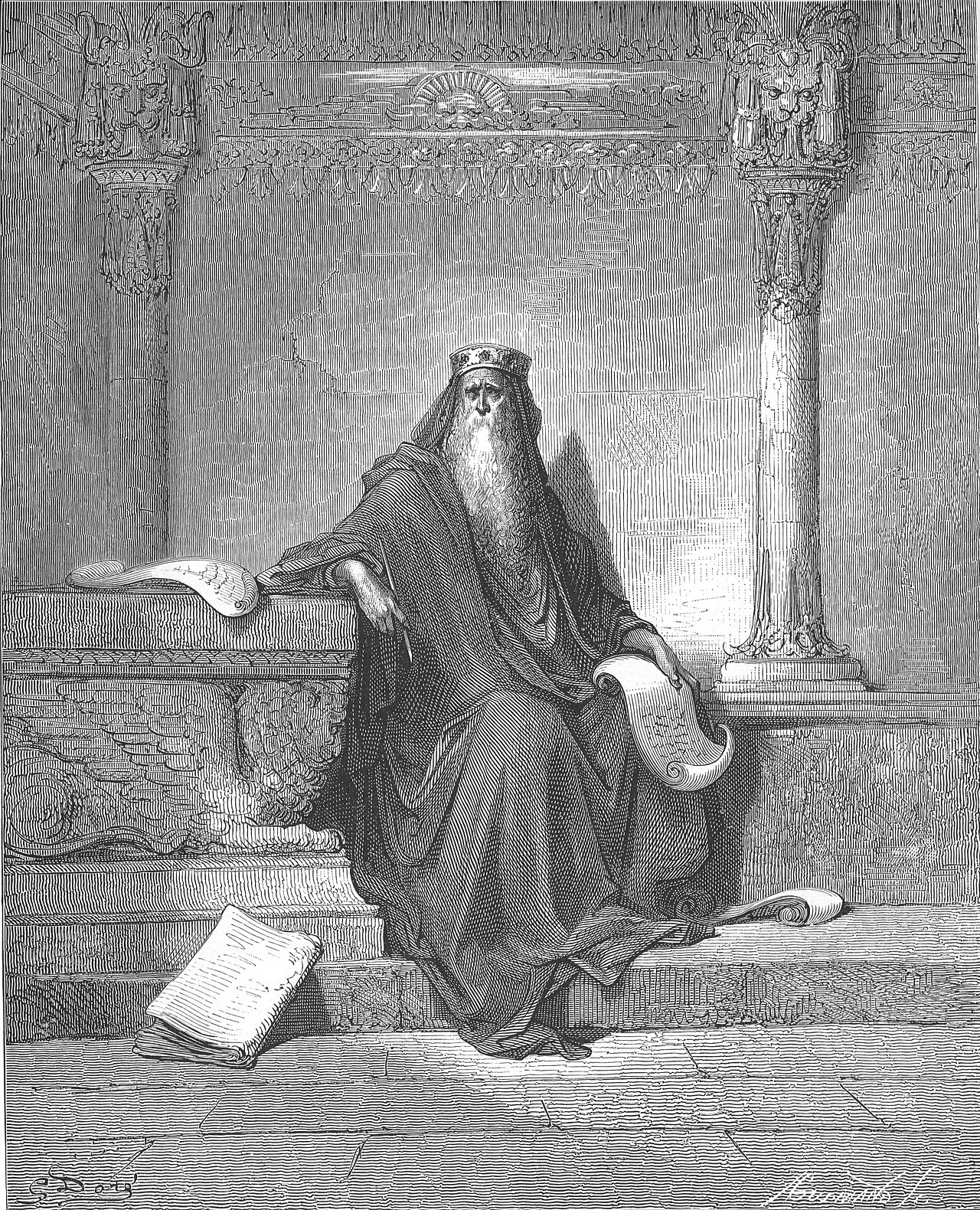
1 Kingschapter 11
43 verses · Jeremiah, by tradition · 6th century BC · History
And he had seven hundred wives, princesses, and three hundred concubines: and his wives turned away his heart.
Introduction
Jeremiah, by tradition, History, 1 Kings Overview.
The historian writes this chapter to explain to a divided people why their one kingdom broke in two. It is the turn of the whole book, the close of Solomon's reign and the rise of the men who would trouble it. Its first hearers knew the law against a king taking many wives, and they knew the shrines on the hill east of Jerusalem that stood for centuries. Listen for when in the king's life the turning comes, and for the reason the LORD gives for leaving one tribe. Watch the prophet with the new cloak. The promise to David holds through the judgment.
Context
- Who
- Israelites who lived in the divided kingdom this chapter explains
- What
- An account of Solomon's many foreign wives and their gods, the LORD's sentence to tear the kingdom from his son, the adversaries raised against him, and Ahijah's word to Jeroboam.
- Where
- Jerusalem and the hill east of the city, with adversaries rising in Edom, in Damascus and in Ephraim, and Egypt as a refuge for two of them.
- When
- The last years of Solomon, about 940 to 931 BC, with the turning of his heart dated to his old age.
- Why
- To give the cause of the division of the kingdom in the king's own unfaithfulness, and to show the LORD keeping one tribe for David's sake.
Historical context
The chapter belongs to Solomon as an old king, and to the three men raised against him, Hadad of Edom, Rezon of Damascus and Jeroboam of Ephraim.
Show the rest of the historical context, 4 more paragraphs
The time is the last decade of the reign, placed at about 940 to 931 BC, and the text dates the turning of his heart to his old age at 11:4.
The places are Jerusalem and the ridge east of it, later remembered as the mount of corruption, where the high places stood until Josiah tore them down at 2 Kings 23:13.
The occasion is the accumulation of foreign marriages and the shrines that came with them, and the sentence that follows.
A first hearer knew how such marriages worked. Each foreign wife came with a diplomatic relationship, an entourage and the expectation that her gods would be honoured in her new home, which was the ordinary understanding of an alliance across the region. He knew the reputations of the gods named, Ashtoreth of Sidon, Chemosh of Moab and Milcom of Ammon, and that the worship of Molech involved passing children through fire. He knew the law had forbidden intermarriage for exactly this reason at Deuteronomy 17:17. He also knew what a prophet was doing when he tore a garment into twelve pieces. Acting a message out was standard prophetic method, and it made the sign easy to remember and to retell.
Significance
The first hearers lived in the wreckage of this chapter, in one of two kingdoms that had been one. It tells them why, and it puts the cause first in a king whose heart was turned when he was old, before Rehoboam's arrogance or the north's grievance.
Show the rest of the significance, 1 more paragraph
The mercy in it is the covenant. For David's sake the tearing is delayed a generation and one tribe is left, so that David would always have a lamp in Jerusalem. The promise held while the judgment fell.
This chapter in Jewish lifeWhat this chapter is in Jewish life and reading.
How it is read
This is the chapter where the classical Jewish reading and the plain Christian reading stand furthest apart in this book, and a reader should have both in view. Rashi is quoted here from the Metsudah Tanach series of Lakewood, New Jersey, which Sefaria reports as CC-BY. On the high place built for Chemosh, Rashi reports what the Rabbis said, and it moves the charge by a step. "Because he did not protest against his wives, it is called by his name" (Rashi on I Kings 11:7:1). The building is named for Solomon in the tradition because he failed to stop it rather than because he raised it himself. Rashi gives the place the teaching stands, the tractate Shabbat at the folio the corpus also carries as a locator on the sixth verse. The translation sets Ralbag beside it, with the command in Leviticus to reprove a neighbour and the warning that a man who fails to reprove carries the other man's sin.
Pharaoh's daughter is singled out from the other foreign wives, and the reason given is affection. She was loved above them all, Rashi says, so the text counts her apart (Rashi on I Kings 11:1:1). The translation notes Radak with a second reason, that she is named first because she was the beginning of the fall. On the sentence God passes, Rashi reads the words about what had been with Solomon as knowledge rather than circumstance. Solomon knew he was crossing the commandments (Rashi on I Kings 11:11:1).
The one note in this chapter that the corpus carries from a commentator other than Rashi is Malbim, quoted here from the Jerusalem Anthology of Rabbi Mike Feuer, which Sefaria reports as CC-BY. On the promise that the whole kingdom will stay unbroken, Malbim asks whose merit holds it. "This will not be because David is your father, because this would only help Shlomo himself" (Malbim on I Kings 11:13:1). The kingdom is kept for the sake of David as God's servant, in Malbim's reading, rather than for the sake of the son's descent from him.
The adversaries are read as medicine. On the raising up of Rezon, Rashi points to Nathan's word to David about chastening a son with the rod of men. The translation notes Radak's reading of the purpose, that God sent the adversaries to bring Solomon to repentance (Rashi on I Kings 11:23:1). Hadad's flight and his welcome in Egypt Rashi fills in plainly, down to the king's daily order for his bread (Rashi on I Kings 11:15:1 and 11:18:1). The word for David's death carries a rule of reading. David is said to have slept, and Joab to have died, and Rashi gives two reasons from the tractate Bava Batra. One is that sleeping is said of a man who dies in his bed and dying of a man who is killed. The other is that sleeping is said of a man survived by a worthy son who takes his place (Rashi on I Kings 11:21:1).
Fifteen further notes stand in the corpus without an English text and are cited and unquoted. Metzudat David stands at Metzudat David on I Kings 11:4:1, 11:5:1, 11:6:1, 11:8:1, 11:20:1, 11:22:1 and 11:24:1. Radak stands at 11:2:1, 11:9:1, 11:14:1, 11:16:1 and 11:17:1, and Malbim at Malbim on I Kings 11:3:1, 11:10:1 and 11:12:1.
What the rabbis say
The corpus carries forty rabbinic locators on this chapter and the text of none, so each is cited and linked here rather than quoted. The foreign wives draw the opening run. On the first verse it holds Bamidbar Rabbah 10:4, Ein Yaakov (Glick Edition), Shabbat 5:9 and Jerusalem Talmud Sanhedrin 2:6:4. On the second it holds Ein Yaakov, Yevamot 8:3, Mekhilta DeRabbi Yishmael, Tractate Pischa 12:25 and Sifrei Bamidbar 78:1. On the third, the count of the wives, it holds Kohelet Rabbah 2:2:3 and Midrash Lekach Tov, Deuteronomy 17:17:1, which is the verse of the law about a king and his wives.
The turning of the heart carries the weight of the chapter. On the fourth verse the corpus holds Ein Yaakov, Sanhedrin 2:14 and the Glick Edition at Sanhedrin 2:12. On the sixth it holds Shabbat 56b:11, the folio Rashi cites for the Rabbis' reading of the high place. On the seventh it holds Ein Yaakov, Sanhedrin 11:10 and the Glick Edition at Sanhedrin 11:13.
The sentence and the mercy in it draw their own set. On the eleventh verse the corpus holds Aggadat Bereshit 76:2 and Midrash Aggadah, Leviticus 25:1:2. On the twelfth it holds Ein Yaakov (Glick Edition), Avodah Zarah 3:1, and on the thirteenth Bamidbar Rabbah 3:2 and Kohelet Rabbah 1:1:2. The adversaries follow. On the fourteenth the corpus holds Bereshit Rabbati, Parashat Bereshit 88 and Ein Yaakov (Glick Edition), Sanhedrin 11:99. On the fifteenth it holds Midrash Tanchuma Buber, Devarim 3:1, and on the sixteenth Bava Batra 21a:13 with Bamidbar Rabbah 14:1. On the twenty-first it holds Bava Batra 116a:12 with Ein Yaakov (Glick Edition), Bava Batra 8:5, which is the passage behind Rashi's note on sleeping and dying. On the twenty-third it holds Midrash Tanchuma Buber, Bereshit 26:1 and Seder Olam Rabbah 16:2, and on the twenty-fifth Seder Olam Rabbah 15:2.
Jeroboam closes the chapter and opens the division. On the twenty-sixth verse the corpus holds Aggadat Bereshit 5:2 and Midrash Shmuel 1:4. On the twenty-seventh it holds Bereshit Rabbati, Parashat Vayechi 60 and Ein Yaakov (Glick Edition), Sanhedrin 11:69. The meeting with Ahijah in the field draws Ein Yaakov (Glick Edition), Sanhedrin 11:71 and Midrash Sekhel Tov, Bereshit 27:15:2 on the twenty-ninth. The tearing of the new cloak draws Midrash Shmuel 18:5 and Ruth Rabbah (Lerner) 7:12:2 on the thirtieth. On the thirty-second, the one tribe left for David's sake, it holds Bereshit Rabbah 98:9 and Eikhah Rabbah, Petichta 23. On the thirty-sixth, the lamp kept in Jerusalem, it holds Midrash Shmuel 19:3 and Sifrei Bamidbar 39:1. What each of them teaches is a saying of the rabbis, and this site reports it as theirs. The quotations wait on a fetch that carries the text.
Sources: Rashi, Rashi on I Kings 11:1:1 to 11:23:1, the Metsudah Tanach series, Lakewood, N.J, reported CC-BY; Malbim, Malbim on I Kings 11:13:1, the Jerusalem Anthology of Rabbi Mike Feuer, reported CC-BY; and 11:3:1, 11:10:1 and 11:12:1 cited by ref; Radak, Radak on I Kings 11:2:1, 11:9:1, 11:14:1, 11:16:1 and 11:17:1, and noted by the Metsudah translation at 11:1:1 and 11:23:1; Metzudat David, Metzudat David on I Kings 11:4:1 to 11:24:1, cited by ref because Sefaria holds no English version; Ralbag, noted at Rashi on I Kings 11:7:1 by the Metsudah translation; The Sefaria corpus on disk, scripts/data/sources/sefaria/1-kings/11.json, fetched 2026-09-19, the forty Midrash and Talmud locators cited above, 2026.
The heads below are this chapter's scenes. The numbered points under each are its verses.
A thousand wives turn away the wisest heart
1 Kings 11:1-3
loved many strange women: Deut 17:17 forbade the king multiplying wives, lest his heart turn away, and the chapter opens by naming the exact three nations of judgment history, Moabites, Ammonites and Edomites, among the seven listed. Seven hundred wives and three hundred concubines complete the reversal of the glory chapters: horses out of Egypt at 10:28-29, silver and gold beyond counting at 10:14, and now wives beyond number, the king's own law broken clause by clause. The narrator states the count and lets it stand against the law without citing the law by name.
1 Kings 11:1
“In noticing successively Solomon’s excessive accumulation of silver and gold 1Ki 10:14-25, his multiplication of horses 1Ki 10:26-29, and his multiplication of wives, the writer has in mind the warning of Moses against these three forms of princely ostentation, all alike forbidden to an Israelite monarch (marginal reference). Zidonians - i. e., Phoenician women. A tradition states that Solomon married a daughter of Hiram, king of Tyre.”
Albert Barnes reads the quoted warning as the sense of the laws at Exodus 34:16 and Deuteronomy 7:3 to 4, which named the Canaanite nations. Ezra and Nehemiah applied it to Moab, Ammon and Edom, and Nehemiah 13:26 names Solomon as the warning. Matthew Henry recalls the women of Moab at Peor.
1 Kings 11:2
“Solomon was master of a great deal of knowledge, but to what purpose, when he had no better a government of his appetites? He was drawn by them to the worship of strange gods, as Israel to Baal-peor by the daughters of Moab. This was the bad consequence of his multiplying wives.”
Matthew Henry · Commentary on the Whole Bible (1707-1721)puritan
1 more voice on this verse
1 Kings 11:2
“Ye shall not go in unto them ... - These words are not a quotation from the Pentateuch. They merely give the general meaning of the two passages prohibiting intermarriage with neighboring idolators (marginal references). Strictly speaking, the prohibition in the Law of intermarriage was confined to the Canaanite nations. But the principle of the prohibition applied equally to the Moabites, Ammonites, and Edomites who all bordered on the holy land; and was so applied by Ezra Ezr 9:1 and Nehemiah Neh 13:23.”
Albert Barnes sets the count beside Song of Songs 6:8, which gives sixty queens and eighty concubines, and suspects the seven hundred wives began as seventy. Adam Clarke counts the concubines as wives of lower rank, like Hagar and Keturah beside Sarah. John Wesley warns that a good man's fall does most harm.
1 Kings 11:3
These numbers seem excessive to many critics, and it must be admitted that history furnishes no parallel to them. In Son 6:8 the number of Solomon’s legitimate wives is said to be sixty, and that of his concubines eighty. It is, perhaps probable, that the text has in this place suffered corruption. For “700” we should perhaps read “70.”
1 Kings 11:4-6
his wives turned away his heart: The verdict is comparative rather than absolute: his heart was not perfect with the Lord his God, as was the heart of David his father, and Solomon went not fully after the Lord, as did David. David's own failures are on record earlier in the history, so the measure is not sinlessness but wholeness of devotion, a heart not divided between the Lord and Ashtoreth and Milcom. Old age is named as the setting, the slow accumulation of seven hundred compromises rather than one sudden fall.
1 Kings 11:4
“Old - About fifty or fifty-five. From his age at his accession (1Ki 2:2 note) he could not have been more than about sixty at his death. The true nature of Solomon’s idolatry was neither complete apostasy - an apostasy from which there could be no recovery; nor a mere toleration, rather praise-worthy than blameable. Solomon did not ever openly or wholly apostatize. He continued his attendance on the worship of Yahweh, and punctually made his offerings three times a year in the temple 1Ki 9:25; but his heart was not “perfect” with God.”
1 more voice on this verse
1 Kings 11:4
“Turned his heart - Not that they changed his mind about the true God, and idols, which is not credible; but they obtained from him a publick indulgence for their worship, and possibly persuaded him to join with them in the outward act of idol-worship; or, at least, in their feasts upon their sacrifices, which was a participation of their idolatry.”
John Wesley · Explanatory Notes upon the Old Testament (1765)evangelical
The Hebrew is went after, and Albert Barnes notes that the phrase in the law always means actual idolatry, citing Deuteronomy 11:28 and 13:2. Ishodad of Merv reads the chapter more gently, as Solomon allowing his wives their gods. Jamieson, Fausset and Brown equate Milcom with Molech.
1 Kings 11:5
“Went after - This expression is common in the Pentateuch, and always signifies actual idolatry (see Deu 11:28; Deu 13:2; Deu 28:14, etc.). For Ashtoreth, or Astarte, the goddess of the Zidonians, see Exo 34:13, note; Deu 16:21, note. On the tomb of a Phoenician king, discovered in 1855, on the site of Sidon, mention is made of a temple of Astarte there, which the monarch built or restored; and his mother is said to have been a priestess of the goddess.”
1 more voice on this verse
1 Kings 11:5
“Ashtoreth--Astarte, Milcom--Molech, and Chemosh--He built altars for these three; but, although he is described (1Ki 11:8) as doing the same for "all his strange wives," there is no evidence that they had idols distinct from these; and there is no trace whatever of Egyptian idolatry.”
Jamieson, Fausset & Brown · Commentary Critical and Explanatory on the Whole Bible (1871)reformed
John Gill reads the charge as divided worship. Solomon kept the temple service and followed other gods beside it, so his heart was never whole. Matthew Henry notes that Solomon made no effort to turn his foreign wives to the God of Israel and built high places for their gods.
1 Kings 11:6
“And Solomon did evil in the sight of the Lord,.... As idolatry is, nothing more provoking to him: and went not fully after the Lord, as did David his father; for though he did not relinquish the worship of the true God, and the service of the temple, yet inasmuch as he worshipped other gods besides, or connived at the worship of them, he did not wholly, and constantly, and solely serve the Lord, as his father did.”
1 Kings 11:7-8
an high place for Chemosh: The high places rise on the hill before Jerusalem, in full sight of the temple Solomon had just built for the name of the Lord, for Chemosh the abomination of Moab and for Molech the abomination of Ammon. Josiah will still be defiling these same mounts three centuries later at 2 Ki 23:13, the text's own note that Solomon's private accommodation to his wives' gods became public Judean worship for generations. The two altars are matched by the two nations of verse 1, Moab and Ammon, the sons of Lot's daughters, standing in shrines beside the house of the Lord.
1 Kings 11:7
“Then did Solomon build an high place for Chemosh, the abomination of Mesh,.... Of this idol see Gill on Jer 48:7, an high place for which he ordered to be built, or at least suffered it to be built, at the instigation of his Moabitish woman or women, 1Ki 11:1, this was built in the hill that is before Jerusalem; on the mount of Olives, as Jarchi, called from hence afterwards the mount of corruption, 2Ki 23:15 and for Molech, the abomination of the children of Ammon, 1Ki 11:5.”
2 more voices on this verse
1 Kings 11:7
“Chemosh (Num 21:29 note), seems to have been widely worshipped in Western Asia. His name occurs frequently on the “Moabite-Stone.” Car-Chemish, “the fort of Chemosh,” a great city of the northern Hittites, must have been under his protection. In Babylon he seems to have been known as Chomus-belus, or Chemosh-Bel. The hill - Olivet.”
1 Kings 11:7
“An high place - That is, an altar upon the high place, as the manner of the Heathens was. The hill - In the mount of olives, which was nigh unto Jerusalem, 2 Sam. xv, 30, and from this act was called the mount of corruption, 2 Kings xxiii, 13.”
John Wesley · Explanatory Notes upon the Old Testament (1765)evangelical
Matthew Henry sets this verse beside the prayer of chapter 8. The king who dedicated the house of the LORD now built high places for all his foreign wives, and Henry says no ship was ever so wrecked. John Wesley draws the lesson that the evening of a life commends its day.
I will rend the kingdom: but not in thy days
1 Kings 11:9-10
appeared unto him twice: The Lord's anger is measured against grace already given: two appearances, at Gibeon in a dream (3:5-14) and at the temple's completion (9:2-9), both carrying the same warning against other gods. The sin is aggravated by the light Solomon had received, not diminished by his wisdom, and the commentators note that greater revelation raises rather than lowers the weight of a broken command. Verse 10 restates the command he was given by name, so the reader cannot mistake ignorance for the cause.
1 Kings 11:9
“The Lord was angry with Solomon - Had not this man’s delinquency been strongly marked by the Divine disapprobation, it would have had a fatal effect on the morals of mankind. Vice is vice, no matter who commits it. And God is as much displeased with sin in Solomon as he can be with it in the most profligate, uneducated wretch. And although God sees the same sin in precisely the same degree of moral turpitude as to the act itself, yet there may be circumstances which greatly aggravate the offense, and subject the offender to greater punishment.”
Adam Clarke · Commentary on the Bible (1810-1826)evangelical
1 more voice on this verse
1 Kings 11:9
“God's appearing to Solomon was such a sensible confirmation of his faith as should have for ever prevented his worshipping any other god; it was also such a distinguishing favour, and put such an honour upon him, as he ought never to have forgotten, especially considering what God said to him in both these appearances.”
Matthew Henry · Commentary on the Whole Bible (1707-1721)puritan
John Gill points back to the second vision in chapter 9, where the warning against other gods came with its threat of exile and a ruined house. Matthew Henry names a trap of kings. Those who demand obedience from their servants forget the rule the LORD holds over them.
1 Kings 11:10
“And had commanded him concerning this thing that he should not go after other gods,.... Which is another aggravation of his sin that it was against an express command of God, and was particularly given him, and he was warned to observe it, and threatened with evil should he break it: but he kept not that which the Lord commanded: see 1Ki 9:5.”
1 Kings 11:11-13
I will surely rend the kingdom: The sentence falls in three moves, and each move names David: not in Solomon's own days, for David thy father's sake, verse 12; not the whole kingdom, one tribe kept back for David my servant's sake and for Jerusalem's sake, verse 13. This is thread 1 stated twice already in five verses, the covenant of 2 Sam 7:14-15 holding a wicked son's judgment inside a father's promise. The kingdom is rent for the son's sin and preserved for the father's sake, the two halves of the same covenant working at once.
1 Kings 11:11
“Wherefore the Lord said unto Solomon,.... Not in a vision, as before, but by a prophet; the Jews say (n), Ahijah the Shilonite, which is probable, see 1Ki 11:29. forasmuch as this is done of thee, that thou hast not kept my covenant and my statutes which I have commanded thee; but broke them by his idolatry: I will surely rend the kingdom from thee, and I will give it to thy servant; meaning Jeroboam, who was not only a subject, but in office under him, 1Ki 11:26. (n) Seder Olam Rabba, c. 20. p. 53. Kimchi in loc.”
John Gill grounds the delay in the promise to David at 2 Samuel 7:12, and he sets aside any merit of David himself. Matthew Henry notes that the kingdom is torn away later. Gill names the son whose hand loses it, Rehoboam.
1 Kings 11:12
“Notwithstanding in thy days I will not do it for David thy father's sake,.... Not for the merits of David, but the promises made to him, 2Sa 7:12, but I will rend it out of the hand of thy son; and immediate successor, Rehoboam.”
The one tribe is Judah, and Albert Barnes treats Benjamin as absorbed into it, so Ahijah keeps back two of the twelve pieces. Jamieson, Fausset and Brown count Benjamin, Levi and northern migrants within the one tribe. John Wesley notes that Bethel, a town of Benjamin, went north.
1 Kings 11:13
“I will give one tribe to thy son--There were left to Rehoboam the tribes of Judah, Benjamin, and Levi (2Ch 11:12, 13); and multitudes of Israelites, who, after the schism of the kingdom, established their residence within the territory of Judah to enjoy the privileges of the true religion (1Ki 12:17). These are all reckoned as one tribe.”
Jamieson, Fausset & Brown · Commentary Critical and Explanatory on the Whole Bible (1871)reformed
3 more voices on this verse
1 Kings 11:13
“One tribe - Benjamin was not entirely his, but part of it adhered to Jeroboam, as Bethel, chap. xii, 29, and Hephron, 2 Chron. xiii, 19, both which were towns of Benjamin.”
John Wesley · Explanatory Notes upon the Old Testament (1765)evangelical
1 Kings 11:13
“One tribe - i. e., (marginal reference) the tribe of Judah. Benjamin was looked upon as absorbed in Judah, so as not to be really a tribe in the same sense as the others. Still, in memory of the fact that the existing tribe of Judah was a double one 1Ki 12:2 l, the prophet Ahijah tore his garment into twelve parts, and kept back two from Jeroboam 1Ki 11:30-31.”
1 Kings 11:13
“God's grace in his people works variously. Thus, though Solomon fell, he was not utterly cast down; what God had said to David concerning him was fulfilled: I will chasten him with the rod of men, but my mercy shall not depart from him, 2 Sam. vii. Though God may suffer those whom he loves to fall into sin, he will not suffer them to lie still in it.”
Matthew Henry · Commentary on the Whole Bible (1707-1721)puritan
Hadad the Edomite and Rezon of Damascus
1 Kings 11:14-22
stirred up an adversary: Hadad the Edomite is the first of two adversaries the Lord himself raises against Solomon, a royal child who fled Joab's slaughter of Edom's males under David and grew up at Pharaoh's own table, married to the queen's sister. The narrator lets the long exile stand as its own comment: a king who married Pharaoh's daughter for peace now houses inside Egypt the very man his father's war created. Hadad's plea to return, though thou hast lacked nothing with me, names the pull of home over comfort, and it comes precisely when Solomon's protection has weakened.
1 Kings 11:14
“And the Lord stirred up an adversary unto Solomon, Hadad the Edomite,.... Though he did not take his kingdom from him for his sin, he chastised him with the rod of men, as he said he would; suffering one, and then another, to rise up and disturb his peace in his old age, see 2Sa 7:14. he was of the king's seed in Edom; of the blood royal.”
4 more voices on this verse
1 Kings 11:14
“The Lord stirred up an adversary - A satan, שטן. When he sent to Hiram to assist him in building the temple of the Lord, he could say, There was no satan, see 1Ki 5:4; and all his kingdom was in peace and security, - every man dwelt under his vine, and under his fig tree, 1Ki 4:25: but now that he had turned away from God, three satans rise up against him at once, Hadad, Rezon, and Jeroboam.”
Adam Clarke · Commentary on the Bible (1810-1826)evangelical
1 Kings 11:14
“The adversary has no power against us unless God has previously permitted it, in order that all our fear and devotion and obedience may be turned to God, since in temptations nothing is permitted evil, unless the power is granted by God.… Moreover, power is given to evil against us according to our sins, as it is written: "Who has given Jacob for spoil and Israel to those who despoiled him?”
Cyprian · written before 258 · Treatise IV. On the Lord's Prayer 25patristic
1 Kings 11:14
“Then, having acquired great power, he at length became king in Damascus, threw off the yoke, and was "the adversary of Israel all the days of Solomon." He was succeeded by Hadad, whose successors took the official title of Ben-hadad from him, the illustrious founder of the powerful kingdom of Damascene-Syria.”
Jamieson, Fausset & Brown · Commentary Critical and Explanatory on the Whole Bible (1871)reformed
1 Kings 11:14
“Though they themselves were moved by principles of ambition or revenge, God made use of them to serve his design of correcting Solomon. The principal judgment threatened was deferred, namely, the rending of the kingdom from him, but he himself was made to fee the smart of the rod, for his greater humiliation.”
Matthew Henry · Commentary on the Whole Bible (1707-1721)puritan
The dead were the fallen of Israel in Albert Barnes's reading, and Edomites in the reading of Adam Clarke and Matthew Henry, who note that none were left alive in Edom to bury them. Barnes ties the slaughter to the war law of Deuteronomy 20:13. The burial gave Hadad time to flee, John Wesley notes.
1 Kings 11:15
“The verse gives certain additional particulars of David’s conquest of Edom (marginal references). Joab was left, or sent, to complete the subjugation of the country, with orders to exterminate all the grown male inhabitants. It was not very often that David acted with any extreme severity in his wars; but he may have considered himself justified by policy, as he certainly was by the letter of the Law Deu 20:13, in adopting this fierce course against Edom. Was in Edom - Or, according to another reading, “smote” Edom. The slain - Probably the Israelites who had fallen in the strnggle.”
1 more voice on this verse
1 Kings 11:15
“And this gave Hadad the opportunity of making his escape, whilst Joab and his men were employed in that solemnity. Had smitten - Or, and he smote, as it is in the Hebrew: which is here noted as the cause of Hadad's flight; he understood what Joab had done in part, and intended farther to do, even to kill all the males and therefore fled for his life.”
John Wesley · Explanatory Notes upon the Old Testament (1765)evangelical
Albert Barnes limits every male to every male Joab could find. Others escaped as Hadad did. John Gill notes that Edom grew strong again and set up its own king in revolt against Judah at 2 Kings 8:20.
1 Kings 11:16
“For six months did Joab remain with all Israel,.... With the whole army: until he had cut off every male in Edom; as he supposed; for it was not fact, since after this they increased again, and became a powerful people, and had a king over them, and revolted from Judah, 2Ki 8:20.”
1 more voice on this verse
1 Kings 11:16
“Every male in Edom - i. e., every male whom he could find. As did Hadad and his company 1Ki 11:17, so others would escape in various directions. The Edomite nation was not destroyed on the occasion.”
The Hebrew calls Hadad a little boy, and Adam Clarke reads it as a child old enough to grasp his danger and flee with his father's servants. Matthew Henry notes that Pharaoh sheltered him as a prince in distress. Egypt raised the adversary Solomon would later face.
1 Kings 11:17
“Hadad being yet a little child - נער קטן naar katan, a little boy; one who was apprehensive of his danger, and could, with his father’s servants, make his escape: not an infant.”
Adam Clarke · Commentary on the Bible (1810-1826)evangelical
Albert Barnes places Midian in the south of Judah and reads Paran as the desert below it, on the road to Egypt. He dates this Pharaoh to the twenty-first dynasty, with Psusennes the First as the likeliest king, in a line that sought alliances with its eastern neighbors. The same policy gave Solomon an Egyptian wife at 3:1.
1 Kings 11:18
“These arose out of Midian - They at first retired to Midian, which lay to the southwest of the Dead Sea. Not supposing themselves in safety there, they went afterwards to Paran in the south of Idumea, and getting a number of persons to join them in Paran, they went straight to Egypt, where we find Hadad became a favourite with Pharaoh, who gave him his sister-in-law to wife; and incorporated him and his family with his own.”
Adam Clarke · Commentary on the Bible (1810-1826)evangelical
John Gill compares Joseph, to whom Pharaoh gave Asenath at Genesis 41:45, and notes that the kings of Egypt married their favorites into great houses. Hadad married into the royal house itself. Gill credits the favor to his bearing as he grew.
1 Kings 11:19
“And Hadad found great favour in the sight of Pharaoh,.... Perhaps for his comely personage, princely qualities, and good behaviour, as he grew up: so that he gave him to wife the sister of his own wife, the sister of Tahpenes the queen; it seems the kings of Egypt used to marry their favourites to great personages; see Gen 41:45.”
John Gill takes the name Genubath to mean stealth, a memory of Hadad's own escape from Edom. The queen herself weaned the boy. Gill reads her care as fondness, and the boy grew up among the sons of Pharaoh as one of them.
1 Kings 11:20
“And the sister of Tahpenes bore him Genubath his son,.... Which signifies "stealth", and the name might be given in memory of himself being carried away by stealth from his own land: whom Tahpenes weaned in Pharaoh's house: who was so fond of the child, that she took it, and weaned it for her in the king's palace: and Genubath was in Pharaoh's household among the sons of Pharaoh; brought up among them, as if he was one of them.”
Albert Barnes reads the wait for Joab's death as a measure of the terror his slaughter in Edom had left, some twenty-five or thirty years before. A refugee at an Eastern court needed the king's leave. John Wesley holds that Hadad ruled Edom under tribute until Solomon turned from God.
1 Kings 11:21
“That Hadad should wait for the death of Joab before requesting leave to return to Idumaea shows how terrible an impression had been made by the severe measures which that commander had carried out twenty-five or thirty years previously 1Ki 11:16. The inability of refugees to depart from an Oriental court without the king’s leave, and his unwillingness ordinarily to grant leave, are illustrated by many passages in the history of Persia.”
Adam Clarke notes that Hadad kept his real purpose from Pharaoh, who was at peace with Israel through Solomon's marriage. Matthew Henry passes on a reflection of Peter Martyr. Heaven is the believer's own country, to be longed for even when the world offers everything.
1 Kings 11:22
"Nothing," says Hadad; "but let me go to my own country, my native air, my native soil." Peter Martyr has a pious reflection upon this: "Heaven is our home, and we ought to keep up a holy affection to that, and desire towards it, even when the world, the place of our banishment, smiles most upon us." Does it ask, What have you lacked, that you are so willing to be gone?
Matthew Henry · Commentary on the Whole Bible (1707-1721)puritan
1 more voice on this verse
1 Kings 11:22
“Let me go in any wise - It does not appear that he avowed his real intention to Pharaoh; for at this time there must have been peace between Israel and Egypt, Solomon having married the daughter of Pharaoh.”
Adam Clarke · Commentary on the Bible (1810-1826)evangelical
1 Kings 11:23-25
another adversary, Rezon: Rezon deserted Hadadezer of Zobah after David's victory there, gathered a band, and took Damascus, reigning as an adversary to Israel all the days of Solomon. Two men displaced by David's wars, one from the south and one from the north, both raised up against the son who inherited the peace without the fighting. The narrator's own accounting is plain: the glory chapters described gold and horses and a queen of Sheba's wonder; this chapter answers with two standing enemies on two borders.
1 Kings 11:23
“And God stirred him up another adversary,.... One from the north, as the other was from the south: Rezon, the son of Eliadah, which fled from his lord Hadadezer king of Zobah: when David fought with him; and this man seeing the battle go against his master, and that he was like to be worsted, deserted him and fled, see 2Sa 8:3.”
Adam Clarke has Rezon hold Damascus until David garrisoned it at 2 Samuel 8:6, then retake it once Solomon turned from God. Albert Barnes reads a slight correction of the text as they made him king at Damascus. John Wesley pictures a band of fugitives living by raiding.
1 Kings 11:24
“And reigned in Damascus - Rezon was one of the captains of Hadadezer, whom David defeated. It seems that at this time Rezon escaped with his men; and; having lived, as is supposed, some time by plunder, he seized on Damascus, and reigned there till David took Damascus, when he subdued Syria, and drove out Rezon. But after Solomon’s defection from God, Rezon, finding that God had departed from Israel, recovered Damascus; and joining with Hadad, harassed Solomon during the remaining part of his reign. But some think that Hadad and Rezon were the same person.”
Adam Clarke · Commentary on the Bible (1810-1826)evangelical
1 more voice on this verse
1 Kings 11:24
“A band - Of soldiers, who fled upon that defeat, 2 Sam. x, 18, and others who readily joined them, and lived by robbery; as many Arabians did. Damascus - And took it, whilst Solomon was wallowing in luxury.”
John Wesley · Explanatory Notes upon the Old Testament (1765)evangelical
John Wesley reads Rezon as a hidden enemy through the good years, who came into the open once Solomon forsook God. Wesley asks what two such adversaries could have done to so powerful a king. His answer is Solomon's own sin, which had made him weak.
1 Kings 11:25
“All adversity - He was a secret enemy, all that time; and when Solomon had forsaken God, he shewed himself openly. Beside - This infelicity was added to the former; whilst Hadad molested him in the south, Rezon threatened him in the north. But what hurt could Hadad or Rezon have done, to so powerful a king as Solomon, if he had not by sin made himself mean and weak?”
John Wesley · Explanatory Notes upon the Old Testament (1765)evangelical
Ahijah tears a new garment into twelve pieces
1 Kings 11:26-28
Jeroboam the son of Nebat: Jeroboam is introduced by tribe, town, and a widow's son's poverty, then by Solomon's own promotion of him, ruler over all the charge of the house of Joseph, on the strength of his industry. The third adversary is not foreign but homegrown, raised by the king's own hand before he is raised against it. Solomon builds Millo and repairs the breaches of the city of David in these same verses, public works that will shortly be paid for in forced labor, the grievance Jeroboam's own tribe carries into chapter 12.
1 Kings 11:26
“And Jeroboam the son of Nebat,.... According to some Jewish writers (r), this was Sheba the son of Bichri; but, as Kimchi observes, he was of the tribe of Benjamin, this of Ephraim; and besides, his head was cut off, and thrown over the wall to Joab, 2Sa 20:1, an Ephrathite of Zereda; some where in the tribe of Ephraim, but nowhere else mentioned.”
1 more voice on this verse
1 Kings 11:26
“He was a young man of talent and energy, who, having been appointed by Solomon superintendent of the engineering works projected around Jerusalem, had risen into public notice, and on being informed by a very significant act of the prophet Ahijah of the royal destiny which, by divine appointment, awaited him, his mind took a new turn.”
Jamieson, Fausset & Brown · Commentary Critical and Explanatory on the Whole Bible (1871)reformed
The account of the rebellion opens on a building site. Albert Barnes dates the work on the supporting terraces to about Solomon's twenty-fourth or twenty-fifth year, the season of 9:15 and 9:24. John Gill reads the building as the cause of the rebellion against the king.
1 Kings 11:27
“Millo was probably fortified in Solomon’s twenty-fourth or twenty-fifth year.”
Albert Barnes reads mighty man of valor here as a man of strength and energy, a flexible term also used of Boaz at Ruth 2:1. John Gill names the house of Joseph as Ephraim and Manasseh and cites Proverbs 22:29 on the skilled man who stands before kings. The same labor force later fueled the revolt.
1 Kings 11:28
“And the man Jeroboam was a mighty man of valour,.... A man of great strength of body, and fortitude of mind: and Solomon seeing the young man that he was industrious; in what he was set about in the above buildings and repairs: he made him ruler over all the charge of the house of Joseph; the tribes of Ephraim and Manasseh, to be a prince or a deputy governor of them; or rather to collect the king's tax from them, or the revenues of that part of the country, see Pro 22:29.”
1 more voice on this verse
1 Kings 11:28
“A mighty man of valor - Here “a man of strength and activity.” It is a vague term of commendation, the exact force of which must be fixed by the context. See Rth 2:1; 1Sa 9:1, etc. Solomon made Jeroboam superintendent of all the forced labor (“the charge”) exacted from his tribe - the tribe of Ephraim - during the time that he was building Millo and fortifying the city of Jerusalem 1Ki 9:15.”
1 Kings 11:29-31
clad himself with a new garment: Ahijah the Shilonite tears his own new garment in twelve pieces and hands Jeroboam ten, the sign acted out before it is explained. The scene answers 1 Sam 15:27-28 in reverse: there Saul tore Samuel's mantle and the prophet read the tear as the kingdom torn from Saul and given to a neighbor better than he; here a prophet tears his own garment on purpose and hands the torn pieces to the man who will receive them. Twelve pieces for twelve tribes, ten handed over, states the coming split before Solomon's death, not after it.
1 Kings 11:29
“At that time - Probably after Jeroboam’s return from Egypt (see 1Ki 11:40). The Shilonite - An inhabitant of Shiloh in Mount Ephraim, the earliest and most sacred of the Hebrew sanctuaries (Jos 18:10; Jdg 18:31; 1Sa 4:3, etc.)”
1 more voice on this verse
1 Kings 11:29
“The heavy exactions and compulsory labor (1Ki 11:28) which Solomon latterly imposed upon his subjects, when his foreign resources began to fail, had prepared the greater part of the kingdom for a revolt under so popular a demagogue as Jeroboam.”
Jamieson, Fausset & Brown · Commentary Critical and Explanatory on the Whole Bible (1871)reformed
John Gill leaves open whether the new cloak was Jeroboam's or the prophet Ahijah's own, and Matthew Henry judges it Ahijah's. Albert Barnes calls this the first acted parable. Cyprian read the coat of Christ, kept whole and never torn, as the sign of the church's unity.
1 Kings 11:30
“And Ahijah caught the new garment that was on him,.... This looks as if it was Jeroboam's garment, having got a new one to appear before the king in; though the sense may be this, that the prophet took hold of his own garment that was upon himself: and rent it in twelve pieces; as symbolical of the twelve tribes of Israel.”
2 more voices on this verse
1 Kings 11:30
“The first instance of the “acted parable.” Generally this mode was adopted upon express divine command (see Jer 13:1-11; Eze 3:1-3). A connection may be traced between the type selected and the words of the announcement to Solomon (1Ki 11:11-13. Compare 1Sa 15:26-28).”
1 Kings 11:30
“It is not certain whether the garment was Jeroboam's, as is commonly taken for granted, or Ahijah's, which is more probable: He (that is, the prophet) had clad himself with a new garment, on purpose that he might with it give him a sign. The rending of the kingdom from Saul was signified by the rending of Samuel's mantle, not Saul's, 1 Sam. xv.”
Matthew Henry · Commentary on the Whole Bible (1707-1721)puritan
Adam Clarke reads the ten pieces as the tribes that would form the northern kingdom of Israel, later ruled from Samaria. Matthew Henry ties the gift to Solomon's sin alone. Ishodad of Merv saw mercy in it, a kingdom offered even to a man God knew would turn wicked.
1 Kings 11:31
“Take thee ten pieces - The garment was the symbol of the kingdom of Israel; the twelve pieces the symbol of the twelve tribes; the ten pieces given to Jeroboam, of the ten tribes which should be given to him, and afterwards form the kingdom of Israel, ruling in Samaria, to distinguish it from the kingdom of Judah, ruling in Jerusalem.”
Adam Clarke · Commentary on the Bible (1810-1826)evangelical
1 more voice on this verse
1 Kings 11:31
In the Gospel there is a proof of this mystery of unity, this inseparable bond of harmony, when the coat of the Lord Jesus Christ is not cut or rent at all. The garment is received whole and the coat taken into possession unspoiled and undivided by those who cast lots for Christ's garment, asking who should put on Christ. Holy Scripture says of this, "But for the coat, because it was not sewn but woven from the top throughout, they said to each other: Let us not rend it but casts lots for it, whose it shall be."
Cyprian · written before 258 · Treatise I. On the Unity of the Church 7patristic
1 Kings 11:32-34
he shall have one tribe: Ahijah's prophecy names the same sins as the narrator did at verse 33, Ashtoreth, Chemosh and Milcom by name, and restates thread 1 twice more: one tribe held back for David my servant's sake and for Jerusalem's sake, verse 32, and the kingdom kept whole in Solomon's own lifetime for David my servant's sake, whom I chose, verse 34. Four statements of the same covenant reason in one chapter, at 11:12, 11:13, 11:32 and here at 11:34, is the highest concentration of the phrase anywhere in Kings. The judgment is real and the mercy is stated in the same sentence as the judgment, not after it.
1 Kings 11:32
“But he shall have one tribe for my servant David's sake,.... See Gill on 1Ki 11:13.”
The plural they takes in Solomon's people with him. Matthew Henry compares Deuteronomy 9:4 to 5, where Israel received Canaan for the wickedness of its nations and for no righteousness of its own. The ten tribes pass to Jeroboam on the same terms.
1 Kings 11:33
“It was because they had done ill, not because he was likely to do much better. Thus Israel must know that it is not for their righteousness that they are made masters of Canaan, but for the wickedness of the Canaanites, Deut. ix.”
Matthew Henry · Commentary on the Whole Bible (1707-1721)puritan
Albert Barnes and John Gill render the clause as taking none of the kingdom from Solomon's hand. He keeps all twelve tribes for his lifetime, as verse 12 promised. The division waits for his son.
1 Kings 11:34
“Howbeit, I will not take the kingdom out of his hand,.... Not any part of it, 1Ki 11:12, but I will make him prince all the days of his life; that is, he shall continue to hold the government of all the tribes so long as he lives: for David my servant's sake, whom I chose, because he kept my commandments and my statutes; see 1Ki 11:12, or was well pleased with, as the Targum; for keeping the commands of God from right principles, and with right views, is well pleasing to him.”
1 Kings 11:35-37
even ten tribes: The kingdom passes from Solomon's son, not from Solomon, softening the immediate blow while making the coming division certain. Jeroboam is offered the full desire of his soul, king over Israel, on terms the next two verses will make conditional rather than unconditional, a kingship offered but not yet secured.
1 Kings 11:35
“But I will take the kingdom out of his son's hand,.... All but the tribes of Judah and Benjamin: and will give it unto thee, even ten tribes: signified by ten pieces of the rent garment he had given him, 1Ki 11:31.”
The Targum renders the lamp as a kingdom, and John Gill reads it as a royal heir shining on David's throne, citing 2 Samuel 21:17. Albert Barnes takes a lamp as the mark of a home still lived in. Adam Clarke and Matthew Henry see the Messiah in it.
1 Kings 11:36
“And unto his son will I give one tribe,.... Judah and Benjamin reckoned as one; See Gill on 1Ki 11:13, that David my servant may have a light always before me in Jerusalem, the city which I have chosen me to put my name there; or a kingdom, as the Targum; or an illustrious prince, a successor, shining in royal majesty and glory, to guide and direct, cheer and comfort, the people of Israel; be an honour to David's family, and a means of continuing the pure worship of God in the temple at Jerusalem; see 2Sa 21:17.”
2 more voices on this verse
1 Kings 11:36
“That David my servant may have a light alway - That his posterity may never fail, and the regal line never become extinct. This, as we have already seen, was in reference to the Messiah. He was not only David’s light, but he was a light to enlighten the Gentiles.”
Adam Clarke · Commentary on the Bible (1810-1826)evangelical
1 Kings 11:36
“He must not think that David was rejected, as Saul was. No, God would not take his loving-kindness from him, as he did from Saul. The house of David must be supported and kept in reputation, for all this, because out of it the Messiah must arise.”
Matthew Henry · Commentary on the Whole Bible (1707-1721)puritan
Adam Clarke and John Gill read the phrase as proof that Jeroboam already wanted the crown. Matthew Henry reads the order the other way. The prophecy came first and emboldened Jeroboam to raise his hand against the king.
1 Kings 11:37
“According to all that thy soul desireth - It appears from this that Jeroboam had affected the kingdom, and was seeking for an opportunity to seize on the government. God now tells him, by his prophet, what he shall have, and what he shall not have, in order to prevent him from attempting to seize on the whole kingdom, to the prejudice of the spiritual seed of David.”
Adam Clarke · Commentary on the Bible (1810-1826)evangelical
1 more voice on this verse
1 Kings 11:37
“But this was the cause, or rather this was the story, of the lifting up of his hand against the king: Solomon made him ruler over the tribes of Joseph, and, as he was going to take possession of his government, he was told by a prophet in God's name that he should be king, which emboldened him to aim high, and in some instances to oppose the king and give him vexation.”
Matthew Henry · Commentary on the Whole Bible (1707-1721)puritan
1 Kings 11:38-39
build thee a sure house: The phrase given here to Jeroboam, I will build thee a sure house, as I built for David, is its third and last occurrence in Scripture, after Eli's house is denied it at 1 Sam 2:35 and David's is granted it at 1 Sam 25:28. The offer to Jeroboam is conditional on the same terms given every king, hearken, walk in my ways, keep my statutes, and 12:26-33 will show him breaking every clause inside two chapters, forfeiting the sure house the moment it is offered. Verse 39 sets the limit on David's own affliction, not for ever, thread 1's promise holding even inside a judgment speech aimed at another man's family.
1 Kings 11:38
“And build thee a sure house - He would have continued his posterity on the throne of Israel, had he not by his wickedness forfeited the promises of God, and thrown himself out of the protection of the Most High.”
Adam Clarke · Commentary on the Bible (1810-1826)evangelical
John Wesley saw the humbling end when kings of David's line reigned in strength over Judah, Asa and Hezekiah among them. Albert Barnes grounds the limit in Psalm 89:28 to 37, a promise kept in the birth of Christ from David's descendants. Adam Clarke cites Jarchi on the kingdom returning to David.
1 Kings 11:39
“But not forever - David had been distinctly promised that God should never fail his seed, whatever their shortcomings Psa 89:28-37. The fulfillment of these promises was seen, partly in the Providence which maintained David’s family in a royal position until Zerubbabel, but mainly in the preservation of his seed to the time fixed for the coming of Christ, and in the birth of Christ - the Eternal King - from one of David’s descendants.”
fled into Egypt, unto Shishak: Solomon's response to a prophecy he cannot undo is to try force, seeking to kill Jeroboam, who flees to the same Egypt that already sheltered Hadad, this time to Pharaoh Shishak by name. Shishak's own campaign against Judah stands recorded five years into Rehoboam's reign at 14:25-26 and on his temple wall at Karnak, so the exile that begins here as one man's refuge returns as an army within a generation.
1 Kings 11:40
“Sought - to kill Jeroboam - He thought by this means to prevent the punishment due to his crimes. Unto Shishak king of Egypt - This is the first time we meet with the proper name of an Egyptian king, Pharaoh being the common name for all the sovereigns of that country. Some suppose that this Shishak was the Sesostris so renowned for his wars and his conquests. But it is likely that this king lived long before Solomon’s time.”
Adam Clarke · Commentary on the Bible (1810-1826)evangelical
1 more voice on this verse
1 Kings 11:40
“Jeroboam prudently withdrew into Egypt. Though God's promise would have secured him any where, yet he would use means for his own preservation, and was content to live in exile and obscurity for a while, being sure of a kingdom at last. And shall not we be so, who have a better kingdom in reserve?”
Matthew Henry · Commentary on the Whole Bible (1707-1721)puritan
Forty years ended, and Rehoboam reigns in his stead
1 Kings 11:41-43
the book of the acts of Solomon?: The closing formula, the book of the acts of Solomon, a source the narrator names and does not reproduce, and forty years on the throne matching David's own reign length at 2:11, frame a life that opened in unmatched wisdom and closes under a sentence of division. Solomon slept with his fathers and was buried in the city of David, the family plot rather than a new monument, and Rehoboam reigned in his stead, carrying into the next chapter the burden his father's building projects and his father's wives had both stored up for him.
1 Kings 11:41
“And the rest of the acts of Solomon, and all that he did, and his wisdom, are they not written in the book of the acts of Solomon? Either written by himself, as Kimchi suggests, though not in being; or by some chronologer or historiographer employed by him in writing the most memorable things that happened in his reign; or by several prophets, as in 2Ch 9:29 out of which the inspired writer of this book took what he was directed to by the Lord to be transmitted to future ages.”
3 more voices on this verse
1 Kings 11:41
“The book of the acts of Solomon? - These acts were written by Nathan the prophet, Ahijah the Shilonite, and Iddo the seer; as we learn from 2Ch 9:29. Probably from these were the Books of Kings and Chronicles composed; but the original documents are long since lost.”
Adam Clarke · Commentary on the Bible (1810-1826)evangelical
1 Kings 11:41
“Shall Solomon fall, that was the beauty of Israel, and so great a blessing of his generation? Yes, it is too true, and the scripture is faithful in relating it, and repeating it, and referring to it long after, Neh. xiii. There was no king like Solomon who was beloved of his God, yet even him did outlandish women cause to sin.”
Matthew Henry · Commentary on the Whole Bible (1707-1721)puritan
1 Kings 11:41
“The book - In the publick records, where the lives and actions of kings were registered from time to time, so this was only a political, not a sacred book.”
John Wesley · Explanatory Notes upon the Old Testament (1765)evangelical
Solomon reigned in Jerusalem over all Israel: Matthew Henry notes that Solomon ruled all Israel from Jerusalem the whole time, which neither his father nor his son did. Josephus gave him eighty years. John Gill refutes the Jewish tradition of a king crowned at twelve from Rehoboam's age of forty-one at 14:21.
1 Kings 11:42
“And the time that Solomon reigned in Jerusalem, over all Israel, was forty years. The same says Eupolemus (z), an Heathen writer, who makes him to live but fifty two years; which is the common tradition of the Jews, who suppose he was but twelve years of age when he began to reign; which is to be confuted from the age of his son Rehoboam, see 1Ki 14:21. Josephus (a), on the other hand, makes him to live to too great an age, who says that he reigned eighty years, and lived to ninety four. (z) Apud Euseb. Praepar.”
1 more voice on this verse
1 Kings 11:42
“Solomon reigned - forty years - Josephus says fourscore years, which is sufficiently absurd. Calmet supposes him to have been eighteen years old when he came to the throne, and that he died A.M. 3029, aged fifty-eight years; and, when we consider the excess in which he lived, and the criminal passions which he must have indulged among his thousand wives, and their idolatrous and impure worship, this life was as long as could be reasonably expected.”
Adam Clarke · Commentary on the Bible (1810-1826)evangelical
John Wesley notes that rested with his fathers is said of good and bad kings alike. He leaves open whether Solomon repented. Adam Clarke judges that the taxes of his reign laid the ground for the split of chapter 12.
1 Kings 11:43
“And Solomon slept with his fathers,.... Died as they did: and was buried in the city of David his father; not in Bethlehem, but Zion, 1Ki 2:10. and Rehoboam his son reigned in his stead; of whom more in the following chapter.”
2 more voices on this verse
1 Kings 11:43
“Solomon slept with his fathers - He died in almost the flower of his age, and, it appears unregretted. His government was no blessing to Israel; and laid, by its exactions and oppressions, the foundation of that schism which was so fatal to the unhappy people of Israel and Judah, and was the most powerful procuring cause of the miseries which have fallen upon the Jewish people from that time until now. I. It may now be necessary to give a more distinct outline of the character of this king.”
Adam Clarke · Commentary on the Bible (1810-1826)evangelical
1 Kings 11:43
“Slept - This expression is promiscuously used concerning good and bad; and signifies only, that they died as their fathers did. But did he repent before he died?”
John Wesley · Explanatory Notes upon the Old Testament (1765)evangelical
How this psalm is built
The form: A regnal judgment, the king's apostasy stated, the sentence pronounced, and the adversaries raised against him named one by one, as Keil and Delitzsch classes it.
The patterns in this chapter
| Device | What it does | Where to see it |
|---|---|---|
| For David my servant's sake | The reason is given four times in one chapter, at verses 12, 13, 32 and 34, twice by the narrator's report of God's sentence and twice in Ahijah's mouth. Keil and Delitzsch read the repetition as the covenant of 2 Samuel 7:14 and 15 holding a son's judgment inside a father's promise. The lamp at verse 36 says the same thing in another figure.Keil and Delitzsch, Biblical Commentary on the Old Testament: The Books of the Kings, 1861 to 1875, on 1 Kings 11:34. | 1 Kings 11:12, 1 Kings 11:13, 1 Kings 11:32, 1 Kings 11:34, 1 Kings 11:36 |
| The three gods named twice | Verse 5 names Ashtoreth of the Zidonians and Milcom of the Ammonites, and verse 7 adds Chemosh of Moab and Molech of Ammon on the hill before Jerusalem. Verse 33 names Ashtoreth, Chemosh and Milcom again in Ahijah's oracle. The narrator's charge and the prophet's charge use the same list. Josiah is still defiling those same high places at 2 Kings 23:13.Keil and Delitzsch, Biblical Commentary on the Old Testament: The Books of the Kings, 1861 to 1875, on 1 Kings 11:7. | 1 Kings 11:5, 1 Kings 11:7, 1 Kings 11:33, 2 Kings 23:13 |
| The torn garment | Ahijah tears his own new garment into twelve pieces at verse 30 and hands Jeroboam ten, acting the message before he explains it. The scene answers 1 Samuel 15:27 and 28 in reverse, where Saul tore Samuel's mantle by accident and the prophet read the tear as the kingdom torn away. Here a prophet tears his own garment on purpose and hands the pieces to the man who will receive them.Matthew Henry, Commentary on the Whole Bible, 1710, on 1 Kings 11:30. | 1 Kings 11:30, 1 Kings 11:31, 1 Samuel 15:27 |
| The LORD stirred up an adversary | The same clause opens the account of Hadad at verse 14 and the account of Rezon at verse 23. The third adversary comes in at verse 26, as a man who lifted up his hand against the king. Two of the three were displaced by David's own wars, and the third was promoted by Solomon himself. Keil and Delitzsch read the three as the narrator's own comment on the peace the glory chapters described.Keil and Delitzsch, Biblical Commentary on the Old Testament: The Books of the Kings, 1861 to 1875, on 1 Kings 11:23. | 1 Kings 11:14, 1 Kings 11:23, 1 Kings 11:26 |
| As was the heart of David his father | The verdict at verses 4 and 6 is comparative rather than absolute. Solomon's heart was not perfect with the LORD as the heart of David his father was, and he went not fully after the LORD as David did. John Gill reads the measure as wholeness of devotion rather than sinlessness, since David's own failures stand earlier in the same history.John Gill, Exposition of the Old Testament, 1748 to 1763, on 1 Kings 11:4. | 1 Kings 11:4, 1 Kings 11:6, 1 Kings 11:33 |
The debated concept
11 more paragraphs on the patterns
The first question is why the wives sank him. One reading takes the marriages as the standard diplomacy of the age, beginning with Pharaoh's daughter at 1 Kings 3:1, and reads the shrines as a treaty obligation to his wives' home courts. On that reading the law forbade the arrangement for exactly this reason. The second reading takes the text's own verdict at verses 4 to 8, which names the gods and says his heart was not perfect with the LORD, and calls it personal apostasy judged as such. The site's book page carries both positions with their holders, and neither excludes the other.
The second question is how a wise man falls. One reading holds that Solomon's wisdom worked in governance and observation without being rooted in a surrendered heart, so wisdom and covenant loyalty stand as separable gifts. The other reads the fall as accommodation accumulating over decades, which is why verse 4 dates it to his old age. Both readings are held by careful readers, and the fall may be both a category and a process.
The third question is the count at verse 3. Adam Clarke discusses the seven hundred wives and three hundred concubines at length, as a royal household of the period rather than a private life. The commentators differ on how much of it is treaty and how much is appetite. The text states the number and gives one consequence.
The fourth is what happened to Solomon afterwards. The chapter records no repentance, and the older writers differ on whether Ecclesiastes should be read as one. Adam Clarke and Matthew Henry both raise the question, and Kings itself is silent, which is where the page leaves it.
The New Testament's use
The chapter is not quoted in the New Testament. Its subject is taken up twice in principle. Nehemiah 13:26 is the Old Testament's own citation of it, asking whether Solomon king of Israel did not sin by these things, and saying that outlandish women caused even him to sin.
Jesus names Solomon twice in the Gospels, at Matthew 6:29 for his glory and at Matthew 12:42 for his wisdom, and in both places the point is that a greater one stands before the hearers. Paul's warning at 1 Corinthians 10:12, that he who thinks he stands should take heed lest he fall, is the sentence the church has most often read this chapter under.
The divine connection
The judgment and the mercy are spoken in the same sentence. Four times in the chapter the reason for the limit on the sentence is David, at verses 12, 13, 32 and 34, and the lamp in Jerusalem at verse 36 says it again. The covenant of 2 Samuel 7:14 and 15 promised chastening for a son's iniquity and a mercy that would not depart, and this chapter is that promise working in both directions at once.
The offer to Jeroboam is the third and last time Scripture uses the phrase a sure house. Eli's house is denied one at 1 Samuel 2:35, David's is granted one at 1 Samuel 25:28, and Jeroboam is offered one here at verse 38 on the same terms given every king. He forfeits it within two chapters at 1 Kings 12:26 to 33.
The sin of the chapter is aggravated by the light the king had. Verse 9 states the ground of the anger plainly, that the LORD had appeared to him twice. Adam Clarke and Matthew Henry both read the verse to say that greater revelation raises the weight of a broken command.
Keep studying
Sources for this chapter
The summary
Jamieson, Fausset & Brown, Commentary Critical and Explanatory; John Wesley, Notes on the Old Testament and Matthew Henry, Complete Commentary.
The context
Keil, The Books of the Kings and Matthew Henry, Commentary on the Whole Bible.
The form and classifications
John Wesley, Explanatory Notes upon the Old Testament, 1765, on 1 Kings 11:4; Keil and Delitzsch, Biblical Commentary on the Old Testament: The Books of the Kings, 1861 to 1875, on 1 Kings 11:1 and Matthew Henry, Commentary on the Whole Bible, 1710, on 1 Kings 11:1.
The exposition
Adam Clarke, Commentary on the Bible; Albert Barnes, Notes, Explanatory and Practical, on the Old and New Testaments (1832-1869); Cyprian, Treatise I. On the Unity of the Church 7; F. W. Farrar, The First Book of Kings (Expositor's Bible); Ishodad of Merv; Jamieson, Fausset & Brown, Commentary Critical and Explanatory on the Whole Bible; John Gill; John Wesley, Explanatory Notes upon the Old Testament; Keil, The Books of the Kings and Matthew Henry, Commentary on the Whole Bible.