
Genesis 27:43
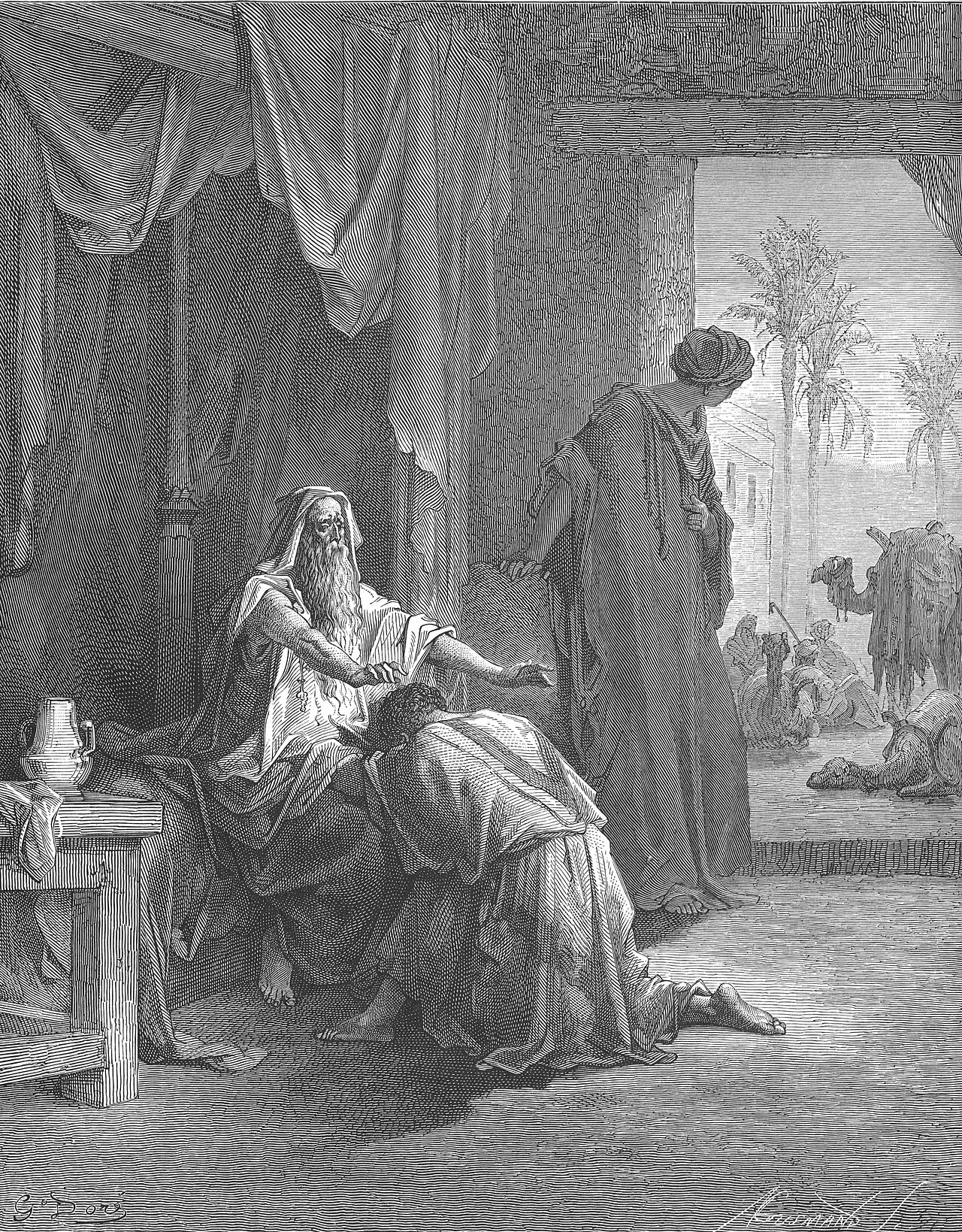
in Genesis 27So now, my son, obey my voice and flee at once to my brother Laban in Haran.
BSB
The same verse in ASV and KJV ▾
ASV
Now therefore, my son, obey my voice; and arise, flee thou to Laban my brother to Haran;
KJV
Now therefore, my son, obey my voice; and arise, flee thou to Laban my brother to Haran;
⋯
This verse in Genesis 27
Commentary
5 notes on this verseThe record, by era
The Church Fathers3 voices
A commentator
Ambrose of MilanOn Jacob and the Blessed Life, Book 2, Chapter 4, Section 15 · Written before 397.
proposed
We have heard the words of an intemperance that is drunk with bodily desires; let us consider the deeds of true virtue. Virtue needs nothing but the grace of God. It pursues the only and supreme good, and it is content with that only good from which we receive all things but on which we bestow nothing because it has no need of anything, just as David says, "I have said to the Lord, 'You are my Lord, for you have no need of my goods.' " And what does the Lord need, when he abounds in all things and imparts everything to us, while providing all things without deficiency?
A commentator
Ambrose of MilanOn Jacob and the Blessed Life, Book 2, Chapter 4, Section 14 · Written before 397.
proposed
But if needs be, let us learn from Rebekah how to make provision so that enmity does not provoke wrath and wrath rush headlong into fratricide. Let Rebekah come—that is, let us put on patience, the good guardian of blamelessness—and let her persuade us not to give in to our anger. Let us withdraw somewhat further, until our anger is softened by time and we are taken by surprise at having forgotten the wrong done us.
A commentator
Clement of RomeClement's First Letter to the Corinthians, Chapters 3-4 · Written before 99.
proposed
Every kind of honour and happiness was bestowed upon you, and then was fulfilled that which is written, "My beloved ate and drank, and was enlarged and became fat, and kicked." [Deuteronomy 32:15] Hence flowed emulation and envy, strife and sedition, persecution and disorder, war and captivity. So the worthless rose up against the honoured, those of no reputation against such as were renowned, the foolish against the wise, the young against those advanced in years. For this reason righteousness and peace are now far departed from you, inasmuch as every one abandons the fear of God, and has become blind in His faith, neither walks in the ordinances of His appointment, nor acts a part becoming a Christian, but walks after his own wicked lusts, resuming the practice of an unrighteous and ungodly envy, by which death itself entered into the world. [Wisdom 2:24] For thus it is written: "And it came to pass after certain days, that Cain brought of the fruits of the earth a sacrifice unto God; and Abel also brought of the firstlings of his sheep, and of the fat thereof. And God had respect to Abel and to his offerings, but Cain and his sacrifices He did not regard. And Cain was deeply grieved, and his countenance fell. And God said to Cain, Why are you grieved, and why is your countenance fallen? If you offer rightly, but do not divide rightly, have you not sinned? Be at peace: your offering returns to yourself, and you shall again possess it. And Cain said to Abel his brother, Let us go into the field. And it came to pass, while they were in the field, that Cain rose up against Abel his brother, and slew him." [Genesis 4:3-8] You see, brethren, how envy and jealousy led to the murder of a brother. Through envy, also, our father Jacob fled from the face of Esau his brother [Genesis 27:41-45]. Envy made Joseph be persecuted unto death, and to come into bondage.
The Puritans and the Awakening1 voice
Now therefore, my son, obey my voice,.... Hearken to what I say, and do according to it, as he had already in many instances, and particularly in a late one, in which he succeeded, and therefore had good reason to attend to her advice and direction, see Gen 27:13, and arise, flee thou to Laban my brother, to Haran; where Laban her brother, dwelt.
The Nineteenth Century1 voice
A commentator
Jamieson, Fausset & Brown1802–1910
Commentary Critical and Explanatory on the Whole Bible (1871)
proposed
these words of Esau were told Rebekah--Poor woman! she now early begins to reap the bitter fruits of her fraudulent device; she is obliged to part with her son, for whom she planned it, never, probably, seeing him again; and he felt the retributive justice of heaven fall upon him heavily in his own future family.
quarantine:debris (2026-07-29) — starts-lowercase
The words behind it
11 Hebrew wordsEvery Hebrew word of this verse in the order it stands, with what it means and the door to its own study. The last column counts the times a word stands in the whole Bible: the rarer the word, the more the places it appears belong together.
| Hebrew | Sound | Meaning | Word study | In the Bible |
|---|---|---|---|---|
| וְעַתָּ֥ה | veatah | and therefore | H6258 → | 433 times |
| בְנִ֖י | veni | O son my | H1121 → | 4930 times |
| שְׁמַ֣ע | shema' | listen | H8085 → | 1159 times |
| בְּקֹלִ֑י | bekoli | to voice my | H6963 → | 506 times |
| וְק֧וּם | vekum | and arise | H6965 → | 628 times |
| בְּרַח־ | berach- | flee | H1272 → | 63 times |
| לְךָ֛ | lekha | for <the> yourself | ||
| אֶל־ | ʾel- | to | H413 → | 5510 times |
| לָבָ֥ן | lavan | Laban | H3837 → | 55 times |
| אָחִ֖י | ʾachi | brother my | H251 → | 630 times |
| חָרָֽנָה׃ | charanah | Haran towards | H2771 → | 12 times |
וְעַתָּ֥הand therefore
veatahH6258 →433 times
בְנִ֖יO son my
veniH1121 →4930 times
שְׁמַ֣עlisten
shema'H8085 →1159 times
בְּקֹלִ֑יto voice my
bekoliH6963 →506 times
וְק֧וּםand arise
vekumH6965 →628 times
בְּרַח־flee
berach-H1272 →63 times
לְךָ֛for <the> yourself
lekha
אֶל־to
ʾel-H413 →5510 times
לָבָ֥ןLaban
lavanH3837 →55 times
אָחִ֖יbrother my
ʾachiH251 →630 times
חָרָֽנָה׃Haran towards
charanahH2771 →12 times
A shaded row is a word that stands 400 times or fewer in the Bible.
The walk
8 stopsEach card is a verse this one points to, and under it the verses that one points to in turn. Where several paths arrive at the same place, that place is listed first: the text keeps returning to it.
Through
Genesis 11:31And Terah took his son Abram, his grandson Lot son of Haran, and his daughter-in-law Sarai the wife of Abram, and they set out from Ur of the Chaldeans for the land of Canaan.…
it leads to
- Nehemiah 9:7
You are the LORD, the God who chose Abram, who brought him out of Ur of the Chaldeans and gave him the name Abraham.
- Acts 7:2–4
And Stephen declared: “Brothers and fathers, listen to me! The God of glory appeared to our father Abraham while he was still in Mesopotamia, before he lived in Haran,
- Genesis 12:4
So Abram departed, as the LORD had directed him, and Lot went with him. Abram was seventy-five years old when he left Haran.
- Nehemiah 9:7
Through
Proverbs 30:17As for the eye that mocks a father and scorns obedience to a mother, may the ravens of the valley pluck it out and young vultures devour it.
it leads to
- Deuteronomy 21:18–21
If a man has a stubborn and rebellious son who does not obey his father and mother and does not listen to them when disciplined,
- Proverbs 23:22
Listen to your father who gave you life, and do not despise your mother when she is old.
- Proverbs 30:11
There is a generation of those who curse their fathers and do not bless their mothers.
- Deuteronomy 21:18–21
Through
Genesis 27:13His mother replied, “Your curse be on me, my son. Just obey my voice and go get them for me.”
it leads to
- Matthew 27:25
All the people answered, “His blood be on us and on our children!”
- Genesis 25:23
and He declared to her: “Two nations are in your womb, and two peoples from within you will be separated; one people will be stronger than the other, and the older will serve the…
Reached by 2 separate paths from here.
- Matthew 27:25
Where this verse is studied
About Genesis
Who and where
1 name in this verse with a page on the site.
This page draws on Ambrose of Milan, On Jacob and the Blessed Life, Book 2, Chapter 4, Section 15; Ambrose of Milan, On Jacob and the Blessed Life, Book 2, Chapter 4, Section 14; Clement of Rome, Clement's First Letter to the Corinthians, Chapters 3-4; Jamieson, Fausset & Brown, Commentary Critical and Explanatory on the Whole Bible and John Gill, Exposition of the Old Testament (1748-1763).