
Joshuachapter 6
27 verses · BSBJoshua book hub →
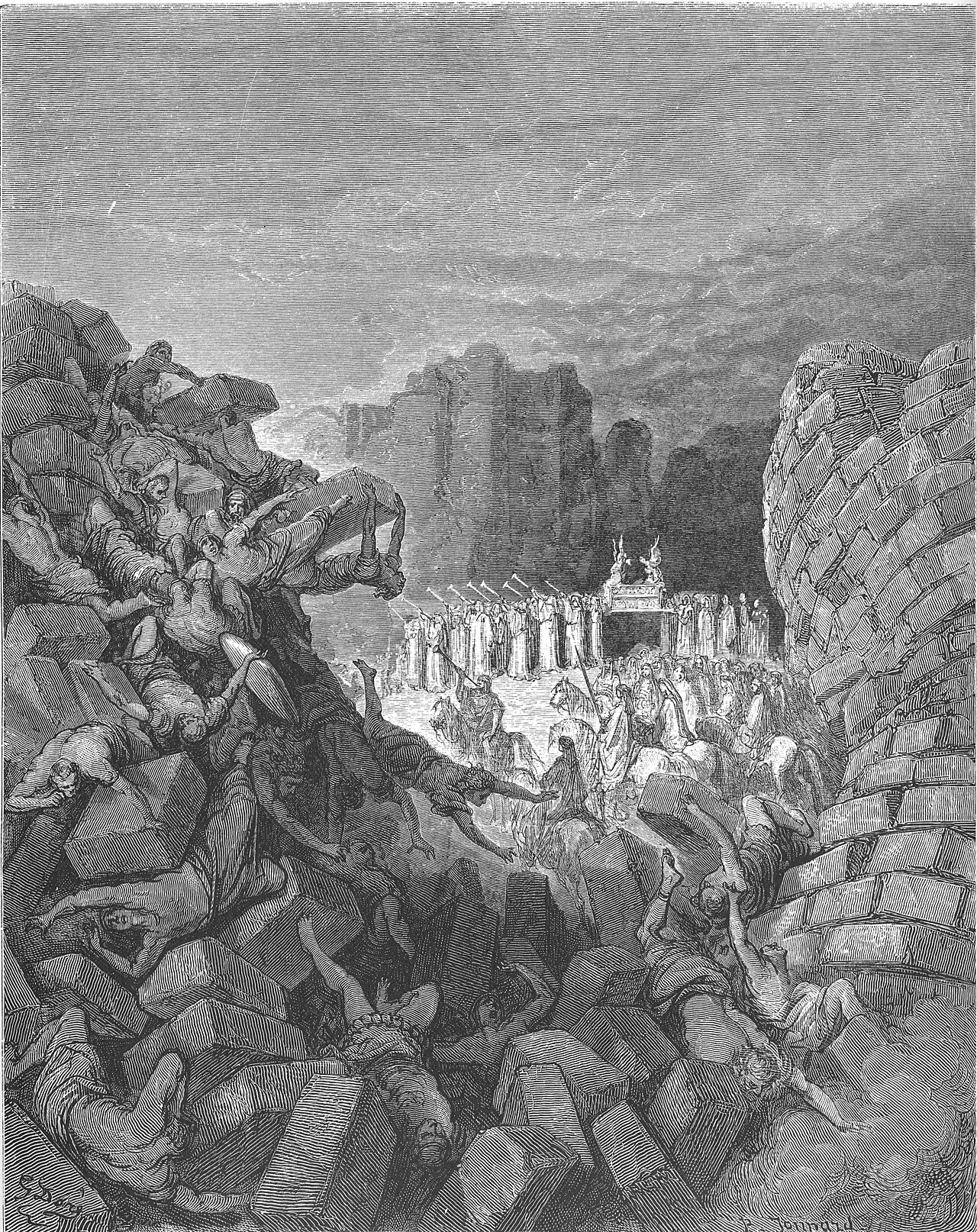
The Walls of Jericho Fall Down, Gustave Doré, Doré's English Bible (1866), public domain
Key verse
Now Jericho was tightly shut up because of the Israelites. No one went out and no one came in.
It stands in Seven priests, seven trumpets, one silent circuit, verses 1 to 11.
The chapter
Chapter summary
Jericho is shut up straitly, and the strategy is liturgy: seven priests with seven trumpets of rams' horns before the ark, one circuit a day for six days in silence, seven circuits on the seventh, then the long blast and the shout: 'and the wall fell down flat, so that the people went up into the city.' The city is devoted to Jehovah, its silver and gold and brass and iron going into his treasury; only Rahab and her father's household are brought out alive, and she dwells in Israel. Joshua curses the man who rebuilds it, and Hebrews 11 remembers the walls that fell by faith after seven days' compassing.
Context
History · Joshua · Joshua overview
Where the chapter sits
Joshua 6 falls in Conquest campaigns (chapters 6–12). Jericho and Ai (central); Gibeonite alliance; five-king coalition at Beth-horon (southern); Hazor and the northern kings.
Jericho falls. Seven priests with seven trumpets; seven days' march; the walls fall flat.
Before it: Entry into the Land, chapters 1–5. After it: Tribal allotments, chapters 13–22.
The whole shape of Joshua→The world behind this chapter
Joshua 6The history
A siege in that world meant months. You cut off water and food, built ramps, undermined walls, and waited for starvation. Jericho is described as shut up tight, nobody going out or coming in, the city had settled in for exactly that.
The rest of the history, and what it meant to them
What Israel does instead is a procession. Armed men, seven priests with rams' horns, the ark, and a rear guard circle the city once a day for six days in silence, and seven times on the seventh day. The horn used was a shofar, a ram's horn, the instrument for signals and for sacred announcements, not a musical trumpet.
The seventh day, the seventh circuit, and the seven priests stack the number of completeness throughout. It also means the seventh day was a long march, seven circuits of the city on foot in one day.
The city was placed under the ban, devoted entirely, with only the silver, gold, bronze, and iron going into the treasury of the LORD's house. Rahab and her family were brought out first and lived among Israel. Joshua then laid a curse on anyone who rebuilt the city, a curse that gets quoted again centuries later in the record of King Ahab's reign, when a man rebuilt Jericho and lost his sons.
What it meant to them
The first hearers were being told the terms of the whole campaign in the first battle. The strongest fortification on their route fell without a siege engine, and the plunder that would normally have paid the army was forbidden to them.
That made the victory unusable as a boast. Nobody could claim Jericho as a feat of arms, and nobody got rich from it.
Sources cited
- John H. Walton, Victor H. Matthews & Mark W. Chavalas, The IVP Bible Background Commentary: Old Testament
- Carl Friedrich Keil & Franz Delitzsch, Commentary on the Old Testament
The structure of this chapter
Places1
The heads below are this chapter's scenes. The numbered points under each are its verses.
A. Seven priests, seven trumpets, one silent circuit
1. (vv. 1-2)
Joshua 6:1
“This verse is strictly parenthetical. It is inserted to explain the declaration commenced Jos 5:14, and interrupted by Joshua’s question and obeisance Jos 5:14-15, but resumed in Jos 6:2. Straitly shut up - See the margin, i. e., not only shut, but barred and bolted.”
Albert Barnes· Notes, Explanatory and Practical, on the Old and New Testaments (1832-1869)· Joshua 6:1evangelical
Joshua 6:1, 1 more voiceWhat preachers and commentators have said about this verse, in their own words.
Joshua 6:1
“It did shut up, and it was shut up (so it is in the margin); it did shut up itself, being strongly fortified both by art and nature, and it was shut up by the obstinacy and resolution of the inhabitants, who agreed never to surrender nor so much as sound a parley…”
Read the whole quotation
none went out as deserters or to treat of peace, nor were any admitted in to offer peace.
Matthew Henry· Commentary on the Whole Bible (1707-1721)· Joshua 6:1puritan
Joshua 6:2
“And the Lord said unto Joshua - This is the same person who in the preceding chapter is called the captain or prince of the Lord’s host, the discourse being here continued that was begun at the conclusion of the preceding chapter, from which the first verses of this are unnaturally divided. I have given into thine hand Jericho, etc.”
Read the whole quotation
- From Jos 24:11, it seems as if there had been persons of all the seven Canaanitish nations then in Jericho, who might have come together at this time to help the king of Jericho against the invading Israelites.
Adam Clarke· Commentary on the Bible (1810-1826)· Joshua 6:2evangelical
a.Verse 1 stands outside the action to explain it. The city is barred from the inside, so nobody is coming out to fight and nobody is getting in to help, and Barnes reads the verse as a parenthesis that resumes the captain's word broken off at 5:14. The promise at verse 2 is in the past tense, I have given into thine hand Jericho, spoken before a man has moved. Joshua repeats that tense back to the people at verse 16 while the wall is still standing.
2. (vv. 3-5)
Joshua 6:3
“Ye shall compass the city - In what order the people marched round the city does not exactly appear from the text.”
Read the whole quotation
Some think they observed the same order as in their ordinary marches in the desert; (see the note on Num 10:14, and see the plans, Num 2:2 (note)); others think that the soldiers marched first, then the priests who blew the trumpets, then those who carried the ark, and lastly the people.
Adam Clarke· Commentary on the Bible (1810-1826)· Joshua 6:3evangelical
Joshua 6:3, 4 more voices
Joshua 6:3
“The command of the Lord as to the mode in which the fall of Jericho should be brought about is given in these verses in a condensed form. Further details (see Jos 6:8-10, Jos 6:16-17, etc.), were, no doubt, among the commands given to Joshua by the Angel.”
Read the whole quotation
Jos 6:4 Trumpets of ram’s horns - Render rather here and in Jos 6:5-6, Jos 6:8, etc., “trumpets of jubilee” (compare Lev 25:10 note). The instrument is more correctly rendered “cornet” (see Lev 25:9, note).
Albert Barnes· Notes, Explanatory and Practical, on the Old and New Testaments (1832-1869)· Joshua 6:3evangelical
Joshua 6:3
“And ye shall compass the city, all ye men of war,....”
Read the whole quotation
Joshua their chief commander under the Lord, and all that were able to make war, even all above twenty years of age; these were to compass the city, not in the form of a siege, but by a procession around it: and go round about the city once; or one time, for the first once in a day, and no more: thus shall thou do six days; one after another; that is, go round it, once every day, for such a time.
John Gill· Exposition of the Old Testament (1748-1763)· Joshua 6:3reformed
Joshua 6:3
“This was all they were to do. He assures them that on the seventh day before night they should, without fail, be masters of the town.”
Read the whole quotation
Up on a signal given, they must all shout, and immediately the wall should fall down, which would not only expose the inhabitants, but so dispirit them that they would not be able to make any resistance,
Matthew Henry· Commentary on the Whole Bible (1707-1721)· Joshua 6:3puritan
Joshua 6:3
“For when they had passed over the Jordan, Joshua commanded them to go round Jericho seven days, each day once, and on the seventh day to go round seven times, and he and the priests were to go before them carrying horns and the ark …”
Philoxenus of Mabbug· written before 523· 13 Ascetic Discourses, Discourse 4 -- On Faith: First Discourse on Simplicity· Joshua 6:3patristic
Joshua 6:4
“Seven trumpets of rams’ horns - The Hebrew word יובלים yobelim does not signify rams’ horns; (see the note on Lev 25:11); nor do any of the ancient versions, the Chaldee excepted, give it this meaning.”
Read the whole quotation
The instruments used on this occasion were evidently of the same kind with those used on the jubilee, and were probably made of horn or of silver; and the text in this place may be translated, And seven priests shall bear before the ark the seven jubilee trumpets, for they appear to have been the same kind as those used on the jubilee.
Adam Clarke· Commentary on the Bible (1810-1826)· Joshua 6:4evangelical
Joshua 6:5
“The wall of the city shall fall down flat - Several commentators, both Jews and Christians, have supposed that the ground under the foundation of the walls opened, and the wall sunk into the chasm, so that there remained nothing but plain ground for the Israelites to walk over.”
Read the whole quotation
Of this the text says nothing: - ונפלה חומת העיר תחתיה venaphelah chomath hair tachteyha, literally translated, is, The wall of the city shall fall down Under Itself; which appears to mean no more than, The wall shall fall down From Its Very Foundations.
Adam Clarke· Commentary on the Bible (1810-1826)· Joshua 6:5evangelical
a.Seven governs the whole instruction: seven priests, seven trumpets, six days and then seven circuits on the seventh. The horns are rams' horns, the yobel horn that Leviticus 25:9 sounds to open the jubilee, the year land returns to the family that held it, and Keil and Delitzsch make that the reason for the instrument chosen. No ramp, no siege engine and no assault order is given, and the only weapon named in the plan is a shout.
3. (vv. 6-7)
Joshua 6:6
“And Joshua the son of Nun called the priests,....”
Read the whole quotation
Not the Levites and Kohathites, whose business it was in common to bear the ark, but upon this occasion the priests; not all of them, but as many as were sufficient for the purpose: and said unto them, take up the ark of the covenant; by putting the staves into the rings of it, and so carry it, Exo 25:14; see Num 7:9, and let seven priests bear seven trumpets of rams' horns before the ark of the Lord: See Gill on Jos 6:4.
John Gill· Exposition of the Old Testament (1748-1763)· Joshua 6:6reformed
Joshua 6:7
“And he said unto the people, pass on, and compass the city,....”
Read the whole quotation
The women and children, the young men under twenty years of age, the unarmed part of the camp, as distinguished from the armed men: and let him that is armed pass on before the ark of the Lord; to guard the ark, protect the priests, and defend the people, should any sally be made by the enemy upon them.
John Gill· Exposition of the Old Testament (1748-1763)· Joshua 6:7reformed
Joshua 6:7, 1 more voice
Joshua 6:7
“He said - The reading in the Hebrew text is “they said.” Joshua no doubt issued his orders through the “officers of the people” (compare Jos 1:10). Him that is armed - i. e. the warriors generally, not a division only.”
Read the whole quotation
“The rereward” Jos 6:9 was merely a detachment, and not a substantial portiere of the host; and was told off, perhaps, from the tribe of Dan (compare the marginal reference) to close the procession and guard the ark from behind.
Albert Barnes· Notes, Explanatory and Practical, on the Old and New Testaments (1832-1869)· Joshua 6:7evangelical
a.Joshua gives the orders back in the words he received them, and the ark sits inside the column rather than behind it. The ark had gone before the people into Jordan at 3:6 and 3:11, and Numbers 10:35 gives the words said over it whenever it set forward, Rise up, Lord, and let thine enemies be scattered. The armed men walk ahead of it and the rest walk behind it, so the fighting men are an escort around a chest.
4. (vv. 8-9)
Joshua 6:8
“And it came to pass, when Joshua had spoken to the people,....”
John Gill· Exposition of the Old Testament (1748-1763)· Joshua 6:8reformed
Joshua 6:8, 1 more voice
Joshua 6:8
“Last Sunday we said that the walls of Jericho were laid waste by the priestly trumpets and that, contrary to order and nature, an unfeeling thing gave way before the sacred sounds with a kind of dread of the threat, and everything so collapsed at …”
Maximus of Turin· written before 465· SERMON 94.1· Joshua 6:8patristic
Joshua 6:9
“The rereward came after the ark - The word מאסף measseph, from אסף asaph, to collect or gather up, may signify either the rereward, as our translation understands it, or the people who carried the baggage of the army; for on the seventh day this was necessary, as much fighting might be naturally expected in the assault…”
Read the whole quotation
and they would need a supply of arms, darts, etc., as well as conveniences for those who might happen to be wounded: or the persons here intended might be such as carried the sacred articles belonging to the ark, or merely such people as might follow in the procession, without observing any particular order.
Adam Clarke· Commentary on the Bible (1810-1826)· Joshua 6:9evangelical
a.The order of march is fixed and the text prints it twice, here and again at verses 12 to 13: armed men, seven priests blowing, the ark, the rereward. Rereward is the King James word for a rear guard, and Isaiah 52:12 uses it of God himself closing the line behind Israel. The trumpets sound continually, so what a barred city hears for six days is one noise repeated.
5. (vv. 10-11)
Joshua 6:10
“The Lord divided the Jordan that His people might pass through dry-shod. This miracle greatly dispirited the Canaanites, and so prepared the way for an easy triumph for the invading Israelites.”
Read the whole quotation
You would have naturally expected that the Lord would have bid His people avail themselves immediately of this terror to strike a heavy blow at once, and press on with might and main before the enemy could take a breath and so sweep the land clear of the adversaries in a single campaign. But it was not so.
Charles Spurgeon· The Metropolitan Tabernacle Pulpit, Sermon No. 795: “Joshua's Vision” (lightly modernized text, CCEL edition) (1868)· Joshua 6:10Particular Baptist
Joshua 6:10, 2 more voices
Joshua 6:10
“The Lord divided the Jordan that His people might pass through dry-shod. This miracle greatly dispirited the Canaanites, and so prepared the way for an easy triumph for the invading Israelites.”
Read the whole quotation
You would have naturally expected that the Lord would have bid His people avail themselves immediately of this terror to strike a heavy blow at once, and press on with might and main before the enemy could take a breath and so sweep the land clear of the adversaries in a single campaign. But it was not so. Instead of immediate activity, the children of Israel pitched their tents at Gilgal and there tarried for a considerable season. For God is in no hurry. His purposes can be accomplished without haste, and though He would have us redeem the time because our days are evil, yet in His eternity He can afford to wait and by His wisdom He so orders His delays that they prove to be far better than our hurries. Why were the people to delay? That they might be obedient to commands which had been forgotten. In the desert, for many reasons, circumcision and the Passover had been neglected. They were not visited with any chastisement on account of this neglect, for the Lord considered their position and condition, and winked at their error. But before He would use them He would have them fully obedient to His will. It cannot be expected that God should tolerate disobedient servants, and therefore they must stay awhile, till they had been attentive to the two great precepts of the Mosaic Covenant. Dear Friends, let us pause and ask ourselves, as Believers, whether we have been in all respects conscientiously attentive to our Master's commands. If not, we may not expect Him to send a blessing to the Church or to the world through us, until first of all we have yielded our willing obedience to that which He has prescribed for us.
Charles Spurgeon· The Metropolitan Tabernacle Pulpit, Sermon No. 795: “Joshua's Vision” (lightly modernized text, CCEL edition) (1868)· Joshua 6:10Particular Baptist
Joshua 6:10
“And Joshua had commanded the people,....”
John Gill· Exposition of the Old Testament (1748-1763)· Joshua 6:10reformed
Joshua 6:11
“So the ark of the Lord compassed the city,....”
John Gill· Exposition of the Old Testament (1748-1763)· Joshua 6:11reformed
Joshua 6:11, 1 more voice
Joshua 6:11
“Is this the people we thought so formidable? Are these their methods of attack?" Thus they cried peace and safety, that the destruction might be the more terrible when it came. Wicked men (says bishop Hall) think God in jest when he is preparing for their judgment; but they will be convinced of their mistake when it is too late.”
Matthew Henry· Commentary on the Whole Bible (1707-1721)· Joshua 6:11puritan
a.Joshua had commanded the people: The silence is ordered in three clauses covering shouting, noise and any word at all, which is heavier than a march order requires. What ends it is a shout released on command at a moment Joshua names, so the sound that takes the city is obedience rather than a cry the men work themselves into. Then the circuit is made once, the people lodge in the camp, and that is the whole of day one.
B. The seventh day, the shout, the wall flat
1. (vv. 12-14)
Joshua 6:12
“And Joshua rose early in the morning,....”
Read the whole quotation
Of the second day; to take care of, direct, and prepare everything for another procession on that day; so active and diligent was he to do the will and work of God, exactly and punctually: and the priests took up the ark of the Lord; and carried it about as they had done the day before.
John Gill· Exposition of the Old Testament (1748-1763)· Joshua 6:12reformed
Joshua 6:13
“And seven priests bearing seven trumpets of rams' horns before the ark of the Lord,....”
Read the whole quotation
See Gill on Jos 6:4, went on continually; or, "going they went" (b): kept on going, making no stop at all, until they had compassed the city: and blew with the trumpets; as they went along: and the armed men went before them, but the rereward came after the ark of the Lord; which the Targum paraphrases as on Jos 6:9, the priests going on, and blowing with the trumpets; See Gill on Jos 6:9. (b) הלכים הלוך "euntes eundo", Montanus.
John Gill· Exposition of the Old Testament (1748-1763)· Joshua 6:13reformed
Joshua 6:14
“So they did six days - It is not likely that the whole Israelitish host went each day round the city.”
Read the whole quotation
This would have been utterly impossible: the fighting men alone amounted to nearly 600,000, independently of the people, who must have amounted at least to two or three millions; we may therefore safely assert that only a select number, such as was deemed necessary for the occasion, were employed. Jericho could not have been a large city: and to reduce it could not have required a hundredth part of the armed force under the command of Joshua.
Adam Clarke· Commentary on the Bible (1810-1826)· Joshua 6:14evangelical
a.These verses repeat verses 8 to 11 almost word for word, and the repetition is the point: six days pass, the same thing happens, and the text records nothing happening. Seven consecutive days of marching means one of them fell on a sabbath, which Henry and Clarke both raise, and the chapter gives neither exemption nor comment. The text never says the people were told in advance how long this would go on.
2. (vv. 15-16)
Joshua 6:15
“And it came to pass on the seventh day,.... Which Jarchi says was the Sabbath day, and which is a common notion of the Jews (c); but whether it was or not, it is certain that one of these seven days must be a sabbath, in which the several things ordered were done, and the procession made.”
John Gill· Exposition of the Old Testament (1748-1763)· Joshua 6:15reformed
Joshua 6:15, 1 more voice
Joshua 6:15
“On the seventh day - Most probably a Sabbath day. The rising early would be necessary to give time for encompassing the city seven times. Jericho appears to have been a city of considerable size and population; and each passage of the large host round it could hardly have taken less than an hour and a half.”
Read the whole quotation
Thus, with the necessary intervals of rest, the evening would be at hand when Joshua gave the signal to shout Jos 6:16; and the work of slaughter was probably commenced just as the hours of the Sabbath were passed.
Albert Barnes· Notes, Explanatory and Practical, on the Old and New Testaments (1832-1869)· Joshua 6:15evangelical
Joshua 6:16
“Shout - To testify your faith in God's promise, and thankfulness for this glorious mercy; to encourage yourselves and brethren, and to strike a terror into your enemies. Given you the city - It is given to them, to be devoted to God, as the first, and perhaps the worst of all the cities of Canaan.”
John Wesley· Explanatory Notes upon the Old Testament (1765)· Joshua 6:16evangelical
Joshua 6:16, 3 more voices
Joshua 6:16
“And it came to pass at the seventh time,....”
John Gill· Exposition of the Old Testament (1748-1763)· Joshua 6:16reformed
Joshua 6:16
“This was a shout of faith; they believed that the walls of Jericho would fall, and by this faith the walls were thrown down.”
Read the whole quotation
It was a shot of prayer, an echo to the sound of the trumpets which proclaimed the promise that God would remember them; with one accord, as one man, they cry to heaven for help, and help comes in.
Matthew Henry· Commentary on the Whole Bible (1707-1721)· Joshua 6:16puritan
Joshua 6:16
“It is given to them to be devoted to God, as the first and perhaps the worst of all the cities of Canaan. The city must be burnt, and all the lives in it sacrificed without mercy to the justice of God. All this they knew was included in those words,”
Matthew Henry· Commentary on the Whole Bible (1707-1721)· Joshua 6:16puritan
a.The seventh day begins at first light and runs seven circuits, so one day costs seven times what each of the six before it cost. Joshua's order is Shout, for the Lord hath given you the city, and that is the tense God used at verse 2, spoken now with the wall still up. The shout falls at the end of the thirteenth circuit, and no Israelite has been permitted a word through any of them.
3. (vv. 17-19)
Joshua 6:17
“Accursed - Better as in margin, (“devoted” (Lev 27:28 note). In other cases the inhabitants only of the towns were slain; their cattle and property became the booty of the victors. But Jericho, as the first Canaanite city that was captured, was devoted by Israel as first-fruits to God, as a token that Israel received all the land from Him.”
Read the whole quotation
Every living thing was put to death (Rahab and her household excepted) as a sacrifice to God, and the indestructible goods were Jos 6:19 brought into the treasury of the sanctuary.
Albert Barnes· Notes, Explanatory and Practical, on the Old and New Testaments (1832-1869)· Joshua 6:17evangelical
Joshua 6:18
This is what is indicated by these words: Take heed that you have nothing worldly in you, that you bring down with you to the church neither worldly customs nor faults nor equivocations of the age. But let all worldly ways be anathema to you.
Read the whole quotation
Do not mix mundane things with divine; do not introduce worldly matters into the mysteries of the church.This is what John also sounds with the trumpet of his epistle, saying, "Do not love the world or the things that are in the world." And likewise Paul: "Do not," he says, "be conformed to this world."
Origen of Alexandria· written before 253· HOMILIES ON JOSHUA 7.4· Joshua 6:18patristic
Joshua 6:18, 1 more voice
Joshua 6:18
“A curse - By provoking God to punish them for your sin, in which they may be one way or other involved; or the whole camp having sins of their own, God might take what occasion he saw fit to inflict this punishment.”
John Wesley· Explanatory Notes upon the Old Testament (1765)· Joshua 6:18evangelical
Joshua 6:19
“But all the silver, and gold - shall come into the treasury - The Brahmins will receive from any caste, however degraded, gold, silver, etc.: but to receive from Shoodras food, garments, etc., would be considered a great degradation. - Ward.”
Adam Clarke· Commentary on the Bible (1810-1826)· Joshua 6:19evangelical
Joshua 6:19, 2 more voices
Joshua 6:19
“But all the silver and gold, and vessels of brass and iron, are consecrated to the Lord,....”
John Gill· Exposition of the Old Testament (1748-1763)· Joshua 6:19reformed
Joshua 6:19
“And when temples, idols, groves, and other things of the sort are authorized to be torn down, although it is evident when we do this that we are not honoring but despising them, still we should not take away anything for private, or at least personal, use so that our purpose in tearing down must be manifest as devotion…”
Read the whole quotation
not cupidity. However, when such things are turned over for public, not private or personal use, as when they are used to honor the true God, that same holds true for things as for people, when they turn from sacrilege and impiety to the true religion. God is understood to have taught this by those texts which you quoted, as when he ordered wood from the grove of foreign gods to be brought for a holocaust and ordered that all the gold, silver and brass vessels be carried into the treasury of the Lord.
Augustine of Hippo· written before 430· LETTER 47· Joshua 6:19patristic
a.The city is placed under the ban, which the King James renders accursed; the Hebrew word is cherem, and a thing under cherem is handed over to God and put past any human use. The accursed thing occurs here at verse 18 for the first time in Scripture, and chapter 7 is what one man taking it costs the nation. Rahab is exempted by name and on a stated ground, because she hid the messengers, and the exemption is announced before the walls fall rather than argued for afterward. The metals go into the treasury as consecrated things, so the ban moves the spoil out of Israel's reach and into God's.
4. (v. 20)
Joshua 6:20
“And did Joshua, the son of Nun, err in recognizing the leader of the heavenly host? But after he believed, he forthwith conquered, being found worthy to triumph in the battle of faith.”
Read the whole quotation
Again, he did not lead forth his armed ranks into the fight, nor did he overthrow the ramparts of the enemy's walls, with battering rams or other engines of war, but with the sound of the seven trumpets of the priests. Thus the blare of the trumpet and the badge of the priest brought a cruel war to an end.
Ambrose of Milan· written before 397· Exposition of the Christian Faith 5.10.126· Joshua 6:20patristic
Joshua 6:20, 2 more voices
Joshua 6:20
“The people shouted with a great shout, that the wall fell down - There has been much learned labor spent to prove that the shouting of the people might be the natural cause that the wall fell down!”
Read the whole quotation
To wait here, either to detail or refute any such arguments, would be lost time: enough of them may be seen in Scheuchzer.
Adam Clarke· Commentary on the Bible (1810-1826)· Joshua 6:20evangelical
Joshua 6:20
“An abstract of this story we find among the trophies of faith, Heb. xi. "By faith the walls of Jericho fell down, after they were compassed about seven days." The Siege of Jericho. 1 Now Jericho was straitly shut up because of the children of Israel: none went out, and none came in.”
Matthew Henry· Commentary on the Whole Bible (1707-1721)· Joshua 6:20puritan
a.Hebrews 11:30 names this as an act of faith, the walls of Jericho fell down after they were compassed about seven days, and the very next verse names Rahab, so the New Testament sets the falling wall and the woman living inside it in consecutive sentences. The wall falls flat and every man goes up straight before him, which means the army enters on every side at once and uses no gate. The mound at Tell es-Sultan is disputed on date rather than on ruin: Garstang read the collapsed walls as the Jericho of Joshua near 1400 BC, Kathleen Kenyon redated that destruction to about 1550 in Digging Up Jericho, and Bryant Wood reopened the pottery case for Garstang's date.
5. (v. 21)
Joshua 6:21
“And they utterly destroyed all that was in the city,.... All the inhabitants of it, by the direction of Joshua, and according to the order of the Lord, Deu 7:1; being guilty of capital crimes, which deserved death, as idolatry, incest, &c.”
Read the whole quotation
both men and women, young and old; neither sex nor age were spared: and ox, and sheep, and ass, with the edge of the sword; in which creatures chiefly lay the substance of the eastern people; see Job 1:3.
John Gill· Exposition of the Old Testament (1748-1763)· Joshua 6:21reformed
a.One verse carries the ban executed, and it is stated without softening and without explanation. The ground Scripture gives is laid down long before this chapter: Genesis 15:16 says the iniquity of the Amorites is not yet full, which makes the four hundred years a delay, and Leviticus 18:24-28 places the ground in what the inhabitants had done. Serious readers differ sharply over how to hold this verse, and the verse itself gives one clause and no discussion.
C. Rahab brought out; Jericho left under a curse
1. (vv. 22-23)
Joshua 6:22
“They were best able to do it who knew her and her house, and they were fittest to do it, that it might appear it was for the sake of her kindness to them that she was thus distinguished and had her life given her for a prey.”
Read the whole quotation
All her kindred were saved with her; like Noah she believed to the saving of her house; and thus faith in Christ brings salvation to the house, Acts xvi.
Matthew Henry· Commentary on the Whole Bible (1707-1721)· Joshua 6:22puritan
Joshua 6:23
“And the young men that were spies went in, and brought out Rahab,.... Not only went into the city, but into Rahab's house, which they knew again by the scarlet thread hung out at the window of it.”
Read the whole quotation
But here a difficulty occurs, how they could be said to go into her house, when it was built on the town wall, Jos 2:15; and that was now fallen down flat.
John Gill· Exposition of the Old Testament (1748-1763)· Joshua 6:23reformed
Joshua 6:23, 1 more voice
Joshua 6:23
“The part of the wall adjoining Rahab’s house had not fallen along with the rest. Rahab and “all that she had,” i. e., the persons belonging to her household, were brought out and “left without the camp of Israel.””
Read the whole quotation
These words literally “made to rest outside the camp of Israel” - indicate that being still in their paganism, they were separated from the camp of the Lord. This was only for a time. They desired, and eventually obtained, admission to the covenant of the chosen people of God Jos 6:25.
Albert Barnes· Notes, Explanatory and Practical, on the Old and New Testaments (1832-1869)· Joshua 6:23evangelical
a.The two men sent in are the same two who swore the oath in chapter 2, so the men who gave the word are the men made to keep it. The terms at 2:12-14 covered her father, her mother, her brethren and all that they had, and verse 23 lists that and adds all her kindred. They are set outside the camp for the moment, which is where a foreign household waited before being received, and verse 25 says where they ended up.
2. (vv. 24-25)
Joshua 6:24
“Only the silver, and the gold - they put into the treasury, etc. - The people were to have no share of the spoils, because they had no hand in the conquest. God alone overthrew the city; and into his treasury only the spoils were brought.”
Read the whole quotation
This is one proof that the agitation of the air, by the sound of the people’s voice, was not the cause of the fall of the city walls.
Adam Clarke· Commentary on the Bible (1810-1826)· Joshua 6:24evangelical
Joshua 6:24, 1 more voice
Joshua 6:24
“The preservation of Rahab the harlot, or inn-keeper, who perished not with those that believed not, Heb. xi.”
Read the whole quotation
The public faith was engaged for her safety by the two spies, who acted therein as public persons; and therefore, though the hurry they were in at the taking of the town was no doubt very great, yet Joshua took effectual care for her preservation.
Matthew Henry· Commentary on the Whole Bible (1707-1721)· Joshua 6:24puritan
Joshua 6:25
“Even unto this day - These words are rightly noted as implying that the narrative was written not long after the occurrences which it records.”
Albert Barnes· Notes, Explanatory and Practical, on the Old and New Testaments (1832-1869)· Joshua 6:25evangelical
Joshua 6:25, 1 more voice
Joshua 6:25
“The harlot olive - For that general command of rooting out the Canaanites seems to have had some exception, in case any of them had sincerely and seasonably cast off their wickedness, and submitted to the Israelites.”
John Wesley· Explanatory Notes upon the Old Testament (1765)· Joshua 6:25evangelical
a.She dwelleth in Israel even unto this day, which tells a reader the account was written while her family were still there and still known by name. Scripture calls her the harlot every time it names her, here and at Hebrews 11:31 and James 2:25, and Matthew 1:5 puts her in the line of Christ as the mother of Boaz. Hebrews 11:30 and 11:31 sit next to each other, the wall falling and the woman inside it living, which is this chapter in two sentences. The scarlet line of 2:18 is read as a figure of the blood by Henry, Gill and many after them, and the New Testament nowhere makes that link, so it carries their names rather than an apostle's.
3. (vv. 26-27)
Joshua 6:26
“It is said of the time when Ahab reigned, "In his days Hiel of Bethel built Jericho; he laid its foundations in Abiram, his firstborn; and he set up its gates in Segub, his youngest son." The apparent sense is that when the above-mentioned city's …”
Bede· written before 735· Questions on the book of Kings 16· Joshua 6:26patristic
Joshua 6:26, 2 more voices
Joshua 6:26
“Joshua adjured them at that time--that is, imposed upon his countrymen a solemn oath, binding on themselves as well as their posterity, that they would never rebuild that city. Its destruction was designed by God to be a permanent memorial of His abhorrence of idolatry and its attendant vices.”
Jamieson, Fausset & Brown· Commentary Critical and Explanatory on the Whole Bible (1871)· Joshua 6:26reformed
Joshua 6:26
“In his youngest son - That is, he shall lose all his children in the work, the first at the beginning, others in the progress of it by degrees, and the youngest in the close of it, when the gates use to be set up. This was fulfilled, 1 Kings xvi, 34.”
John Wesley· Explanatory Notes upon the Old Testament (1765)· Joshua 6:26evangelical
Joshua 6:27
“The word of the Lord was with him - (So the Chaldee:) Even Christ himself, the same that was with Moses. Nothing makes a man appear more truly great, than to have the evidences of God's presence with him.”
John Wesley· Explanatory Notes upon the Old Testament (1765)· Joshua 6:27evangelical
a.The curse names a price in sons rather than a general warning, the firstborn at the foundation and the youngest at the gates. 1 Kings 16:34 discharges it by name in the days of Ahab, where Hiel the Bethelite builds Jericho, lays the foundation in Abiram his firstborn and sets up the gates in his youngest son Segub, according to the word of the Lord which he spake by Joshua the son of Nun. People live at the site long before that, at Judges 3:13 and 2 Samuel 10:5, so what the curse holds is the walling and gating of it. The chapter closes on the promise of 1:5 and 1:9 kept, the Lord was with Joshua.
This page carries no textual note on Joshua 6. Where this site has examined a place the manuscripts differ, the examination is in the manuscripts room. Every place this site examines →
This page draws on 14 works. Open the list of works
This page draws on Adam Clarke; Albert Barnes; Ambrose of Milan, Exposition of the Christian Faith 5.10.126; Augustine of Hippo, LETTER 47; Bede, Questions on the book of Kings 16; Charles Spurgeon, The Metropolitan Tabernacle Pulpit, Sermon No. 795: “Joshua's Vision” (lightly modernized text, CCEL edition) (1868); Jamieson, Fausset & Brown; John Gill; John Wesley, Explanatory Notes upon the Old Testament (1765); Keil and Delitzsch, Biblical Commentary on the Old Testament: Joshua, Judges, Ruth; Matthew Henry; Maximus of Turin, SERMON 94.1; Origen of Alexandria, HOMILIES ON JOSHUA 7.4 and Philoxenus of Mabbug, 13 Ascetic Discourses, Discourse 4 -- On Faith: First Discourse on Simplicity.
Keep studying
On this page
Studies6
On this verse
On this chapter
On this book
Places1