
Joshua 6:4
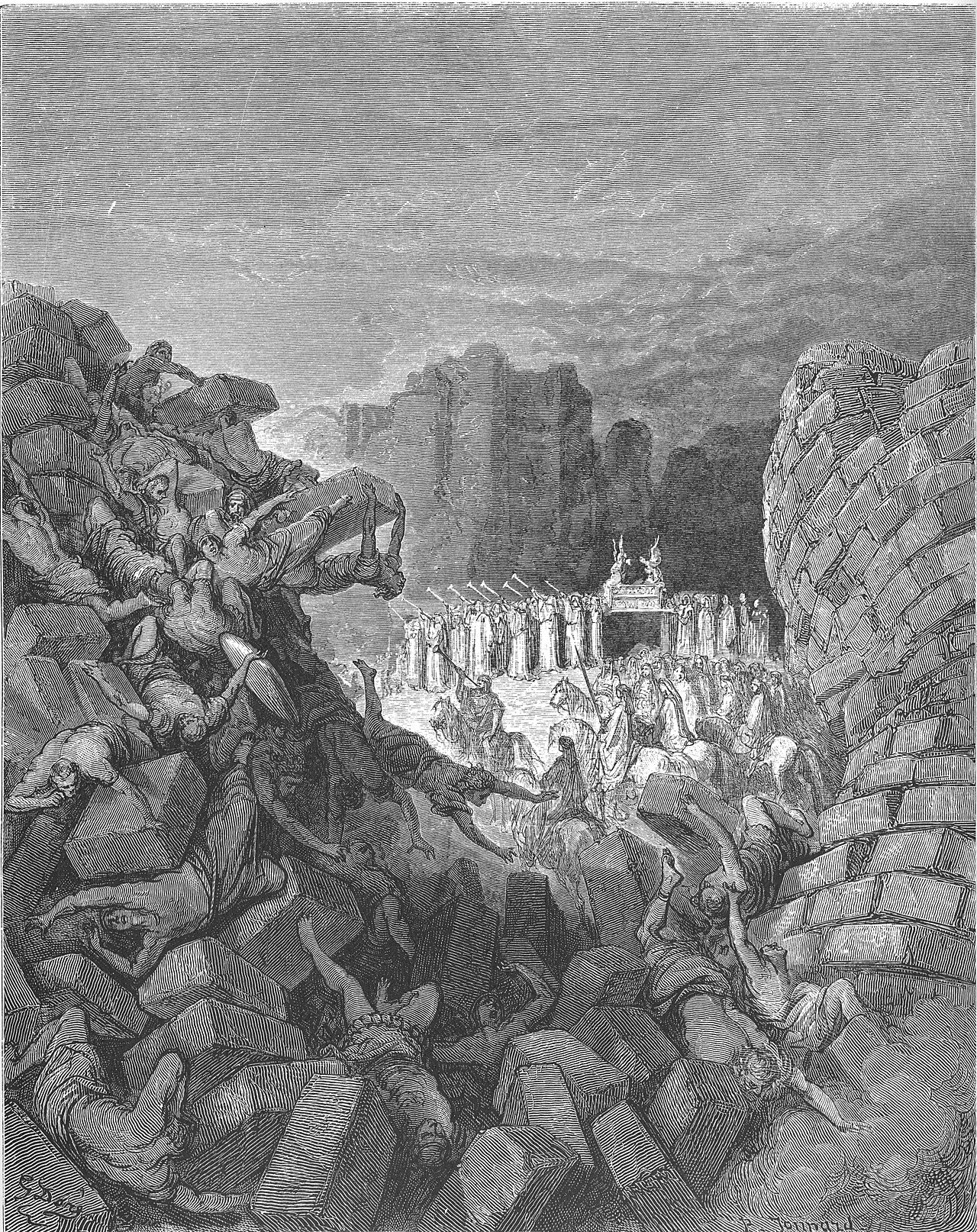
in Joshua 6Have seven priests carry seven rams’ horns in front of the ark. Then on the seventh day, march around the city seven times, while the priests blow the horns.
BSB
The same verse in ASV and KJV ▾
ASV
And seven priests shall bear seven trumpets of rams’ horns before the ark: and the seventh day ye shall compass the city seven times, and the priests shall blow the trumpets.
KJV
And seven priests shall bear before the ark seven trumpets of rams’ horns: and the seventh day ye shall compass the city seven times, and the priests shall blow with the trumpets.
⋯
This verse in Joshua 6
Commentary
9 notes on this verseSeven trumpets of rams’ horns - The Hebrew word יובלים yobelim does not signify rams’ horns; (see the note on Lev 25:11); nor do any of the ancient versions, the Chaldee excepted, give it this meaning. The instruments used on this occasion were evidently of the same kind with those used on the jubilee, and were probably made of horn or of silver; and the text in this place may be translated, And seven priests shall bear before the ark the seven jubilee trumpets, for they appear to have been the same kind as those used on the jubilee.
This site's exposition
with all the men of war
on Joshua 6:3-5
The horns are rams' horns, the yobel horn Leviticus 25:9 sounds to open the jubilee, the year land returns to the family that held it. Keil and Delitzsch make that the reason for the instrument chosen. The only weapon named in the plan is a shout.
This site's exposition
seven rams’ horns in front of the ark
Clarke disputes the translation rams' horns. He says no ancient version except the Aramaic Targum gives it that sense, and takes the instruments to be the jubilee trumpets, made of horn. Jamieson, Fausset and Brown render the Hebrew horns of jubilee, the bent trumpets that proclaimed that year.
The record, by era
The Church Fathers2 voices
But the Jews are sure to say that ever since this precept was given through Moses, the observance has been binding. But it is clear according to the text that the precept was not eternal or spiritual but temporary, which would one day cease.
Though we appear unarmed in body, we nonetheless are bearing arms with which even in time of sunny peace we grapple in spirit against the unsubstantial foe. Now we need God to help us, and him only we must fear; without him our armor falls …
The Puritans and the Awakening3 voices
And seven priests shall bear before the ark seven trumpets of rams' horns,.... The ark was to be taken up and carried by priests round the city.
Thus by the foolishness of preaching, fitly compared to the sounding of these rams' horns, the devil's kingdom is thrown down; and the weapons of our warfare, though they are not carnal nor seem to a carnal eye likely to bring any thing to pass, are yet mighty through God to the pulling down of strong-holds, 2 Cor. x.
This was all they were to do. He assures them that on the seventh day before night they should, without fail, be masters of the town. Up on a signal given, they must all shout, and immediately the wall should fall down, which would not only expose the inhabitants, but so dispirit them that they would not be able to make any resistance,
1 more voice on this verse
The Nineteenth Century1 voice
A commentator
Jamieson, Fausset & Brown1802–1910
Commentary Critical and Explanatory on the Whole Bible (1871)
proposed
ye shall compass the city, all ye men of war. . . . Thus shalt thou do six days, &c.--Directions are here given as to the mode of procedure. Hebrew, "horns of jubilee"; that is, the bent or crooked trumpets with which the jubilee was proclaimed.
quarantine:debris (2026-07-29) — starts-lowercase
The words behind it
18 Hebrew wordsEvery Hebrew word of this verse in the order it stands, with what it means and the door to its own study. The last column counts the times a word stands in the whole Bible: the rarer the word, the more the places it appears belong together.
| Hebrew | Sound | Meaning | Word study | In the Bible |
|---|---|---|---|---|
| וְשִׁבְעָ֣ה | veshivah | and seven | H7651 → | 394 times |
| כֹהֲנִ֡ים | khohanim | priests | H3548 → | 750 times |
| יִשְׂאוּ֩ | yisu | they will carry | H5375 → | 656 times |
| שִׁבְעָ֨ה | shivah | seven | H7651 → | 394 times |
| שׁוֹפְר֤וֹת | shofrot | <the> trumpets of | H7782 → | 72 times |
| הַיּֽוֹבְלִים֙ | haiyovlim | <the> rams' horns | H3104 → | 27 times |
| לִפְנֵ֣י | lifnei | <to> before | H6440 → | 2123 times |
| הָאָר֔וֹן | haaron | the ark | H727 → | 202 times |
| וּבַיּוֹם֙ | uvaiyom | and on the day | H3117 → | 2304 times |
| הַשְּׁבִיעִ֔י | hashevii | <the> seventh | H7637 → | 98 times |
| תָּסֹ֥בּוּ | tasobu | you will go round | H5437 → | 161 times |
| אֶת־ | ʾet- | <obj.> | H853 → | 10935 times |
| הָעִ֖יר | hair | the city | H5892 → | 1090 times |
| שֶׁ֣בַע | sheva' | seven | H7651 → | 394 times |
| פְּעָמִ֑ים | peamim | times | H6471 → | 118 times |
| וְהַכֹּ֣הֲנִ֔ים | vehakohanim | and the priests | H3548 → | 750 times |
| יִתְקְע֖וּ | yitkeu | they will give a blast | H8628 → | 69 times |
| בַּשּׁוֹפָרֽוֹת׃ | bashofarot | on the trumpets | H7782 → | 72 times |
וְשִׁבְעָ֣הand seven
veshivahH7651 →394 times
כֹהֲנִ֡יםpriests
khohanimH3548 →750 times
יִשְׂאוּ֩they will carry
yisuH5375 →656 times
שִׁבְעָ֨הseven
shivahH7651 →394 times
שׁוֹפְר֤וֹת<the> trumpets of
shofrotH7782 →72 times
הַיּֽוֹבְלִים֙<the> rams' horns
haiyovlimH3104 →27 times
לִפְנֵ֣י<to> before
lifneiH6440 →2123 times
הָאָר֔וֹןthe ark
haaronH727 →202 times
וּבַיּוֹם֙and on the day
uvaiyomH3117 →2304 times
הַשְּׁבִיעִ֔י<the> seventh
hasheviiH7637 →98 times
תָּסֹ֥בּוּyou will go round
tasobuH5437 →161 times
אֶת־<obj.>
ʾet-H853 →10935 times
הָעִ֖ירthe city
hairH5892 →1090 times
שֶׁ֣בַעseven
sheva'H7651 →394 times
פְּעָמִ֑יםtimes
peamimH6471 →118 times
וְהַכֹּ֣הֲנִ֔יםand the priests
vehakohanimH3548 →750 times
יִתְקְע֖וּthey will give a blast
yitkeuH8628 →69 times
בַּשּׁוֹפָרֽוֹת׃on the trumpets
bashofarotH7782 →72 times
A shaded row is a word that stands 400 times or fewer in the Bible.
The walk
8 stopsEach card is a verse this one points to, and under it the verses that one points to in turn. Where several paths arrive at the same place, that place is listed first: the text keeps returning to it.
Through
2 Chronicles 20:17You need not fight this battle. Take up your positions, stand firm, and see the salvation of the LORD on your behalf, O Judah and Jerusalem. Do not be afraid or discouraged. Go out…
it leads to
- Exodus 14:13–14
But Moses told the people, “Do not be afraid. Stand firm and you will see the LORD’s salvation, which He will accomplish for you today; for the Egyptians you see today, you will never…
- 2 Chronicles 15:2
So he went out to meet Asa and said to him, “Listen to me, Asa and all Judah and Benjamin. The LORD is with you when you are with Him. If you seek Him,…
- Isaiah 41:10
Do not fear, for I am with you; do not be afraid, for I am your God. I will strengthen you; I will surely help you; I will uphold you with My right hand…
- Psalms 46:10–11
“Be still and know that I am God; I will be exalted among the nations, I will be exalted over the earth.”
- Matthew 28:20
and teaching them to obey all that I have commanded you. And surely I am with you always, even to the end of the age.”
- Exodus 14:13–14
Through
Revelation 16:1Then I heard a loud voice from the temple saying to the seven angels, “Go, pour out on the earth the seven bowls of God’s wrath.”
it leads to
- Zephaniah 3:8
Therefore wait for Me,” declares the LORD, “until the day I rise to testify. For My decision is to gather nations, to assemble kingdoms, to pour out upon them My indignation—all My burning anger.…
- Jeremiah 10:25
Pour out Your wrath on the nations that do not acknowledge You, and on the families that do not call on Your name. For they have devoured Jacob; they have consumed him and finished…
- Revelation 15:1
Then I saw another great and marvelous sign in heaven: seven angels with the seven final plagues, with which the wrath of God is completed.
- Zephaniah 3:8
Where this verse is studied
On this page
Studies11
On this verse
About Joshua
This page draws on Adam Clarke, Commentary on the Bible; Jamieson, Fausset & Brown, Commentary Critical and Explanatory on the Whole Bible; John Gill, Exposition of the Old Testament (1748-1763); Keil and Delitzsch, Biblical Commentary on the Old Testament: Joshua, Judges, Ruth; Matthew Henry, Commentary on the Whole Bible; Paulinus of Nola, POEM 26.99-114 and Tertullian, AN ANSWER TO THE JEWS 4.