
Joshua 6:2
in Joshua 6And the LORD said to Joshua, “Behold, I have delivered Jericho into your hand, along with its king and its mighty men of valor.
BSB
The same verse in ASV and KJV ▾
ASV
And Jehovah said unto Joshua, See, I have given into thy hand Jericho, and the king thereof, and the mighty men of valor.
KJV
And the Lord said unto Joshua, See, I have given into thine hand Jericho, and the king thereof, and the mighty men of valour.
⋯
This verse in Joshua 6
Commentary
10 notes on this verseAnd the Lord said unto Joshua - This is the same person who in the preceding chapter is called the captain or prince of the Lord’s host, the discourse being here continued that was begun at the conclusion of the preceding chapter, from which the first verses of this are unnaturally divided. I have given into thine hand Jericho, etc. - From Jos 24:11, it seems as if there had been persons of all the seven Canaanitish nations then in Jericho, who might have come together at this time to help the king of Jericho against the invading Israelites.
This site's exposition
Jericho was tightly shut up
on Joshua 6:1-2
Verse 1 stands outside the action: the city is barred from within. Barnes reads it as a parenthesis resuming the Commander’s word of 5:14. The promise is past tense, “I have delivered Jericho into your hand”, and Joshua repeats that tense at verse 16 while the wall still stands.
This site's exposition
along with its king and its mighty men of valor
Clarke takes the speaker to be the Commander of 5:14, whose words run on after the parenthesis, and he judges the chapter break unnatural. From 24:11 he suggests that fighters of all seven nations were inside the walls. The promise names the trained soldiers too.
The record, by era
The Church Fathers2 voices
Though we appear unarmed in body, we nonetheless are bearing arms with which even in time of sunny peace we grapple in spirit against the unsubstantial foe. Now we need God to help us, and him only we must fear; without him our armor falls …
But the Jews are sure to say that ever since this precept was given through Moses, the observance has been binding. But it is clear according to the text that the precept was not eternal or spiritual but temporary, which would one day cease.
The Puritans and the Awakening2 voices
And the Lord said unto Joshua,....
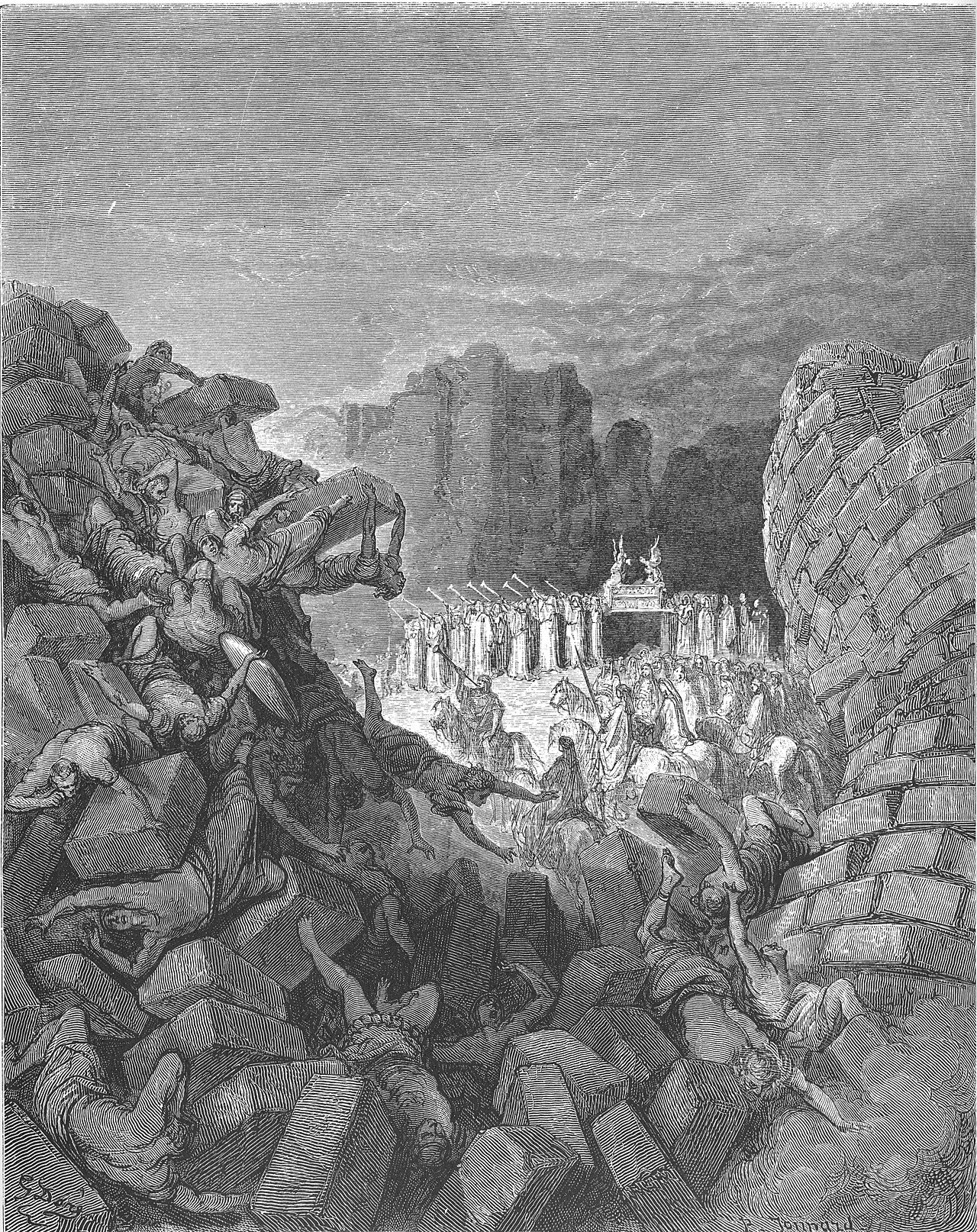
No trenches are to be opened, no batteries erected, nor battering rams drawn up, nor any military preparations made; but the ark of God must be carried by the priests round the city once a day for six days together, and seven times the seventh day, attended by the men of war in silence, the priests all the while blowing with trumpets of rams' horns,
The Nineteenth Century1 voice
A commentator
Jamieson, Fausset & Brown1802–1910
Commentary Critical and Explanatory on the Whole Bible (1871)
proposed
See, I have given into thine hand Jericho--The language intimates that a purpose already formed was about to be carried into immediate execution; and that, although the king and inhabitants of Jericho were fierce and experienced warriors, who would make a stout and determined resistance, the Lord promised a certain and easy victory over them.
2 more voices on this verse
The Nineteenth Century2 voices
I SEE many ministering Brothers here. I think I shall follow the example of Martin Luther who observes that he frequently saw in the church at Wittenberg sundry learned doctors and there usually sat Dr. Justus Jonas and others of whom he said were infinitely greater and more wise than himself. "But," said Martin, "I do not, therefore, alter my style of preaching—I do not preach to them—I preach to those peasants who come in from the country and to the citizens of Wittenberg. For then I am quite certain that if they can understand me, Dr.
I SEE many ministering Brothers here. I think I shall follow the example of Martin Luther who observes that he frequently saw in the church at Wittenberg sundry learned doctors and there usually sat Dr. Justus Jonas and others of whom he said were infinitely greater and more wise than himself. "But," said Martin, "I do not, therefore, alter my style of preaching—I do not preach to them—I preach to those peasants who come in from the country and to the citizens of Wittenberg. For then I am quite certain that if they can understand me, Dr. Justus Jonas and the learned divines can understand me, too, if they like." I shall, moreover, adopt what is said to have been Mr. Wesley's exhortation to his preachers, namely, aim low. "There is more likelihood," he says, "of hitting the men than when you fire high." I may also frankly confess I am reduced to that precept by necessity since I have no capabilities of firing high and must therefore shoot low. We shall take our text now and try, if we can, to get something out of it which may be applicable to the present position of our Society and see if we cannot draw some words and thoughts from it which may strengthen, encourage and nerve us for future action in this good work of God. The Irish Society has to do with one of the citadels of Romanism and it strikes me that there is a very evident parallel between our efforts and the work which Israel had to do against this city of Jericho. Jericho was a strongly defended city and shut up so that none went in or came out. And Romanism seems to have accomplished this admirably. It shuts up its disciples so that they are scarcely accessible and converts from it are few and far between. None, I was about to say, go in—very few, indeed, from us—and there are very few who ever come out again. Jericho was the frontier city.
How the passage was read
What the Jewish commentators add
On the verses either side of this one
Shut and barred. [Lit. closed and closed] Targum translates: ‘Closed with iron gates and reinforced with bars of copper.’
This section is reception history: how the passage was read and kept in the Jewish tradition. Where a reading parts from an essential of the Christian faith, the section says so at that point.
Texts and citation data: Sefaria; each excerpt follows its version’s licence. 4 further sources are cited on this chapter that carry no English text this site may quote or only restate the verse.
The words behind it
13 Hebrew wordsEvery Hebrew word of this verse in the order it stands, with what it means and the door to its own study. The last column counts the times a word stands in the whole Bible: the rarer the word, the more the places it appears belong together.
| Hebrew | Sound | Meaning | Word study | In the Bible |
|---|---|---|---|---|
| וַיֹּ֤אמֶר | vaiyomer | and he said | H559 → | 5305 times |
| יְהוָה֙ | yahweh | Yahweh | H3068 → | 6520 times |
| אֶל־ | ʾel- | to | H413 → | 5510 times |
| יְהוֹשֻׁ֔עַ | yehoshua' | Joshua | H3091 → | 218 times |
| רְאֵה֙ | reeh | see | H7200 → | 1300 times |
| נָתַ֣תִּי | natati | I have given | H5414 → | 2011 times |
| בְיָֽדְךָ֔ | veyadekha | in hand your | H3027 → | 1618 times |
| אֶת־ | ʾet- | <obj.> | H853 → | 10935 times |
| יְרִיח֖וֹ | yericho | Jericho | H3405 → | 57 times |
| וְאֶת־ | veet | and <obj.> | H853 → | 10935 times |
| מַלְכָּ֑הּ | malkah | king its | H4428 → | 2525 times |
| גִּבּוֹרֵ֖י | giborei | [the] mighty [men] of | H1368 → | 158 times |
| הֶחָֽיִל׃ | hechayil | <the> strength | H2428 → | 246 times |
וַיֹּ֤אמֶרand he said
vaiyomerH559 →5305 times
יְהוָה֙Yahweh
yahwehH3068 →6520 times
אֶל־to
ʾel-H413 →5510 times
יְהוֹשֻׁ֔עַJoshua
yehoshua'H3091 →218 times
רְאֵה֙see
reehH7200 →1300 times
נָתַ֣תִּיI have given
natatiH5414 →2011 times
בְיָֽדְךָ֔in hand your
veyadekhaH3027 →1618 times
אֶת־<obj.>
ʾet-H853 →10935 times
יְרִיח֖וֹJericho
yerichoH3405 →57 times
וְאֶת־and <obj.>
veetH853 →10935 times
מַלְכָּ֑הּking its
malkahH4428 →2525 times
גִּבּוֹרֵ֖י[the] mighty [men] of
giboreiH1368 →158 times
הֶחָֽיִל׃<the> strength
hechayilH2428 →246 times
A shaded row is a word that stands 400 times or fewer in the Bible.
The walk
8 stopsEach card is a verse this one points to, and under it the verses that one points to in turn. Where several paths arrive at the same place, that place is listed first: the text keeps returning to it.
Through
Joshua 8:1Then the LORD said to Joshua, “Do not be afraid or discouraged. Take the whole army with you, and go up and attack Ai. See, I have delivered into your hand the king of…
it leads to
- Joshua 1:9
Have I not commanded you to be strong and courageous? Do not be afraid; do not be discouraged, for the LORD your God is with you wherever you go.”
- Deuteronomy 31:8
The LORD Himself goes before you; He will be with you. He will never leave you nor forsake you. Do not be afraid or discouraged.”
- Deuteronomy 7:18
But do not be afraid of them. Be sure to remember what the LORD your God did to Pharaoh and all Egypt:
- Deuteronomy 1:21
See, the LORD your God has placed the land before you. Go up and take possession of it as the LORD, the God of your fathers, has told you. Do not be afraid or…
- Joshua 1:9
Through
Joshua 2:9and said to them, “I know that the LORD has given you this land and that the fear of you has fallen on us, so that all who dwell in the land are melting…
it leads to
- Exodus 23:27
I will send My terror ahead of you and throw into confusion every nation you encounter. I will make all your enemies turn and run.
- Exodus 23:27
Through
Deuteronomy 7:24He will hand their kings over to you, and you will wipe out their names from under heaven. No one will be able to stand against you; you will annihilate them.
it leads to
- Joshua 10:8
The LORD said to Joshua, “Do not be afraid of them, for I have delivered them into your hand. Not one of them shall stand against you.”
- Joshua 23:9
The LORD has driven out great and powerful nations before you, and to this day no one can stand against you.
- Joshua 1:5
No one shall stand against you all the days of your life. As I was with Moses, so will I be with you; I will never leave you nor forsake you.
- Joshua 10:8
Where this verse is studied
On this page
Studies11
About Joshua
Who and where
2 names in this verse with a page on the site.
- PersonConquestJoshuaMoses' minister and successor, one of the two faithful spies; he led Israel across Jordan, around Jericho, and through the conques…
- PlaceJordan valleyJerichoThe city of palms whose walls fell flat at the seventh trumpet-circuit; Rahab's city, later rebuilt under a curse, and the road do…
This page draws on Adam Clarke, Commentary on the Bible; Albert Barnes, Notes on the Old Testament; Charles Spurgeon, The Metropolitan Tabernacle Pulpit, Sermon No. 629: “Jericho Captured” (lightly modernized text, CCEL edition); Jamieson, Fausset & Brown, Commentary Critical and Explanatory on the Whole Bible; John Gill, Exposition of the Old Testament (1748-1763); Matthew Henry, Commentary on the Whole Bible; Paulinus of Nola, POEM 26.99-114 and Tertullian, AN ANSWER TO THE JEWS 4.