
Joshua 6:5
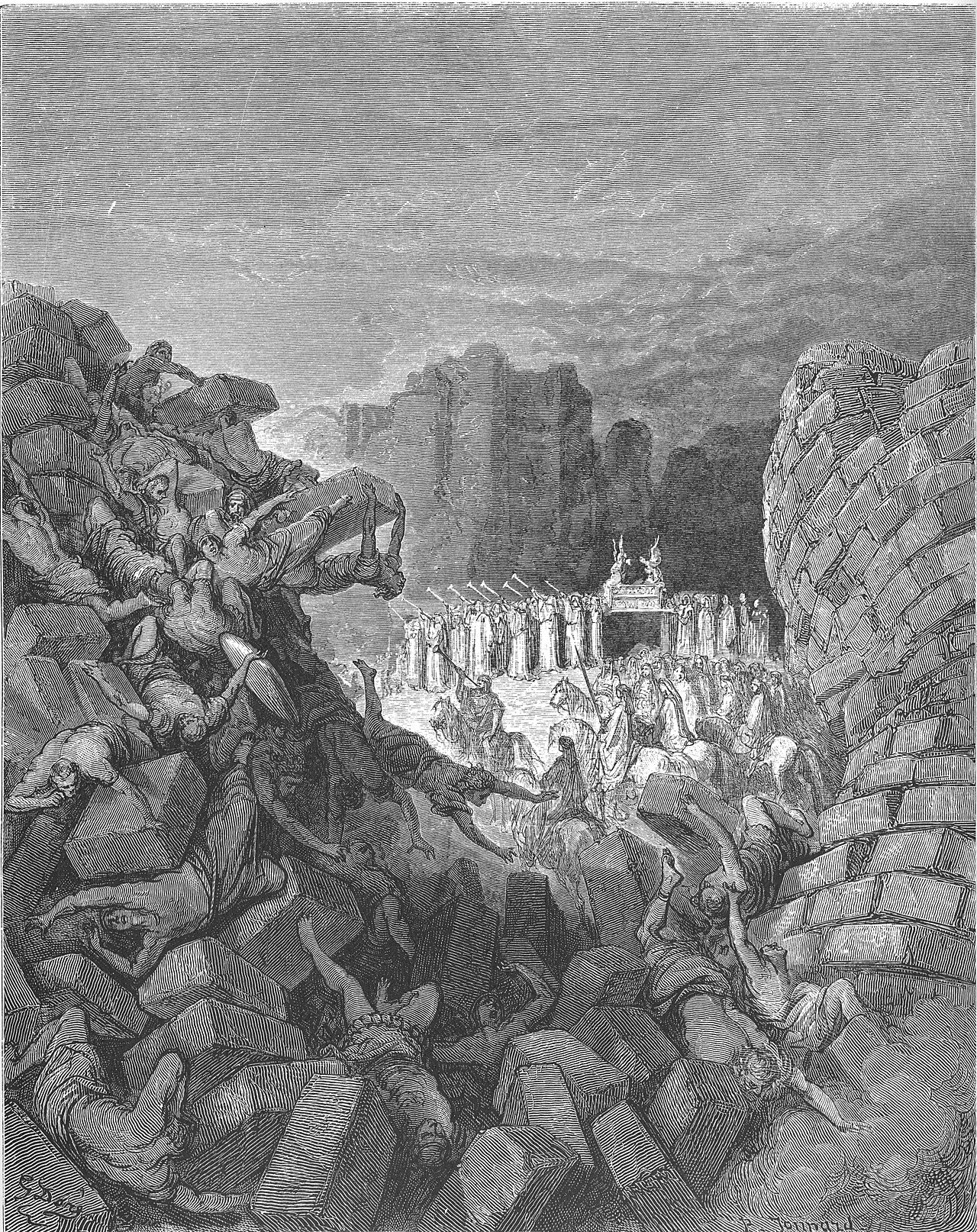
in Joshua 6And when there is a long blast of the ram’s horn and you hear its sound, have all the people give a mighty shout. Then the wall of the city will collapse and all your people will charge straight into the city.”
BSB
The same verse in ASV and KJV ▾
ASV
And it shall be, that, when they make a long blast with the ram’s horn, and when ye hear the sound of the trumpet, all the people shall shout with a great shout; and the wall of the city shall fall down flat, and the people shall go up every man straight before him.
KJV
And it shall come to pass, that when they make a long blast with the ram’s horn, and when ye hear the sound of the trumpet, all the people shall shout with a great shout; and the wall of the city shall fall down flat, and the people shall ascend up every man straight before him.
⋯
This verse in Joshua 6
Commentary
10 notes on this verseThe wall of the city shall fall down flat - Several commentators, both Jews and Christians, have supposed that the ground under the foundation of the walls opened, and the wall sunk into the chasm, so that there remained nothing but plain ground for the Israelites to walk over. Of this the text says nothing: - ונפלה חומת העיר תחתיה venaphelah chomath hair tachteyha, literally translated, is, The wall of the city shall fall down Under Itself; which appears to mean no more than, The wall shall fall down From Its Very Foundations.
This site's exposition
with all the men of war
on Joshua 6:3-5
The horns are rams' horns, the yobel horn Leviticus 25:9 sounds to open the jubilee, the year land returns to the family that held it. Keil and Delitzsch make that the reason for the instrument chosen. The only weapon named in the plan is a shout.
This site's exposition
the wall of the city will collapse
Literally, the wall will fall under itself. Clarke reports writers who had the ground open and swallow the wall, and answers that the text says only that it fell from its foundations. Henry sees the whole plan as a test of whether Israel would obey an order that looked foolish.
The record, by era
The Church Fathers3 voices
Though we appear unarmed in body, we nonetheless are bearing arms with which even in time of sunny peace we grapple in spirit against the unsubstantial foe. Now we need God to help us, and him only we must fear; without him our armor falls …
The walls of Jericho fell down on account of the priestly trumpets because they contained within themselves a sinful people. A battering ram did not strike it, nor did a machine of war storm it, but—what is remarkable—the terror of the priestly sound brought it …
But the Jews are sure to say that ever since this precept was given through Moses, the observance has been binding. But it is clear according to the text that the precept was not eternal or spiritual but temporary, which would one day cease.
The Puritans and the Awakening2 voices
And it shall come to pass, that when they make a long blast with the ram's horn,....
(4.) It was to try the faith, obedience, and patience, of the people, to try whether they would observe a precept which to human policy seemed foolish to obey and believe a promise which in human probability seemed impossible to be performed. They were also proved whether they could patiently bear the reproaches of their enemies and patiently wait for the salvation of the Lord.
2 more voices on this verse
The Puritans and the Awakening1 voice
Thus by the foolishness of preaching, fitly compared to the sounding of these rams' horns, the devil's kingdom is thrown down; and the weapons of our warfare, though they are not carnal nor seem to a carnal eye likely to bring any thing to pass, are yet mighty through God to the pulling down of strong-holds, 2 Cor. x.
The Nineteenth Century1 voice
A commentator
Jamieson, Fausset & Brown1802–1910
Commentary Critical and Explanatory on the Whole Bible (1871)
proposed
ye shall compass the city, all ye men of war. . . . Thus shalt thou do six days, &c.--Directions are here given as to the mode of procedure. Hebrew, "horns of jubilee"; that is, the bent or crooked trumpets with which the jubilee was proclaimed.
quarantine:debris (2026-07-29) — starts-lowercase
The words behind it
21 Hebrew wordsEvery Hebrew word of this verse in the order it stands, with what it means and the door to its own study. The last column counts the times a word stands in the whole Bible: the rarer the word, the more the places it appears belong together.
| Hebrew | Sound | Meaning | Word study | In the Bible |
|---|---|---|---|---|
| וְהָיָ֞ה | vehayah | and it will be | H1961 → | 3559 times |
| בִּמְשֹׁ֣ךְ׀ | bimshokh | when blow | H4900 → | |
| בְּקֶ֣רֶן | bekeren | on [the] horn of | H7161 → | |
| הַיּוֹבֵ֗ל | haiyovel | <the> ram's horn | H3104 → | 27 times |
| כְּשָׁמְעֲכֶם֙ | keshameakhem | just as hear you | H8085 → | 1159 times |
| אֶת־ | ʾet- | <obj.> | H853 → | 10935 times |
| ק֣וֹל | kol | [the] sound of | H6963 → | 506 times |
| הַשּׁוֹפָ֔ר | hashofar | the trumpet | H7782 → | 72 times |
| יָרִ֥יעוּ | yariu | they will shout | H7321 → | 44 times |
| כָל־ | khol- | all | H3605 → | 5413 times |
| הָעָ֖ם | haam | the people | H5971 → | 1873 times |
| תְּרוּעָ֣ה | teruah | a shout | H8643 → | |
| גְדוֹלָ֑ה | gedolah | loud | H1419 → | 526 times |
| וְנָ֨פְלָ֜ה | venafelah | and it will fall | H5307 → | 435 times |
| חוֹמַ֤ת | chomat | [the] wall of | H2346 → | 133 times |
| הָעִיר֙ | hair | the city | H5892 → | 1090 times |
| תַּחְתֶּ֔יהָ | tachteiha | in place its | H8478 → | 505 times |
| וְעָל֥וּ | vealu | and they will go up | H5927 → | 890 times |
| הָעָ֖ם | haam | the people | H5971 → | 1873 times |
| אִ֥ישׁ | ʾish | everyone | H376 → | 1663 times |
| נֶגְדּֽוֹ׃ | negdo | before himself | H5048 → | 151 times |
וְהָיָ֞הand it will be
vehayahH1961 →3559 times
בִּמְשֹׁ֣ךְ׀when blow
bimshokhH4900 →
בְּקֶ֣רֶןon [the] horn of
bekerenH7161 →
הַיּוֹבֵ֗ל<the> ram's horn
haiyovelH3104 →27 times
כְּשָׁמְעֲכֶם֙just as hear you
keshameakhemH8085 →1159 times
אֶת־<obj.>
ʾet-H853 →10935 times
ק֣וֹל[the] sound of
kolH6963 →506 times
הַשּׁוֹפָ֔רthe trumpet
hashofarH7782 →72 times
יָרִ֥יעוּthey will shout
yariuH7321 →44 times
כָל־all
khol-H3605 →5413 times
הָעָ֖םthe people
haamH5971 →1873 times
תְּרוּעָ֣הa shout
teruahH8643 →
גְדוֹלָ֑הloud
gedolahH1419 →526 times
וְנָ֨פְלָ֜הand it will fall
venafelahH5307 →435 times
חוֹמַ֤ת[the] wall of
chomatH2346 →133 times
הָעִיר֙the city
hairH5892 →1090 times
תַּחְתֶּ֔יהָin place its
tachteihaH8478 →505 times
וְעָל֥וּand they will go up
vealuH5927 →890 times
הָעָ֖םthe people
haamH5971 →1873 times
אִ֥ישׁeveryone
ʾishH376 →1663 times
נֶגְדּֽוֹ׃before himself
negdoH5048 →151 times
A shaded row is a word that stands 400 times or fewer in the Bible.
The walk
8 stopsEach card is a verse this one points to, and under it the verses that one points to in turn. Where several paths arrive at the same place, that place is listed first: the text keeps returning to it.
Through
Hebrews 11:30By faith the walls of Jericho fell, after the people had marched around them for seven days.
it leads to
- Joshua 6:3–20
March around the city with all the men of war, circling the city one time. Do this for six days.
- 2 Corinthians 10:4–5
The weapons of our warfare are not the weapons of the world. Instead, they have divine power to demolish strongholds.
- Joshua 6:3–20
Through
Exodus 19:19And as the sound of the ram’s horn grew louder and louder, Moses spoke and God answered him in the thunder.
it leads to
- Psalms 81:7
You called out in distress, and I rescued you; I answered you from the cloud of thunder; I tested you at the waters of Meribah. Selah
- Exodus 19:16
On the third day, when morning came, there was thunder and lightning. A thick cloud was upon the mountain, and a very loud blast of the ram’s horn went out, so that all the…
- Psalms 81:7
Through
Joshua 6:16After the seventh time around, the priests blew the horns, and Joshua commanded the people, “Shout! For the LORD has given you the city!
it leads to
- 2 Chronicles 13:15
and the men of Judah raised the battle cry. And when they raised the cry, God routed Jeroboam and all Israel before Abijah and Judah.
- 2 Chronicles 20:22–23
The moment they began their shouts and praises, the LORD set ambushes against the men of Ammon, Moab, and Mount Seir who had come against Judah, and they were defeated.
- Judges 7:20–22
The three companies blew their horns and shattered their jars. Holding the torches in their left hands and the horns in their right hands, they shouted, “A sword for the LORD and for Gideon!”
- 2 Chronicles 13:15
Through
1 Samuel 4:5When the ark of the covenant of the LORD entered the camp, all the Israelites raised such a great shout that it shook the ground.
it leads to
- Job 20:5
the triumph of the wicked has been brief and the joy of the godless momentary?
- Job 20:5
Where this verse is studied
On this page
Studies11
On this verse
About Joshua
This page draws on Adam Clarke, Commentary on the Bible; Jamieson, Fausset & Brown, Commentary Critical and Explanatory on the Whole Bible; John Gill, Exposition of the Old Testament (1748-1763); Keil and Delitzsch, Biblical Commentary on the Old Testament: Joshua, Judges, Ruth; Matthew Henry, Commentary on the Whole Bible; Maximus of Turin, SERMON 93.2; Paulinus of Nola, POEM 26.99-114 and Tertullian, AN ANSWER TO THE JEWS 4.