
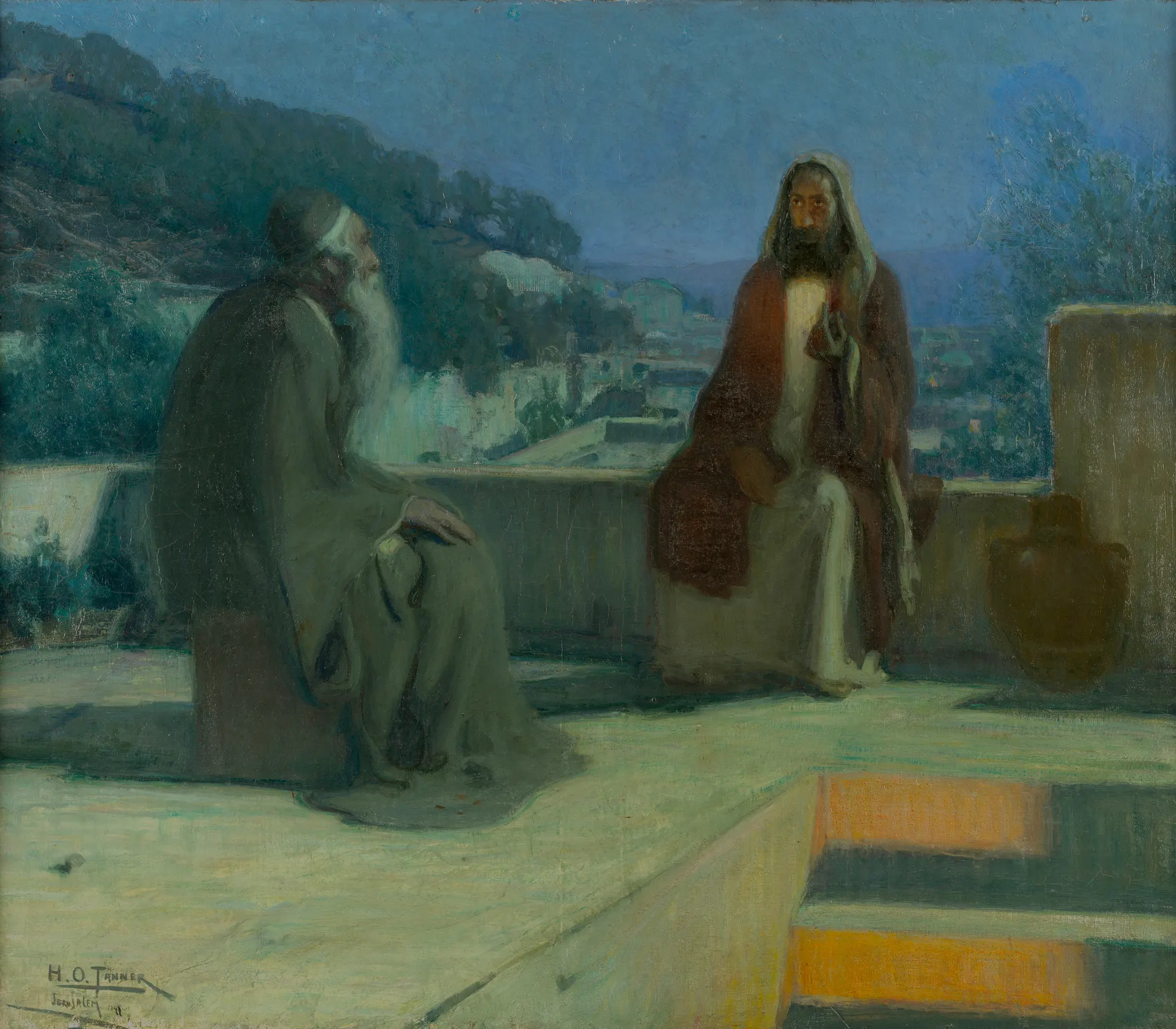
Johnchapter 14
31 verses · John, by tradition · AD 85 to 95 · The Gospels
Jesus answered, “I am the way and the truth and the life. No one comes to the Father except through Me.
Introduction
John, by tradition, The Gospels, John Overview.
This chapter comes from the disciple who reclined beside Jesus at the supper, the man the church has named John. He wrote it down late in a long life, for believers who had never seen Jesus and had to trust Him unseen. The chapter belongs to the farewell Jesus gave on His last night, spoken to eleven frightened men around a table. Listen for how often the disciples break in with questions, one voice after another. Listen also for the new name given to the Spirit. Hear it as teaching for anyone left to follow a Lord they cannot see.
Context
- Who
- Readers who had lost their place in the community they were raised in
- What
- Part of the farewell Jesus spoke to His disciples on the night before His death, answering their fear that He was leaving them.
- Where
- Jerusalem, at the supper table on the night of the betrayal, before Jesus went out across the Kidron Valley.
- When
- The night before the crucifixion, about AD 30 to 33, written down about AD 85 to 95 on the traditional dating.
- Why
- To steady troubled disciples by telling them where He was going, how they would come to the Father, and who would be with them once He had gone.
Historical context
The picture of a father's house with many rooms describes how families actually lived. A household compound grew by adding rooms around a courtyard as sons married and brought wives home; a father with many rooms was a father whose family had not been scattered. Some readers connect this with the betrothal custom in which a groom prepared a place at his father's house before coming for his bride, and the words fit that pattern, though the text does not spell the custom out.
Show the rest of the historical context, 3 more paragraphs
The word translated Helper or Advocate was a courtroom term. It named someone who stood alongside a defendant to speak for him, not a lawyer in the modern professional sense, but a supporter with standing. Promising another one of the same kind means the disciples were being told they would not be left without representation.
Peace I leave with you is a farewell greeting with a specific shape. Shalom was the ordinary word for hello and goodbye, and Jesus takes the routine parting word and says he gives it not as the world gives, a deliberate contrast with a courtesy people said without meaning.
The chapter ends with a stage direction: rise, let us go from here. What follows in the next chapters is spoken either as they prepare to leave or on the walk down through the city and across the Kidron, which is worth knowing when the vine appears in the next chapter.
Significance
Thomas and Philip both ask questions that sound slow, and readers were meant to be grateful for them. The answers are the two most quoted sentences in the chapter: I am the way, the truth, and the life, and, whoever has seen me has seen the Father.
Show the rest of the significance, 1 more paragraph
For congregations who had lost the house they grew up in, the promise that the Father and the Son would come and make their home with anyone who keeps his word gave them back the thing they had lost, in a form nobody could put them out of.
The heads below are this chapter's scenes. The numbered points under each are its verses.
Let Not Your Heart Be Troubled: I Am the Way
Jesus tells the eleven to believe in God and to believe in Him as well. Their hearts are troubled by what He has just said about betrayal and about going away. Belief in the Son stands beside belief in God.
John 14:1
“Let not your heart be troubled - At my departure. Believe - This is the sum of all his discourse, which is urged till they did believe, Chap. xvi, 30.”
John Wesley · Explanatory Notes upon the New Testament (1755)evangelical
4 more voices on this verseWhat preachers and commentators have said about this verse, in their own words.
John 14:1
“Let not your heart be troubled - The disciples had been greatly distressed at what Jesus had said about leaving them. Compare Joh 16:6, Joh 16:22. Perhaps they had indicated their distress to him in some manner by their countenance or their expressions, and he proceeds new to administer to them such consolations as their circumstances made proper.”
John 14:1
“In commanding them not to be troubled, Jesus placed them, as it were, on the threshold between hope and fear. This way, if they fell into weakness and suffering in their human frailty, the hope of his mercy might help them to recover. On the other hand, the fear of stumbling might urge them to fall less often inasmuch as they had not yet been endowed with the power from above, from on high—I mean the grace that comes through the Spirit that always keeps them from failure.”
Cyril of Alexandria · written before 444 · Commentary on the Gospel of John, Book 9patristic
John 14:1
“Those that rightly believe in God will believe in Jesus Christ, whom he has made known to them; and believing in God through Jesus Christ is an excellent means of keeping trouble from the heart. The joy of faith is the best remedy against the griefs of sense; it is a remedy with a promise annexed to it; the just shall live by faith; a remedy with a probatum est annexed to it.”
Matthew Henry · Commentary on the Whole Bible (1707-1721)puritan
John 14:1
“Let not your heart be troubled,.... In some copies this verse begins thus, and he said to his disciples; and certain it is, that these words are addressed to them in general, Peter being only the person our Lord was discoursing with in the latter part of the preceding chapter; but turning, as it were, from him, he directs his speech to them all.”
John 14:2-3
In My Father’s house are many rooms: The Greek word behind rooms is monai, abiding places, and the Father's house has room for many. Jesus gives His departure a purpose: He goes to prepare a place and comes back for His own. The place He prepares is where He is.
John 14:2
In my Father's house are many mansions--and so room for all, and a place for each. if not, I would have told you--that is, I would tell you so at once; I go to prepare a place for you--to obtain for you a right to be there, and to possess your "place."
Jamieson, Fausset & Brown · Commentary Critical and Explanatory on the Whole Bible (1871)reformed
4 more voices on this verse
John 14:2
“In my Father's house are many mansions,.... This he says to draw off their minds from an earthly kingdom to an heavenly one; to point out the place to them whither he was going, and to support them with the views and hopes of glory under all their troubles. By his "Father's house" is meant heaven; see 2Co 5:1; which is of his Father's building, where he has, and will have all his family.”
John 14:2
“In my Father’s house, etc. - The kingdom of glory. Many mansions - Though I have said before that whither I am going ye cannot come now, yet do not think that we shall be for ever separated. I am going to that state of glory where there is not only a place of supreme eminence for myself, but also places for all my disciples; - various degrees of glory, suited to the various capacities and attainments of my followers.”
Adam Clarke · Commentary on the Bible (1810-1826)evangelical
John 14:2
“In my Father's house are many mansions - Enough to receive both the holy angels, and your predecessors in the faith, and all that now believe, and a great multitude, which no man can number.”
John Wesley · Explanatory Notes upon the New Testament (1755)evangelical
John 14:2
MY real text is not in the Bible—it is one of those Christian proverbs which are not Inspired in words, but the spirit of which is Inspired, "Heaven is a prepared place for a prepared people." You have often heard that sentence. It is familiar in your mouths as household words, and well it may be. Yet I shall have two texts from the Scriptures. The first will be our Savior's words to His disciples, "I go to prepare a place for you," from which we learn that "Heaven is a prepared place."
Charles Spurgeon · written before 1892 · The Metropolitan Tabernacle Pulpit, Sermon No. 2751: “'A Prepared Place for a Prepared People'” (lightly modernized text, CCEL edition)Particular Baptist
I will come back and welcome you: Readers place His coming back at different times. Clarke takes it of the return after the resurrection, Gill of death or the second coming, and Jamieson, Fausset and Brown of His appearing. Every reading keeps the purpose, that He will welcome them and they will be where He is.
John 14:3
“And if I go - And when I shall have gone and prepared a place for you - opened the kingdom of an eternal glory for your reception, and for the reception of all that shall die in the faith, I will come again, after my resurrection, and give you the fullest assurances of this state of blessedness; and confirm you in the faith, by my grace and the effusion of my Spirit.”
Adam Clarke · Commentary on the Bible (1810-1826)evangelical
3 more voices on this verse
John 14:3
“He will be the finisher of that of which he is the author. If he has prepared the place for us, he will prepare us for it, and in due time put us in possession of it. As the resurrection of Christ is the assurance of our resurrection, so his ascension, victory, and glory, are an assurance of ours.”
Matthew Henry · Commentary on the Whole Bible (1707-1721)puritan
John 14:3
“Therefore if the mansions in God the Father's home had not been many in number, He would have said that He was going on before them, namely to prepare beforehand the habitations of the saints: but knowing that there are many such, already fully prepared and awaiting the arrival of those who love God, He says that He will depart not for this purpose, but for the sake of securing the way to the mansions above, to prepare a passage of safety for you, and to smooth the path that was impassable in old time.”
Cyril of Alexandria · written before 444 · Commentary on the Gospel of John, Book 9patristic
John 14:3
“I will come again and receive you unto myself--strictly, at His Personal appearing; but in a secondary and comforting sense, to each individually. Mark again the claim made:--to come again to receive His people to Himself, that where He is there they may be also. He thinks it ought to be enough to be assured that they shall be where He is and in His keeping.”
Jamieson, Fausset & Brown · Commentary Critical and Explanatory on the Whole Bible (1871)reformed
John 14:4-5
You know the way to the place: Jesus says they know the way to the place where He is going. Thomas answers plainly that they do not know where He is going, so the way is hidden from them. His honest question draws the answer that follows.
John 14:4
“And whither I go ye know,.... They might have known, at least, whither he was going, since he had spoke of his Father's house, and of his going to prepare a place for them there, and doubtless had some knowledge thereof, though very confused and imperfect: and the way ye know: this also they might have known from some expressions of his, that the way to his Father's house lay through sufferings and death, in which way they also were to follow him to his kingdom and glory.”
3 more voices on this verse
John 14:4
"I Myself," He seems to say, "am going on before to make ready for you the path of entrance into the heavens: but if you wish, and if it is the delight of your heart, to rest within those mansions, and if you have devoted all your endeavours to reach the city above and to dwell in the company of the holy spirits, then ye know the way, which is Myself; for assuredly through Me. and none other, will you gain that blessing so marvellous.
Cyril of Alexandria · written before 444 · Commentary on the Gospel of John, Book 9patristic
John 14:4
“We should mark in these verses how much better Jesus speaks of believers than they speak of themselves. He says to His disciples, "You know where I go, and you know the way." And yet Thomas at once breaks in with the remark, "We know neither the where nor the way." The apparent contradiction demands explanation. It is more seeming than real. Certainly, in one point of view, the knowledge of the disciples was very small.”
John 14:4
“He is "THE TRUTH" of all we find in the Father when we get to Him, "For in Him dwelleth all the fulness of the Godhead bodily" (Col 2:9), and He is all "THE LIFE" that shall ever flow to us and bless us from the Godhead thus approached and thus manifested in Him--"this is the true God and eternal life" (1Jo 5:20).”
Jamieson, Fausset & Brown · Commentary Critical and Explanatory on the Whole Bible (1871)reformed
Thomas speaks for men who expected an earthly kingdom. They had heard Jesus speak of His death and could not fit it into that hope, so where He was going made no sense. Peter had claimed he could follow at once, and Thomas asks only how to know the way.
John 14:5
“We know not whither thou goest - Though Jesus had so often told them of his approaching death and resurrection, yet it seems they did not understand him, nor did they fully comprehend him until after his resurrection. See Luk 24:21. They entertained the common notions of a temporal kingdom; they supposed still that he was to be an earthly prince and leader, and they did not comprehend the reason why he should die. Thomas confessed his ignorance, and the Saviour again patiently explained his meaning.”
Jesus answers Thomas with a person. He is the way to the Father, the truth about the Father, and the life the Father gives. The single road to the Father runs through the Son, and every approach to God comes by Him.
John 14:6
“I am the Way - That leads so the Father: - the Truth that teaches the knowledge of God, and directs in the way: - the Life that animates all those who seek and serve him, and which is to be enjoyed eternally at the end of the way. Christ is the Way: 1. By his doctrine, Joh 6:68. 2. By his example, 1Pe 2:21. 3. By his sacrifice, Heb 9:8, Heb 9:9. 4. By his Spirit, Joh 16:13. He is the Truth: 1. In opposition to all false religions.”
Adam Clarke · Commentary on the Bible (1810-1826)evangelical
3 more voices on this verse
John 14:6
“Thomas had enquired both whither he went and what was the way, and Christ answers both these enquiries and makes good what he had said, that they would have needed no answer if they had understood themselves aright; for they knew him, and he was the way; they knew the Father, and he was the end; and therefore, whither I go you know, and the way you know.”
Matthew Henry · Commentary on the Whole Bible (1707-1721)puritan
John 14:6
“He is therefore one and the same God, who called Abraham and gave him the promise. But He is the Creator, who does also through Christ prepare lights in the world, [namely] those who believe from among the Gentiles. And He says, "Ye are the light of the world;" that is, as the stars of heaven. Him, therefore, I have rightly shown to be known by no man, unless by the Son, and to whomsoever the Son shall reveal Him.”
Irenaeus · written before 202 · Against Heresies Book IVpatristic
John 14:6
“JESUS had been speaking about the Father, about His going to the Father, about the Father's house and about going there. And He was asked by Thomas this question, "We know not where You are going, and how can we know the way?" We are to understand this verse as being an answer to that question. He tells him where He was going, namely, to the Father, and also the way to the Father, namely, by Himself. Now this verse has been read and read, too, with a great deal of profit, without always being read correctly.”
Charles Spurgeon · written before 1892 · The Metropolitan Tabernacle Pulpit, Sermon No. 3544: “The Only Road” (lightly modernized text, CCEL edition)Particular Baptist
If you had known Me, you would know My Father as well: Whoever knows the Son knows the Father as well. From now on, Jesus says, they do know the Father and have seen Him in the Son. Their years of following already count as acquaintance with God.
John 14:7
“For no one can know the Father, unless through the Word of God, that is, unless by the Son revealing [Him]; neither can he have knowledge of the Son, unless through the good pleasure of the Father. But the Son performs the good pleasure of the Father; for the Father sends, and the Son is sent, and comes.”
Irenaeus · written before 202 · Against Heresies Book IVpatristic
2 more voices on this verse
John 14:7
“If ye had known me - By this Jesus does not intend to say that they were not truly his disciples, but that they had not a full and accurate knowledge of his character and designs. They still retained, to a large extent, the Jewish notions respecting a temporal Messiah, and did not fully understand that he was to die and be raised from the dead. Ye should have known my Father also - You would have known the counsels and designs of my Father respecting my death and resurrection.”
John 14:7
“Note, Many of the disciples of Christ have more knowledge and more grace than they think they have, and Christ takes notice of, and is well pleased with, that good in them which they themselves are not aware of; for those that know God do not all at once know that they know him, 1 John ii.”
Matthew Henry · Commentary on the Whole Bible (1707-1721)puritan
John 14:8-9
Philip asks Jesus to show them the Father, and one sight of Him would be enough. Jesus answers that anyone who has seen Him has seen the Father, a claim about His own person. The Father is seen in the Son.
John 14:8
“Show us the Father - As if he had said, We have seen and adored thee, and our happiness will be complete if thou show us the Father. The demand of Philip was similar to that made by Moses, Exo 33:18. He wished to see the glory of God. In Peter, James, or John, this would have been inexcusable; but Philip had not seen the transfiguration on the mount. The Jewish history is full of the manifestations which God made of himself, and especially when he gave the law.”
Adam Clarke · Commentary on the Bible (1810-1826)evangelical
1 more voice on this verse
John 14:8
“Philip is anxious to learn, but not very keen in that understanding which is adapted to Divine vision; for else he would never have supposed it possible with bodily eyes to behold in its fulness the Divine nature in spite of the plain declaration of God: No man shall see My Face and live.”
Cyril of Alexandria · written before 444 · Commentary on the Gospel of John, Book 9patristic
I have been with you all this: Jesus answers Philip with a question about time. For more than three years Philip had watched Him heal the sick and raise the dead, and still he asks to be shown the Father. The question turns a request to see into a matter of knowing the Son.
John 14:9
In the church, I know of only one image, that is, the image of the unseen God. God has said about this image, "Let us make man [humankind] in our image." Of this image it is written that Christ is the "effulgence of the glory and impress of his hypostasis." In that image, I perceive the Father as the Lord Jesus himself has said, "The one who has seen me has seen the Father."
Ambrose of Milan · written before 397 · Sermon Against Auxentius 32patristic
1 more voice on this verse
John 14:9
“So long time - For more than three years Jesus had been with them. He had raised the dead, cast out devils, healed the sick, done those things which no one could have done who had not come from God. In that time they had had full opportunity to learn his character and his mission from God. Nor was it needful, after so many proofs of his divine mission, that God should “visibly manifest” himself to them in order that they might be convinced that he came from him.”
John 14:10-11
it is the Father dwelling in Me: Jesus states the indwelling as present fact: He is in the Father, and the Father dwells in Him. The words He speaks are the Father's, and the Father at work in Him does the works. The works themselves are ground enough to believe.
John 14:10
“I am in the Father, and the Father in me? - We are essentially one; and those who have seen me have seen him who sent me. He doeth the works - We are not only one in nature, but one also in operation. The works which I have done bear witness of the infinite perfection of my nature. Such miracles as I have wrought could only be performed by unlimited power.”
Adam Clarke · Commentary on the Bible (1810-1826)evangelical
2 more voices on this verse
John 14:10
Let us proceed then to consider the attributes of the Father, and we shall come to know whether this Image is really his. The Father is eternal, immortal, powerful, light, King, Sovereign, God, Lord, Creator and Maker. These attributes must be in the Image to make it true that whoever "has seen" the Son "has seen the Father."
Athanasius of Alexandria · written before 373 · Discourses Against the Arians 1.21patristic
John 14:10
“Believest thou not that I am in the Father?.... This surely is, as it must needs be, and ought to be, an article of your faith, "that I am in the Father", and the Father in me; phrases which are expressive of the sameness of nature in the Father and the Son; of the Son's perfect equality with the Father, since the Son is as much in the Father, as the Father is in the Son; and also of the personal distinction there is between them; for nothing with propriety can be said to be in itself.”
The reproof given to Philip now widens to the whole company. Jesus offers two grounds to believe, His own word that He is in the Father and the works themselves. The works are deeds only God does, so they show that the Son shares the Father's nature.
John 14:11
“And such or so important a dispensation He did not bring about by means of the creations of others, but by His own; neither by those things which were created out of ignorance and defect, but by those which had their substance from the wisdom and power of His Father. For He was neither unrighteous, so that He should covet the property of another; nor needy, that He could not by His own means impart life to His own, and make use of His own creation for the salvation of man.”
Irenaeus · written before 202 · Against Heresies 5.18.1patristic
John 14:12-14
whoever believes in Me will also do the works that I am doing: The works Jesus does continue in whoever believes, and they reach further once He goes to the Father. Greater speaks of reach: after Pentecost the same works run out through the church to the nations. Asking in His name brings the Father glory in the Son.
John 14:12
“Skillfully inserting here the word also, he has allowed us similarity and yet has not ascribed natural unity. The work of the Father and the work of the Son, therefore, are one.”
Ambrose of Milan · written before 397 · Exposition of the Christian Faith 3.11.91patristic
3 more voices on this verse
John 14:12
“And greater works than these - The miracles which I have wrought could not have been wrought but by the omnipotence of God; but that omnipotence can work greater. And those who believe on my name shall, through my almighty power, be enabled to work greater miracles than those which l have ordinarily wrought. An impostor might seduce the people by false miracles; but he could not make his power and cunning pass to all those who were seduced by him: but I will give you this proof of the divinity of my mission and the truth of my doctrine.”
Adam Clarke · Commentary on the Bible (1810-1826)evangelical
John 14:12
“Greater works than these shall he do - So one apostle wrought miracles merely by his shadow, Acts v, 15; another by handkerchiefs carried from his body, Acts xix, 12; and all spake with various tongues. But the converting one sinner is a greater work than all these.”
John Wesley · Explanatory Notes upon the New Testament (1755)evangelical
John 14:12
“Did Christ heal the sick, cleanse the leper, raise the dead? Did he convince and convert sinners, and draw multitudes to him? Though he should depart, the work should not cease, nor fall to the ground, but should be carried on as vigorously and successfully as ever; and it is still in the doing.”
Matthew Henry · Commentary on the Whole Bible (1707-1721)puritan
I will do whatever you ask: To ask in the name of Jesus is to ask on His account. So a man draws money in the name of the one who gave him the right. The name also sets the measure, for Jesus means Saviour, and a request against the asker's salvation is asked outside it.
John 14:13
But if we think it impious to believe that the Father has handed over all judgment to the Son in such a way that he does not have it himself—for he has it and cannot lose what the divine majesty has by its very nature—we ought to consider it equally impious to suppose that the Son cannot give what either men and women can merit or any creature can receive, especially as he himself has said, "I go to my Father, and whatever you shall ask of him in my name, that will I do."
Ambrose of Milan · written before 397 · Exposition of the Christian Faith 5.5.66patristic
1 more voice on this verse
John 14:13
“Whatsoever ye shall ask - This promise referred particularly to the apostles in their work of spreading the gospel; it is, however, true of all Christians, if what they ask is in faith, and according to the will of God, Jas 1:6; 1Jn 5:14. In my name - This is equivalent to saying on my account, or for my sake. If a man who has money in a bank authorizes us to draw it, we are said to do it in his name.”
If you ask Me for anything: The promise of verse 13 is said again for emphasis. This time the request is put to the Son Himself, and He answers it, as one equal with the Father. What He will do is give spiritual gifts fit for heaven to give.
John 14:14
“Having ordained that when men pray they must ask in His Name and promising that He will Himself supply to them that ask whatsoever they desire to receive, He takes great thought not to seem to speak falsehood, having in view the unholy slanders of such as are wont to be captious. For a man can see, and best out of the Sacred Writings themselves, that some approach and ask earnestly in His Name, and notwithstanding in no wise receive; because God is not ignorant of what is fitting for each and profitable for the askers.”
Cyril of Alexandria · written before 444 · Commentary on the Gospel of John, Book 9patristic
1 more voice on this verse
John 14:14
“As priest he is ordained for men to make intercession, as king he is authorized by the Father to execute judgment. When Christ saith, I will pray the Father, it does not suppose that the Father is unwilling, or must be importuned to it, but only that the gift of the Spirit is a fruit of Christ's mediation, purchased by his merit, and taken out by his intercession.”
Matthew Henry · Commentary on the Whole Bible (1707-1721)puritan
If Ye Love Me, Ye Will Keep My Commandments
If you love Me, you will keep My commandments: Love for Jesus is the love that keeps His commandments. The standard was already given at 13:34, where the disciples are told to love one another as He loved them. The promise of another Advocate follows this condition at once.
John 14:15
“If ye love me - Do not show your love by grief at my departure merely; or by profession, but by obedience. Keep my commandments - This is the only proper evidence of love to Jesus, for mere profession is no proof of love; but that love for him which leads us to do all his will, to love each other, to deny ourselves, to take up our cross, and to follow him through evil report and through good report, is true attachment.”
1 more voice on this verse
John 14:15
“THIS is a chapter singularly full of certainties and remarkably studded with "ifs." Concerning most of the great things in it there never can be an, "if," and yet, "if," comes up, I think, no less than seven times in the chapter and, "if," too, not about trifles, but about the most solemn subjects. It is, perhaps, worthy of mention that with each of these, "ifs," there is something connected, as following out of it, or appearing to be involved in it, or connected with it. Look at the second verse.”
John 14:16-17
He will give you another Advocate to be with you forever—: Another here is allos in Greek, another of the same kind, so the Advocate carries on what Jesus Himself has been to them. The Spirit of truth abides with the disciples now and will be in them, and the gift stands forever. The world cannot receive Him or know Him.
John 14:16
“And I will pray the Father,...., Here Christ speaks as Mediator, and promises his disciples, that he would intercede for them with the Father; which is designed as an encouragement to them to ask for what they want, in his name, and to comfort their hearts, which were troubled at the news of his departure from them; and he shall give you another Comforter.”
4 more voices on this verse
John 14:16
“I will pray the Father - After having made an atonement for the sin of the world, I will become the Mediator between God and man; and through my mediation and intercession shall all the blessings of grace and glory be acquired. Another Comforter - The word παρακλητος signifies not only a comforter, but also an advocate, a defender of a cause, a counsellor, patron, mediator. Christ is thus termed, 1Jn 2:1, where the common translation renders the word advocate.”
Adam Clarke · Commentary on the Bible (1810-1826)evangelical
John 14:16
“THE unspeakable gift of the Son of God was followed up by the equally priceless gift of the Holy Spirit. Must it not be confessed by us that we think far less of the Holy Spirit than we should? I am sure we do not exalt the Savior too much, nor is He too often the subject of our meditations, but at the same time we give to the Holy Spirit a very disproportionate place compared with the Redeemer. I fear that we even grieve the Spirit by our neglect of Him.”
John 14:16
“Its proper sense is an "advocate," "patron," "helper." In this sense it is plainly meant of Christ (1Jo 2:1), and in this sense it comprehends all the comfort as well as aid of the Spirit's work. The Spirit is here promised as One who would supply Christ's own place in His absence. that he may abide with you for ever--never go away, as Jesus was going to do in the body.”
Jamieson, Fausset & Brown · Commentary Critical and Explanatory on the Whole Bible (1871)reformed
John 14:16
“It is promised that they shall have another comforter. This is the great New-Testament promise ( Acts i. 4 ), as that of the Messiah was of the Old Testament; a promise adapted to the present distress of the disciples, who were in sorrow, and needed a comforter.”
Matthew Henry · Commentary on the Whole Bible (1707-1721)puritan
the Spirit of truth: is named for His work, teaching the truth and guiding the disciples into all of it at 16:13. The world has no spiritual sight and cannot receive Him. The verbs move from abides to will be, so the disciples already hold the beginning of the gift.
John 14:17
“The Spirit of truth - Who has, reveals, testifies, and defends the truth as it is in Jesus. Whom the world - All who do not love or fear God, cannot receive, because it seeth him not - Having no spiritual senses, no internal eye to discern him; nor consequently knoweth him.”
John Wesley · Explanatory Notes upon the New Testament (1755)evangelical
3 more voices on this verse
John 14:17
“THE part of the text on which we shall meditate is this—"The Spirit of Truth, you know Him, for He dwells with you and shall be in you." Observe that the Holy Spirit is here called the Spirit of Truth. There is much meaning in this expression. He is the Teacher of the Truth of God, unalloyed Truth, practical, divinely effective Truth of God. He never teaches anything but the Truth of God. If it comes from the Spirit of God, we may receive it from Him without any hesitation.”
John 14:17
“The Lord called the Spirit "Spirit of truth" and "Paraclete," showing that the Triad is complete in him. In him the Word makes glorious the creation and, by bestowing on it divine life and sonship, draws it to the Father. But that which joins creation to the Word cannot belong to the creatures. And that which bestows sonship upon the creation could not be alien from the Son. For we should have otherwise to seek another spirit, so that by him this Spirit might be joined to the Word. But that would be absurd.”
Athanasius of Alexandria · written before 373 · Letter to Serapion 1.25patristic
John 14:17
“The Spirit of truth - He is thus called here because he would teach them the truth, or would guide them into all truth, Joh 16:13. He would keep them from all error, and teach them the truth, which, either by writing or preaching, they were to communicate to others.”
John 14:18-20
I will not leave you as orphans: Orphans translates orphanous, children left with no father, and Jesus promises to come to them Himself. The world loses sight of Him while the disciples see Him, and they live because He lives. On that day they will know they are in Him.
John 14:18
“I will not leave you comfortless--in a bereaved and desolate condition; or (as in Margin) "orphans." I will come to you--"I come" or "am coming" to you; that is, plainly by the Spirit, since it was to make His departure to be no bereavement.”
Jamieson, Fausset & Brown · Commentary Critical and Explanatory on the Whole Bible (1871)reformed
4 more voices on this verse
John 14:18
“I will not leave you orphans - A word that is elegantly applied to those who have lost any dear friend. I come to you - What was certainly and speedily to be, our Lord speaks of as if it were already.”
John Wesley · Explanatory Notes upon the New Testament (1755)evangelical
John 14:18
“Of necessity our Lord Jesus the Christ at this point finishes the discourse touching the Holy and Consubstantial Trinity. For He has already shown before, setting forth both words and facts for assurance unto them that love Him, both that He is in His nature God and is begotten of God the Father, and is of equal might and like mind with Him. For to this end He also at one time said: What I speak, I speak not from Myself; and at another time again: If I do not the works of My Father, believe Me not.”
Cyril of Alexandria · written before 444 · Commentary on the Gospel of John, Book 9patristic
John 14:18
“I will not leave you comfortless - Literally, orphans. The original word ορφανος, is by some derived from ορφνος, obscure, dark, because, says Mintert, an orphan (one deprived of father and mother) is little esteemed, neglected, and is obliged to wander about in obscurity and darkness. Others derive it from the Hebrew חרף charaph, to strip or make bare, despoil, because such a child is destitute of comfort, direction, and support, and is a prey to misery and disease, to sin and to death.”
Adam Clarke · Commentary on the Bible (1810-1826)evangelical
John 14:18
“The short passage before us is singularly rich in "precious promises." Twice our Lord Jesus Christ says, "I will." Twice He says to believers, "You shall." We learn from this passage, that Christ's second coming is meant to be the special comfort of believers. He says to His disciples, "I will not leave you comfortless—I will come to you." Now what is the "coming" here spoken of? It is only fair to say that this is a disputed point among Christians. Many refer it to our Lord's coming to His disciples after His resurrection.”
Because I live, you also will live: The tenses carry the promise. Jesus speaks of His life in the present and of theirs in the future, for His risen life comes first and theirs follows from it. The world loses sight of Him at His death, and the disciples see Him again after the resurrection.
John 14:19
“A little while - This was the day before his death. Seeth me no more - No more until the day of judgment. The men of the world would not see him visibly, and they had not the eye of faith to discern him. But ye see me - Ye shall continue to see me by faith, even when the world cannot. You will continue to see me by the eye of faith as still your gracious Saviour and Friend.”
3 more voices on this verse
John 14:19
“But ye see me - That is, ye shall certainly see me. Because I live, ye shall live also - Because I am the living One in my Divine nature, and shall rise again in my human nature, and live for ever in heaven: therefore ye shall live the life of faith and love on earth, and hereafter the life of glory.”
John Wesley · Explanatory Notes upon the New Testament (1755)evangelical
John 14:19
Those who love evil in the world will go down to Hades and be banished from the presence of Christ. However, the lovers of virtue who have kept inviolate the earnest of the Spirit will be with him and dwell with him. And being with him surely they shall also behold his divine beauty without any hindrance. For he says, "the Lord shall be your eternal light and God shall be your glory."
Cyril of Alexandria · written before 444 · Commentary on the Gospel of John, Book 9patristic
John 14:19
“WHATEVER religious privileges men of the world may have, they will lose them. It was a great favor to see Christ in the flesh. Kings and Prophets had desired to see His day and had died disappointed because He had not come, but that sight of Him which the generation in which Christ lived enjoyed was taken from them. They were none the better and, in some respects, they were all the worse for having seen Him, whose blood was on them and on their children.”
Charles Spurgeon · written before 1892 · The Metropolitan Tabernacle Pulpit, Sermon No. 3443: “Seeing Jesus” (lightly modernized text, CCEL edition)Particular Baptist
On that day you will know: Readers differ on which day is meant. John Chrysostom and Albert Barnes take it as the days after the resurrection, when the risen Lord settled their faith. Augustine of Hippo takes it as the life to come, when believers will see what they now believe.
John 14:20
If it is merely because he loves and is loved that the Son is in God the Father, and if by the same law we are in the Son and he in us, and no different bond of union is discernible—whether we consider that which binds the Son to the Father or us to him and him to us—then in what sense, or on what principle, I ask you, does Jesus say that "in that day" we shall know the mystery of this?…"For in that day you shall know," he says, "that I am in the Father, and you are…
Cyril of Alexandria · written before 444 · Commentary on the Gospel of John, Book 9patristic
1 more voice on this verse
John 14:20
“That I am in my Father - After my resurrection, ye shall be more fully convinced of this important truth, that I and the Father are One; for I will live in you by the energy of my Spirit, and ye shall live in me by faith, love, and obedience.”
Adam Clarke · Commentary on the Bible (1810-1826)evangelical
Whoever has My commandments and keeps them is the one who loves Me: Keeping His commandments is what loving Him looks like. The Father loves that person, the Son loves him, and the Son promises to reveal Himself to him. The promise stands for any obedient believer.
John 14:21
“He that hath ... - This intimate union is further manifested by these facts: 1. That true love to Jesus will produce obedience. See Joh 14:15. 2. That those who love him will be loved of the Father, showing that there is a union between the Father and the Son. 3. That Jesus also will love them, evincing still the same union. Religion is love. The love of one holy being or object is the love of all. The kingdom of God is one. His people, though called by different names, are one.”
1 more voice on this verse
John 14:21
“Our Saviour here says that the revelation of the mystery in us will then be clearest when we see ourselves living in conformity with His likeness. For as I live, He says, ye shall live also; the mind of each being fulfilled as it were not with what he has heard and believed merely, but rather with what he actually enjoys, when he has reached the completion of the promise. For experience is more powerful than language in ability to convince and satisfy.”
Cyril of Alexandria · written before 444 · Commentary on the Gospel of John, Book 10patristic
John 14:22-24
This Judas is the other disciple of that name, and he expects Messiah revealed to the whole nation. The answer moves the revealing indoors: the Father and the Son make Their home with anyone who keeps His word. Home here is mone, the word behind rooms in verse 2.
John 14:22
“Judas saith unto him, not Iscariot,.... This was Judas Lebbaeus, whose surname was Thaddaeus, the same with Jude the apostle, the author of the epistle which bears his name; and is said to be "not Iscariot", to distinguish him from the betrayer.”
We will come to him and make: The Father and the Son come together to the one who loves Jesus, and the Spirit of verse 17 dwells there with Them. The more a man obeys, the more God loves him. A visit and a home differ, and the promise is a home.
John 14:23
“Will keep my words - See Joh 14:15. We will come to him - We will come to him with the manifestation of pardon, peace of conscience, and joy in the Holy Spirit. It means that God will manifest himself to the soul as a Father and Friend; that Jesus will manifest himself as a Saviour; that is, that there will be shed abroad in the heart just views and proper feelings toward God and Christ. The Christian will rejoice in the perfections of God and of Christ, and will delight to contemplate the glories of a present Saviour.”
4 more voices on this verse
John 14:23
“My Father will love him - The more any man loves and obeys, the more God will love him. And we will come to him, and make our abode with him - Which implies such a large manifestation of the Divine presence and love, that the former in justification is as nothing in comparison of it.”
John Wesley · Explanatory Notes upon the New Testament (1755)evangelical
John 14:23
“Rightly therefore in the creation of the world the heaven is both first and last, wherein is that which is beyond heaven, even the God of heaven. And of man is rather to be understood the text, Heaven is my throne, for God does not sit above the element, but in the heart of man. Wherefore the Lord also says, We will come unto Him, and make our abode with Him. Heaven therefore is the first work in the creation of the world, and man the last.”
Ambrose of Milan · written before 397 · Letter 49 (To Horontianus), Section 8patristic
John 14:23
“As the Son came in the Father's name, so the Father shall send the Spirit in My name, says Jesus, that is, with like divine power and authority to reproduce in their souls what Christ taught them, "bringing to living consciousness what lay like slumbering germs in their minds" [OLSHAUSEN]. On this rests the credibility and ultimate divine authority of THE GOSPEL HISTORY.”
Jamieson, Fausset & Brown · Commentary Critical and Explanatory on the Whole Bible (1871)reformed
John 14:23
“Christ is the true Son, and so when we receive the Spirit, we are made sons. For it says; 'you did not receive the spirit of slavery leading you back into fear, but you have received the Spirit of adopted sonship' [Romans 8:15]. But when we are made sons in the Spirit, it is clear that we are called children of God in Christ... And when the Spirit is given to us-the Saviour said: 'Receive the Holy Spirit' [John 20:22]- God [The Father] is in us... But when God is in us, the Son is also in us.”
Athanasius of Alexandria · written before 373 · Commentary (church-history corpus)patristic
Whoever does not love Me does: Verse 24 states verse 23 from the other side and so answers the question of Judas. The world receives no revealing, for it neither loves Him nor keeps His words. To refuse His word is to refuse the Father.
John 14:24
“He that loveth me not, etc. - Hence we learn that the man who is not obedient to the testimonies of Christ does not love him; and the Spirit of this truth has said, He who loves not the Lord Jesus Christ, let him be accursed, 1Co 16:22.”
Adam Clarke · Commentary on the Bible (1810-1826)evangelical
1 more voice on this verse
John 14:24
“ALL through this thrice-blessed chapter, man cuts a very sorry figure. Whoever it is that speaks, whether it is Philip, or Judas, or Thomas, each one displays his own ignorance, either by asking an unwise question or by making a mistaken request. Yet, Brothers and Sisters, these Apostolic men were, by no means, inferior persons, but so superior that we sink into insignificance in comparison with them!”
The Comforter Comes; My Peace I Give Unto You
John 14:25-26
All this I have spoken to you while I am still with you: The Advocate is named the Holy Spirit here, and the Father sends Him in the Son's name. Two offices are given: He will teach all things, and He will remind them of everything Jesus told them. The remembering carries John's own record decades later.
John 14:25
“Have I spoken - For your consolation and guidance. But, though he had said so many things to console them, yet the Spirit would be given also as their Comforter and Guide.”
1 more voice on this verse
John 14:25
“Contrariwise, His speech has in it the human element, and is not quite foreign to the standards we apply to ourselves, to the extent that the mind into which it entered was fitted to receive the words before us. Perhaps some one will plausibly say that Christ is not amongst us according to the power of His Godhead, although He fills the Universe and is not wholly separated from anything, but rather encompasses with unspeakable might earth and heaven, and does not leave the depths of the abyss: for where is not God"?”
Cyril of Alexandria · written before 444 · Commentary on the Gospel of John, Book 10patristic
whom the Father will send in My name: The Father sends the Spirit in the Son's name, one sending in which Father, Son and Spirit act together. All things means what the apostles needed for their work. Unless the Spirit teaches within, the teacher outside labours in vain.
John 14:26
“He shall teach you all things - If in the things which I have already spoken to you, there appear to you any obscurity, the Holy Spirit, the Advocate, Counsellor, and Instructer, will take away all your doubts, free you from all embarrassment, and give you a perfect understanding in all things: and this Spirit ye shall shortly receive.”
Adam Clarke · Commentary on the Bible (1810-1826)evangelical
2 more voices on this verse
John 14:26
“For he who came in the name of the Son surely also came in the name of the Father, for the name of the Father and of the Son is one. Thus it comes about that the name of the Father and of the Son and of the Holy Spirit is one.”
Ambrose of Milan · written before 397 · On the Holy Spirit 1.13.134patristic
John 14:26
“In my name - For my sake, in my room, and as my agent. He will teach you all things - Necessary for you to know. Here is a clear promise to the apostles, and their successors in the faith, that the Holy Ghost will teach them all that truth which is needful for their salvation.”
John Wesley · Explanatory Notes upon the New Testament (1755)evangelical
Peace I leave with you: Peace was the ordinary farewell in Hebrew, shalom, and Jesus fills the word with His gift. The world gives peace that holds while circumstances hold; His rests on who He is and what He will finish at the cross. The command of verse 1 comes back, now with fear named.
John 14:27
“For it belongs to the perfect not to be easily moved by worldly matters, not to be disturbed by fear, not to be agitated by suspicion, not to be shaken by terror, not to be harassed by sorrow: but rather, to calm the unchanging mind, like a safe seashore against the rising waves of worldly storms, with steadfast faith and unwavering devotion. This firmament, Christ introduced into the minds of Christians, bringing internal peace to the souls of the righteous; so that our heart is not troubled, nor our mind disturbed.”
Ambrose of Milan · written before 397 · On Jacob and the Blessed Life, Book 2, Chapter 6patristic
3 more voices on this verse
John 14:27
“OUR LORD WAS now about to die, to depart from this world, and to ascend to his Father; he therefore makes his will; and this is the blessed legacy which he leaves to the faithful—“Peace I leave with you, my peace I give unto you.” We may rest well assured that this testament of our Lord Jesus Christ is valid. You have here his own signature; it is signed, sealed, and delivered in the presence of the eleven apostles, who are faithful and true witnesses.”
John 14:27
“Many a legacy is "left" that is never "given" to the legatee, many a gift destined that never reaches its proper object. But Christ is the Executor of His own Testament; the peace He "leaves" He "gives"; Thus all is secure. not as the world giveth--in contrast with the world, He gives sincerely, substantially, eternally.”
Jamieson, Fausset & Brown · Commentary Critical and Explanatory on the Whole Bible (1871)reformed
John 14:27
“Peace I leave with you - This was a common form of benediction among the Jews. See the notes at Mat 10:13. It is the invocation of the blessings of peace and happiness. In this place it was, however, much more than a mere form or an empty wish. It came from Him who had power to make peace and to confer it on all, Eph 2:15. It refers here particularly to the consolations which he gave to his disciples in view of his approaching death.”
John 14:28-29
If they loved Him, His going to the Father would make them glad. The Son speaks in His sent and humbled condition, and there the Father is greater. The same Gospel records His claim at 10:30 that He and the Father are one.
John 14:28
“I go away - To the Father by my death: And come again unto you - By my resurrection. Ye would rejoice - Because, as the Messiah, I am going to receive a kingdom, and power, and glory, for ever. Therefore as my friends ye should rejoice in my elevation, though for a while it may put you to the pain of being separated from me: besides, I am going that I may send you the Holy Spirit, which shall fill you with the fullness of God: on your own account, therefore, ye should have rejoiced and not mourned.”
Adam Clarke · Commentary on the Bible (1810-1826)evangelical
4 more voices on this verse
John 14:28
For if any one should inquire the reason why the Father, who has fellowship with the Son in all things, has been declared by the Lord alone to know the hour and the day [of judgment], he will find at present no more suitable, or becoming, or safe reason than this (since, indeed, the Lord is the only true Master), that we may learn through Him that the Father is above all things. For "the Father," says He, "is greater than I."
Irenaeus · written before 202 · Against Heresies 2.28.8patristic
John 14:28
“God the Father is greater than I - As he was man. As God, neither is greater nor less than the other.”
John Wesley · Explanatory Notes upon the New Testament (1755)evangelical
John 14:28
“If ye loved me, ye would rejoice, because I said, I go unto the Father, for my Father is greater than I--These words, which Arians and Socinians perpetually quote as triumphant evidence against the proper Divinity of Christ, really yield no intelligible sense on their principles.”
Jamieson, Fausset & Brown · Commentary Critical and Explanatory on the Whole Bible (1871)reformed
John 14:28
“THE loving Jesus saw a shade of sadness fall upon the faces of the 12 while He talked to them of His departure. Though He was, Himself, to die, with His usual self-forgetfulness He only thought of them and He desired to comfort them—to comfort them about the present sorrow of His departure. See how skillfully, how wisely He drew upon their love for their comfort. The most common and usual source of comfort is Christ's love to us, but in this instance the most applicable and the most influential source of comfort was their love to Him.”
I have told you before it happens: Jesus has told them before it happens so that the coming days will strengthen their faith. What He foretold was His death, His rising and His going to the Father. A prophecy kept is a sure pledge.
John 14:29
“Before it come to pass - Before my death, resurrection, and ascension. Ye might believe - You might be confirmed or strengthened in faith by the evidence which I gave that I came from God - the power of foretelling future events.”
1 more voice on this verse
John 14:29
“A prophecy of the future is manifestly a sure pledge of what the future has in store for us. Christ confirms therefore the heart of His disciples, and seems to inspire in them a firm conviction that He is really ascending to God the Father in the heavens, to reign with Him and share His throne as God, and as God really begotten of Him.”
Cyril of Alexandria · written before 444 · Commentary on the Gospel of John, Book 10patristic
John 14:30-31
the prince of this world is coming: The prince of this world comes with no claim on Jesus. Satan finds no sin in Him to take hold of, as he found one in Judas at 13:27. The cross is obedience: Jesus does exactly what the Father commanded, so the world may know He loves the Father.
John 14:30
“The prince of this world is coming - To make his grand assault. But he hath nothing in me - No right, no claim, or power. There is no guilt in me, to give him power over me; no corruption to take part with his temptation.”
John Wesley · Explanatory Notes upon the New Testament (1755)evangelical
2 more voices on this verse
John 14:30
“The prince of this world - Τουτου, of this, is omitted by ABDEGHKLMS, Mt. BH, one hundred others; both the Syriac, later Persic, all the Arabic, and several of the primitive fathers. I rather think the omission of the pronoun makes the sense more general; for, had he said This world, the words might have been restrained to the Jewish state, or to the Roman government. But who is the person called here the prince of the world?”
Adam Clarke · Commentary on the Bible (1810-1826)evangelical
John 14:30
“Now when the impious Jews were already at hand, with the band of soldiers whom they brought, and their leader who also had promised to betray Him, and were ready to take Him and bear Him away in no long time to His sufferings upon the cross, and before the Crucifixion, He declared that He would break off His discourse with them. For, He says, the time is short and already past.”
Cyril of Alexandria · written before 444 · Commentary on the Gospel of John, Book 10patristic
Get up! Let us go on from here: The command to get up raises a question of place, for chapters 15 to 17 come before 18:1 has Jesus cross the Kidron Valley. Adam Clarke has the company hear part of what follows on the way to the garden, and John Wesley in the city.
John 14:31
“That the world may know that I love the Father - That it might not be alleged that his virtue had not been subjected to trial. It was subjected. He was tempted in all points like as we are, yet without sin, Heb 4:15. He passed through the severest forms of temptation, that it might be seen and known that his holiness was proof to all trial, and that human nature might be so pure as to resist all forms of temptation.”
2 more voices on this verse
John 14:31
“Let us withdraw from the bond of the body and leave everything earthly so that when the adversary comes he may find nothing of his in us. Let us strive for the eternal and fly up to the divine on the wings of love and the oars of charity. Let us rise up from here, that is, from the things of the age and those of the world.”
Ambrose of Milan · written before 397 · Death as a Good 5.16patristic
John 14:31
“Arise, let us go hence - Into the city, to the passover. All that has been related from Chap. xii, 31, was done and said on Thursday, without the city. But what follows in the fifteenth, sixteenth, and seventeenth chapters, was said in the city, on the very evening of the passover just before he went over the brook Kedron.”
John Wesley · Explanatory Notes upon the New Testament (1755)evangelical
How this psalm is built
The form: The discourse Jesus addressed to His disciples after the supper, on the eve of His departure and close to His passion, as Hippo classes it.
The patterns in this chapter
| Device | What it does | Where to see it |
|---|---|---|
| The troubled heart named at both ends | Verse 1 opens on Do not let your hearts be troubled, and verse 27 says the same words again with do not be afraid added. Everything between the two answers the trouble, so the chapter closes on the command it began with. The site's published exposition of verse 27 records the return of the command of verse 1.This site's published exposition of John 14:27, The exposition_notes row on John 14:27, citing J. C. Ryle, Expository Thoughts on the Gospels, John, and Adam Clarke, Commentary on the Bible. | John 14:1, John 14:27 |
| Three disciples, three interruptions | Thomas speaks at verse 5, Philip at verse 8 and Judas at verse 22, and each time Jesus answers the question and goes further. Charles Spurgeon reads the three as a pattern of the whole chapter: whoever speaks, Philip, Judas or Thomas, shows his own ignorance, and the Lord teaches him through it.Charles Spurgeon, The Metropolitan Tabernacle Pulpit, Sermon No. 1842, "The Private Tutor", on John 14:24. | John 14:5, John 14:8, John 14:22 |
| Another Advocate | The title Advocate stands four times in the Berean text of the farewell, at 14:16, 14:26, 15:26 and 16:7, and this chapter holds the first two. John Chrysostom reads the word another at verse 16 as marking a distinct Person, and the title itself as marking one substance with the Son.John Chrysostom, Homily on the Gospel of John 75, on John 14:16. | John 14:16, John 14:26 |
Where the farewell was spoken
8 more paragraphs on the patterns
The chapter ends on the words Get up! Let us go on from here, and yet three more chapters of teaching and prayer follow before 18:1 says that Jesus went out across the Kidron Valley. Adam Clarke, following Calmet, has the company rise from the table and hear part of what follows on the road toward Gethsemane (Commentary on the Bible, on John 14:31). John Wesley holds that they went into the city and that chapters 15 to 17 were spoken there, before they crossed the brook (Explanatory Notes upon the New Testament, on John 14:31). The Gospel leaves the place unstated, and the page settles neither.
The debated reading: the Father is greater
Verse 28 says that the Father is greater than I, and the fathers read it against the charge that the Son is less than God. John Wesley reads it of the Son as man, since as God neither is greater than the other (Explanatory Notes upon the New Testament, on John 14:28). Hilary of Poitiers reads it of the Father as Father, greater because He begets, while the Son as Son is no less (On the Trinity 9.56).
Augustine of Hippo reads such sayings as showing that one has His origin from the other (Answer to Maximus 2.14.8). Basil of Caesarea sets out the senses of greater, size, time, dignity, power and cause, and allows only cause (Against Eunomius 4).
The three questions
Thomas asks the way, Philip asks to be shown the Father, and Judas asks why the revealing is for them and not for the world. Each answer is one of the chapter's great sayings: I am the way and the truth and the life at verse 6, Anyone who has seen Me has seen the Father at verse 9, and We will come to him and make Our home with him at verse 23.
What the chapter hands forward
The Advocate promised at verses 16 and 26 is named again at 15:26 and 16:7, and the peace of verse 27 returns at 16:33. The prince of this world of verse 30 is named once more at 16:11, where he stands condemned.
Keep studying
Studies32
- The Rapture: the Blessed Hope and the Four Timings
- Names of God
- The Fruit of the Spirit
- “Great Is Truth.” The Three Guardsmen
- Asking in His Name
- The Deity of Christ
Show the next 6 titles
- Enoch Walked With God
- The Words Emunah and Pistis
- How Scripture Shapes Christian Ethics
- Jesus on Himself
- Jesus on Prayer
- Jesus on the Father
Show the next 6 titles
Words12
Sources for this chapter
The summary
Jamieson, Fausset & Brown, Commentary Critical and Explanatory; John Calvin, Commentaries; John Wesley, Explanatory Notes Upon the New Testament and Matthew Henry, Complete Commentary.
The form and classifications
Albert Barnes, Notes, Explanatory and Practical, on the Gospels, on John 15:11; Augustine of Hippo, Tractates on John 92, on John 15:26 and Charles Spurgeon, The Metropolitan Tabernacle Pulpit, Sermon No. 1994, "Sweet Peace For Tried Believers", on John 16:33.
The exposition
Adam Clarke, Commentary on the Bible; Albert Barnes, Notes, Explanatory and Practical, on the Gospels; Alexander Maclaren, Expositions of Holy Scripture, John; Augustine of Hippo; Bonaventure, Commentary on John, Chapter 14; Brooke Foss Westcott, The Gospel according to St. John; Charles Spurgeon, Metropolitan Tabernacle Pulpit, sermons on John 14:6; Cyril of Alexandria; Didymus the Blind, ON THE HOLY SPIRIT 30-31; Gregory the Dialogist, Catena Aurea by Aquinas; J. C. Ryle, Expository Thoughts on the Gospels, John; Jamieson, Fausset & Brown, Commentary Critical and Explanatory on the Whole Bible; John Calvin, Commentary on the Gospel according to John; John Chrysostom; John Gill, Exposition of the New Testament; John Wesley, Explanatory Notes upon the New Testament; Matthew Henry, Commentary on the Whole Bible; Theodore of Mopsuestia, COMMENTARY ON JOHN 6.14.18-19; Theophylact of Ohrid, Commentary on John and Thomas Aquinas, Commentary on John.