
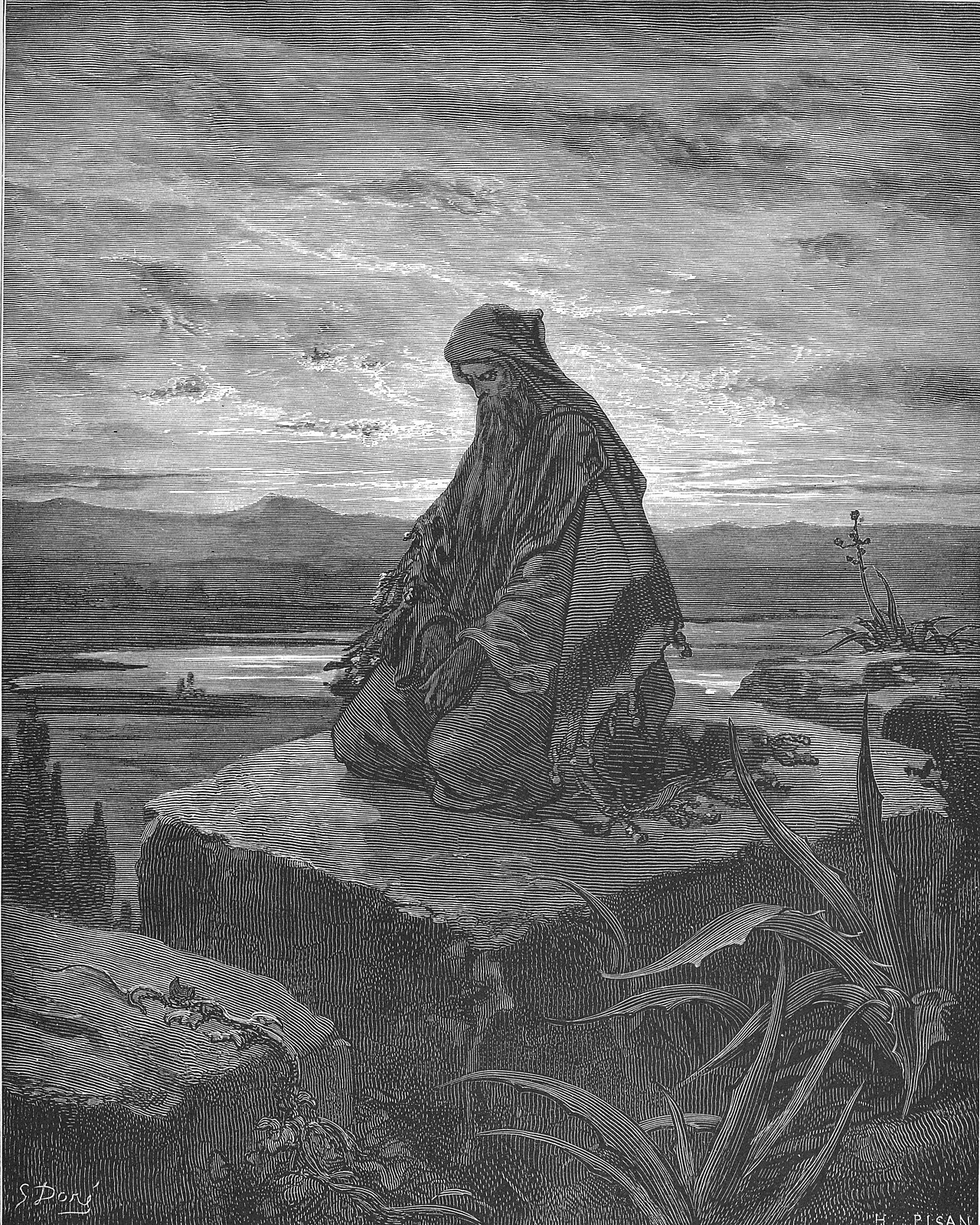
Isaiahchapter 66
24 verses · Isaiah · 8th century BC · The Prophets
“As they go forth, they will see the corpses of the men who have rebelled against Me; for their worm will never die, their fire will never be quenched, and they will be a horror to all mankind.”
Introduction
Isaiah, The Prophets, Isaiah Overview.
Isaiah closes his book here, and he returns to the temple courts where the book began, still arguing about worship. The chapter speaks to everyone the book has addressed, from the temple crowd to the far coasts. It moves from the temple to a birth, then to judgment, then to a gathering of the nations. Listen for the kind of person the LORD looks to. Listen also for the birth without labour and the mother comforting her child. The last verse is hard, and the book leaves it standing.
Context
- Who
- Everyone the book has addressed, from the temple crowd to the ends of the earth
- What
- The book's closing chapter, on true worship, the birth of a new people, judgment on the rebellious and the gathering of all nations.
- Where
- The temple in Jerusalem, the far coastlands and nations, and the valley outside the city where the dead lie.
- When
- Spoken about 700 to 690 BC on the site's reading, ending with a scene beyond all history.
- Why
- To close the book by showing whom the LORD regards, how He will judge, and that all flesh will come to worship Him.
Historical context
The opening question is aimed at temple pride: heaven is my throne and the earth is my footstool; where is the house that you build for me, and where is the place of my rest? A throne with a footstool was the standard way a great king was pictured, and every court in the region had one. Isaiah's point is one of scale. And then the answer about who God does look at: the poor and contrite in spirit, and the one who trembles at my word.
Show the rest of the historical context, 5 more paragraphs
The list of corrupted sacrifices is deliberately shocking, pairing each legitimate offering with an abomination. Killing an ox is like murdering a man; sacrificing a lamb is like breaking a dog's neck; offering a grain offering is like offering swine's blood; burning incense is like blessing an idol. The dog was an unclean scavenger in that world, and swine's blood was the worst thing that could go on an altar. The charge is not that they stopped sacrificing. It is that they kept it up while choosing their own ways.
The birth image in the middle is medical and impossible. Before she was in labor she gave birth; before her pain came she delivered a boy. Shall a nation be born at once? Every hearer knew that labor is the price of a child; this one arrives without it.
Then the mother nursing: you will be carried on her side and dandled on her knees, the hip-carry of a toddler and the bouncing on the knees that anyone with children has done, and God says, as one whom his mother comforts, so I will comfort you.
The final mission goes out to the map's edges. Survivors are sent to Tarshish, Pul, Lud, Tubal, and Javan, the far west, Africa, Asia Minor, and the Greek lands, to the coastlands that have not heard my fame or seen my glory, and they declare his glory among the nations. Then the scattered brothers are brought back on horses, chariots, litters, mules, and camels, as an offering, and God says he will take some of them for priests and Levites.
The last verse looks at a valley the hearers could see from the city. Corpses of the rebels, with a worm that does not die and a fire not quenched, the picture is the burning refuse ground in the ravine outside Jerusalem, where the bodies of the disgraced were thrown. Jesus later used the name of that valley for the final judgment.
Significance
The book ends where it began, in the temple courts, arguing about worship, but the terms have changed. In chapter 1 the sacrifices were rejected. Here the man God regards is the one who trembles at his word, and that man is being thrown out of the assembly by his own brothers.
Show the rest of the significance, 1 more paragraph
And the closing scene answers the question the whole book asked. From one new moon to another and from one Sabbath to another, all flesh will come to worship before me. Not one nation. All of them, on the ordinary calendar of Israel's worship.
This chapter in Jewish lifeWhat this chapter is in Jewish life and reading.
What is done
The site's own table in src/lib/hebraic/readings.ts, probed for this lane, printed no weekly portion and no Haftarah from this chapter, and no festival reading for the book. That table carries the Haftarah of each of the fifty-four weekly portions and the books read whole at the feasts, and it carries nothing for the special Sabbaths or the fast days. This card therefore names no public reading of the chapter and leaves that question to a source that holds those readings.
The corpus joins the chapter to the weeks of the Torah portions through the works arranged by portion. Under the third verse it carries Midrash Tanchuma Buber, Achrei Mot 18:1. Under the seventh verse it carries Bereshit Rabbati, Parashat Bereshit 21. Under the eighth verse it carries Midrash Tanchuma Buber, Vaera 18:2. Under the fifteenth verse it carries Midrash Tanchuma, Bereshit 5:10.
How it is read
Two commentators on this chapter carry English in the corpus. Rashi is quoted from The Judaica Press complete Tanach with Rashi, translated by A. J. Rosenberg, which Sefaria reports as CC-BY, and every quotation of it is held to fifty words or fewer because the translation is modern. Ibn Ezra is quoted from the version Sefaria titles Commentary of Ibn Ezra on Isaiah - trans. by M. Friedlander, 1873, which it reports as Public Domain.
Rashi reads the first verse as a refusal: "I do not need your Temple". The second verse gives the reason. God dwelt among Israel while they obeyed, since His way is to look on the poor and crushed in spirit who hasten to do His bidding (Rashi on Isaiah 66:1:1 and 66:2:1). Those who tremble at His word in the fifth verse are "The righteous who hasten with quaking to draw near to His words" (Rashi on Isaiah 66:5:1).
The birth of the seventh to ninth verses Rashi reads as Zion receiving her children. She bears before her pains because the nations bring her children into her midst. The question of the ninth verse is God's own: "Shall I commence a thing and not be able to complete it?" (Rashi on Isaiah 66:7:1 and 66:9:1). Ibn Ezra reads the comfort of the thirteenth verse from ordinary life: "Every woman has compassion upon her child" (Ibn Ezra on Isaiah 66:13:1).
Rashi reads the priests and Levites of the twenty-first verse as Israelites hidden among the nations. They are "now assimilated among the heathens (nations [Mss. and K’li Paz]) under coercion", and God knows them and chooses them again (Rashi on Isaiah 66:21:1). Ibn Ezra's note on the new moons of the twenty-third verse is on the phrase itself, which he reads as whenever the new moon comes (Ibn Ezra on Isaiah 66:23:1). The book ends on the worm of the last verse, and Rashi's note on it is one line on the worm that consumes their flesh (Rashi on Isaiah 66:24:1).
What the rabbis say
The corpus carries forty rabbinic locators on this chapter and the text of none, so each is cited and linked here rather than quoted. On the first verse it holds Aggadat Bereshit 19:1 and Bamidbar Rabbah 12:3. On the second verse it holds Bereshit Rabbah 12:2 and Ein Yaakov (Glick Edition), Shabbat 16:18. On the third verse it holds Midrash Aggadah, Leviticus 17:4:1 and Midrash Tanchuma Buber, Achrei Mot 18:1. On the fourth verse it holds Midrash Tehillim 10:2. On the fifth verse it holds Bava Metzia 33b:4 and Ein Yaakov (Glick Edition), Bava Metzia 2:7.
On the sixth verse it holds Bamidbar Rabbah 10:2 and Eikhah Rabbah 2:11. On the seventh verse it holds Bereshit Rabbah 85:1 and Bereshit Rabbati, Parashat Bereshit 21. On the eighth verse it holds Aggadat Bereshit 29:1 and Midrash Tanchuma Buber, Vaera 18:2. On the tenth verse it holds Bava Batra 60b:18 and Ein Yaakov (Glick Edition), Bava Batra 3:7. On the eleventh verse it holds Otzar Midrashim, Midrash Shelosha v'Arba'ah 2:12 and Tanna DeBei Eliyahu Rabbah 20:1. On the twelfth verse it holds Berakhot 56b:8 and Bereshit Rabbah 66:2.
On the thirteenth verse it holds Midrash Sekhel Tov, Bereshit 50:26:19 and Pesikta DeRav Kahana 19:3. On the fourteenth verse it holds Aggadat Bereshit 23:1 and Aggadat Bereshit 23:2. On the fifteenth verse it holds Ein Yaakov (Glick Edition), Sanhedrin 4:23 and Midrash Tanchuma, Bereshit 5:10. On the sixteenth verse it holds Ein Yaakov (Glick Edition), Sotah 1:34 and Ein Yaakov (Glick Edition), Zevachim 14:1. On the seventeenth verse it holds Bamidbar Rabbah 12:4 and Midrash Aggadah, Leviticus 11:4:1. On the nineteenth verse it holds Mekhilta DeRabbi Shimon Ben Yochai 14:4 and Mekhilta DeRabbi Shimon Ben Yochai 14:5.
On the twentieth verse it holds Bamidbar Rabbah 12:17 and Jerusalem Talmud Berakhot 5:1:12. On the twenty-first verse it holds Mekhilta DeRabbi Yishmael, Tractate Pischa 12:29 and Yalkut Shimoni on Torah 207:1. On the twenty-second verse it holds Aggadat Bereshit 74:1. On the twenty-third verse it holds Ein Yaakov (Glick Edition), Sotah 1:12. On the twenty-fourth verse it holds Bamidbar Rabbah 23:5. What each of them teaches is a saying of the rabbis, and is reported as theirs wherever this site quotes one. The quotations wait on a fetch that carries the text.
Sources: Rashi, Rashi on Isaiah 66:1:1 to 66:24:1, The Judaica Press complete Tanach with Rashi, translated by A. J. Rosenberg, reported CC-BY; Ibn Ezra, Ibn Ezra on Isaiah 66:6:1 to 66:23:1, Commentary of Ibn Ezra on Isaiah - trans. by M. Friedlander, 1873, reported Public Domain; The Sefaria corpus, scripts/data/sources/sefaria/isaiah/66.json, the 40 Talmud and Midrash locators of this chapter; The site's own files, src/lib/hebraic/readings.ts, printing no portion and no Haftarah for this chapter and no festival reading for this book.
The heads below are this chapter's scenes. The numbered points under each are its verses.
Heaven Is My Throne: to This Man Will I Look
Isaiah 66:1-2
“Heaven is My throne, and earth is My footstool” is quoted by Stephen at Acts 7:49-50. The question of what house could be built weighs trust in a building. The chapter turns from building to character: “he who is humble and contrite in spirit, who trembles at My word”.
Isaiah 66:1
“The heaven is my throne - (See the notes at Isa 57:15). Here he is represented as having his seat or throne there. He speaks as a king. heaven is the place where he holds his court; from where he dispenses his commands; and from where he surveys all his works (compare 2Ch 6:18; Mat 5:34). The idea here is, that as God dwelt in the vast and distant heavens, no house that could be built on earth could be magnificent enough to be his abode.”
Cross references
Isaiah 66:1
- Quoted inActs 7:49“‘Heaven is My throne and the earth is My footstool. What kind of house will you build for Me, says the Lord, or where will My place of repose be?”
'Heaven is my throne... what house will ye build me?' (Stephen on the temple)
Has not My hand made all these things?: Clarke says one Hebrew word has dropped from the text, so all these things belong to the LORD. Gregory of Nyssa reads the hand as the Son's power. Jamieson, Fausset & Brown set the one who is humble and trembles at the word beside Josiah in 2 Kings 22:19.
Isaiah 66:2
“And all those things have been “And all these things are mine” - A word absolutely necessary to the sense is here lost out of the text: לי li, mine. It is preserved by the Septuagint and Syriac.”
Adam Clarke · Commentary on the Bible (1810-1826)evangelical
Isaiah 66:3-4
Whoever slaughters an ox is like one who slays a man: Each lawful act is paired with an atrocity: “Whoever slaughters an ox is like one who slays a man”. The worshippers kept the forms while “they have chosen their own ways and delighted in their abominations”. Their choosing is answered by His: “So I will choose their punishment”.
Isaiah 66:3
“God loathes even the sacrifices of the wicked (Isa 1:11; 28:9). is as if--LOWTH not so well omits these words: "He that killeth an ox (presently after) murders a man" (as in Eze 23:39). But the omission in the Hebrew of "is as if"--increases the force of the comparison.”
Jamieson, Fausset & Brown · Commentary Critical and Explanatory on the Whole Bible (1871)reformed
2 more voices on this verse
Isaiah 66:3
“The unbelieving Jews, after the gospel was preached and in it notice given of the offering up of the great sacrifice, which put an end to all the ceremonial services, continued to offer sacrifices, as if the law of Moses had been still in force and could make the comers thereunto perfect: this was an abomination.”
Matthew Henry · Commentary on the Whole Bible (1707-1721)puritan
Isaiah 66:3
He is angry with them, saying by Isaiah, "Who has required these of your hands?" And by Jeremiah, since they were very bold, he threatens, "Gather together your whole burnt offerings with your sacrifices, and eat flesh, for I did not speak to your ancestors or command them in the day that I brought them out of the land of Egypt, concerning whole burnt offerings and sacrifices."
Athanasius of Alexandria · written before 373 · Festal Letters 19:2patristic
So I will choose their punishment: Barnes gives the Hebrew behind punishment as calamity, and he sets aside the older rendering, delusions. Jamieson, Fausset & Brown read the terror as the thing they feared, which their chosen abominations were meant to avert. The charge that no one answered when He called repeats 65:12.
Isaiah 66:4
“However, the Hebrew means rather "vexations," "calamities," which also the parallelism to "fears" requires; "choose their calamities" means, "choose the calamities which they thought to escape by their own ways." their fears--the things they feared, to avert which their idolatrous "abominations" (Isa 66:3) were practised.”
Jamieson, Fausset & Brown · Commentary Critical and Explanatory on the Whole Bible (1871)reformed
You who tremble at His word: “You who tremble at His word” picks up verse 2 and names a group inside Israel marked by reverence. Their people turn on them: “Your brothers who hate you and exclude you”. The mockers' words are quoted against them, and the verse ends, “But they will be put to shame”.
Isaiah 66:5
“Hear the word of the Lord - This is an address to the pious and persecuted portion of the nation. It is designed for their consolation, and contains the assurance that Yahweh would appear in their behalf, and that they should be under his protecting care though they were cast out by their brethren. To whom this refers has been a question with expositors, and it is perhaps not possible to determine with certainty.”
1 more voice on this verse
Isaiah 66:5
“This perhaps might have reference to the case of some of the Jews at their return out of captivity; but nothing like it appears in the history, and therefore it is rather to be referred to the first preachers and professors of the gospel among the Jews, to whose case it is very applicable. How the faithful servants of God were persecuted: Their brethren hated them.”
Matthew Henry · Commentary on the Whole Bible (1707-1721)puritan
Hear the uproar from the city: Three sounds are named in one verse, the uproar from the city, the voice from the temple, and the voice of the LORD. The temple becomes the source of judgment, “repaying His enemies what they deserve”. The repayment answers the empty sacrifices of verses 3 and 4.
Isaiah 66:6
“A voice of noise from the city, a voice from the temple, a voice of the Lord - It is very remarkable that similar words were spoken by Jesus, son of Ananias, previously to the destruction of Jerusalem. See his very affecting history related by Josephus, War, B. vi., chap. v.”
Adam Clarke · Commentary on the Bible (1810-1826)evangelical
1 more voice on this verse
Isaiah 66:6
“Some think this prophecy was fulfilled in the prodigies that went before that destruction of Jerusalem, related by Josephus in his History of the Wars of the Jews (4.388 and 6.311), that the temple-doors flew open suddenly of their own accord, and the priests heard a noise of motion or shifting in the most holy place, and presently a voice, saying, Let us depart hence.”
Matthew Henry · Commentary on the Whole Bible (1707-1721)puritan
Zion Travailed and Brought Forth; Comfort as a Mother Comforts
Isaiah 66:7-9
“Before she was in labor, she gave birth” reverses the order, the delivery before the pain. The question follows, “Can a country be born in a day”. The LORD finishes what He begins: “Shall I bring a baby to the point of birth and not deliver it?”
Isaiah 66:7
“Before she travailed, she brought forth - That is, Zion. The idea here is, that there would be a great and sudden increase of her numbers. Zion is here represented, as it often is, as a female (see Isa 1:8), and as the mother of spiritual children (compare Isa 54:1; Isa 49:20-21). The particular idea here is, that the increase would be sudden - as if a child were born without the usual delay and pain of parturition.”
2 more voices on this verse
Isaiah 66:7
“Before she travailed, she brought forth,.... That is, Zion, as appears from the following verse: lest it should be thought that the interest of Christ would be swallowed up and lost in the destruction of the Jews, this, and what follows, are said concerning the conversion of many of that people, both in the first times of the Gospel, and in the latter day, as well as concerning the calling of the Gentiles, and the uniting of both in one church state.”
Isaiah 66:7
“A man child's birth is in the East a matter of special joy, while that of a female is not so; therefore, it here means the manly sons of the restored Jewish Church, the singular being used collectively for the plural: or the many sons being regarded as one under Messiah, who shall then be manifested as their one representative Head.”
Jamieson, Fausset & Brown · Commentary Critical and Explanatory on the Whole Bible (1871)reformed
Can a country be born in a day: Aquinas sets the question beside 49:21, where Zion wonders who gave birth to her children. Wesley and Jerome see the nation born in a day when the apostles preached and believers were gathered at once. Spurgeon preached it as Travailing for Souls, labor in prayer.
Isaiah 66:8
“In English Version it means, The earth brings forth its productions gradually, not in one day (Mr 4:28). at once--In this case, contrary to the usual growth of the nations by degrees, Israel starts into maturity at once. for--rather, "is a nation born at once, that Zion has, so soon as she travailed, brought forth?" [MAURER].”
Jamieson, Fausset & Brown · Commentary Critical and Explanatory on the Whole Bible (1871)reformed
1 more voice on this verse
Isaiah 66:8
“Who hath seen “And who hath seen” - Twenty MSS., (four ancient), of Kennicott’s, and twenty-nine of De Rossi’s, and two ancient of my own, and the two oldest editions, with two others, have ומי umi, adding the conjunction ו vau; and so read all the ancient versions. And who hath seen?”
Adam Clarke · Commentary on the Bible (1810-1826)evangelical
bring a baby to the point of birth: The Hebrew verb behind the point of birth describes the breaking open that comes before delivery, Clarke explains. Jamieson, Fausset & Brown set the verse against 37:3, where Hezekiah mourned children come to birth with no strength to deliver. Gill notes that the LORD claims the birth as His work.
Isaiah 66:9
“Shall I bring to the birth, and not cause to bring forth, saith the Lord?.... Or, "to the place of breaking" forth of children, as in Hos 13:13, the womb, and the mouth of it: or, "shall I break or open" that, so some (s) render it; lest too much should or seem to be attributed to the Church, she being said to travail in birth, and bring forth children, this is said by the Lord.”
1 more voice on this verse
Isaiah 66:9
“Shall I bring to the birth? - The sense of this verse is plain. It is, that God would certainly accomplish what he had here predicted, and for which he had made ample arrangements and preparations. He would not commence the work, and then abandon it. The figure which is used here is obvious; but one which does not render very ample illustration proper. Jarchi has well expressed it: ‘Num ego adducerem uxorem meam ad sellam partus, sc. ad partitudinem, et non aperirem uterum ejus, ut foetum suum in lucem produceret?”
Isaiah 66:10-11
Be glad for Jerusalem and rejoice over her: “Be glad for Jerusalem and rejoice over her, all who love her” calls the mourners into joy. The images make Jerusalem the source of comfort, a mother feeding her children, “so that you may nurse and be satisfied”. The grief the book's early chapters voiced is answered here.
Isaiah 66:10
“The word of God, the covenant of grace (especially the promises of that covenant), the ordinances of God, and all the opportunities of attending on him and conversing with him, are the breasts, which the church calls and counts the breasts of her consolations, where her comforts are laid up, and whence by faith and prayer they are drawn.”
Matthew Henry · Commentary on the Whole Bible (1707-1721)puritan
delight yourselves in her glorious abundance: Jamieson, Fausset & Brown give the Hebrew behind glorious abundance as a flow like rays, milk streaming from her breasts. Barnes finds the same figure at 60:16 and 49:23. Wesley reads her comforting breasts as the gospel and her glory as Christ.
Isaiah 66:11
“That ye may suck, and be satisfied with the breast of her consolations,.... This, according to our version, expresses the end of the church's friends being called together to rejoice with her, that they might partake of her joys and comforts, delights and pleasures: but the words may be better rendered, either, according to Kimchi's sense, "therefore shall ye suck" (t), &c.; because ye have mourned for her, and because ye have rejoiced with her; or rather, as Noldius (u), "because ye suck", &c.; partake of her privileges and ordinances, so give a reason why they should rejoice with her.”
2 more voices on this verse
Isaiah 66:11
“That ye may suck - The same figure occurs in Isa 60:16; and substantidally in Isa 49:23. See the note at those places. That ye may milk out - The image is an obvious one. It means that they who sympathized with Zion would be nourished by the same truth, and comforted with the same sources of consolation.”
Isaiah 66:11
“Consolations - The gospel doctrine was their breasts of consolation. Her glory - Christ was the glory of the people of Israel, though he was also a light to the Gentiles.”
John Wesley · Explanatory Notes upon the Old Testament (1765)evangelical
Isaiah 66:12-14
“I will extend peace to her like a river, and the wealth of nations like a flowing stream” pictures plenty arriving by a steady channel. The comfort becomes personal, spoken by the LORD Himself: “As a mother comforts her son, so will I comfort you”.
Isaiah 66:12
“For thus saith the Lord, behold, I will extend peace to her like a river,.... As the river Euphrates, so the Targum; or as the Nile, which overflowed Egypt, and made it fruitful; or as any flowing river, large and spreading, continuing to flow, and brings blessings with it where it comes; and so denotes the abundance of this peace, the perpetuity of it, and its blessed effects.”
2 more voices on this verse
Isaiah 66:12
“Like a river, and - like a flowing stream “Like the great river, and like the overflowing stream” - That is, the Euphrates, (it ought to have been pointed כנהר cannahar, ut fluvius ille, as the river), and the Nile. Then shall ye suck “And ye shall suck at the breast” - These two words על שד al shad, at the breast, seem to have been omitted in the present text, from their likeness to the two words following; על צד al tsad, at the side. A very probable conjecture of Houbigant.”
Adam Clarke · Commentary on the Bible (1810-1826)evangelical
Isaiah 66:12
“Like a river - It is plain this prophecy relates to a farther conversion of the Jews than hath been yet seen. Her sides - The Gentiles were born upon the sides of Jerusalem and dandled upon her knees, as first hearing from the Apostles (who were members of the Jewish church) the glad tidings of salvation.”
John Wesley · Explanatory Notes upon the Old Testament (1765)evangelical
As a mother comforts her son: Barnes links the image to 49:15, where the care of the LORD for Zion exceeds a mother's care for her nursing child. Jerome says the love of mothers who nurse their children teaches the mercy of the Creator. Spurgeon applies the promise to Israel and all God's servants.
Isaiah 66:13
“WE do not intend entering into a discussion of the context and its relationship literally to the Jewish people. We have never hesitated to assert our conviction that there are great blessings in store for God's ancient Israel and that the day shall come when her comfort shall abound, when the glory of the Gentiles shall flow to her like a flowing stream and she shall be comforted by her God as one whom his mother comforts.”
Charles Spurgeon · written before 1892 · The Metropolitan Tabernacle Pulpit, Sermon No. 3189: “The Tenderness of God's Comfort” (lightly modernized text, CCEL edition)Particular Baptist
you will flourish like grass: Jerome's text reads that the bones will flourish, and Aquinas takes them as the dry bones of Ezekiel 37:4. Theodoret sees the resurrection of the dead in it. The Septuagint names the servants those who fear and the enemies unbelievers, Jerome notes.
The LORD Comes with Fire, and All Flesh Shall Worship
Isaiah 66:15-17
“For behold, the LORD will come with fire” sets fire against the nursing pictures of verses 11 to 13. Those judged are named by their rites: they eat “swine and vermin and rats”, animals the law forbids at Leviticus 11:7 and 11:29.
Isaiah 66:15
“For behold, the Lord will come with fire - The Septuagint reads this ‘As fire’ (ὡς πύρ hōs pur). Fire is a common emblem to denote the coming of the Lord to judge and punish his enemies Psa 50:3: Our God shall come, and shall not keep silence; A fire shall devour before him, And it shall be very tempestuous round about him. So Hab 2:5: Before him went the pestilence, And burning coals went forth at his feet. So Psa 97:3: A fire goeth before him, And burneth up his enemies round about.”
1 more voice on this verse
Isaiah 66:15
“With fire - With terrible judgments, or with fire in a proper sense, understanding it of the fire with which enemies use to consume places brought under their power. Whirlwind - With a sudden sweeping judgment. Fury - That is, with fervour; for fury properly taken is not in God.”
John Wesley · Explanatory Notes upon the Old Testament (1765)evangelical
For by fire and by His sword: Barnes gives the verb as judge, the sense the Berean prints, and limits all flesh to the foes of God. Jamieson, Fausset & Brown add that the godly are hidden away from the judgment, as in 26:20. Wesley says God pleads first by words and then by fire.
Isaiah 66:16
“For by fire and by his sword - The sword is an instrument by which punishment is executed (see the notes at Isa 34:5; compare Rom 13:4). Will he plead with all flesh - Or rather, he will judge (נשׁפט nı̂shephaṭ), that is, he will execute his purposes of vengeance on all the human race. Of course, only that part is intended who ought to be subject to punishment; that is, all his foes.”
1 more voice on this verse
Isaiah 66:16
"For he will come like fire." … For he will descend from heaven in the glory of God the Father and with the angels. This is his chariot, as it is praised in the Psalms: "The chariot of the Lord is ten thousand in dimensions with thousands of those rejoicing." For he will come to give judgment in anger and to cast them off with a flame of fire. For "casting off" means rejection, just as he says to those who are dead in their sins, "Depart from me, you evildoers."
Cyril of Alexandria · written before 444 · Commentary on Isaiah 5:6.66:15-17patristic
Barnes reads consecrate and purify as the washings of idol rites. Clarke takes the one they follow as Adad, a Syrian god whose name means one. Jamieson, Fausset & Brown take it as an idol left unnamed in contempt.
Isaiah 66:17
“They that sanctify themselves - That is, who attempt to purify themselves by idolatrous rites, by ablutions, and lustrations. The design here is, to describe those who will be exposed to the wrath of God when he shall come to execute vengeance. And purify themselves in the gardens - (See the notes at Isa 65:3). Behind one tree in the midst - This passage has not a little exercised the ingenuity of commentators. It is quite evident that our translators were not able to satisfy themselves with regard to its meaning.”
Isaiah 66:18-21
am coming to gather all nations and tongues: “I, knowing their deeds and thoughts, am coming to gather all nations and tongues” turns judgment into witness. The survivors are sent across the world, and “they will proclaim My glory among the nations”. Delitzsch and Alexander weigh whether the priests and Levites of verse 21 are Gentiles or Israelites.
Isaiah 66:18
“For I know their works - A word is here lost out of the present text, leaving the text quite imperfect. The word is יודע yodea, knowing, supplied from the Syriac. The Chaldee had the same word in the copy before him, which he paraphrases by קדמי גלן kedemi gelon, their deeds are manifest before me; and the Aldine and Complutensian editions of the Septuagint acknowledge the same word επισταμαι, which is verified by MS. Pachom. and the Arabic version. I think there can be little doubt of its being genuine.”
Adam Clarke · Commentary on the Bible (1810-1826)evangelical
1 more voice on this verse
Isaiah 66:18
“As to this, it is here promised, 1. That some of the Jewish nation should, by the grace of God, be distinguished form the rest, and marked for salvation: I will not only set up a gathering ensign among them, to which the Gentiles shall seek (as is promised, ch. xi. 12 ), but there shall be those among them on whom I will set a differencing sign; for so the word signifies.”
Matthew Henry · Commentary on the Whole Bible (1707-1721)puritan
I will establish a sign among them: Clarke suspects that the archers of Lud began as Meshech, a people paired with Tubal, and the Septuagint has Mosoch there. Aquinas reads the sign as the edict of Cyrus. Theodoret finds the survivors in the apostles, who preached the gospel to all nations.
Isaiah 66:19
“And I will set a sign among them - (See the notes at Isa 11:12; Isa 18:3). On the meaning of the word ‘sign’ (אות 'ôth), see the notes at Isa 7:11. What is its meaning here is to be determined by the connection.”
1 more voice on this verse
Isaiah 66:19
“Afar off - To all the quarters of the world. They shall - This was eminently made good after the destruction of Jerusalem, when the believers among the Jews, as well as the apostles went about publishing the gospel to all people, which was declaring the Lord's glory.”
John Wesley · Explanatory Notes upon the Old Testament (1765)evangelical
they will bring all your brothers: Jamieson, Fausset & Brown read your brothers as the Jews carried by the nations, and the gift as the figure Paul uses in Romans 15:16. Barnes pictures a vast caravan of the nations. Henry recalls the eunuch who came to worship at Jerusalem in his chariot.
Isaiah 66:20
“The eunuch some time after came to worship at Jerusalem in his chariot and took home with him the knowledge of Christ and his holy religion. [2.] To the Gentiles, some of all nations, that should be converted to Christ, and so added to his church, which, though a spiritual accession, is often in prophecy represented by a local motion.”
Matthew Henry · Commentary on the Whole Bible (1707-1721)puritan
1 more voice on this verse
Isaiah 66:20
“Your brethren -- those who are the children of Abraham, not considered as the father of the Jewish nation only, but considered as the father of many nations, and as the father of the faithful, and so are your brethren, shall be brought out of all nations for an offering to the Lord.”
John Wesley · Explanatory Notes upon the Old Testament (1765)evangelical
Barnes notes that the law chose priests and Levites by descent, so he reads these as ministers of religion. Jamieson, Fausset & Brown join the verse to 1 Peter 2:9, where the Gentiles draw near to God as the priests did. Henry points to elders taken from the nations themselves.
Isaiah 66:21
THIS chapter is surrounded with critical difficulties, and yet it is full of spiritual instruction. The verse before us is by some referred to Gentiles, and supposed to mean that the Lord promises that he will take out of the heathen nations a people whom he will make into priests and Levites. Others would say it points to the Jews, rejected for their unbelief and dispersed in judgment among all nations. When their own Messiah came, it was not with a devout faith, but with a profane imprecation, they said, “His blood be on us, and on our children.”
1 more voice on this verse
Isaiah 66:21
“And I will also take of them for priests - I will give to them an honorable place in my public service; that is, I will make them ministers of religion as if they were priests and Levites. This cannot be taken literally - because the priests and Levites among the Jews were determined by law, and by regular genealogical descent, and there was no provision for substituting any in their place.”
Isaiah 66:22-23
The new heavens and new earth of 65:17 return as a guarantee that “your descendants and your name will endure”. Worship keeps the calendar of Israel and spreads it. “From one New Moon to another and from one Sabbath to another, all mankind will come to worship before Me”.
Isaiah 66:22
“For as the new heavens and the new earth - (See the notes at Isa 65:17). Shall remain before me - They shall not pass away and be succeeded by others. The idea is, that the state of things here described would be permanent and abiding. So shall your seed and your name remain - (See the notes at Isa 65:15).”
2 more voices on this verse
Isaiah 66:22
“The new heavens - The new state of the church to be raised up under the Messiah. Remain - As I intend that shall abide, so there shall be a daily succession of true believers for the upholding of it.”
John Wesley · Explanatory Notes upon the Old Testament (1765)evangelical
Isaiah 66:22
“Old things have passed away, behold all things have become new ( 2 Cor. v. 17 ), the old covenant of peculiarity is set aside, and a new covenant, a covenant of grace, established, Heb. viii. We are now to serve in newness of the spirit, and not in the oldness of the letter, Rom. vii.”
Matthew Henry · Commentary on the Whole Bible (1707-1721)puritan
From one New Moon to another: Jamieson, Fausset & Brown render the Hebrew as every New Moon, and cite Zechariah 14:16, where the nations come up to worship. They hold the Sabbath binding, while Wesley reads New Moon and Sabbath as Old Testament names for gospel worship. Barnes calls this the fitting close of the book.
Isaiah 66:23
“And it shall come to pass - As the prophet closes the book and winds up his whole prophecy, he directs the attention to that future period which had occupied so much of his attention in vision, when the whole world should be acquainted with the true religion, and all nations should worship Yahweh. Of such a book there could be no more appropriate close; and such a contemplation especially became the last prophetic moments of the ‘evangelical prophet’ Isaiah.”
The last verse turns to “the corpses of the men who have rebelled against Me”, “for their worm will never die”. Jesus takes up these words of final judgment at Mark 9:48. In the synagogue, when this chapter is read, verse 23 is read again after verse 24.
Isaiah 66:24
“If heaven and earth are renewed, how can we doubt the possibility of our renewal, for whom heaven and earth were made? If the transgressor is kept for punishment, why should not the just person be preserved for glory? If the worm of sinners does not die, how shall the flesh of the just perish? For the resurrection, as the very form of the word indicates, is this: What has fallen shall rise again, what has died shall live again.”
Ambrose of Milan · written before 397 · On the Death of Satyrus 2.87patristic
1 more voice on this verse
Isaiah 66:24
“For their worm shall not die - These words of the prophet are applied by our blessed Savior, Mar 9:44, to express the everlasting punishment of the wicked in Gehenna, or in hell.”
Adam Clarke · Commentary on the Bible (1810-1826)evangelical
ConnectionsIsaiah 1:2
Keep studying
Studies8
Words12
Subjects1
Sources for this chapter
The summary
Jamieson, Fausset & Brown, Commentary Critical and Explanatory; John Calvin, Commentaries; John Wesley, Notes on the Old Testament and Matthew Henry, Complete Commentary.
The exposition
Adam Clarke, Commentary on the Bible; Albert Barnes; Charles Spurgeon; Franz Delitzsch, Biblical Commentary on the Prophecies of Isaiah; Gregory of Nyssa, AGAINST EUNOMIUS 7:1; Jamieson, Fausset & Brown, Commentary Critical and Explanatory on the Whole Bible; Jerome; John Calvin, Commentary on the Book of the Prophet Isaiah; John Gill; John Wesley, Explanatory Notes upon the Old Testament; Joseph Addison Alexander, Commentary on the Prophecies of Isaiah; Matthew Henry, Commentary on the Whole Bible; Theodoret of Cyrus and Thomas Aquinas, Commentary on Isaiah.