
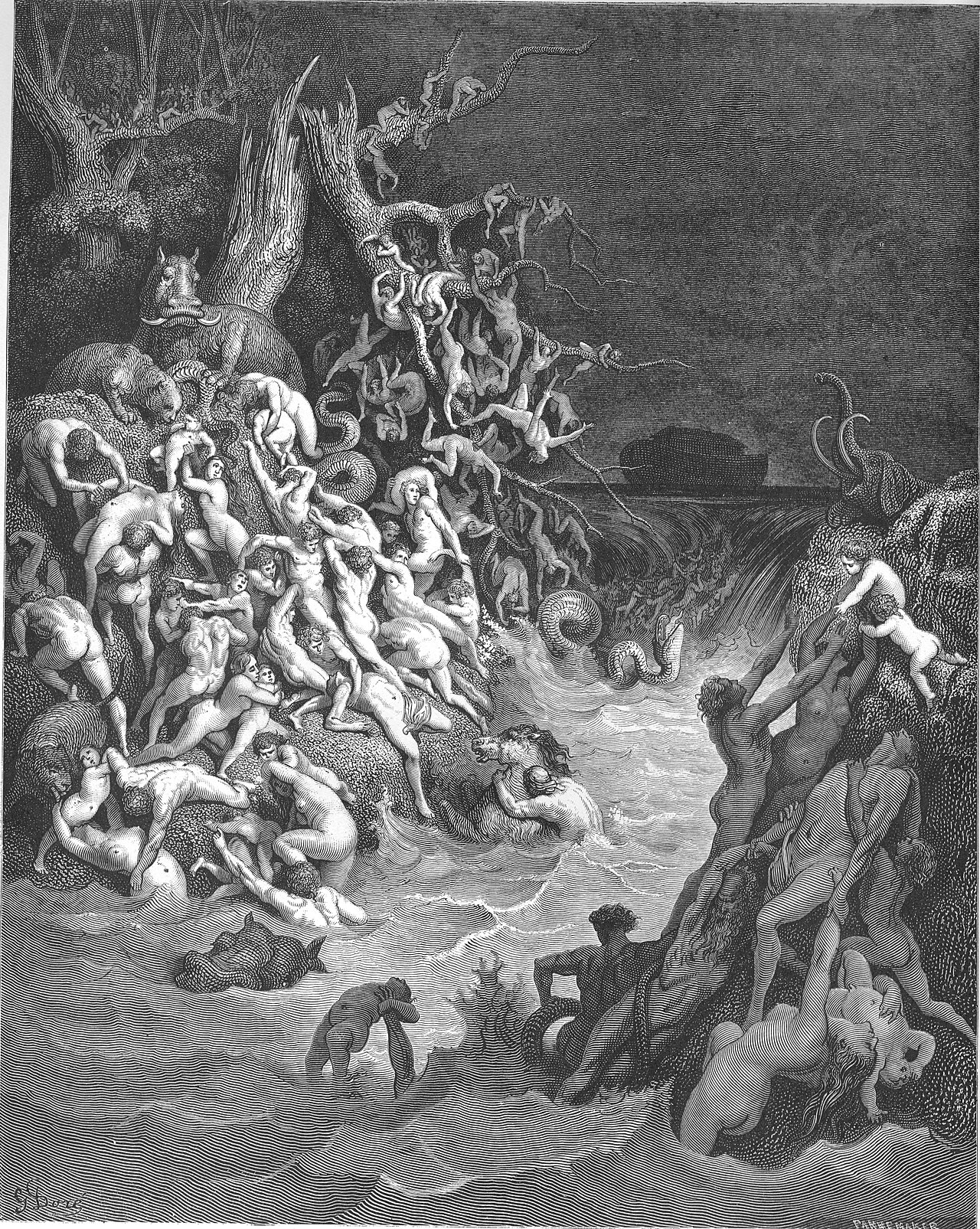
Genesischapter 6
22 verses · Moses, by tradition · 15th to 13th century BC · The Law
The Nephilim were on the earth in those days—and afterward as well—when the sons of God had relations with the daughters of men. And they bore them children who became the mighty men of old, men of renown.
Introduction
Moses, by tradition, The Law, Genesis Overview.
This chapter was written for Israel in the wilderness, and tradition gives it to Moses. It opens with a short passage readers have argued over since ancient times, and then it turns to the reason for the flood. The chapter sets God's grief and judgment beside His care for one man and his household. It is also a building account, with measurements given in the same careful way the tabernacle's would be. Listen for the word the chapter uses for what filled the earth, and for how Noah answers what he is told. The flood story it begins runs to the end of chapter 9.
Context
- Who
- Israel in the wilderness, being told why God once wiped the slate clean
- What
- An account of the corruption of the earth before the flood, God's decision to judge it, and His command to Noah to build the ark.
- Where
- The inhabited earth before the flood; the chapter names no place for the building of the ark.
- When
- Before any dated history; the chapter opens the section headed the generations of Noah at Genesis 6:9 and gives no date.
- Why
- To show that God judges violence and corruption and that He makes a way of rescue before the judgment falls.
Historical context
The chapter opens the third named section of the book, the generations of Noah, and Noah is the man it follows. God speaks the sentence and gives the measurements, and Noah does what he is told.
Show the rest of the historical context, 4 more paragraphs
The opening verses report that the sons of God took wives from the daughters of men and that the Nephilim were on the earth in those days. The oldest Jewish and early Christian readers took the sons of God to be angelic beings, and a later reading takes them as the godly line of Seth, with both readings holding long histories and named holders, which the chapter's study row sets out.
The measurements are given in cubits of roughly eighteen inches, so the vessel runs about 450 feet long, 75 wide and 45 high, on three decks. The proportion of length to width is one shipbuilders still treat as stable for a hull built to float and to hold rather than to be sailed.
Gopher wood cannot now be identified with confidence. The pitch is familiar, since bitumen seeps up naturally in Mesopotamia, and the same waterproofing is used later on the basket that carries the infant Moses.
Flood accounts survive from the same region. The Gilgamesh Epic and the older Atrahasis tablets both carry a warned man and a sealed vessel, and in those versions the gods send the water because people are noisy and are keeping them awake. Genesis gives a moral cause, since the earth was filled with violence.
Significance
Israel heard that God weighs what people do to each other, and that violence is the word the chapter uses for what broke the world.
Show the rest of the significance, 1 more paragraph
They heard as well that the judgment came with a long warning, and that the door stood open through all the years of the hammering.
This chapter in Jewish lifeWhat this chapter is in Jewish life and reading.
What is done
This chapter is cut in two by the annual cycle, and the cut falls between the eighth verse and the ninth (src/lib/hebraic/readings.ts). The first eight verses close the opening portion of the year, and the ninth verse opens the portion that carries the flood. A congregation therefore hears the sons of God, the hundred and twenty years and the favour shown to Noah on one Sabbath, and the building of the ark on the next. The card above carries both portions and the prophetic reading set beside each.
How it is read
Rashi is quoted here from the public domain Rosenbaum and Silbermann edition, and Radak from the CC-BY translation of Eliyahu Munk, HaChut Hameshulash.
The sons of God of the second verse are the contested point of the chapter, and Rashi gives two readings of the phrase. The first is that they were the sons of princes and rulers (Rashi on Genesis 6:2:1, citing Genesis Rabbah 26:15). The second is that they were princely angels sent from God, who mixed with the daughters of men. He holds that the word for God carries authority wherever it stands in Scripture, and he reads the passage by that rule. A Christian reader meets both of those readings in his own commentaries, and this site names each with its holder.
Rashi reads the hundred and twenty years as the term of warning, and he reads the building of the ark as the warning itself. God could have saved Noah in many ways. The work was given to him so that his generation would watch it for a hundred and twenty years and ask what it was for (Rashi on Genesis 6:14:1, citing Sanhedrin 108b). Radak reads the same term as a lesson in patience. God knew they would not repent, and gave the years so that a man would learn to be slow with his neighbour (Radak on Genesis 6:5:1).
Rashi reads the corruption of the earth as lewdness and idolatry together (Rashi on Genesis 6:11:1, citing Sanhedrin 57a). He takes the corrupting of all flesh at its widest, holding that cattle, beasts and birds bred outside their own kind (Rashi on Genesis 6:12:1, citing Genesis Rabbah 28:8). Radak asks why the three sons are named again here, and answers that they were raised to walk in the way of their father, and were saved for their own righteousness (Radak on Genesis 6:10:1).
Ibn Ezra carries four comments on this chapter that the corpus holds by reference alone, and one comment of Rashi is held the same way. They are Ibn Ezra on Genesis 6:1:1, 6:1:2, 6:8:1 and 6:15:1, and Rashi on Genesis 6:19:1.
What the rabbis say
Rashi carries four sayings of the rabbis on this chapter, and each stands here as what they taught.
The giants of the fourth verse are named from their fall. Rashi reports that they were called fallen ones because they fell and brought down the world with them (Rashi on Genesis 6:4:1, citing Genesis Rabbah 26:7). On the same passage he reports the saying of Rabbi Judan, that a bride was taken by one of the lords before her own wedding (Rashi on Genesis 6:2:2, citing Genesis Rabbah 26:5).
On the grief of God in the sixth verse Rashi reports a reading that turns the word toward comfort. God was consoled that man had been made on earth, since a heavenly being of the same mind would have drawn the host of heaven into rebellion (Rashi on Genesis 6:6:1, citing Genesis Rabbah 27:4). On the seventeenth verse he reports God agreeing with the angels who had questioned the making of man in the first place (Rashi on Genesis 6:17:1, citing Genesis Rabbah 31:12).
The light of the ark in the sixteenth verse is the insight most often repeated from this chapter. Rashi reports two opinions, that it was a window, and that it was "a precious stone that gave light to them" (Rashi on Genesis 6:16:1, citing Genesis Rabbah 31:11). He reports that the animals came to the ark of their own accord, and that Noah took in those the ark allowed to pass (Rashi on Genesis 6:20:1, citing Sanhedrin 108b). Radak adds that the predators among them ate no flesh while they were aboard (Radak on Genesis 6:21:1).
The corpus records forty places where the Midrash and the Talmud cite this chapter, thirty three under Midrash and seven under Talmud, with the locator for each one and no text. Bereshit Rabbah reads the fourth verse at 26:7, the sixth at 27:4 and 32:7, and the seventh at 28:2 and 28:3. It reads the eighth verse at 29:1, the tenth at 26:2, the eleventh at 32:1, the thirteenth at 31:1 and 31:2, and the fourteenth at 31:8. It reads the fifteenth at 31:10 and 31:11, the eighteenth at 34:7, the twenty first at 30:8 and the twenty second at 32:5.
Aggadat Bereshit reads the fifth verse at 1:1 and 1:3, the ninth at 4:2 and 7:2, the tenth at 10:2, the twelfth at 5:3 and the fourteenth at 1:2. Bamidbar Rabbah reads the first verse at 10:5, the second at 20:2 and 9:24, the eighth at 5:3 and the seventeenth at 11:7. Bereshit Rabbati reads the eleventh verse at Parashat Noah 7, Midrash Lekach Tov reads the twentieth at Genesis 6:20:1, and Midrash Tanchuma is cited at Noach 11:3.
Sources: Rashi, Rashi on Genesis 6, in Pentateuch with Rashi's commentary by M. Rosenbaum and A. M. Silbermann, 1929 to 1934, public domain, about 1090; Radak, Radak on Genesis 6:5:1, 6:10:1 and 6:21:1, in HaChut Hameshulash, translated by Eliyahu Munk, CC-BY, about 1200; Ibn Ezra, his four comments on Genesis 6, cited by reference; the licence Sefaria reports for the English version keeps the text out of the corpus; The Midrash and the Talmud, the forty locators on Genesis 6 in scripts/data/sources/sefaria/genesis/6.json; MannaFest, the annual cycle table at src/lib/hebraic/readings.ts, 2026.
The heads below are this chapter's scenes. The numbered points under each are its verses.
Sons of God and the Giants
Genesis 6:1-2
when men began to multiply on the face of the earth: Men multiply on the earth and daughters are born to them, and the sons of God take wives from among them. The phrase sons of God, bene ha-elohim, names angelic beings everywhere else in the Old Testament, as at Job 1:6. Fallen angels took human wives, and Jude 6 and 2 Peter 2:4 look back to it. Augustine and Calvin took them as Seth's line marrying Cain's.
Genesis 6:1
“And for a very long while wickedness extended and spread, and reached and laid hold upon the whole race of mankind, until a very small seed of righteousness remained among them: and illicit unions took place upon the earth, since angels were united with the daughters of the race of mankind; and they bore to them sons who for their exceeding greatness were called giants.”
Irenaeus · written before 202 · The Demonstration of the Apostolic Preaching, Sections 18-19patristic
the sons of God saw: The verbs follow 3:6, where the woman saw and took. Jerome noted that elohim can mean God or gods, and that Aquila rendered the phrase sons of gods. Ephrem the Syrian read these men as Seth's sons leaving their first wives for Cain's daughters.
Genesis 6:2
“Because the sons of Seth were going into the daughters of Cain, they turned away from their first wives whom they had previously taken.”
Ephrem the Syrian · written before 373 · COMMENTARY ON GENESIS 6.3.3patristic
1 more voice on this verse
Genesis 6:2
“This article deals a death blow to any non-supernatural (or non-mythic as some prefer) interpretation in the sense that, if you care about interpreting the Bible in context, no human interpretation of the sons of God can work.”
Man is mortal, the LORD says, and His Spirit will not contend with him forever. His days shall be 120 years, and most take that as the count to the flood. Men in the chapters after this still live far longer. 1 Peter 3:20 calls it God's patience while the ark was being made.
Genesis 6:3
“Justice said, Cut them down; but mercy interceded, Lord, let them alone this year also; and so far mercy prevailed, that a reprieve was obtained for six-score years. Note, The time of God's patience and forbearance towards provoking sinners is sometimes long, but always limited: reprieves are not pardons; though God bear a great while, he will not bear always.”
Matthew Henry · Commentary on the Whole Bible (1707-1721)puritan
1 more voice on this verse
Genesis 6:3
“My spirit shall not always strive - It is only by the influence of the Spirit of God that the carnal mind can be subdued and destroyed; but those who wilfully resist and grieve that Spirit must be ultimately left to the hardness and blindness of their own hearts, if they do not repent and turn to God. God delights in mercy, and therefore a gracious warning is given.”
Adam Clarke · Commentary on the Bible (1810-1826)evangelical
The Nephilim were on the earth: The Hebrew word is nephilim, which the Septuagint rendered gigantes and the King James translators gave as giants. The verse puts them on the earth in those days and after. Their children became the mighty men of old, the men of renown, and the word turns up once more at Numbers 13:33. Joshua 11:22 leaves Anakim in Gath, and Goliath comes out of Gath.
Genesis 6:4
“There were giants in the earth - נפלים nephilim, from נפל naphal, “he fell.” Those who had apostatized or fallen from the true religion. The Septuagint translate the original word by γιγαντες, which literally signifies earth-born, and which we, following them, term giants, without having any reference to the meaning of the word, which we generally conceive to signify persons of enormous stature. But the word when properly understood makes a very just distinction between the sons of men and the sons of God; those were the nephilim, the fallen earth-born men, with the animal and devilish mind.”
Adam Clarke · Commentary on the Bible (1810-1826)evangelical
Every Thought Only Evil
Genesis 6:5-7
the wickedness of man was great upon the earth: The verdict covers every inclination of his heart, altogether evil all the time. The verb rendered regretted does not mean God changed His mind about right and wrong, and the older writers read it as Scripture giving God's grief in words a man can feel. He was grieved in His heart. Jesus points back to these days at Matthew 24:38, where men ate and drank until the day Noah entered the ark.
Genesis 6:5
“The wickedness of man was great - What an awful character does God give of the inhabitants of the antediluvian world! 1. They were flesh, (Gen 6:3), wholly sensual, the desires of the mind overwhelmed and lost in the desires of the flesh, their souls no longer discerning their high destiny, but ever minding earthly things, so that they were sensualized, brutalized, and become flesh; incarnated so as not to retain God in their knowledge, and they lived, seeking their portion in this life. 2. They were in a state of wickedness.”
Adam Clarke · Commentary on the Bible (1810-1826)evangelical
2 more voices on this verse
Genesis 6:5
“Note, All the sins of sinners are known to God the Judge. Those that are most conversant in the world, though they see much wickedness in it, yet they see but little of that which is; but God sees all, and judges aright concerning it, how great it is, nor can he be deceived in his judgment. He observed the fountain of sin that was in men's hearts.”
Matthew Henry · Commentary on the Whole Bible (1707-1721)puritan
Genesis 6:5
“And then Michael, Uriel, Raphael, and Gabriel looked down from heaven and saw much blood being shed upon the earth, and all lawlessness being wrought upon the earth.”
Book of Enoch · written before -300 · 1 Enoch, Chapters 9-11patristic
He was grieved in His heart: Regretted is nacham, the root of comfort in the naming of Noah at 5:29. Grieved shares its root with the toil of that verse. Gill held that God never changes His purposes, and read the regret as a turn in how the LORD dealt with man on the earth.
Genesis 6:6
“And it repented the Lord that he had made man on the earth,.... Because of the wickedness of man, the wickedness of his heart, and the wickedness of his life and conversation, which was so general, and increased to such a degree, that it was intolerable; wherefore God could have wished, as it were, that he had never made him, since he proved so bad; not that repentance, properly speaking, can fall upon God, for he never changes his mind or alters his purposes, though he sometimes changes the course and dispensations of his providence.”
The list runs backward through creation, from man on the sixth day to the birds of the fifth. Ambrose asked what harm the creatures without reason had done, and answered that they were made for man's use and fell with him. Created is the verb of 1:27.
Genesis 6:7
“'I will wipe from the face of the Earth,' He said, 'man, beasts, crawling creatures, and birds of the sky' (Gen. VI, 7). What harm had the irrational creatures done? But because these things had been done for the sake of humanity, once humanity was destroyed, the logical consequence was that these things should also be destroyed, since there was no one to make use of them. However, on a deeper level, this is revealed as the mind of man, which is capable of reason; for man is defined as a living, mortal, rational animal.”
Ambrose of Milan · written before 397 · On Noah and the Ark, 4.10patristic
1 more voice on this verse
Genesis 6:7
“When God repented that he had made man, he resolved to destroy man. Thus those that truly repent of sin will resolve, in the strength of God's grace, to mortify sin and to destroy it, and so to undo what they have done amiss. We do but mock God in saying that we are sorry for our sin, and that it grieves us to the heart, if we continue to indulge it.”
Matthew Henry · Commentary on the Whole Bible (1707-1721)puritan
found favor in the eyes of the LORD: This is the first time the word favor appears in the Bible. It lands on one man in a generation God has said He will destroy. It is spoken over him before anything is said about his character. Verse 9 puts his character after the favor.
Genesis 6:8
“But Noah found grace in the eyes of the Lord. This man and his family were the only exception to the general apostasy; God always reserves some, in the worst of times, for himself; there is a remnant, according to the election of grace; it was but a small one, and that now appeared; and this was owing to the grace of God, and his choice upon that, and not to the merits of the creature.”
2 more voices on this verse
Genesis 6:8
“Noah found grace in the eyes of the Lord - Why? Because he was, 1. A just man, איש צדיק ish tsaddik, a man who gave to all their due; for this is the ideal meaning of the original word. 2. He was perfect in his generation - he was in all things a consistent character, never departing from the truth in principle or practice. 3. He walked with God - he was not only righteous in his conduct, but he was pious, and had continual communion with God.”
Adam Clarke · Commentary on the Bible (1810-1826)evangelical
Genesis 6:8
“It also magnifies his grace towards Noah that he was made a vessel of God's mercy when all mankind besides had become the generation of his wrath: distinguishing favours bring under peculiarly strong obligations.”
Matthew Henry · Commentary on the Whole Bible (1707-1721)puritan
Noah, a Righteous Man
Genesis 6:9-10
This is the account of Noah: The phrase walked with God was used of Enoch at 5:24, and it is used of Noah here. The verse sets Noah down as righteous and blameless in his generation. His three sons stand here, Shem, Ham and Japheth, and Genesis follows Shem's line down to Abram. The account narrows to one household.
Genesis 6:9
“It was God's good-will to him that produced this good work in him. He was a very good man, but he was no better than the grace of God made him, 1 Cor. xv. Now observe his character. [1.] He was a just man, that is, justified before God by faith in the promised seed; for he was an heir of the righteousness which is by faith, Heb. xi.”
Matthew Henry · Commentary on the Whole Bible (1707-1721)puritan
Connections2 Peter 2:5
Noah had three sons: Noah's three sons already stood at 5:32. Cain's line also ends on a man with three sons at 4:20 to 22, and the line of Shem ends the same way with Terah at 11:26. Adam Clarke held that Shem comes first for the line of the Messiah.
Genesis 6:10
“And Noah begat three sons, Shem, Ham, and Japheth. When he was five hundred years of age, and before the flood came upon the earth; and when it was so wicked as is next described: of these sons of his, and of the order in which they are placed; see Gill on Gen 5:32.”
Genesis 6:11-12
the earth was corrupt in the sight of God: The earth is called corrupt three times in these two verses, and full of violence, a line repeated at verse 13. The root behind corrupt is the root behind destroy in verse 13, so the earth had ruined itself before God said He would ruin it. God looked upon the earth and saw, which is the wording of the sixth day. The verdict has gone from very good to corrupt.
Genesis 6:11
“The earth also was corrupt - See the note on Gen 6:5.”
Adam Clarke · Commentary on the Bible (1810-1826)evangelical
1 more voice on this verse
Genesis 6:11
“Somebody may say to me, "Was Adam, created by God as the first man in the original state of the world, condemned for lack of faith or for sin?" It was not incredulity but disobedience that was the cause for his condemnation and the reason why all his posterity are punished. Cain too was condemned, not for lack of faith but because he killed his brother. Why need I seek further proof when I read that this whole world was destroyed not for incredulity but for wickedness.”
Augustine of Hippo · written before 430 · CHRISTIAN LIFE 13patristic
God looked upon the earth: Gill read God's looking as special notice of the earth, His eyes being always upon it. The Hebrew behind all living creatures is all flesh. Verse 17 uses the same phrase for every creature with the breath of life, so the judgment matches the reach of the corruption.
Genesis 6:12
“And God looked upon the earth, and, behold, it was corrupt,.... This is spoken as if he had never looked upon it before; whereas his eyes are always upon the earth, and the inhabitants of it, and upon all their ways and works: but this denotes the special notice he took, and the particular observation he made upon the condition and circumstances the earth, and its inhabitants, were in.”
Build an Ark of Gopher Wood
Genesis 6:13-14
God tells Noah what is coming and then tells him to build the thing that will carry him through it. The Hebrew word for ark, tebah, stands in one other place in Scripture, the basket of reeds daubed with pitch that carried the infant Moses at Exodus 2:3. Gopher wood is named once, and the species is unknown. The word for the pitch is close kin to the word for atonement.
Genesis 6:13
“I will destroy them with the earth - Not only the human race was to he destroyed, but all terrestrial animals, i.e. those which could not live in the waters. These must necessarily be destroyed when the whole surface of the earth was drowned. But destroying the earth may probably mean the alteration of its constitution. Dr. Woodward, in his natural history of the earth, has rendered it exceedingly probable that the whole terrestrial substance was amalgamated with the waters, after which the different materials of its composition settled in beds or strata according to their respective gravities.”
Adam Clarke · Commentary on the Bible (1810-1826)evangelical
make rooms in the ark: The word for rooms means nests. Gill described the ark as a flat-bottomed chest, made to float a little way on the waters. Matthew Henry noted that God set Noah to work on the means of his own rescue.
Genesis 6:14
“Make thee an ark of Gopher wood,.... It is not called a ship, for it was not made for sailing to any distant parts, but an ark or chest, being like one, flat bottomed, and ridged and sloping upwards, and was made for floating on the waters for a little way.”
2 more voices on this verse
Genesis 6:14
“Make thee an ark - תבת tebath, a word which is used only to express this vessel, and that in which Moses was preserved, Exo 2:3, Exo 2:5. It signifies no more than our word vessel in its common acceptation - a hollow place capable of containing persons, goods, etc., without any particular reference to shape or form. Gopher wood - Some think the cedar is meant; others, the cypress.”
Adam Clarke · Commentary on the Bible (1810-1826)evangelical
Genesis 6:14
“God could have secured Noah by the ministration of angels, without putting him to any care, or pains, or trouble, himself; but he chose to employ him in making that which was to be the means of his preservation, both for the trial of his faith and obedience and to teach us that none shall be saved by Christ but those only that work out their salvation.”
Matthew Henry · Commentary on the Whole Bible (1707-1721)puritan
Connections1 Peter 3:20, 1 Peter 3:20–21, Exodus 2:3
Genesis 6:15-16
The ark is to be 300 cubits long: The measurements are exact: 300 cubits long, 50 wide, 30 high. There is one door in the side and one roof above, and Genesis 7:16 adds that the LORD shut him in. Jerome read the 300 cubits as the letter Tau and a sign of the cross, and Clarke works the figures out in feet. Every part of it is specified for Noah.
Genesis 6:15
We read in Genesis that the ark that Noah built was three hundred cubits long, fifty cubits wide and thirty cubits high. Notice the mystical significance of the numbers. In the number fifty, penance is symbolized because the fiftieth psalm of King David is the prayer of his repentance. Three hundred contains the symbol of crucifixion. The letter T is the sign for three hundred, whence Ezekiel says, "Mark THAV on the forehead of those who moan; and do not kill any marked with THAV."
Jerome · written before 420 · HOMILIES 84patristic
1 more voice on this verse
Genesis 6:15
“Thou shalt make - the length of the ark - three hundred cubits, the breadth of it fifty cubits, and the height of it thirty cubits - Allowing the cubit, which is the length from the elbow to the tip of the middle finger, to be eighteen inches, the ark must have been four hundred and fifty feet in length, seventy-five in breadth, and forty-five in height.”
Adam Clarke · Commentary on the Bible (1810-1826)evangelical
make a roof for the ark: The word for roof is tsohar, which Adam Clarke tied to a root meaning bright. Jerome read it as a window. The three decks share the ark's 30 cubits of height from verse 15.
Genesis 6:16
“A window shalt thou make - What this was cannot be absolutely ascertained. The original word צהר tsohar signifies clear or bright; the Septuagint translate it by επωυναγων, “collecting, thou shalt make the ark,” which plainly shows they did not understand the word as signifying any kind of window or light. Symmacbus translates it διαφανες, a transparency; and Aquila, μεσημβρινον, the noon. Jonathan ben Uzziel supposes that it was a precious luminous stone which Noah, by Divine command, brought from the river Pison.”
Adam Clarke · Commentary on the Bible (1810-1826)evangelical
I will bring floodwaters upon the earth: The LORD says the floodwaters will come upon the earth, and every creature with the breath of life will perish. The King James doubles the pronoun at the head of the verse, and Jamieson, Fausset and Brown read the doubling as a mark of certainty. A doubled dream is established by God at Genesis 41:32. The word for flood here is mabbul, and Scripture uses it of this event only.
Genesis 6:17
“And, behold, I, even I, do bring a flood of waters upon the earth,.... That there was such a flood of waters brought upon the earth, is confirmed by the testimonies of Heathen writers of all nations; only instead of Noah they put some person of great antiquity in their nation, as the Chaldeans, Sisithrus or Xisuthrus; the Grecians and Romans, Prometheus or Deucalion, or Ogyges.”
2 more voices on this verse
Genesis 6:17
“And, behold, I, even I, do bring a flood--The repetition of the announcement was to establish its certainty (Ge 41:32). Whatever opinion may be entertained as to the operation of natural laws and agencies in the deluge, it was brought on the world by God as a punishment for the enormous wickedness of its inhabitants.”
Jamieson, Fausset & Brown · Commentary Critical and Explanatory on the Whole Bible (1871)reformed
Genesis 6:17
“I-do bring a flood - מבול; mabbul; a word used only to designate the general deluge, being never applied to signify any other kind of inundation; and does not the Holy Spirit intend to show by this that no other flood was ever like this, and that it should continue to be the sole one of the kind? There have been many partial inundations in various countries, but never more than One general deluge; and we have God’s promise, Gen 9:15, that there shall never be another.”
Adam Clarke · Commentary on the Bible (1810-1826)evangelical
Genesis 6:18-19
I will establish My covenant with you: This is the first time the word covenant appears in the Bible. It is spoken before the flood comes, so the promise stands over Noah through the years he spends on the ark. His sons, his wife and his sons' wives are inside it, a household kept alive with him. 1 Peter 3:20 counts eight souls saved through water.
Genesis 6:18
“But with thee will I establish my covenant - (1.) The covenant of Providence, that the course of nature shall be continued to the end of time, not withstanding the interruption which the flood would give to it: this promise was immediately made to Noah and his sons, chap. ix, 8, &c. they were as trustees for all this part of the creation, and a great honour was thereby put upon him and his.”
John Wesley · Explanatory Notes upon the Old Testament (1765)evangelical
2 more voices on this verse
Genesis 6:18
“And therefore, since all earthly things perish in the flood, but the just alone remains forever, it is said to him: I will establish my covenant with thee; for he is the heir of divine grace, he is the heavenly possessor of the inheritance, the sharer in the most blessed goods.”
Ambrose of Milan · written before 397 · On Noah and the Ark, Chapter Xpatristic
Genesis 6:18
“Their parents' piety often procures them temporal salvation, as here; and it furthers them in the way to eternal salvation, if they improve the benefit of it. God here makes Noah a great blessing to the world, and herein makes him an eminent type of the Messiah, though not the Messiah himself, as his parents expected, ch. v. 29 .”
Matthew Henry · Commentary on the Whole Bible (1707-1721)puritan
two of every living creature: Two of each kind is the general rule, and 7:2 adds seven pairs of every clean animal. Male and female is the phrase of 1:27, and the pairs carry the blessing to multiply through the flood. Adam Clarke saw God preserving the creatures He had made.
Genesis 6:19
“To keep them alive - God might have destroyed all the animal creation, and created others to occupy the new world, but he chose rather to preserve those already created. The Creator and Preserver of the universe does nothing but what is essentially necessary to be done. Nothing should be wantonly wasted; nor should power or skill be lavished where no necessity exists; and yet it required more means and economy to preserve the old than to have created new ones.”
Adam Clarke · Commentary on the Bible (1810-1826)evangelical
1 more voice on this verse
Genesis 6:19
“This was a great honour put upon him, that not only in him the race of mankind should be kept up, and that from him should proceed a new world, the church, the soul of the world, and Messiah, the head of that church, but that he should be instrumental to preserve the inferior creatures, and so mankind should in him acquire a new title to them and their service.”
Matthew Henry · Commentary on the Whole Bible (1707-1721)puritan
Genesis 6:20-22
will come to you to be kept alive: The creatures come to Noah on their own, two of every kind, to be kept alive. What he is told to do is gather food for himself and for the animals. The chapter closes on one line, that Noah did everything as God commanded. 2 Peter 2:5 calls him a preacher of righteousness.
Genesis 6:20
“On that same day elephants came from the east, apes and peacocks approached from the south, other animals gathered from the west, and still others hastened to come from the north. Lions came from the jungles, and wild beasts arrived from their lairs.”
Ephrem the Syrian · written before 373 · COMMENTARY ON GENESIS 6.9.2patristic
every kind of food: The food for man and beast recalls 1:29 and 30, where God gave plants as food to both. Meat is first given at 9:3, after the flood. Matthew Henry saw Noah here as a type of Christ, who preserves those He will rule.
Genesis 6:21
“Herein also he was a type of Christ, to whom it is owing that the world stands, by whom all things consist, and who preserves mankind from being totally cut off and ruined by sin; in him the holy seed is saved alive, and the creation rescued from the vanity under which it groans. Noah saved those whom he was to rule, so does Christ, Heb. v. 9 .”
Matthew Henry · Commentary on the Whole Bible (1707-1721)puritan
So Noah did everything precisely: Noah does all he is commanded again at 7:5, and Exodus 40:16 uses the same form of Moses. Hebrews 11:7 calls his work on the ark faith. Clarke held that Noah preached to his generation through the 120 years.
Genesis 6:22
“Thus did Noah - He prepared the ark; and during one hundred and twenty years preached righteousness to that sinful generation, 2Pe 2:5. And this we are informed, 1Pe 3:18, 1Pe 3:19, etc., he did by the Spirit of Christ; for it was only through him that the doctrine of repentance could ever be successfully preached. The people in Noah’s time are represented as shut up in prison - arrested and condemned by God’s justice, but graciously allowed the space of one hundred and twenty years to repent in.”
Adam Clarke · Commentary on the Bible (1810-1826)evangelical
How this psalm is built
The form: A narrative of the sentence on the old world, closing in God's charge to build the ark and in the first promise Scripture calls a covenant, as Jamieson, Fausset & Brown classes it.
The patterns in this chapter
| Device | What it does | Where to see it |
|---|---|---|
| The fallen ones and the root under the name | Adam Clarke prints the Hebrew of verse 4 as nephilim and derives it from naphal, he fell, so the word names those who had apostatized or fallen from the true religion. He records that the Septuagint rendered the word gigantes, which English versions carried over as giants, and he holds the Hebrew sense to be the fallen earth-born men rather than men of enormous stature.Adam Clarke, Commentary on the Bible, 1832, on Genesis 6:4. | Genesis 6:4 |
| The one root under corrupt and destroy | The earth is called corrupt three times across verses 11 and 12, and the sentence at the end of verse 13 uses the same root for what God will now do to it. On that reading the earth had already ruined itself before God said He would ruin it, and the verdict of Genesis 1:31 has been reversed by the creature rather than by the Creator.This site's published exposition of Genesis, the published note on Genesis 6:11 and 12 in the store, whose sources are John Calvin, Commentary on Genesis, and John Gill, Exposition of the Old Testament. | Genesis 6:11, Genesis 6:12, Genesis 6:13 |
| The two words this account keeps for itself | Adam Clarke states that tebah, the word for the ark at verse 14, stands for this vessel and for the basket that carried the infant Moses at Exodus 2:3 and 2:5, and that its sense reaches to a hollow place able to hold persons and goods. He states that mabbul, the word for the flood at verse 17, is reserved for the general deluge alone, and he ties the reserve of the word to the promise of Genesis 9:15.Adam Clarke, Commentary on the Bible, 1832, on Genesis 6:14 and on Genesis 6:17. | Genesis 6:14, Genesis 6:17 |
| The ark given by measure and by part | Verses 15 and 16 give the vessel as a list: the three dimensions first, then the roof, the wall finished a cubit from the top, the one door in the side and the three decks. Adam Clarke turns the cubits into feet by taking the cubit as the length from the elbow to the tip of the middle finger. Jamieson, Fausset and Brown read the described shape as an immense house rather than a ship, built to float where it was set.Adam Clarke, Commentary on the Bible, 1832, on Genesis 6:15. | Genesis 6:15, Genesis 6:16 |
| The charge to Noah as one unbroken speech | God speaks from verse 13 to verse 21 and Noah stays silent, and the chapter closes with one line of narration at verse 22. Jamieson, Fausset and Brown read verse 18 as a special promise of deliverance, called a covenant to convince Noah of the confidence to be placed in it, and they read verses 19 to 21 as the substance and terms of that covenant. On their reading the speech is a single legal act rather than a run of separate instructions.Jamieson, Fausset & Brown, Commentary Critical and Explanatory on the Whole Bible, 1871, on Genesis 6:18. | Genesis 6:13, Genesis 6:18, Genesis 6:21, Genesis 6:22 |
The debate over the sons of God of verses 1 to 4
11 more paragraphs on the patterns
The angelic reading. On this reading the sons of God are fallen angelic beings who took human wives, and the Nephilim of verse 4 are what came of it. This site's published exposition of verses 1 and 2 states the case for it: the phrase bene ha-elohim names angelic beings everywhere else in the Old Testament, and Jude 6 and 2 Peter 2:4 look back to fallen angels for their example of judgment. The site's published dossier records the reading as the ancient Jewish one, preserved in 1 Enoch, and as the site's own tradition. The strongest objection is Adam Clarke's. He holds that the whole passage marks a distinction between two human lines rather than between spirits and men, and that the Septuagint's gigantes, carried into English as giants, put an account of enormous stature into a verse that speaks of the fallen (Commentary on the Bible, 1832, on Genesis 6:4).
The Sethite reading. On this reading the sons of God are the godly line of Seth and the daughters of men are the line of Cain, and the sin of verses 1 and 2 is the marriage of the two. This site's published exposition of verses 1 and 2 records that John Calvin took the sons of God as Seth's line, and the published dossier attributes the reading to Augustine and to much of the medieval and Reformation church. Adam Clarke's treatment of verse 4 belongs with it, since he reads the Nephilim as the fallen earth-born men with the animal and devilish mind, set against the sons of God as a term of religion. The strongest objection is the one the site's own exposition states for the other side, that the Old Testament uses bene ha-elohim of angelic beings in its other occurrences, and that Jude 6 and 2 Peter 2:4 read the generation before the flood in those terms.
Neither reading is settled here. The chapter gives the phrase twice and leaves it undefined, and the two readings divide over which sense the writer assumed his readers already had.
The debate over the hundred and twenty years of verse 3
The span is read two ways. Most take it as the count from the announcement to the flood, and this site's published exposition of verse 3 records that reading with 1 Peter 3:20, which calls the span God's patience while the ark was being made. Adam Clarke reads it the same way and has Noah preaching righteousness through those hundred and twenty years, on the ground of 2 Peter 2:5 (Commentary on the Bible, 1832, on Genesis 6:22). Matthew Henry reads the same years as a reprieve, with justice calling for the sentence at once and mercy obtaining a term of six score years, and he presses that reprieves are distinct from pardons (Commentary on the Whole Bible, 1710, on Genesis 6:3).
The other reading takes the verse as a new limit on human life. The strongest objection to it is the one this site's published exposition of verse 3 states, that men in the chapters after this still live far longer, Noah himself reaching 950 years at Genesis 9:29. This site's published exposition of Genesis 9:28 and 29 records that Jerome read the hundred and twenty years as a term of warning given to that generation.
The New Testament's use
Jesus reads these days as the picture of the days before His own coming. This site's published exposition of verses 5 to 7 records that He points back to them at Matthew 24:38.
Peter reads the chapter twice. This site's published exposition of verses 18 and 19 records 1 Peter 3:20, which counts eight souls saved through water, and the exposition of verses 20 to 22 records 2 Peter 2:5, which calls Noah a preacher of righteousness. Adam Clarke joins 1 Peter 3:18 and 19 to the same account and holds that Noah preached by the Spirit of Christ (Commentary on the Bible, 1832, on Genesis 6:22).
The letter to the Hebrews reads the building itself as faith. Jamieson, Fausset and Brown cite Hebrews 11:7 at verse 13 and observe what the work cost Noah in public standing, since the opinion of mankind would ridicule the undertaking and the whole world would be ranged against him (Commentary Critical and Explanatory on the Whole Bible, 1871, on Genesis 6:13). They cite the same verse again at verse 9, where they hold that Noah was just as living by faith and perfect in the sense of being sincere in his desire to do God's will.
Jude 6 and 2 Peter 2:4 stand behind the angelic reading of verses 1 to 4, as this site's published exposition of those verses records.
Keep studying
Studies12
Words12
Sources for this chapter
The summary
Jamieson, Fausset & Brown, Commentary Critical and Explanatory; John Wesley, Notes on the Old Testament and Matthew Henry, Complete Commentary.
The context
Chuck Missler, Learn the Bible in 24 Hours and Michael Heiser, The Unseen Realm.
The form and classifications
Adam Clarke, Commentary on the Bible, 1832, on Genesis 6:22; Jamieson, Fausset & Brown, Commentary Critical and Explanatory on the Whole Bible, 1871, on Genesis 6:18; Matthew Henry, Commentary on the Whole Bible, 1710, on Genesis 6:3 and This site's published structure of Genesis, src/components/book/dossier-content/genesis.ts, the theology entry The Toledoth Structure, which lists Genesis 6:9 among the ten.
The exposition
Adam Clarke, Commentary on the Bible; Ambrose of Milan, On Noah and the Ark, 4.10; Chuck Missler; Ephrem the Syrian, COMMENTARY ON GENESIS 6.3.3; Jamieson, Fausset & Brown, Commentary Critical and Explanatory on the Whole Bible; Jerome; John Calvin, Commentary on Genesis; John Gill; John Wesley, Explanatory Notes upon the Old Testament and Matthew Henry, Commentary on the Whole Bible.