
Genesis 6:3
in Genesis 6So the LORD said, “My Spirit will not contend with man forever, for he is mortal; his days shall be 120 years.”
BSB
The same verse in ASV and KJV ▾
ASV
And Jehovah said, My Spirit shall not strive with man for ever, for that he also is flesh: yet shall his days be a hundred and twenty years.
KJV
And the Lord said, My spirit shall not always strive with man, for that he also is flesh: yet his days shall be an hundred and twenty years.
⋯
This verse in Genesis 6
Commentary
21 notes on this verseA commentator
IrenaeusThe Demonstration of the Apostolic Preaching, Sections 18-19 · Written before 202.
And for a very long while wickedness extended and spread, and reached and laid hold upon the whole race of mankind, until a very small seed of righteousness remained among them: and illicit unions took place upon the earth, since angels were united with the daughters of the race of mankind; and they bore to them sons who for their exceeding greatness were called giants.
This site's exposition
his days shall be 120 years
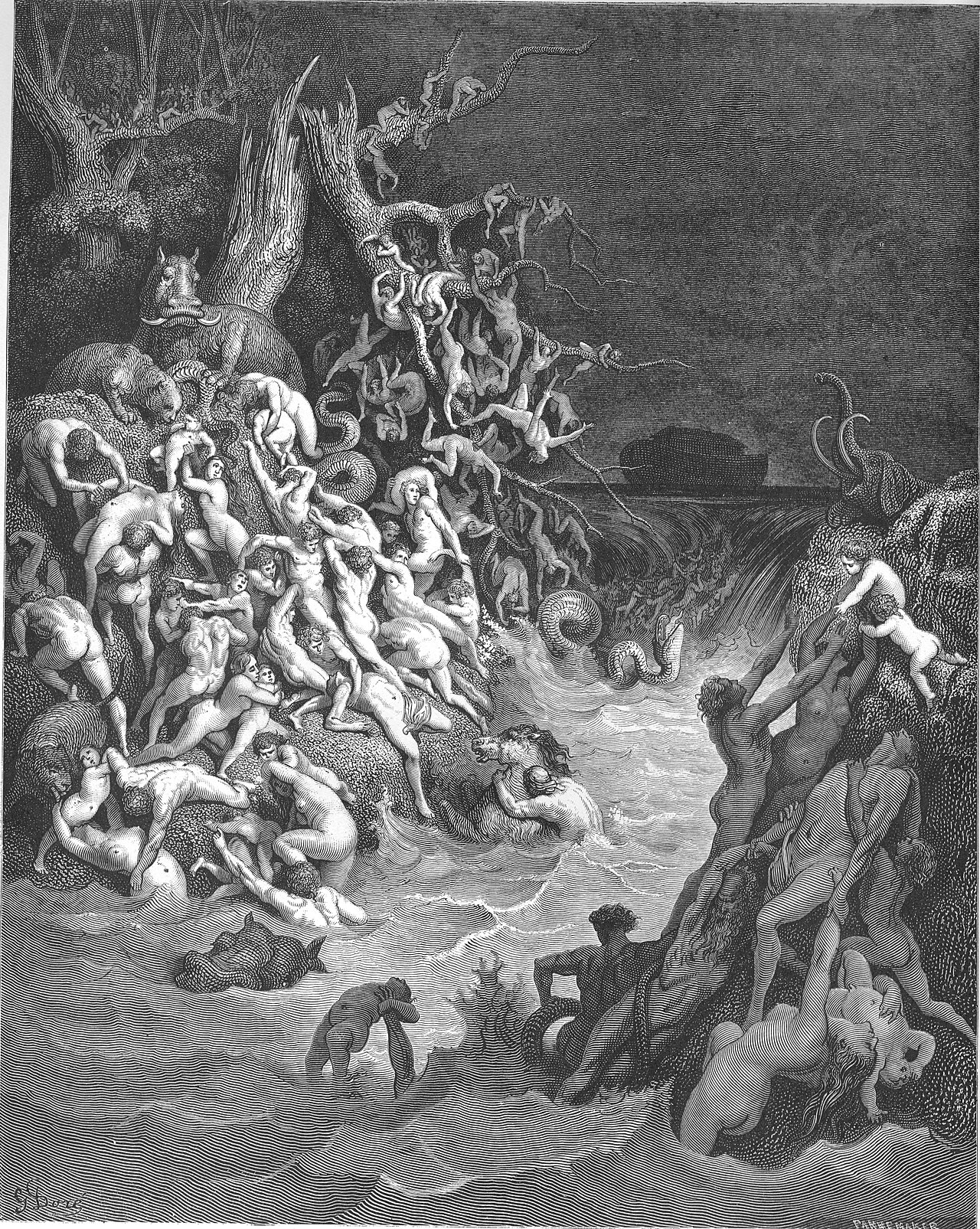
Man is mortal, the LORD says, and His Spirit will not contend with him forever. His days shall be 120 years, and most take that as the count to the flood. Men in the chapters after this still live far longer. 1 Peter 3:20 calls it God's patience while the ark was being made.
The record, by era
The Church Fathers5 voices
Since the Son of God is always one and the same, He gives to those who believe on Him a well of water [springing up] to eternal life, but He causes the unfruitful fig-tree immediately to dry up; and in the days of Noah He justly brought on the deluge for the purpose of extinguishing that most infamous race of men then existent, who could not bring forth fruit to God, since the angels that sinned had commingled with them, and [acted as He did] in order that He might put a check upon the sins of these men, but [that at the same time] He might preserve the archetype, the formation of Adam. And it was He who rained fire and brimstone from heaven, in the days of Lot, upon Sodom and Gomorrah, "an example of the righteous judgment of God," that all may know, "that every tree that bringeth not forth good fruit shall be cut down, and cast into the fire."
A commentator
Eusebius of CaesareaPreparation for the Gospel, BOOK V, CHAPTER IV · Written before 339.
proposed
But when they did nothing of this kind, but tried to make supplication to the evil daemons by a foul and licentious life and unseemly words, and by feeding on raw flesh, and rending victims asunder, and by human sacrifices, how was it even possible that doing such deeds, and pursuing practices pleasing to the wicked, they should be received as friends by the Supreme God, or by the divine Powers subject to Him, or by any good beings at all? But in fact it is manifest to all that he who practises the things that are dear to the wicked can never be a friend of the good. So then it was not to gods, nor yet to good daemons, but only to the wicked, that those of whom I have spoken paid worship. And this argument is still further confirmed by Plutarch, in the passage where he says that the mythical narratives told as concerning gods are certain tales about daemons, and the deeds of Giants and Titans celebrated in song among the Greeks are also stories about daemons, intended to suggest a new phase of thought. Of this kind then perhaps were the statements in the Sacred Scripture concerning the giants before the flood, and those concerning their progenitors, of whom it is said, 'And when the angels of God saw the daughters of men that they were fair, they took unto them wives of all that they chose,' and of these were born 'the giants the men of renown which were of old.' For one might say that these daemons are those giants, and that their spirits have been deified by the subsequent generations of men, and that their battles, and their quarrels among themselves, and their wars are the subjects of these legends that are told as of gods.
V. (19) And, in all such matters, it is impossible for the spirit of God to remain and to pass all its time, as the law-giver himself shows.
A commentator
JosephusAntiquities of the Jews - Book I, Chapter 3, Section 1 · Written before 100.
proposed
For many angels of God accompanied with women, and begat sons that proved unjust, and despisers of all that was good, on account of the confidence they had in their own strength; for the tradition is, that these men did what resembled the acts of …
This generation will not live nine hundred years like the previous generations, for it is flesh and its days are filled with the deeds of flesh. Therefore, their days will be one hundred and twenty years.
14 more voices on this verse
The Church Fathers7 voices
A commentator
Book of JubileesBook of Jubilees Chapter 5, sections 1-11, Charles' 1913 translation · Written before -100.
proposed
And it came to pass when the children of men began to multiply on the face of the earth and daughters were born unto them, that the angels of God saw them on a certain year of this jubilee, that they were beautiful to look …
As long then as there continued that separation of the lines between them, the seed of Seth, as it sprang from an excellent root, was by reason of its sanctity termed "angels of God," or as some copies have it "sons of God;" and on the contrary the others by reason of their own and their fathers' wickedness and their earthly deeds were termed "children of men." Though then there was up to this time that holy and salutary separation between them, yet after this the sons of Seth who were the sons of God saw the daughters of those who were born of the line of Cain, and inflamed with the desire for their beauty took to themselves from them wives who taught their husbands the wickedness of their fathers, and at once led them astray from their innate holiness and the single-mindedness of their forefathers...From these sons of Seth then and daughters of Cain, as we have said, there were I born still worse children who became mighty hunters, violent and most fierce men who were termed giants by reason of the size of their bodies and their cruelty and wickedness. For these first began to harass their neighbours and to practise pillaging among men, getting their living rather by rapine than by being contented with the sweat and labour of toil, and their wickedness increased to such a pitch that the world could only be purified by the flood and deluge.
God, when He had made the whole world, and subjected things earthly to man, and arranged the heavenly elements for the increase of fruits and rotation of the seasons, and appointed this divine law-for these things also He evidently made for man-committed the care of men and of all things under heaven to angels whom He appointed over them. But the angels transgressed this appointment, and were captivated by love of women, and begat children who are those that are called demons; and besides, they afterwards subdued the human race to themselves, partly by magical writings, and partly by fears and the punishments they occasioned, and partly by teaching them to offer sacrifices, and incense, and libations, of which things they stood in need after they were enslaved by lustful passions; and among men they sowed murders, wars, adulteries, intemperate deeds, and all wickedness. Whence also the poets and mythologists, not knowing that it was the angels and those demons who had been begotten by them that did these things to men, and women, and cities, and nations, which they related, ascribed them to god himself, and to those who were accounted to be his very offspring, and to the offspring of those who were called his brother), Neptune and Pluto, and to the children again of these their offspring. For whatever name each of the angels had given to himself and his children, by that name they called them.
And it came to pass when the children of men had multiplied that in those days were born unto them beautiful and comely daughters.
When men multiplied on the earth, the angels of heaven came together with the daughters of men. In some copies I found "the sons of God."
(Version 3.) And the Lord God said: My spirit will not dwell in these men forever, because they are flesh. In Hebrew, it is written, My spirit will not judge these men forever, because they are flesh: that is, because the condition of man is fragile, I will not subject them to eternal torment; but here I will restore to them what they deserve. Therefore, it signifies not severity, as it is read in our codices, but rather the mercy of God, while the sinner is visited here for his crime. And an angry God speaks to some: I will not visit their daughters, when they have fornicated, and their wives, when they have committed adultery (Hosea IV, 14). And in another place: I will visit their iniquities with a rod, and their sins with scourges: nevertheless, I will not take away my mercy from them (Ps. LXXXVIII, 33). Furthermore, so that it does not appear cruel on His part for not giving a place of repentance to sinners, He added: But their days shall be one hundred and twenty years. This is, they will have 120 years to do penance. Therefore, human life, as many err, is not condensed into 120 years: but to that generation, 120 years were given for penance. For we find that after the flood, Abraham lived for 175 years, and others for over 200 and 300 years. But because they refused to do penance, God did not want to wait for the appointed time: but with 20 years cut off, He brought about the flood in the 100th year designated for doing penance.
By the justice of God in some sense, the human race was delivered into the power of the devil; the sin of the first man passing over originally into all of both sexes in their birth through conjugal union, and the debt of our first parents binding their whole posterity. This delivering up is first signified in Genesis, where, when it had been said to the serpent, "Dust shalt thou eat," it was said to the man, "Dust thou art, and unto dust thou shall return." In the words, "Unto dust shalt thou return," the death of the body is fore-announced, because he would not have experienced that either, if he had continued to the end upright as he was made; but in that it is said to him whilst still living, "Dust thou art," it is shown that the whole man was changed for the worse. For "Dust thou art" is much the same as, "My spirit shall not always remain in these men, for that they also are flesh." Therefore it was at that time shown, that he was delivered to him, in that it had been said to him, "Dust shall thou eat."
The Medieval Church1 voice
And God said, "My Spirit shall not remain in man forever, because he is flesh; and his days shall be one hundred and twenty years."
The Puritans and the Awakening3 voices
Justice said, Cut them down; but mercy interceded, Lord, let them alone this year also; and so far mercy prevailed, that a reprieve was obtained for six-score years. Note, The time of God's patience and forbearance towards provoking sinners is sometimes long, but always limited: reprieves are not pardons; though God bear a great while, he will not bear always.
And the Lord said,....
Justice said, Cut them down; but mercy interceded, Lord, let them alone this year also; and so far mercy prevailed, that a reprieve was obtained for six-score years. Note, The time of God's patience and forbearance towards provoking sinners is sometimes long, but always limited: reprieves are not pardons; though God bear a great while, he will not bear always.
The Nineteenth Century2 voices
My spirit shall not always strive - It is only by the influence of the Spirit of God that the carnal mind can be subdued and destroyed; but those who wilfully resist and grieve that Spirit must be ultimately left to the hardness and blindness of their own hearts, if they do not repent and turn to God. God delights in mercy, and therefore a gracious warning is given.
A commentator
Jamieson, Fausset & Brown1802–1910
Commentary Critical and Explanatory on the Whole Bible (1871)
proposed
flesh--utterly, hopelessly debased. And the Lord said, My spirit shall not always strive--Christ, as God, had by His Spirit inspiring Enoch, Noah, and perhaps other prophets (1Pe 3:20;
quarantine:debris (2026-07-29) — starts-lowercase+unbalanced-parens
Modern Voices1 voice
Some authorities suggest that this might be an allusion to the Sons of God who came down to corrupt the daughters of men, resulting in the Nephilim (Fallen Ones) of Genesis 6.
The words behind it
15 Hebrew wordsEvery Hebrew word of this verse in the order it stands, with what it means and the door to its own study. The last column counts the times a word stands in the whole Bible: the rarer the word, the more the places it appears belong together.
| Hebrew | Sound | Meaning | Word study | In the Bible |
|---|---|---|---|---|
| וַיֹּ֣אמֶר | vaiyomer | and he said | H559 → | 5305 times |
| יְהוָ֗ה | yahweh | Yahweh | H3068 → | 6520 times |
| לֹֽא־ | lo'- | not | H3808 → | 5168 times |
| יָד֨וֹן | yadon | <it> will remain | H1777 → | 24 times |
| רוּחִ֤י | ruchi | spirit my | H7307 → | 378 times |
| בָֽאָדָם֙ | vaadam | in <the> humankind | H120 → | 551 times |
| לְעֹלָ֔ם | leolam | for ever | H5769 → | 438 times |
| בְּשַׁגַּ֖ם | beshagam | in that also | H1571 → | 769 times |
| ה֣וּא | hu' | he | H1931 → | 1879 times |
| בָשָׂ֑ר | vasar | [is] flesh | H1320 → | 270 times |
| וְהָי֣וּ | vehayu | and they will be | H1961 → | 3559 times |
| יָמָ֔יו | yamav | days his | H3117 → | 2304 times |
| מֵאָ֥ה | meah | one hundred | H3967 → | 581 times |
| וְעֶשְׂרִ֖ים | veesrim | and twenty | H6242 → | 315 times |
| שָׁנָֽה׃ | shanah | year[s] | H8141 → | 877 times |
וַיֹּ֣אמֶרand he said
vaiyomerH559 →5305 times
יְהוָ֗הYahweh
yahwehH3068 →6520 times
לֹֽא־not
lo'-H3808 →5168 times
יָד֨וֹן<it> will remain
yadonH1777 →24 times
רוּחִ֤יspirit my
ruchiH7307 →378 times
בָֽאָדָם֙in <the> humankind
vaadamH120 →551 times
לְעֹלָ֔םfor ever
leolamH5769 →438 times
בְּשַׁגַּ֖םin that also
beshagamH1571 →769 times
ה֣וּאhe
hu'H1931 →1879 times
בָשָׂ֑ר[is] flesh
vasarH1320 →270 times
וְהָי֣וּand they will be
vehayuH1961 →3559 times
יָמָ֔יוdays his
yamavH3117 →2304 times
מֵאָ֥הone hundred
meahH3967 →581 times
וְעֶשְׂרִ֖יםand twenty
veesrimH6242 →315 times
שָׁנָֽה׃year[s]
shanahH8141 →877 times
A shaded row is a word that stands 400 times or fewer in the Bible.
The walk
8 stopsEach card is a verse this one points to, and under it the verses that one points to in turn. Where several paths arrive at the same place, that place is listed first: the text keeps returning to it.
Through
Isaiah 63:10But they rebelled and grieved His Holy Spirit. So He turned and became their enemy, and He Himself fought against them.
it leads to
- Acts 7:51
You stiff-necked people with uncircumcised hearts and ears! You always resist the Holy Spirit, just as your fathers did.
Reached by 2 separate paths from here.
- Ephesians 4:30
And do not grieve the Holy Spirit of God, in whom you were sealed for the day of redemption.
- Psalms 78:56
But they tested and disobeyed God Most High, for they did not keep His decrees.
- Psalms 78:40
How often they disobeyed Him in the wilderness and grieved Him in the desert!
- Acts 7:51
Through
Jeremiah 11:11Therefore this is what the LORD says: ‘I am about to bring upon them a disaster that they cannot escape. They will cry out to Me, but I will not listen to them.
it leads to
- Proverbs 1:28
Then they will call on me, but I will not answer; they will earnestly seek me, but will not find me.
- Ezekiel 8:18
Therefore I will respond with wrath. I will not look on them with pity, nor will I spare them. Although they shout loudly in My ears, I will not listen to them.”
- Isaiah 1:15
When you spread out your hands in prayer, I will hide My eyes from you; even though you multiply your prayers, I will not listen. Your hands are covered with blood.
- Proverbs 1:28
Through
Psalms 78:39He remembered that they were but flesh, a passing breeze that does not return.
it leads to
- James 4:14
You do not even know what will happen tomorrow! What is your life? You are a mist that appears for a little while and then vanishes.
- James 4:14
Where this verse is studied
On this page
Studies11
On this verse
About Genesis
This page draws on 20 works. Open the list of works
This page draws on Adam Clarke, Commentary on the Bible; Augustine of Hippo, On the Trinity 13.12.16; Bede, Commentary on Genesis (Hexaemeron); Book of Enoch, 1 Enoch, Chapters 6-8, 15, 16; Book of Jubilees, Book of Jubilees Chapter 5, sections 1-11, Charles' 1913 translation; Chuck Missler, The Gospel in Genesis (article); Ephrem the Syrian, COMMENTARY ON GENESIS 6.4.1; Eusebius of Caesarea, Preparation for the Gospel, BOOK V, CHAPTER IV; Irenaeus, The Demonstration of the Apostolic Preaching, Sections 18-19; Irenaeus, Against Heresies 4.36.4; Jamieson, Fausset & Brown, Commentary Critical and Explanatory on the Whole Bible; Jerome, Hebrew Questions on Genesis; John Cassian, Conference 8, CHAPTER XXI; John Gill, Exposition of the Old Testament; John Gill, Exposition of the Old Testament (1748-1763); Josephus, Antiquities of the Jews - Book I, Chapter 3, Section 1; Julius Africanus, Fragment 2; Justin Martyr, The Second Apology, Chapter V; Matthew Henry, Commentary on the Whole Bible and Philo of Alexandria, ON THE GIANTS.