
AD 1491 to 1498 · Story · Featured Study
Savonarola in Florence
A friar called a whole city to repentance, and after an ordeal that never took place the city turned on him.
When Rome threatened to excommunicate him, Savonarola told Florence to bear the excommunication aloft on a lance and open the gates to it.
- When
- 1491 to 1498
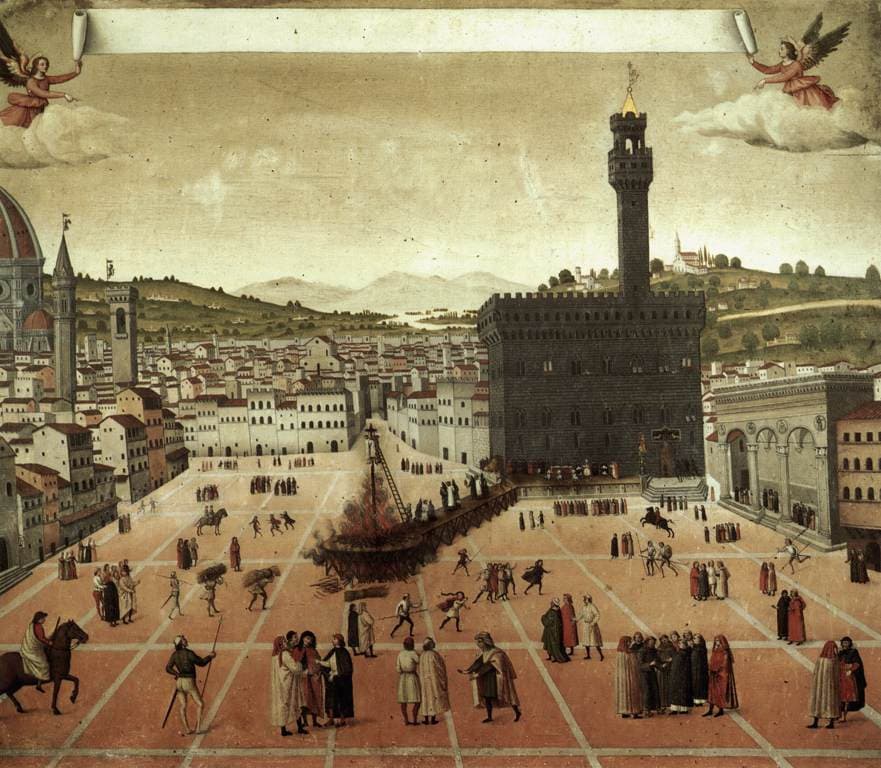
Attributed to Francesco Rosselli, Execution of Savonarola (a copy of about 1650), public domain
Have mercy on me, O God, according to Your loving devotion; according to Your great compassion, blot out my transgressions.
Summary
Girolamo Savonarola became prior of San Marco in Florence in 1491 and preached judgment to the city. Florence burned its vain things at his word, and in the end it hanged and burned him.
- He was born at Ferrara in 1452 and joined the Dominicans in 1475.
- The crowds at his sermons grew every day.
- A Catholic historian judged him good in life but a fanatic.
The Texts He Preached and Prayed
He preached the flood and Haggai to Florence, and in prison he prayed through Psalms 51 and 31.
Savonarola preached to Florence from the Old Testament. Villari names his texts for the year the French came: sermons on Noah's ark that year, and in Advent the prophet Haggai.
In his little prison, after his first examination, he wrote two meditations, on the Miserere of Psalm 51 and on Psalm 31.
In the pulpit
And behold, I will bring floodwaters upon the earth to destroy every creature under the heavens that has the breath of life. Everything on the earth will perish.
Villari says he cried this verse's words in Latin from the pulpit of the Duomo on 21 September 1494.
Genesis 6:17BSB
“Is it a time for you yourselves to live in your paneled houses, while this house lies in ruins?”
Villari says he chose Haggai that Advent because the prophet urged the people to rebuild the temple.
Haggai 1:4BSB
In prison
In You, O LORD, I have taken refuge; let me never be put to shame; save me by Your righteousness.
His second prison meditation takes this cry of trust for its text.
Psalm 31:1BSB
Psalm 31:1
Who Recorded Savonarola
An eyewitness diary, the friar's own writings and two historians make the record.
The diarist wrote in the city, and the two historians wrote four centuries later.
| Witness | Written | Its side |
|---|---|---|
| Luca Landucci, A Florentine Diary from 1450 to 1516, in Jervis's English of 1927 | Kept through the years 1450 to 1516 | A citizen of Florence who saw him die |
| Savonarola's prison meditations, in Perowne's Latin and English of 1900 | In prison, in his last weeks | His own words |
| Pasquale Villari, Life and Times of Girolamo Savonarola, in Linda Villari's English | 1888 | His biographer and champion |
| Ludwig Pastor, History of the Popes, volume 6, in Antrobus's English | 1898 | A Catholic historian of the popes |
Prior of San Marco, the Last Seven Years
Seven years ran from his election as prior to the fire in the square.
In July 1491 the friars of San Marco in Florence elected him their prior.
In 1492, by his own account as Villari gives it, he saw a hand in the sky holding a sword. On the sword was written Gladius Domini super terram cito et velociter, the sword of the Lord over the earth, soon and swiftly.
Villari sums his preaching in three propositions, “that the Church will be scourged,” that it will be “speedily regenerated,” and “that all this will come to pass quickly.”
Pico della Mirandola said that a cold shiver ran through him at the friar's preaching on the flood. On 17 November the King of France entered Florence.
On the last day of carnival in February 1497 the city kept a Mass and a religious solemnity in place of the old revels. At the next carnival Landucci saw a pile of “nude statues and playing-boards, heretical books” set up in the square for the fire. With them stood mirrors and other vain things worth thousands of florins.
The pope's brief of excommunication was dated 13 May 1497 and was published in the churches of Florence on 18 June.
The Ordeal, the Trial and the Fire
The prophecy of a quick renewal failed, and the city that had heard him turned on him.
On 7 April 1498 a scaffold fifty braccia long was built in the square for an ordeal by fire between the Dominicans and the Franciscans. The dispute ended with both orders gone home and no fire lit, and Landucci writes that the people “almost lost faith in the prophet.”
He was examined in prison. Villari, his champion, holds that he was not allowed to write his own confession and that the notary who took down his replies falsified them.
Landucci watched the three friars hanged from the cross on the scaffold. Fra Silvestro was hanged first, then Fra Domenico of Pescia, and last Savonarola, who did not speak aloud. A fire was then lit beneath them, and the last of their dust was carried to the Arno by the Ponte Vecchio.
Landucci writes that everyone had expected some sign, and “Many, in fact, fell from their faith.”
Villari, writing in 1888, dates the death to 23 May 1498, and the English of Landucci, the eyewitness, heads the entry 22 May.
Pastor names his interference in politics and his insubordination towards the Holy See as his greatest faults. He says the friar became “the head of a political party and a fanatic, openly demanding the death of all enemies of the Republic.”
In Their Own Words
Girolamo Savonarola (1452 to 1498)
Meditation on Psalm 51 (1498), in Meditations on Psalm LI and Part of Psalm XXXI in Latin, with an English translation by E. H. Perowne (London, 1900), the opening
Alas! wretch that I am
“Alas! wretch that I am, destitute of all help, who have offended heaven and earth, whither shall I go?”
Roman Catholic
About this saying1 paragraph
Before any word of mercy, the fifteenth-century meditation begins in despair.
Girolamo Savonarola
Meditation on Psalm 51 (1498), in Meditations on Psalm LI and Part of Psalm XXXI in Latin, with an English translation by E. H. Perowne (London, 1900), the opening, after the cry
God is merciful
“God is merciful; my Saviour is pitiful.”
Roman Catholic
About this saying1 paragraph
A few lines on, the fifteenth-century prisoner answers his own despair.
Girolamo Savonarola
Meditation on Psalm 31 (1498), in Meditations on Psalm LI and Part of Psalm XXXI in Latin, with an English translation by E. H. Perowne (London, 1900), the meditation on Psalm 31
In Thee, O Lord, have I hoped
“In Thee, therefore, O Lord, have I hoped, even as my Hope hath taught me to hope.”
Roman Catholic
About this saying1 paragraph
The second meditation, from the same fifteenth-century cell, turns despair into hope.
How Savonarola Has Been Judged
Luther claimed him for the Reformation, and Villari and Pastor read him inside the Catholic faith.
A martyr of the Reformation2 paragraphs
Villari writes that the meditation on the Miserere ran into thirteen editions. Luther republished it with a preface calling Savonarola a precursor of Protestant doctrine. Villari dates that edition to Strasbourg in 1524, and Perowne, following Gregorovius, to 1522.
In Villari's English of the preface, Luther says he was put to death “solely for having desired that some one should come to purify the slough of Rome.”
A Catholic reformer of conduct2 paragraphs
Villari himself, on a sentence of the friar's manuscripts, writes that its idea “is throughout opposed to that constituting the foundation of Luther's doctrines.”
Pastor judges that in theory Savonarola remained true to the dogmas of the Catholic Church. His denial of the Holy See's power to punish and his plans for calling a Council made his tendencies, Pastor says, “practically uncatholic.”
The cause asked for in 19971 paragraph
Santi e Beati reports that on 30 May 1997 the Dominican postulator general asked the diocese of Florence to weigh a cause for his beatification. It adds that the Holy See has never granted the leave to open it.
What Savonarola Left
His sermons promised Florence that the Church would be renewed quickly, and the renewal did not come in his lifetime. In prison he asked for mercy in the words of Psalm 51.
Sources
Scripture is the Berean Standard Bible.
- The Holy Bible, Berean Standard Bible (read 2026)
- Pasquale Villari, Life and Times of Girolamo Savonarola, translated by Linda Villari (1888), the popular edition (New York, 1896)
- Luca Landucci, A Florentine Diary from 1450 to 1516, translated by Alice de Rosen Jervis (London, 1927), the entries for 1494 to 1498.
- Girolamo Savonarola, Meditations on Psalm LI and Part of Psalm XXXI in Latin, with an English translation by E. H. Perowne (London, 1900)
- Ludwig Pastor, The History of the Popes, vol. 6, edited by Frederick Ignatius Antrobus (London, 1898)
- Santi e Beati, "Girolamo Savonarola", entry 91638.
Keep Studying
Read it4