
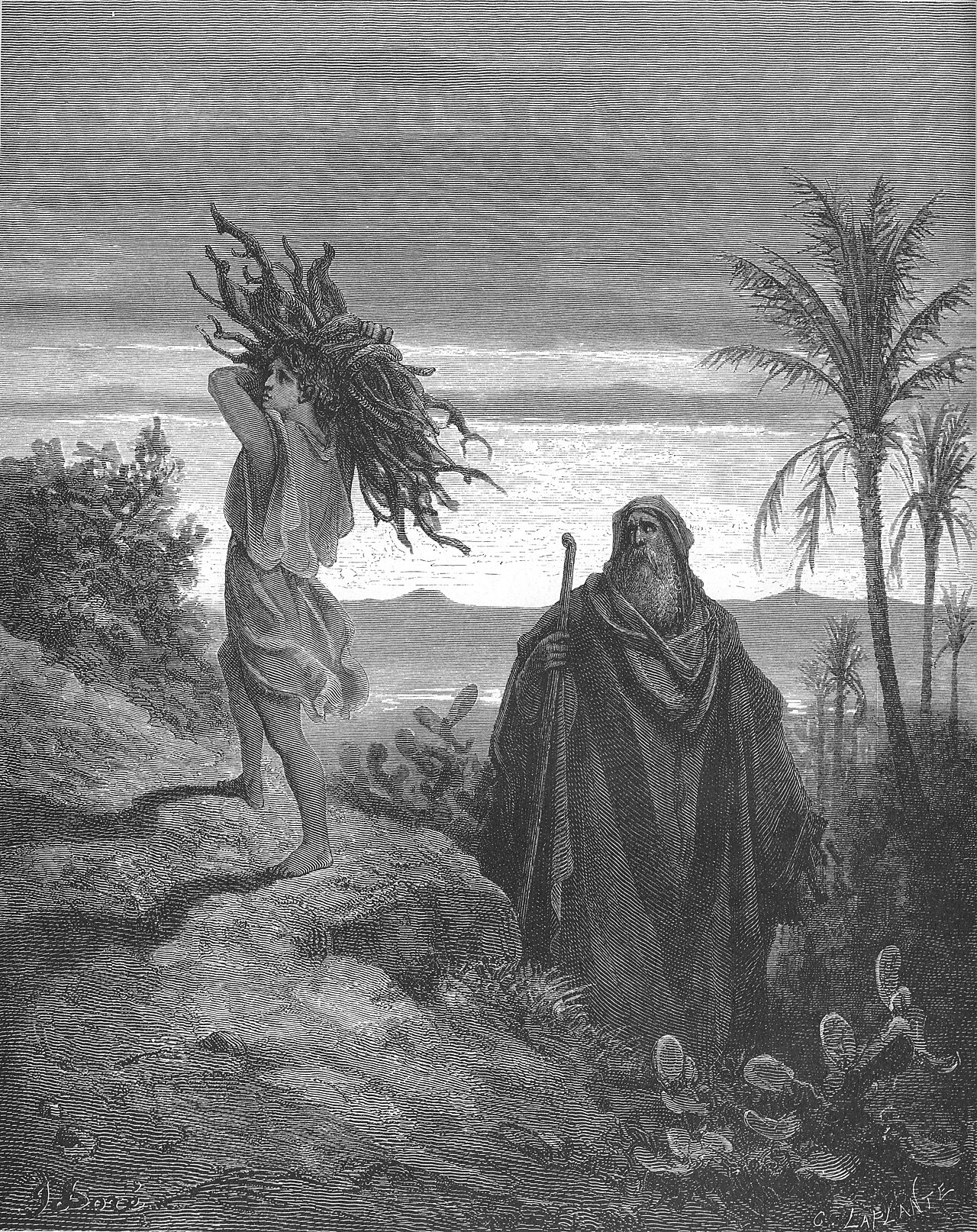
Genesischapter 22
24 verses · Moses, by tradition · 15th to 13th century BC · The Law
In Jewish life
The reading
Weekly portion 4 of 54
וַיֵּרָא Vayera, Genesis 18:1 to 22:24
Read with it: 2 Kings 4:1 to 4:37 in Ashkenazi use, and 2 Kings 4:1 to 4:23 in Sephardi use.
The verse numbers here are the ones a Hebrew Bible carries, which differ from an English Bible by a verse or two in several places. The Sephardi reading is named only where this site records a difference; communities vary beyond what is listed. What these books are, and how a Christian reader meets them →
What is done
This chapter closes the fourth portion of the annual cycle, and the portion ends with its last verse (src/lib/hebraic/readings.ts).
It is also read on its own at a feast. This site records that Genesis 22 is read in the synagogue on Rosh Hashanah. The ram's horn sounded on that day recalls the ram caught in the thicket, and the liturgy pleads the merit of the binding for the descendants of Isaac. The record stands at src/app/featured/aqedah/page.tsx and at src/components/book/guides/genesis/GenesisGuide.tsx, which names Genesis Rabbah 56 and the Rosh Hashanah Musaf. The card above carries the portion and the prophetic reading set beside it.
How it is read
Rashi is quoted here from the public domain Rosenbaum and Silbermann edition, and Radak from the CC-BY translation of Eliyahu Munk, HaChut Hameshulash.
The tradition reads this chapter as the supreme test of Abraham, and it reads Isaac as a grown man who knew what was coming. Rashi holds that Isaac understood at the eighth verse that he was walking on to be killed (Rashi on Genesis 22:8:1). Rashi reads the request in the second verse as a request. God asks him to stand firm in this trial, so that nobody may say the earlier trials were no tests (Rashi on Genesis 22:2:1, citing Sanhedrin 89b). He reads the early rising of the third verse as eagerness to obey (Rashi on Genesis 22:3:1, citing Pesachim 4a).
Rashi reads the three days as time given on purpose. Had the place been shown at once, people would have said that Abraham was rushed into it and would have refused on reflection (Rashi on Genesis 22:4:1, citing Midrash Tanchuma, Vayera 22). On the binding itself he explains the word as hands and feet tied together behind (Rashi on Genesis 22:9:1). Radak reads the hand with the knife as the ordinary order of an offering, the killing before the burning (Radak on Genesis 22:10:1).
Radak reads the second call from heaven as the promise of a return. What Abraham was ready to do would be repaid to his children when the occasion came (Radak on Genesis 22:15:1). Rashi reads the doubled blessing of the seventeenth verse as one blessing for the father and one for the son (Rashi on Genesis 22:17:1, citing Genesis Rabbah 56:11).
A Christian reader comes to this chapter with the church's reading of a father and an only son, and this site sets that reading beside Israel's own and says which is which. The standard modern study of the Jewish tradition here is Jon D. Levenson, The Death and Resurrection of the Beloved Son, 1993, which this site names on its own page for the chapter (src/app/featured/aqedah/page.tsx). Ibn Ezra carries two comments the corpus holds by reference alone, at Ibn Ezra on Genesis 22:16:1 and 22:18:1.
What the rabbis say
Rashi carries the traditional insights of this chapter, and each stands here as what the rabbis taught.
The first is on what the first verse means by these things. Rashi reports one opinion that it follows the words of Satan, who said that Abraham had held great banquets and had never brought God so much as one bullock. God answered that Abraham would give his son at a word. He reports a second opinion, that it follows the words of Ishmael, who boasted to Isaac about his own circumcision (Rashi on Genesis 22:1:1, citing Sanhedrin 89b).
The second is on the knife. Rashi gives two readings of its name, one from the eating of flesh and one from the reward. Rashi writes that "Israel still eats of the reward given for it" (Rashi on Genesis 22:6:1, citing Genesis Rabbah 56:3).
The third is the moment on the mountain. Rashi reports that when the hand was stopped Abraham asked to draw at least a little blood from the boy. God answered that he was to put no blemish on him at all (Rashi on Genesis 22:12:1, citing Genesis Rabbah 56:7). He reports that the doubling of the name in the eleventh verse is affection (Rashi on Genesis 22:11:1, citing Genesis Rabbah 56:7).
The fourth is the ram. Rashi reports that it had been set apart for this since the six days of creation (Rashi on Genesis 22:13:1, citing Avot 5:5 and Midrash Tanchuma, Vayera 23). He reads the name given to the place as the choosing of that place for the Presence and for sacrifice (Rashi on Genesis 22:14:1). On the last verses he reports Abraham thinking on the way home that a slain son would have died childless. The news of the birth of Rebecca came for that reason (Rashi on Genesis 22:20:1).
The corpus records forty places where the Midrash and the Talmud cite this chapter, thirty four under Midrash and six under Talmud, with the locator for each one and no text. Bereshit Rabbah reads the fourth verse at 56:1, the sixth at 56:3, the seventh at 56:4 and the ninth at 56:5. It reads the tenth verse at 55:8 and 56:6, the fifteenth and sixteenth at 56:11 and the twentieth at 57:1.
Aggadat Bereshit reads the first verse at 31:1 and 31:3, the second at 22:2, the eighth at 19:1 and the twelfth at 16:2 and 31:2. It reads the fourteenth verse at 30:1 and 38:3. Bamidbar Rabbah reads the third verse at 20:12, the eleventh at 14:21 and 20:15, the thirteenth at 13:14, the seventeenth at 14:12 and the eighteenth at 2:13. Bereshit Rabbati reads five places in Parashat Vayera and Parashat Miketz, and Kohelet Rabbah reads the twenty third verse at 1:5:1.
The Talmud is cited at Bava Kamma 49a:5 on the fifth verse and Berakhot 62b:15 on the eighth. The Jerusalem Talmud reads the twenty first verse at Sotah 5:6:2. Avot DeRabbi Natan reads the ram at 1:8, and its second recension reads the second verse at 48:12 and the fifth at 43:1.
The text, verse by verse
Each word shows the Hebrew, the English under it, how it sounds and its Strong’s number. A rule between verses marks where the Hebrew manuscripts end a paragraph.
Take Your Son, Your Only Son
Onkelos Genesis 22:1
After these events, Elohim tested Avraham and said to him, Avraham! and he [Avraham] said, Here I am.
Read it in full at Sefaria · Metsudah Chumash, Metsudah Publications, 2009 [with Onkelos translation]
The Lord Will Provide
Ramban on Genesis 22:12
At the beginning Abraham’s fear of G-d was latent; it had not become actualized through such a great deed. But now it was known in actuality, and his merit was perfect, and his reward would be complete from the Eternal, the G-d of Israel. 385 See Ruth:12.
Read it in full at Sefaria · Commentary on the Torah by Ramban (Nachmanides). Translated and annotated by Charles B. Chavel. New York, Shilo Pub. House, 1971-1976
Ibn Ezra on Genesis 22:13
Abraham beheld a ram after ( achar ) it had been caught in the thicket by its horns. 21 Scripture reads: achar ne’achaz.
Read it in full at Sefaria · Ibn Ezra's commentary on the Pentateuch, tran. and annot. by H. Norman Strickman and Arthur M. Silver. Menorah Pub., 1988-2004
A Blessing God Swore by Himself
The Children of Nahor
Hebrew words in this chapter
The 40 most used Hebrew words of the chapter, counted by lemma. The article, the object marker, the negatives and the common prepositions are left out.
| Word | Sense here | Uses | Strong’s |
|---|---|---|---|
| אַבְרָהָםʼAbrâhâm | Abraham | 20 | H85 |
| אָמַרʼâmar | to say | 18 | H559 |
| בֵּןbên | son | 11 | H1121 |
| הָלַךְhâlak | went | 7 | H1980 |
| הִנֵּהhinnêh | here I | 6 | H2009 |
| לָקַחlâqach | to take | 6 | H3947 |
| עֹלָהʻôlâh | burnt offering | 6 | H5930 |
| אֱלֹהִיםʼĕlôhîym | God | 5 | H430 |
| יִצְחָקYitschâq | Isaac | 5 | H3327 |
| נַעַרnaʻar | servants his | 5 | H5288 |
| עֵץʻêts | wood | 5 | H6086 |
| רָאָהrâʼâh | to see | 5 | H7200 |
| יְהֹוָהYᵉhôvâh | yahweh | 5 | H3068 |
| מָקוֹםmâqôwm | place | 4 | H4725 |
| בְּאֵר שֶׁבַעBᵉʼêr Shebaʻ | beer | 4 | H884 |
| יָלַדyâlad | she has borne | 4 | H3205 |
| דָּבָרdâbâr | the things | 3 | H1697 |
| יָחִידyâchîyd | only | 3 | H3173 |
| שְׁנַיִםshᵉnayim | two | 3 | H8147 |
| יָדyâd | hand | 3 | H3027 |
| Word | Sense here | Uses | Strong’s |
|---|---|---|---|
| יַחַדyachad | together | 3 | H3162 |
| אָבʼâb | father | 3 | H1 |
| קָרָאqârâʼ | to call | 3 | H7121 |
| שָׁמַיִםshâmayim | heaven | 3 | H8064 |
| בָרַךְbârak | to bless | 3 | H1288 |
| זֶרַעzeraʻ | offspring your | 3 | H2233 |
| אָחʼâch | brother | 3 | H251 |
| אֶרֶץʼerets | land | 2 | H776 |
| עָלָהʻâlâh | and offer up him | 2 | H5927 |
| שָׁםshâm | there | 2 | H8033 |
| הַרhar | mountain | 2 | H2022 |
| חֲמוֹרchămôwr | donkey | 2 | H2543 |
| קוּםqûwm | and he arose | 2 | H6965 |
| יוֹםyôwm | day | 2 | H3117 |
| נָשָׂאnâsâʼ | to lift | 2 | H5375 |
| עַיִןʻayin | eyes his | 2 | H5869 |
| יָשַׁבyâshab | remain | 2 | H3427 |
| שׁוּבshûwb | to return | 2 | H7725 |
| שׂוּםsûwm | and he put | 2 | H7760 |
| אֵשׁʼêsh | fire | 2 | H784 |
Keep studying
Studies14
Words12
Trails1
Sources for this chapter
The Hebrew text
STEP Bible, the tagged Hebrew text and its English glosses and James Strong, Strong's Exhaustive Concordance.
In Jewish life
Rashi, Rashi on Genesis 22, in Pentateuch with Rashi's commentary by M. Rosenbaum and A. M. Silbermann, 1929 to 1934, public domain; Radak, Radak on Genesis 22:7:1, 22:10:1, 22:15:1, 22:21:1, 22:22:1 and 22:24:1, in HaChut Hameshulash, translated by Eliyahu Munk, CC-BY; Jon D. Levenson, The Death and Resurrection of the Beloved Son, 1993, named at src/app/featured/aqedah/page.tsx and cited there rather than quoted; MannaFest, the Rosh Hashanah reading and the merit of the binding, as recorded at src/app/featured/aqedah/page.tsx and src/components/book/guides/genesis/GenesisGuide.tsx and The Midrash and the Talmud, the forty locators on Genesis 22 in scripts/data/sources/sefaria/genesis/22.json.
The rabbinic texts
Ramban, Commentary on the Torah by Ramban (Nachmanides). Translated and annotated by Charles B. Chavel. New York, Shilo Pub. House, 1971-1976; Ibn Ezra, Ibn Ezra's commentary on the Pentateuch, tran. and annot. by H. Norman Strickman and Arthur M. Silver. Menorah Pub., 1988-2004; Targum, Metsudah Chumash, Metsudah Publications, 2009 [with Onkelos translation] and Sefaria, texts and citation data.