
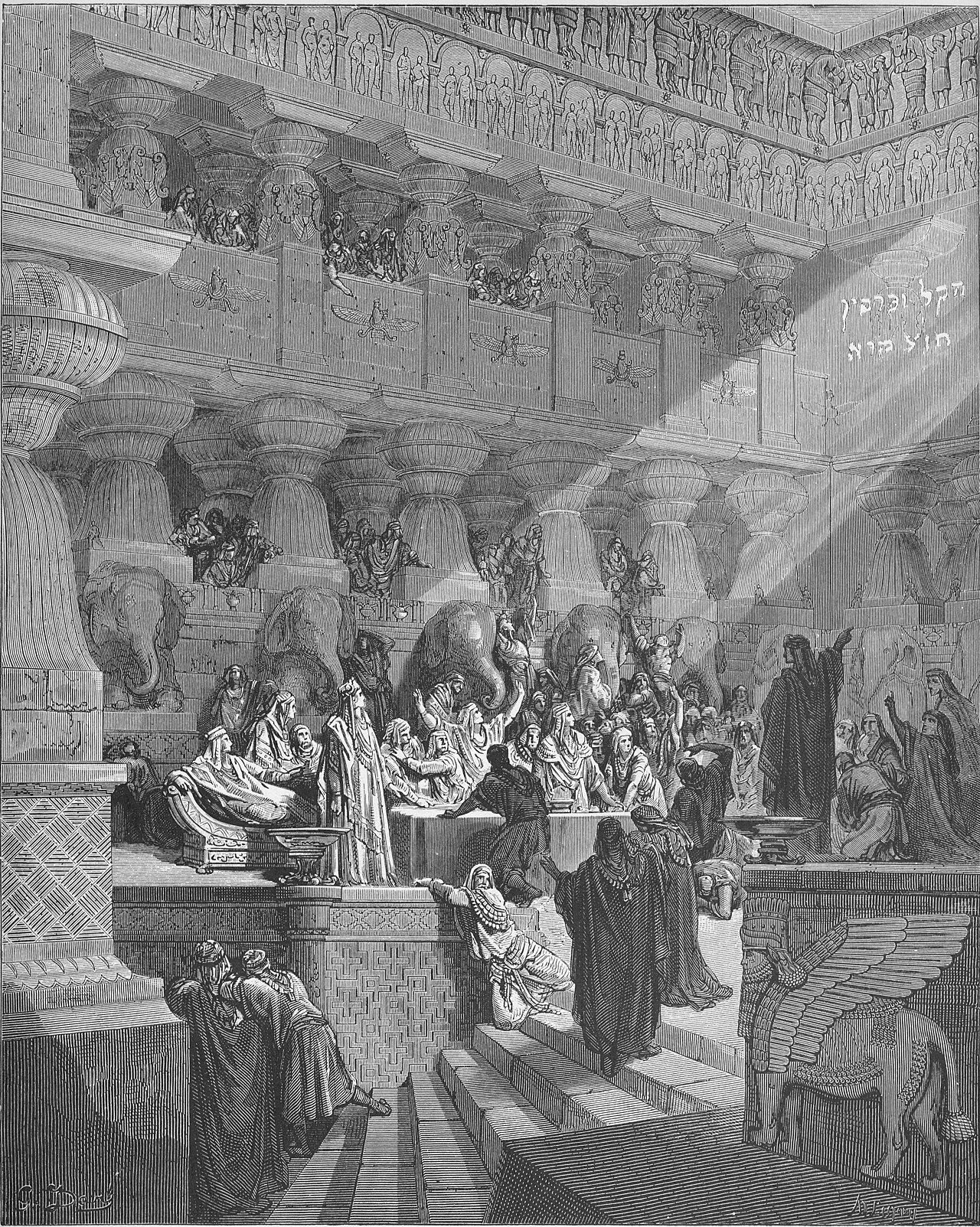
Danielchapter 5
31 verses · Daniel, by tradition · 6th century BC · The Prophets
Later, King Belshazzar held a great feast for a thousand of his nobles, and he drank wine with them.
Introduction
Daniel, by tradition, The Prophets, Daniel Overview.
This chapter is set on the last night of the Babylonian empire, inside a palace that believed itself safe. It was kept for exiles who had seen the vessels of their temple carried off as trophies and wondered whether their God still ruled. Daniel is now an old man, called back into a court that had forgotten him. Listen for the contrast between this king and the king of the chapter before, and for the reason Daniel gives for the verdict. The chapter moves from a banquet to a judgment within a single night.
Context
- Who
- Exiles asking whether their God still ruled while a foreign king did
- What
- A narrative of Belshazzar's feast, the writing on the wall, Daniel's reading of it and the fall of Babylon that night.
- Where
- The banqueting hall of the royal palace in Babylon.
- When
- The night Babylon fell to the Persians, in October 539 BC.
- Why
- To show that God judges the proud who defy Him, and that the empires which seemed to have defeated His people stand under His verdict.
Historical context
For a long time Belshazzar was the book's embarrassment: no Babylonian king list had his name. Then cuneiform texts turned up naming Belshazzar as the son of Nabonidus, the last king of Babylon. Nabonidus spent about ten years away from the city at the desert oasis of Tema in Arabia, and left Belshazzar holding the kingship in Babylon.
Show the rest of the historical context, 4 more paragraphs
That solves the strangest detail in the chapter. Belshazzar offers Daniel the third place in the kingdom, not the second, because the first place was his absent father's and the second was already his own. It is a small thing that only makes sense if the writer knew how that court actually worked.
The Nabonidus Chronicle, a Babylonian tablet, records what happened outside. Cyrus's army beat the Babylonians at Opis, took Sippar without a fight, and then entered Babylon itself without a battle. Greek writers add the detail that the attackers lowered the Euphrates, which ran straight through the middle of the city, and walked in along the drained riverbed under the walls.
Those walls were the reason the party could happen at all. Babylon's defenses were famous enough that Herodotus devotes pages to them, and the city had grain stored for years. Belshazzar was not being reckless by feasting while an army camped nearby. He was being confident. The river was the one door nobody had bolted.
Drinking from the temple vessels taken out of Jerusalem was not just insult; in the ancient world, captured temple gear proved whose god had won. He was toasting his own gods with the trophies.
Significance
For the exiles this was the answer to a question forty-seven years old. Jerusalem's holy vessels sat in Babylon's treasury as evidence that Babylon's gods had beaten Israel's God. On this night the God of those vessels wrote on the wall of the man holding them, and the empire was handed to somebody else before morning.
Show the rest of the significance, 1 more paragraph
The verdict Daniel reads out is personal, not just political: "thou hast been weighed in the balances, and art found wanting." Belshazzar knew what had happened to Nebuchadnezzar and humbled himself anyway. The chapter says the God who patiently restored one king ended another in a night.
This chapter in Jewish lifeWhat this chapter is in Jewish life and reading.
What is done
Belshazzar's feast is not read in the synagogue. Probed for this lane, the site's own table in src/lib/hebraic/readings.ts printed parashot total 0 and haftarah uses total 0 for Daniel, and no festival reading. The site's book dossier records that Daniel stands among the Writings in the Hebrew Bible rather than among the Prophets, so no weekly portion is drawn from it and no Haftarah either.
The chapter reaches the Purim scroll through its Midrash. The site's festival table records that Esther is read whole at Purim. The corpus carries three passages of Esther Rabbah, at 2:11, 4:3 and 5:1, under the second verse, where the vessels of the Temple are brought to the feast, and Esther Rabbah 2:12 under the first. The writing on the wall is met in the Talmud at Sanhedrin 22a:1 and 22a:9, which the corpus carries under the eighth verse and the twenty-fifth.
How it is read
Rashi is quoted from The Judaica Press complete Tanach with Rashi, translated by A. J. Rosenberg, which Sefaria reports as CC-BY, save one note at the nineteenth verse, which the corpus carries in the Sefaria Community Translation, which Sefaria reports as CC0. Ibn Ezra is quoted from the Sefaria Community Translation, which Sefaria reports as CC0. Each quotation is held to fifty words or fewer.
Rashi places Belshazzar in the line of kings. "He was his son, and he reigned after Evil-merodach, who reigned instead of Nebuchadnezzar, and (he) too was the son of Nebuchadnezzar" (Rashi on Daniel 5:1:1). The feast turns on the wine: the king gave his order "with the counsel of the wine He said with the counsel of the wine that he had imbibed" (Rashi on Daniel 5:2:1). The hand, in Rashi's reading, came from heaven (Rashi on Daniel 5:5:1). The queen entered "because she heard the words of the king and his princes, came to the banquet hall" (Rashi on Daniel 5:10:1).
Daniel's rebuke carries the moral of the chapter, and Rashi states it in one clause. The son knew all that had befallen his father, "and you should have feared the Holy One, blessed be He" (Rashi on Daniel 5:22:1). Ibn Ezra reads the opening word of that rebuke as a summons to listen: "Listen, you, O king" (Ibn Ezra on Daniel 5:18:1).
The corpus carries twenty-four commentary entries on this chapter, the cap its fetch sets, and they stop at the twenty-fourth verse, so what the commentators say on the verses after it is not reported here. The corpus carries five further notes on this chapter without an English text, each marked linked because Sefaria holds no English version of the ref. They stand cited and unquoted: Metzudat David on Daniel 5:4:1, Daniel 5:13:1, Daniel 5:14:1, Daniel 5:15:1 and Daniel 5:23:1.
What the rabbis say
The corpus carries thirty-nine rabbinic locators on this chapter. Five of them stand in the Talmud and its minor tractates and the rest in the Midrash. The corpus carries the text of none, so each is cited by ref here and never quoted.
On the first verse it holds Bereshit Rabbati, Parashat Noah 22 and Esther Rabbah 2:12. On the second verse it holds Esther Rabbah 2:11, Esther Rabbah 4:3 and Esther Rabbah 5:1. On the fourth verse it holds Kohelet Rabbah 5:2:1. On the fifth verse it holds Jerusalem Talmud Yoma 3:8:7, Midrash Sekhel Tov, Bereshit 37:3:4 and Midrash Tehillim 75:3. On the seventh verse it holds Bamidbar Rabbah 12:4 and Midrash Lekach Tov, Exodus 25:3:2. On the eighth verse it holds Ein Yaakov (Glick Edition), Sanhedrin 2:15, Jerusalem Talmud Megillah 1:9:4 and Sanhedrin 22a:1.
On the eleventh verse it holds Midrash Lekach Tov on Esther, Introduction 3. On the twelfth verse it holds Ruth Rabbah (Lerner) 7:3:1, Ruth Rabbah 7:2 and Yalkut Shimoni on Torah 159:1. On the thirteenth verse it holds Midrash Lekach Tov on Esther 2:19:2 and Midrash Tanchuma Buber, Miketz 4:4. On the fourteenth verse it holds Midrash Sekhel Tov, Shemot 12:42:11. On the sixteenth verse it holds Jerusalem Talmud Shabbat 6:2:13. On the seventeenth verse it holds Mekhilta DeRabbi Shimon Ben Yochai 19:14 and Pesikta Rabbati 11:1.
On the twentieth verse it holds Esther Rabbah 3:1 and Midrash Lekach Tov on Lamentations 1:5:1. On the twenty-first verse it holds Midrash Tanchuma Buber, Vaera 8:1 and Midrash Tanchuma, Tetzaveh 6:1. On the twenty-third verse it holds Ein Yaakov, Megillah 1:23 and Ein Yaakov, Rosh Hashanah 1:3. On the twenty-fourth verse it holds Midrash Tanchuma, Bereshit 5:14. On the twenty-fifth verse it holds Sanhedrin 22a:9. On the span Daniel 5:26 to 27 it holds Ein Yaakov, Sanhedrin 2:16.
On the twenty-eighth verse it holds Sifrei Aggadah on Esther, Midrash Panim Acherim, Version II 1:15. On the twenty-ninth verse it holds Mekhilta DeRabbi Shimon Ben Yochai 14:20 and Mekhilta DeRabbi Yishmael, Tractate Vayehi Beshalach 6:3. On the thirtieth verse it holds Ein Yaakov (Glick Edition), Nedarim 8:1 and Ein Yaakov, Nedarim 8:1. On the span Daniel 4:34 to 5:1 it holds Bereshit Rabbah 85:2.
Sefaria also files one link for this chapter to Learning to Read Midrash, a modern study rather than a rabbinic source. It is named among the sources and left out of the count above. What each locator teaches is a saying of the rabbis, and it is reported as theirs wherever this site quotes one. The quotations wait on a fetch that carries the text.
Sources: Rashi, Rashi on Daniel 5:1:1 to Daniel 5:24:1, The Judaica Press complete Tanach with Rashi, translated by A. J. Rosenberg, reported CC-BY; Ibn Ezra, Ibn Ezra on Daniel 5:18:1, Sefaria Community Translation, reported CC0; Rashi, Rashi on Daniel 5:19:1, Sefaria Community Translation, reported CC0; Metzudat David, Metzudat David on Daniel 5:4:1, Daniel 5:13:1, Daniel 5:14:1, Daniel 5:15:1 and Daniel 5:23:1, cited by ref because the corpus carries no English text; Learning to Read Midrash, Learning to Read Midrash, Chapter 14; The Meaning of a Chronological Problem; Connecting Yosef and Yehuda 39, linked by Sefaria under Midrash, cited by ref; The Sefaria corpus, scripts/data/sources/sefaria/daniel/5.json, the 39 Talmud and Midrash locators of this chapter; The site's own files, src/lib/hebraic/readings.ts, probed for this book and printing daniel parashot total 0 and haftarah uses total 0, and src/components/book/dossier-content/daniel.ts on the place of Daniel among the Writings.
The heads below are this chapter's scenes. The numbered points under each are its verses.
Belshazzar drinks from the temple vessels
held a great feast: The feast is Belshazzar's, but the kings who came between Nebuchadnezzar and him are disputed. Jerome said Evil-merodach was king first, and Adam Clarke set two more kings before Belshazzar's reign of seventeen years. Albert Barnes found the records too confused to settle.
Daniel 5:1-4
held a great feast: Belshazzar's feast follows Nebuchadnezzar's humbling, and the king sends for the vessels “that Nebuchadnezzar his father had taken from the temple in Jerusalem”. The feast “for a thousand of his nobles” drinks from vessels, which verse 23 counts as exalting himself against the Lord of heaven.
Daniel 5:1
“Belshazzar - The grandson of Nebuchadnezzar. Made a great feast - After the manner of the eastern kings who shewed their magnificence this way. But this is prodigious that he should carouse when the city was besieged, and ready to be taken by Darius the Mede.”
John Wesley · Explanatory Notes upon the Old Testament (1765)evangelical
2 more voices on this verseWhat preachers and commentators have said about this verse, in their own words.
Daniel 5:1
“Belshazzar the king - See Introduction to the chapter, Section II. In the Introduction to the chapter here referred to, I have stated what seemed to be necessary in order to illustrate the history of Belshazzar, so far as that can be now known. The statements in regard to this monarch, it is well understood, are exceedingly confused, and the task of reconciling them is now hopeless.”
Daniel 5:1
“Belshazzar was joint king with his father (called Minus in the inscriptions), but subordinate to him; hence the Babylonian account suppresses the facts which cast discredit on Babylon, namely, that Belshazzar shut himself up in that city and fell at its capture; while it records the surrender of the principal king in Borsippa (see my Introduction to Daniel).”
Jamieson, Fausset & Brown · Commentary Critical and Explanatory on the Whole Bible (1871)reformed
Nebuchadnezzar his father: Nebuchadnezzar is called Belshazzar's father in a wider sense. Jamieson, Fausset and Brown took Belshazzar to be his grandson and cited Jeremiah 27:7. They noted inscriptions showing that Belshazzar ruled the kingdom jointly with Nabonidus, the last king of Babylon, and under him.
Daniel 5:2
“While he tasted the wine, he commanded to bring the vessels of the temple, that they might drink in them. When he tasted how rich and fine the wine was, "O," said he, "it is a pity but we should have holy vessels to drink such delicious wine as this in," which was looked upon as a piece of wit, and, to carry on the humour, the vessels of the temple were immediately sent for.”
Matthew Henry · Commentary on the Whole Bible (1707-1721)puritan
1 more voice on this verse
Daniel 5:2
“BEROSUS makes Nabonidus, the last king, to have been one of the people, raised to the throne by an insurrection. As the inscriptions show that Belshazzar was distinct from, and joint king with, him, this is not at variance with Daniel, whose statement that Belshazzar was son (grandson) of Nebuchadnezzar is corroborated by Jeremiah (Jer 27:7).”
Jamieson, Fausset & Brown · Commentary Critical and Explanatory on the Whole Bible (1871)reformed
the house of God in Jerusalem: Jerome observed that while these vessels sat in a temple in Babylon, God did not act, for they were still kept for worship there. Albert Barnes added that they had likely never been brought to a feast before. The king drank wine from holy vessels.
Daniel 5:3
“Then they brought the golden vessels that were taken out of the temple of the house of God which was at Jerusalem,....”
gods of gold and silver: Albert Barnes took praise here to mean speaking of these gods' history, attributes and deeds. Jerome called it folly to drink from the temple's gold vessels while praising gods of wood and stone. Jamieson, Fausset and Brown cited Isaiah 44:9 here.
Daniel 5:4
“Drunken worshippers, who are not men, but beasts, are the most proper for the service of dunghill deities, that are not gods, but devils. They have erred through wine, Isa. xxvii.”
Matthew Henry · Commentary on the Whole Bible (1707-1721)puritan
Fingers writing on the plaster of the wall
Daniel 5:5-6
the fingers of a human hand: At the feast “the fingers of a human hand appeared and wrote on the plaster of the wall, near the lampstand”. Before any word is read, “his face grew pale and his thoughts so alarmed him that his hips gave way and his knees knocked together”.
Daniel 5:5
“In the same hour - On the word “hour,” see the note at Dan 4:19. Came forth fingers of a man’s hand - Not the whole hand, but only the parts usually employed in writing. Not a man writing; not even an arm, but fingers that seemed to move themselves. They appeared to come forth from the walls, and were seen before they began to write. It was this that made it so impressive and alarming.”
1 more voice on this verse
Daniel 5:5
“It is significant, that on the same wall on which the king was accustomed to read the flattering legends of his own magnificence, he beholds the mysterious inscription which foretells his fall (compare Pr 16:18; Ac 12:21-23). part of the hand--the anterior part, namely, the fingers.”
Jamieson, Fausset & Brown · Commentary Critical and Explanatory on the Whole Bible (1871)reformed
his face grew pale: Albert Barnes noted that the Aramaic word behind face means brightness, so the king's bright face grew pale as death. Matthew Henry asked why the king was alarmed when he could not yet read the writing. Barnes left open whether guilt or fear of God moved him.
Daniel 5:6
The king’s countenance was changed - Here is a very natural description of fear and terror. 1. The face grows pale; 2. The mind becomes greatly agitated; 3. Pains seize on the lower part of the back and kidneys; 4. A universal tremor takes place, so that the knees smite against each other; 5. And lastly, either a syncope takes place, or the cry of distress is uttered, Dan 5:7: “The king cried.”
Adam Clarke · Commentary on the Bible (1810-1826)evangelical
Daniel 5:7-9
The king calls for “the enchanters, astrologers, and diviners”, and “they could not read the inscription,” the second time Babylon's experts fail. The reward of purple, “a gold chain,” and “the third highest ruler in the kingdom” has puzzled readers expecting first or second place.
Daniel 5:7
“He knew what these pretenders to wisdom aimed at, and what would please them, and therefore promised them a scarlet robe and a gold chain, glorious things in the eyes of those that know no better. Nay, he should be primus par regni--chief minister of state, the third ruler in the kingdom, next to the king and his heir apparent.”
Matthew Henry · Commentary on the Whole Bible (1707-1721)puritan
1 more voice on this verse
Daniel 5:7
“The world wishes to be deceived and shuts its eyes against the light [CALVIN]. The Hebrews think the words were Chaldee, but in the old Hebrew character (like that now in the Samaritan Pentateuch). third ruler--The first place was given to the king; the second, to the son of the king, or of the queen; the third, to the chief of the satraps.”
Jamieson, Fausset & Brown · Commentary Critical and Explanatory on the Whole Bible (1871)reformed
could not read the inscription: Why Babylon's experts failed is debated. Adam Clarke held that the words were written in the old Hebrew script, strange to the Chaldeans but familiar to Daniel. Albert Barnes allowed either that reading or a script found in no language at all.
Daniel 5:8
“Then came in all the king’s wise men - The classes above referred to, Dan 5:7. But they could not read the writing - The character was an unknown character to them. It may have been a character which was not found in any language, and which made the power of Daniel to read it the more remarkable, or it may have been, as suggested in the notes at Dan 5:7, a foreign character with which they had no acquaintance, though familiar to Daniel.”
his nobles were bewildered: Albert Barnes observed that writing no one can read can terrify a man as much as a known danger. Theodoret of Cyrus saw mercy in the delay. In his reading, God terrified the king but did not kill him at once, out of care for the nobles present.
Daniel 5:9
“Then was king Belshazzar greatly troubled - Not doubting that this was a Divine intimation of some fearful event, and yet unable to understand its meaning. We are quite as likely to be troubled by what is merely “mysterious” in regard to the future - by anything that gives us some undefined foreboding - as we are by what is really formidable when we know what it is.”
2 more voices on this verse
Daniel 5:9
“And so while they were begging, the heart of the king was disturbed and his form was changed and his magistrates were troubled.”
Hippolytus of Rome · written before 235 · Commentary on Daniel 3.15.4patristic
Daniel 5:9
“25 And this is the writing that was written, MENE, MENE, TEKEL, UPHARSIN. 26 This is the interpretation of the thing: MENE; God hath numbered thy kingdom, and finished it.”
Matthew Henry · Commentary on the Whole Bible (1707-1721)puritan
The queen remembers a man with the spirit of the holy gods
Daniel 5:10-12
the queen: enters unsummoned, and the older commentators take her as the queen mother, since she knows Daniel's service in detail the court has forgotten. She recalls his “extraordinary spirit, as well as knowledge, understanding, and the ability to interpret dreams,” from Nebuchadnezzar's reign.
Daniel 5:10
“The queen - came - This is generally allowed to have been the widow of Nebuchadnezzar; if so, she was the queen Amiyt, daughter of Astyages, sister of Darius the Mede, and aunt of Cyrus, according to Polyhistor, cited by Cedrenus. See Calmet. Others think that Nitocris was the person who is said to be queen when Cyrus took the city; and is stated to have been a lady of eminent wisdom and discretion, and to have had the chief direction of the public affairs.”
Adam Clarke · Commentary on the Bible (1810-1826)evangelical
the spirit of the holy gods: Jerome reported that all the ancient translators except Symmachus rendered this phrase as the spirit of God. Symmachus kept the wording of the Aramaic original. Albert Barnes inferred from the queen's words that Daniel no longer served at court, though she knew where to find him.
Daniel 5:11
“Yet what was the wisdom of them both compared with the treasures of wisdom hidden in Christ? (2.) He had an admirably good heart: An excellent spirit was found in him, which was a great ornament to his wisdom and knowledge, and qualified him to receive that gift; for God gives to a man that is good in his sight wisdom, and knowledge, and joy.”
Matthew Henry · Commentary on the Whole Bible (1707-1721)puritan
solve difficult problems: Albert Barnes read an extraordinary spirit as a mind that excels in wisdom and knowledge. Adam Clarke glossed the solving of hard problems as untying knots. He said the East used that expression for a judge of eminent wisdom and skill.
Daniel 5:12
“Forasmuch as an excellent spirit - Not an excellent spirit in the sense in which that phrase is sometimes used now, as denoting a good and pious spirit, but a spirit or mind that excels; that is, that is “distinguished” for wisdom and knowledge. Interpreting of dreams - Margin, “or, of an interpreter.” This was regarded as a great attainment, and was supposed to prove that one who could do it was inspired by the gods. And showing of hard sentences - The meaning of enigmatical or obscure sentences.”
Daniel 5:13-16
one of the exiles: Belshazzar names Daniel by his exile, and knows him by report: “I have heard that the spirit of the gods is in you”. His offer repeats verse 7 word for word, purple, “a gold chain,” and “the third highest ruler in the kingdom”.
Daniel 5:13
“He was now nearly ninety years of age, so that his years, and honours, and former preferments, might have entitled him to a free admission into the king's presence; yet he was willing to be conducted in, as a stranger, by the master of the ceremonies.”
Matthew Henry · Commentary on the Whole Bible (1707-1721)puritan
the spirit of the gods: Belshazzar repeats the queen's praise almost word for word. John Gill thought he had often heard of Daniel but had chosen not to honour him as his grandfather had. Ambrose of Milan read the phrase as testimony that Daniel prophesied by the Holy Spirit.
Daniel 5:14
And lest any one should perhaps think that, as the Scripture says, "God raised up the Holy Spirit of a young youth," the spirit in him was that of a person, not the Holy Spirit, let him read farther on, and he will find that Daniel received the Holy Spirit and therefore prophesied. Lastly, too, the king advanced him because he had the grace of the Spirit. For he speaks thus: "Daniel, you are able, forasmuch as the Holy Spirit of God is in you."
Ambrose of Milan · written before 397 · On the Holy Spirit 3.6.43patristic
the wise men and enchanters: The king admits to Daniel what his court has shown. Matthew Henry saw God's hand in the silence of Babylon's experts and compared it to the pagan oracles falling dumb at Christ's birth. Hippolytus of Rome held that only those trained from childhood in God's law could read God's writing.
clothed in purple: The offer repeats the reward first promised in verse 7: “you will be clothed in purple and have a gold chain placed around your neck”. The king makes it to Daniel only after every other reader has failed, as verse 15 records. Daniel declines the gifts in the next verse.
Daniel 5:16
“But God so ordered it that they had nothing at all to say, as, when Christ was born, the heathen oracles were struck dumb. The interpretation which Daniel gave of these mystic characters, which was so far from easing the king of his fears that we may suppose it increased them rather.”
Matthew Henry · Commentary on the Whole Bible (1707-1721)puritan
1 more voice on this verse
Daniel 5:16
“Dissolve doubts - Untie knots - unbind what is bound. An expression used in the east to signify a judge of eminent wisdom and skill.”
Adam Clarke · Commentary on the Bible (1810-1826)evangelical
You knew all this and did not humble your heart
Daniel refuses the reward before he reads the writing: “You may keep your gifts for yourself and give your rewards to someone else”. Gill sets this beside Daniel's acceptance of honors under Nebuchadnezzar, and here the message is the king's doom, so Daniel speaks with no fee attached.
Daniel 5:17
“He slights the offer he made him of rewards, is not pleased that it was mentioned, for he is not one of those that divine for money; what gratuities Nebuchadnezzar gave him afterwards he gladly accepted, but he scorned to bargain for them, or to read the writing to the king for and in consideration of such and such honours promised him.”
Matthew Henry · Commentary on the Whole Bible (1707-1721)puritan
1 more voice on this verse
Daniel 5:17
“For here he declares his interpretation of the words is not from the desire of reward. The honors in Da 5:29 were doubtless urged on him, without his wish, in such a way that he could not with propriety refuse them. Had he refused them after announcing the doom of the kingdom, he might have been suspected of cowardice or treason.”
Jamieson, Fausset & Brown · Commentary Critical and Explanatory on the Whole Bible (1871)reformed
Daniel 5:18-21
the Most High God gave: Before he reads the writing, Daniel retells chapter 4 in brief: the greatness God gave Nebuchadnezzar and the pride when “his heart became arrogant”. The king lived among the beasts “until he acknowledged that the Most High God rules over the kingdom of mankind”.
Daniel 5:18
“O thou king, the most high God gave Nebuchadnezzar thy father a kingdom ... - This reference to Nebuchadnezzar is evidently designed to show to Belshazzar the wickedness of his own course, and the reason which he had to apprehend the Divine vengeance, because he had not learned to avoid the sins which brought so great calamities upon his predecessor.”
1 more voice on this verse
Daniel 5:18
“God gave--It was not his own birth or talents which gave him the vast empire, as he thought. To make him unlearn his proud thought was the object of God's visitation on him. majesty--in the eyes of his subjects. glory--from his victories. honour--from the enlargement and decoration of the city.”
Jamieson, Fausset & Brown · Commentary Critical and Explanatory on the Whole Bible (1871)reformed
He killed whom he wished: Adam Clarke called this the mark of a despot, whose will is the only rule of his conduct. Albert Barnes stressed that the greatness came from God. Jerome saw Daniel setting the elder king's example before Belshazzar to warn him of the same judgment for the same pride.
his spirit was hardened with pride: Matthew Henry called pride the sin that hardens the heart and makes the means of repentance ineffectual. Albert Barnes noted that Nebuchadnezzar was deposed by God's providence, without any act of his own subjects. Adam Clarke tied the deposing to his insanity.
Daniel 5:20
“But when his heart was lifted up - See Dan 4:30. And his mind hardened in pride - Margin, “to deal proudly.” The state of mind indicated here is that in which there is no sense of dependence, but where one feels that he has all resources in himself, and need only look to himself. He was deposed from his kingly throne - Margin, “made to come down.” That is, he was so deposed by the providence of God, not by the acts of his own subjects.”
until he acknowledged that the Most: Matthew Henry read Daniel's words to the king as articles of impeachment, the charge read out before the sentence. Stating the charge first shows God just when He judges. Henry's first charge was that Belshazzar knew all this about his father and did not humble his heart.
Daniel 5:21
“And he was driven ... - See this fully explained in Dan 4:25-33.”
Daniel 5:22-23
have not humbled your heart: Daniel turns to Belshazzar's guilt: “you his son, O Belshazzar, have not humbled your heart, even though you knew all this”. The charge follows in full, “you have exalted yourself against the Lord of heaven,” with the temple vessels in his hand and praise for gods.
Daniel 5:22
“And thou his son, O Belshazzar, hast not humbled thine heart ... - As thou shouldst have done in remembrance of these events. The idea is, that we ought to derive valuable lessons from what has taken place in past times; that, from the events which have occurred in history, we should learn what God approves and what he disapproves; that we should avoid the course which has subjected others to his displeasure, and which has brought his judgments upon them.”
2 more voices on this verse
Daniel 5:22
“Note, It is a great offence to God if our hearts be not humbled before him to comply both with his precepts and with his providences, humbled by repentance, obedience, and patience; nay, he expects from the greatest of men that their hearts should be humbled before him, by an acknowledgment that, great as they are, to him they are accountable.”
Matthew Henry · Commentary on the Whole Bible (1707-1721)puritan
Daniel 5:22
“Hast not humbled thine heart - These judgments and mercies have had no good effect upon thee.”
Adam Clarke · Commentary on the Bible (1810-1826)evangelical
your very breath: Daniel sets the gods that cannot see, hear or understand beside the God who holds the king's breath in His hand. Theodoret of Cyrus read this as teaching the whole hall to glorify the unseen Creator. Matthew Henry held that the charge stands against every man.
Daniel 5:24-25
He sent the hand: The inscription reads “MENE, MENE, TEKEL, PARSIN,” and Keil identifies the Aramaic terms as a mina, a mina, a shekel, and half-minas or divisions. The older commentators note that the wise men could likely read the words as vocabulary and missed only their meaning.
Daniel 5:24
“Then was the part of the hand sent - This was the filling up of the cup of thy iniquity; this last act made thee ripe for destruction.”
Adam Clarke · Commentary on the Bible (1810-1826)evangelical
Numbered, weighed, divided: and the city falls that night
MENE, MENE, TEKEL, PARSIN: John Gill read the inscription's words as verbs: he has numbered, he has numbered, he has weighed, and they divide. MENE is written twice, and verse 26 reads it as the end of the reign. Albert Barnes noted that PARSIN is the plural of PERES.
Daniel 5:25
“And this is the writing that was written - The Babylonians, it would seem, were unacquainted with the “characters” that were used, and of course unable to understand the meaning. See Dan 5:8. The first thing, therefore, for Daniel to do was to read the writing, and this he was able to do without difficulty, probably, as already remarked, because it was in the ancient Hebrew character - a character quite familiar to him, though not known to the Babylonians, whom Belshazzar consulted.”
Daniel 5:26-28
God has numbered the days: MENE means God “has numbered the days of your reign,” and PERES that the kingdom is “given over to the Medes and Persians”. Clarke notes that peres shares its Aramaic root with the name of Persia, so the verdict names its own executor.
Daniel 5:26
“This is the interpretation of the thing - It may seem not to have been difficult to interpret the meaning of the communication, when one was able to read the words, or when the sense of the words was understood. But, if the words are placed together, and considered in their abstract form, the whole communication would be so enigmatical that the interpretation would not be likely to occur to anyone without a Divine guidance.”
1 more voice on this verse
Daniel 5:26
“MENE - MENE MENE, it is numbered, it is numbered; the words are doubled for the greater confirmation. It relates to the number of the seventy years for the overthrow of the Babylonish empire.”
John Wesley · Explanatory Notes upon the Old Testament (1765)evangelical
weighed on the scales: Albert Barnes, following Gesenius, took TEKEL to mean weighed, and the scales as a sign of justice. John Gill pictured gold weighed and found false. Charles Spurgeon preached that kings who escape the scales on earth are still weighed by God.
Daniel 5:27
“Tekel - This word (תקל teqēl) is also, according to Gesenius, a passive participle (from תקל teqal - “to poise, to weigh”), and means “weighed.” It would be used with reference to anything placed in a balance to ascertain its weight; and hence, like the word “measure,” would denote that the extent, dimensions, true worth, or character of anything was ascertained. As by the use of scales the weight of anything is known, so the word is applied to any estimate of character or of actions, and a balance becomes the emblem of justice.”
1 more voice on this verse
Daniel 5:27
“THERE IS A WEIGHING TIME for kings and emperors, and all the monarchs of earth, albeit some of them have exalted themselves to a position in which they appear to be irresponsible to man. Though they escape the scales on earth, they must surely be tried at the bar of God. For nations there is a weighing time. National sins demand national punishments.”
PERES carries a play on sound. John Wesley noted that it means both broken off and Persian. Jamieson, Fausset and Brown gave two readings of divided: the kingdom shared between the Medes and Persians, following Maurer, or cut from Belshazzar, following Grotius.
Daniel 5:28
“Peres - In Dan 5:25 this is “Upharsin.” These are but different forms of the same word - the word in Dan 5:25 being in the plural, and here in the singular. The verb (פרס peras) means, to “divide;” and in this form, as in the previous cases, it is, according to Gesenius, participle meaning “divided.” As it stands here, it would be applicable to anything that was “divided” or “sundered” - whether a kingdom, a palace, a house, territory, etc. “What” was divided could be known only by Divine revelation.”
1 more voice on this verse
Daniel 5:28
“Peres--the explanation of "dividers" (Da 5:25), the active participle plural there being used for the passive participle singular, "dividers" for "divided." The word "Peres" alludes to the similar word "Persia." divided--namely, among the Medes and Persians [MAURER]; or, "severed" from thee [GROTIUS].”
Jamieson, Fausset & Brown · Commentary Critical and Explanatory on the Whole Bible (1871)reformed
third highest ruler in the kingdom: Belshazzar keeps his word under sentence, giving Daniel the purple, the gold chain and the rank of “the third highest ruler in the kingdom”. Nineteenth and twentieth century archaeology shows Belshazzar as co-regent under his father Nabonidus, who remained first ruler, so third was the most he could give.
Daniel 5:29
“As the capture of the city by Cyrus was not till near daylight, there was no want of time in that eventful night for accomplishing all that is here recorded. The capture of the city so immediately after the prophecy of it (following Belshazzar's sacrilege), marked most emphatically to the whole world the connection between Babylon's sin and its punishment.”
Jamieson, Fausset & Brown · Commentary Critical and Explanatory on the Whole Bible (1871)reformed
Daniel 5:30-31
Belshazzar king of the Chaldeans: “That very night Belshazzar king of the Chaldeans was slain,” the sentence falling within hours of its writing and Babylon falling at the feast. “Darius the Mede received the kingdom at the age of sixty-two,” and the older commentators treat his identity as open. The book leaves it unresolved.
Daniel 5:30
“In that night was Belshazzar - slain - Xenophon says, he was dispatched by two lords, Gadatas and Gobrias, who went over to Cyrus, to avenge themselves of certain wrongs which Belshazzar had done them. We have already seen that Cyrus entered the city by the bed of the Euphrates, which he had emptied, by cutting a channel for the waters, and directing them into the marshy country.”
Adam Clarke · Commentary on the Bible (1810-1826)evangelical
1 more voice on this verse
Daniel 5:30
“And it was foretold what a consternation it would be to the court, Jer. li. Note, Death comes as a snare upon those whose hearts are overcharged with surfeiting and drunkenness. The transferring of the kingdom into other hands.”
Matthew Henry · Commentary on the Whole Bible (1707-1721)puritan
Darius the Mede received the kingdom: on the night Belshazzar was slain, but who he was is contested. John Gill, Adam Clarke and Jamieson, Fausset and Brown identified him as Cyaxares II, uncle of Cyrus, who took Babylon. Hippolytus of Rome identified him with Ahasuerus.
Daniel 5:31
“And so Darius, who was called Ahasuerus, received the kingdom and "appointed one-hundred-twenty satraps and appointed three governors over them, whom Daniel was one of, for the satraps to give account that the king may not be overburdened.”
Hippolytus of Rome · written before 235 · Commentary on Daniel 3.19.1-2patristic
3 more voices on this verse
Daniel 5:31
“And Darius the Median took the kingdom,.... This was Cyaxares the son of Astyages, and uncle of Cyrus; he is called the Median, to distinguish him from another Darius the Persian, that came after, Ezr 4:5, the same took the kingdom of Babylon from Cyrus who conquered it; he took it with his consent, being the senior prince and his uncle. Darius reigned not long, but two years; and not alone, but Cyrus with him, though he is only mentioned.”
Daniel 5:31
“And Darius the Median took the kingdom - The city and kingdom were actually taken by Cyrus, though acting in the name and by the authority of Darius, or Cyaxares, who was his uncle. For a full explanation of the conquests of Cyrus, and of the reason why the city is said to have been taken by Darius, see the notes at Isa 41:2. In regard to the question who Darius the Median was, see the Introduction to Daniel 6, section II.”
Daniel 5:31
“Darius the Median--that is, Cyaxares II, the son and successor of Astyages, 569-536 B.C. Though Koresh, or Cyrus, was leader of the assault, yet all was done in the name of Darius; therefore, he alone is mentioned here; but Da 6:28 shows Daniel was not ignorant of Cyrus' share in the capture of Babylon.”
Jamieson, Fausset & Brown · Commentary Critical and Explanatory on the Whole Bible (1871)reformed
Keep studying
Studies9
Sources for this chapter
The summary
Jamieson, Fausset & Brown, Commentary Critical and Explanatory; John Calvin, Commentaries; John Wesley, Notes on the Old Testament and Matthew Henry, Complete Commentary.
The exposition
Adam Clarke, Commentary on the Bible; Albert Barnes; Ambrose of Milan, On the Holy Spirit 3.6.43; Carl Friedrich Keil, Biblical Commentary on the Book of Daniel; Charles Spurgeon, The New Park Street Pulpit, Sermon No. 257: “The Scales of Judgment” (lightly modernized text, CCEL edition); Hippolytus of Rome; Jamieson, Fausset & Brown, Commentary Critical and Explanatory on the Whole Bible; Jamieson, Fausset, and Brown, Commentary Critical and Explanatory on the Whole Bible; Jerome; John Gill; John Wesley, Explanatory Notes upon the Old Testament; Matthew Henry, Commentary on the Whole Bible and Theodoret of Cyrus.