
Daniel 5:1
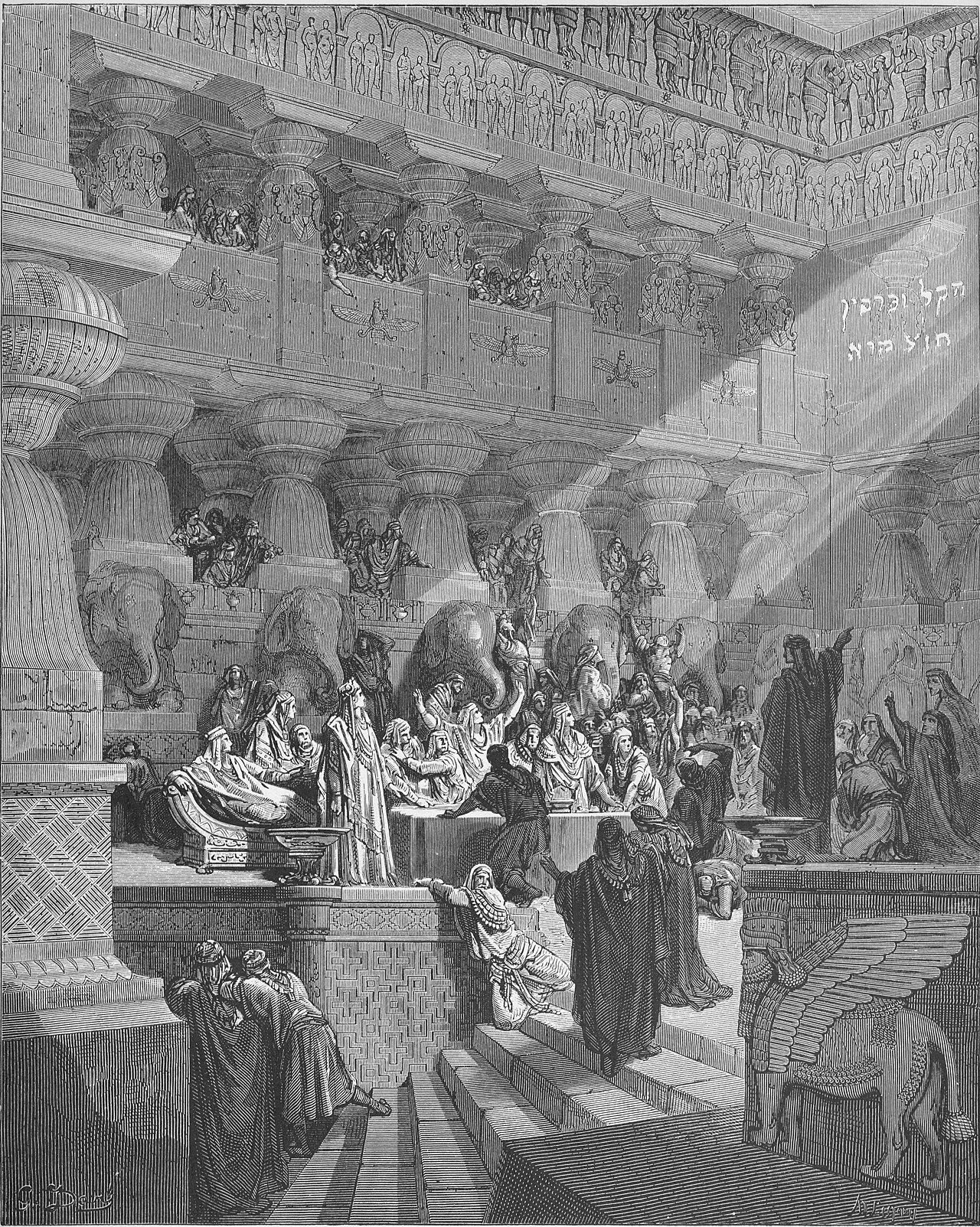
in Daniel 5Later, King Belshazzar held a great feast for a thousand of his nobles, and he drank wine with them.
BSB
The same verse in ASV and KJV ▾
ASV
Belshazzar the king made a great feast to a thousand of his lords, and drank wine before the thousand.
KJV
Belshazzar the king made a great feast to a thousand of his lords, and drank wine before the thousand.
⋯
This verse in Daniel 5
Commentary
5 notes on this verseVerse 1. "Belshazzar the king made a great feast for his one thousand nobles; and each one drank in the order of his age." It should be known that this man was not the son of Nebuchadnezzar, as readers commonly imagine; but according to Berosus, who wrote the history of the Chaldeans, and also Josephus, who follows Berosus, after Nebuchadnezzar's reign of forty-three years, a son named Evilmerodach succeeded to his throne.
This site's exposition
made a great feast
on Daniel 5:1-4
Belshazzar's feast opens the chapter on the same stage where Nebuchadnezzar's pride was broken one chapter earlier, and the bench reads the placement as deliberate: a son who had every reason to know what pride costs a king in this book chooses that same night to send for the temple vessels his grandfather took from Jerusalem. Wine before a thousand lords sets the scene as revelry rather than state business, and Gill and Barnes both note the vessels are drunk from precisely because they are sacred, an act of contempt aimed at the God of Israel rather than mere carelessness. The gods of gold, silver, brass, iron, wood and stone are praised in the same breath, idols that cannot see, hear, or know, which the chapter will use against Belshazzar directly at verse 23.
The record, by era
The Puritans and the Awakening1 voice
Belshazzar - The grandson of Nebuchadnezzar. Made a great feast - After the manner of the eastern kings who shewed their magnificence this way. But this is prodigious that he should carouse when the city was besieged, and ready to be taken by Darius the Mede.
The Nineteenth Century2 voices
A commentator
Albert Barnes1798–1870
Notes, Explanatory and Practical, on the Old and New Testaments (1832-1869)
Belshazzar the king - See Introduction to the chapter, Section II. In the Introduction to the chapter here referred to, I have stated what seemed to be necessary in order to illustrate the history of Belshazzar, so far as that can be now known. The statements in regard to this monarch, it is well understood, are exceedingly confused, and the task of reconciling them is now hopeless.
A commentator
Jamieson, Fausset & Brown1802–1910
Commentary Critical and Explanatory on the Whole Bible (1871)
Belshazzar was joint king with his father (called Minus in the inscriptions), but subordinate to him; hence the Babylonian account suppresses the facts which cast discredit on Babylon, namely, that Belshazzar shut himself up in that city and fell at its capture; while it records the surrender of the principal king in Borsippa (see my Introduction to Daniel).
How the passage was read
What the Jewish commentators add
King Belshazzar He was his son, and he reigned after Evil-merodach, who reigned instead of Nebuchadnezzar, and (he) too was the son of Nebuchadnezzar.
This section is reception history: how the passage was read and kept in the Jewish tradition. Where a reading parts from an essential of the Christian faith, the section says so at that point.
Texts and citation data: Sefaria; each excerpt follows its version’s licence. 2 further sources are cited on this chapter that carry no English text this site may quote or only restate the verse.
The words behind it
11 Hebrew wordsEvery Hebrew word of this verse in the order it stands, with what it means and the door to its own study. The last column counts the times a word stands in the whole Bible: the rarer the word, the more the places it appears belong together.
| Hebrew | Sound | Meaning | Word study | In the Bible |
|---|---|---|---|---|
| בֵּלְשַׁאצַּ֣ר | beleshatzar | Belshazzar | H1113 → | 7 times |
| מַלְכָּ֗א | malka' | king the | H4430 → | 180 times |
| עֲבַד֙ | ʾavad | he made | H5648 → | 28 times |
| לְחֶ֣ם | lechem | a feast | H3900 → | |
| רַ֔ב | rav | great | H7229 → | 15 times |
| לְרַבְרְבָנ֖וֹהִי | leravrevanohi | for nobles his | H7261 → | 8 times |
| אֲלַ֑ף | ʾalaf | a thousand | H506 → | 4 times |
| וְלָקֳבֵ֥ל | velokovel | and <to> before | H6903 → | 29 times |
| אַלְפָּ֖א | ʾalpa' | thousand the | H506 → | 4 times |
| חַמְרָ֥א | chamra' | <the> wine | H2562 → | 6 times |
| שָׁתֵֽה׃ | shateh | [he was] drinking | H8355 → | 5 times |
בֵּלְשַׁאצַּ֣רBelshazzar
beleshatzarH1113 →7 times
מַלְכָּ֗אking the
malka'H4430 →180 times
עֲבַד֙he made
ʾavadH5648 →28 times
לְחֶ֣םa feast
lechemH3900 →
רַ֔בgreat
ravH7229 →15 times
לְרַבְרְבָנ֖וֹהִיfor nobles his
leravrevanohiH7261 →8 times
אֲלַ֑ףa thousand
ʾalafH506 →4 times
וְלָקֳבֵ֥לand <to> before
velokovelH6903 →29 times
אַלְפָּ֖אthousand the
ʾalpa'H506 →4 times
חַמְרָ֥א<the> wine
chamra'H2562 →6 times
שָׁתֵֽה׃[he was] drinking
shatehH8355 →5 times
A shaded row is a word that stands 400 times or fewer in the Bible.
The walk
8 stopsEach card is a verse this one points to, and under it the verses that one points to in turn. Where several paths arrive at the same place, that place is listed first: the text keeps returning to it.
Through
Esther 1:3In the third year of his reign, Xerxes held a feast for all his officials and servants. The military leaders of Persia and Media were there, along with the nobles and princes of the…
it leads to
- Mark 6:21
On Herod’s birthday, her opportunity arose. Herod held a banquet for his nobles and military commanders and the leading men of Galilee.
Reached by 2 separate paths from here.
- Esther 2:18
Then the king held a great banquet, Esther’s banquet, for all his officials and servants. He proclaimed a tax holiday in the provinces and gave gifts worthy of the king’s bounty.
- Mark 6:21
Through
Jeremiah 51:57I will make her princes and wise men drunk, along with her governors, officials, and warriors. Then they will fall asleep forever and not wake up,” declares the King, whose name is the LORD…
it leads to
- Jeremiah 25:27
“Then you are to tell them that this is what the LORD of Hosts, the God of Israel, says: ‘Drink, get drunk, and vomit. Fall down and never get up again, because of the…
Reached by 2 separate paths from here.
- Jeremiah 46:18
As surely as I live, declares the King, whose name is the LORD of Hosts, there will come one who is like Tabor among the mountains and like Carmel by the sea.
- Jeremiah 25:27
Through
Genesis 40:20On the third day, which was Pharaoh’s birthday, he held a feast for all his officials, and in their presence he lifted up the heads of the chief cupbearer and the chief baker.
it leads to
- Genesis 40:19
Within three days Pharaoh will lift off your head and hang you on a tree. Then the birds will eat the flesh of your body.”
- Genesis 40:13
Within three days Pharaoh will lift up your head and restore your position. You will put Pharaoh’s cup in his hand, just as you did when you were his cupbearer.
- Matthew 14:6
On Herod’s birthday, however, the daughter of Herodias danced before them and pleased Herod
- Genesis 40:19
Through
Jeremiah 51:39While they are flushed with heat, I will serve them a feast, and I will make them drunk so that they may revel; then they will fall asleep forever and never wake up, declares…
it leads to
- Jeremiah 51:57
I will make her princes and wise men drunk, along with her governors, officials, and warriors. Then they will fall asleep forever and not wake up,” declares the King, whose name is the LORD…
- Jeremiah 51:57
Where this verse is studied
On this page
Studies4
What the record shows
2 entries- Belshazzar — attested in contemporary inscriptionundisputed
Nabonidus Cylinder (Sippar); 'Verse Account of Nabonidus'; administrative tablets
Biblical figure (Son and co-regent of Nabonidus, ca. 550-539 BC) identified in extra-biblical epigraphy.
Counterpoint: The cuneiform texts call Belshazzar the son and crown prince of Nabonidus, and no Babylonian document ever gives him the royal title "king," which Daniel 5 does. Historians such as Paul-Alain Beaulieu also point out that Daniel calls Nebuchadnezzar his father, though the two were not related by blood — defenders answer that "father" can mean royal predecessor and that Belshazzar ruled in fact if not in title.
- Nabonidus Cylinder (Sippar)undisputed
Sippar (and Ur duplicates) · British Museum
Counterpoint: The cylinder names Belshazzar as Nabonidus's son and prays for him, but no Babylonian text ever gives Belshazzar the title of king — Paul-Alain Beaulieu's study of the reign finds he acted with royal authority in his father's absence without ever holding the kingship. Alan Millard defends Daniel's usage as a functional co-regency and 'father' as dynastic ancestry; the question remains genuinely argued.
About Daniel
This page draws on Albert Barnes, Notes on the Book of Daniel; Albert Barnes, Notes, Explanatory and Practical, on the Old and New Testaments (1832-1869); Jamieson, Fausset & Brown, Commentary Critical and Explanatory on the Whole Bible; Jerome, Commentary on Daniel; John Gill, Exposition of the Old Testament and John Wesley, Explanatory Notes upon the Old Testament.