
Daniel 5:2
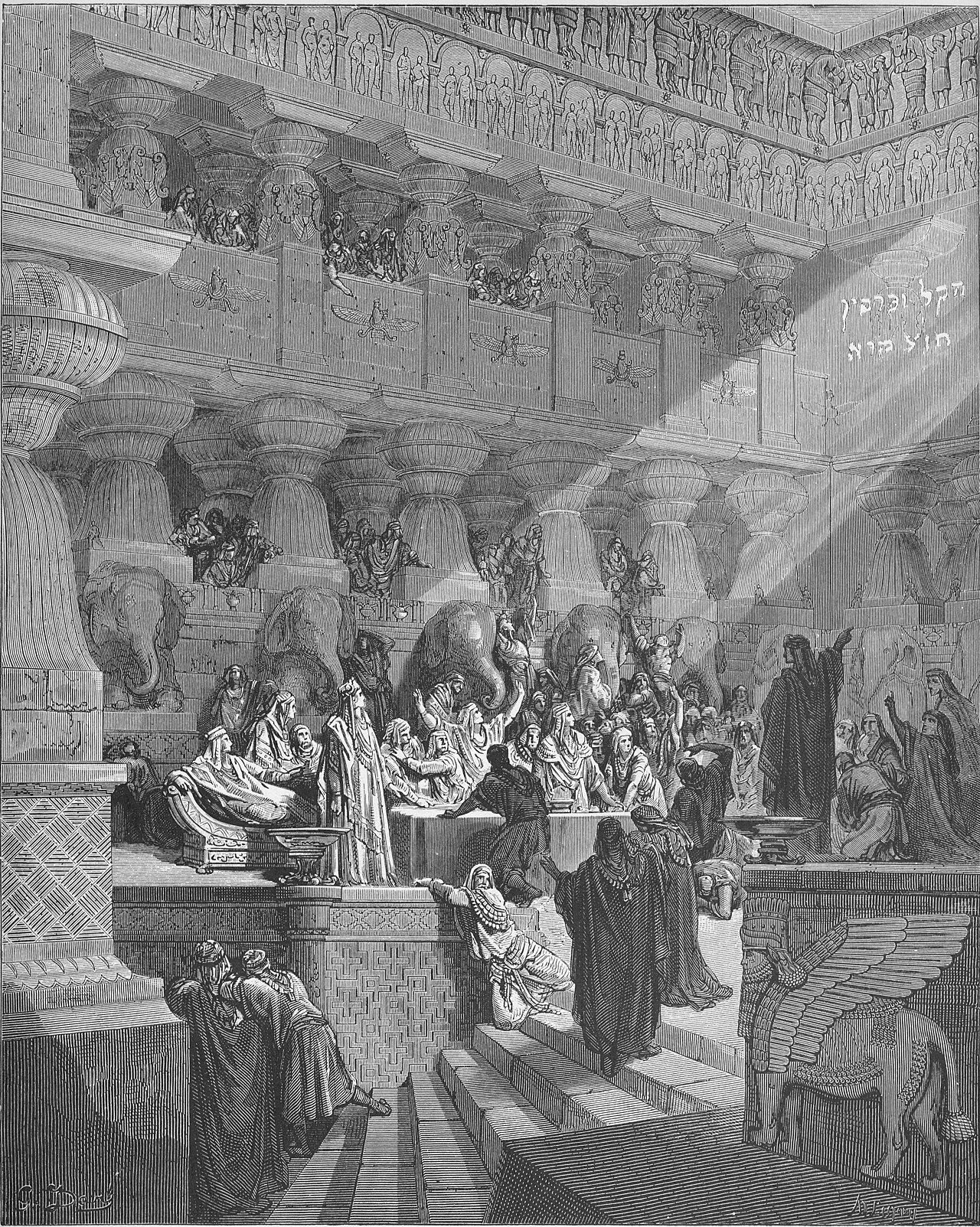
in Daniel 5Under the influence of the wine, Belshazzar gave orders to bring in the gold and silver vessels that Nebuchadnezzar his father had taken from the temple in Jerusalem, so that the king could drink from them, along with his nobles, his wives, and his concubines.
BSB
The same verse in ASV and KJV ▾
ASV
Belshazzar, while he tasted the wine, commanded to bring the golden and silver vessels which Nebuchadnezzar his father had taken out of the temple which was in Jerusalem; that the king and his lords, his wives and his concubines, might drink therefrom.
KJV
Belshazzar, whiles he tasted the wine, commanded to bring the golden and silver vessels which his father Nebuchadnezzar had taken out of the temple which was in Jerusalem; that the king, and his princes, his wives, and his concubines, might drink therein.
⋯
This verse in Daniel 5
Commentary
14 notes on this verseA commentator
Jamieson, Fausset & Brown1802–1910
Commentary Critical and Explanatory on the Whole Bible (1871)
BEROSUS makes Nabonidus, the last king, to have been one of the people, raised to the throne by an insurrection. As the inscriptions show that Belshazzar was distinct from, and joint king with, him, this is not at variance with Daniel, whose statement that Belshazzar was son (grandson) of Nebuchadnezzar is corroborated by Jeremiah (Jer 27:7).
This site's exposition
made a great feast
on Daniel 5:1-4
Belshazzar's feast opens the chapter on the same stage where Nebuchadnezzar's pride was broken one chapter earlier, and the bench reads the placement as deliberate: a son who had every reason to know what pride costs a king in this book chooses that same night to send for the temple vessels his grandfather took from Jerusalem. Wine before a thousand lords sets the scene as revelry rather than state business, and Gill and Barnes both note the vessels are drunk from precisely because they are sacred, an act of contempt aimed at the God of Israel rather than mere carelessness. The gods of gold, silver, brass, iron, wood and stone are praised in the same breath, idols that cannot see, hear, or know, which the chapter will use against Belshazzar directly at verse 23.
The record, by era
The Church Fathers5 voices
Verse 2. "Being now drunken, he therefore gave order that the golden and silver vessels be brought in which his father, Nebuchadnezzar, had taken away from the temple which was in Jerusalem, in order that the king might drink from them..."
"Under the influence of wine, he commanded that they bring the vessels" from the sanctuary and did not hesitate in showing them to his lords and concubines and other guests, as he intended to use them for a profane symposium. His father had taken those …
In other words, intoxication confused his thinking, and intemperance gave rise to this insane action against God: the vessels consecrated to the worship of God, which his father Nebuchadnezzar had seized when God surrendered them but had honored in the way he thought fit and …
Therefore I summon you before God and Jesus Christ and his elect angels to guard that which you have received, not readily exposing to the public gaze the vessels of the Lord's temple.… Unchaste eyes see nothing correctly. They fail to appreciate the beauty of the soul and only value that of the body. Hezekiah showed God's treasure to the Assyrians, who ought never to have seen what they were sure to covet. The consequence was that Judea was torn by continual wars and that the very first things carried away to Babylon were these vessels of the Lord. We find Belshazzar at his feast and among his concubines (vice always glories in defiling what is noble) drinking out of these sacred cups.
While they were drunk, the king, being puffed up, commanded that the golden and silver vessels, which Nebuchadnezzar his father had brought out from the Temple which was in Jerusalem, to be brought forth, that the magistrate and his mistresses may drink from them. Those vessels, which were dedicated to God for his glory and honor by other kings, they took with defiled hands, and made a drink offering in them and praised the lifeless and motionless idols.
7 more voices on this verse
The Medieval Church3 voices
The words "at the taste of the wine, [Belshazzar] said," that is, after he became drunk and unreasonable as a consequence of tasting wine.
The third kind of relative worship we give to objects dedicated to God, such as the holy Gospel and other books, for they have been written for our instruction, on whom the end of the ages has come. Obviously, patens, chalices, censers, candlesticks and altars should all receive respect. Remember how Belshazzar made his people serve wine in sacred vessels and how God brought his kingdom to an end.
[God] showed that His true servants and friends are those who walk before Him in fear and reverence and do His will, since virtuous deeds and purity of conscience are things holy [and beloved] of God. But when people repudiate His paths, the Lord repudiates …
The Puritans and the Awakening2 voices
While he tasted the wine, he commanded to bring the vessels of the temple, that they might drink in them. When he tasted how rich and fine the wine was, "O," said he, "it is a pity but we should have holy vessels to drink such delicious wine as this in," which was looked upon as a piece of wit, and, to carry on the humour, the vessels of the temple were immediately sent for.
Belshazzar, while he tasted the wine,....
The Nineteenth Century2 voices
Whiles he tasted the wine - He relished it, got heated by it, and when Wine got fully in, Wit went wholly out; and in consequence he acted the profane part of which we immediately read.
A commentator
Albert Barnes1798–1870
Notes, Explanatory and Practical, on the Old and New Testaments (1832-1869)
proposed
Belshazzar, while he tasted the wine - As the effect of tasting the wine - stating a fact which is illustrated in every age and land, that men, under the influence of intoxicating drinks, will do what they would not do when sober. In his sober moments it would seem probable that he would have respected the vessels consecrated to the service of religion, and would not have treated them with dishonor by introducing them for purposes of revelry. Commanded to bring the golden and silver vessels - These vessels had been carefully deposited in some place as the spoils of victory (see Dan 1:2), and it would appear that they had not before been desecrated for purposes of feasting. Belshazzar did what other men would have done in the same condition. He wished to make a display; to do something unusually surprising; and, though it had not been contemplated when the festival was appointed to make use of these vessels, yet, under the excitement of wine, nothing was too sacred to be introduced to the scenes of intoxication; nothing too foolish to be done. In regard to the vessels taken from the temple at Jerusalem, see the note at Dan 1:2. Which his father Nebuchadnezzar had taken - Margin, “grandfather.” According to the best account which we have of Belshazzar, he was the son of Evil-Merodach, who was the son of Nebuchadnezzar (see the Introduction to the chapter, Section II.), and therefore the word is used here, as in the margin, to denote grandfather. Compare Jer 27:7. See the note at Isa 14:22. The word father is often used in a large signification. See 2Sa 9:7; also the notes at Mat 1:1. […]
How the passage was read
What the Jewish commentators add
On the verses either side of this one
King Belshazzar He was his son, and he reigned after Evil-merodach, who reigned instead of Nebuchadnezzar, and (he) too was the son of Nebuchadnezzar.
This section is reception history: how the passage was read and kept in the Jewish tradition. Where a reading parts from an essential of the Christian faith, the section says so at that point.
Texts and citation data: Sefaria; each excerpt follows its version’s licence. 2 further sources are cited on this chapter that carry no English text this site may quote or only restate the verse.
The words behind it
22 Hebrew wordsEvery Hebrew word of this verse in the order it stands, with what it means and the door to its own study. The last column counts the times a word stands in the whole Bible: the rarer the word, the more the places it appears belong together.
| Hebrew | Sound | Meaning | Word study | In the Bible |
|---|---|---|---|---|
| בֵּלְשַׁאצַּ֞ר | beleshatzar | Belshazzar | H1113 → | 7 times |
| אֲמַ֣ר׀ | ʾamar | he said | H560 → | 71 times |
| בִּטְעֵ֣ם | bitem | in [the] taste of | H2942 → | 28 times |
| חַמְרָ֗א | chamra' | wine the | H2562 → | 6 times |
| לְהַיְתָיָה֙ | lehaytayah | to bring | H858 → | 16 times |
| לְמָאנֵי֙ | lemanei | <obj.> [the] vessels of | H3984 → | 7 times |
| דַּהֲבָ֣א | dahava' | <the> gold | H1722 → | 23 times |
| וְכַסְפָּ֔א | vekhaspa' | and <the> silver | H3702 → | 13 times |
| דִּ֤י | di | which | H1768 → | 345 times |
| הַנְפֵּק֙ | hanpek | he had brought out | H5312 → | 11 times |
| נְבוּכַדְנֶצַּ֣ר | nevukhadnetzar | Nebuchadnezzar | H5020 → | 31 times |
| אֲב֔וּהִי | ʾavuhi | father his | H2 → | 9 times |
| מִן־ | min- | from | H4481 → | 109 times |
| הֵיכְלָ֖א | heikhla' | temple the | H1965 → | 13 times |
| דִּ֣י | di | which | H1768 → | 345 times |
| בִירוּשְׁלֶ֑ם | virushelem | [was] in Jerusalem | H3390 → | 26 times |
| וְיִשְׁתּ֣וֹן | veyishton | so they may drink | H8355 → | 5 times |
| בְּה֗וֹן | behon | with <the> them | ||
| מַלְכָּא֙ | malka' | king the | H4430 → | 180 times |
| וְרַבְרְבָנ֔וֹהִי | veravrevanohi | and nobles his | H7261 → | 8 times |
| שֵׁגְלָתֵ֖הּ | shegelateh | wives his | H7695 → | 3 times |
| וּלְחֵנָתֵֽהּ׃ | ulechenateh | and concubines his | H3904 → | 3 times |
בֵּלְשַׁאצַּ֞רBelshazzar
beleshatzarH1113 →7 times
אֲמַ֣ר׀he said
ʾamarH560 →71 times
בִּטְעֵ֣םin [the] taste of
bitemH2942 →28 times
חַמְרָ֗אwine the
chamra'H2562 →6 times
לְהַיְתָיָה֙to bring
lehaytayahH858 →16 times
לְמָאנֵי֙<obj.> [the] vessels of
lemaneiH3984 →7 times
דַּהֲבָ֣א<the> gold
dahava'H1722 →23 times
וְכַסְפָּ֔אand <the> silver
vekhaspa'H3702 →13 times
דִּ֤יwhich
diH1768 →345 times
הַנְפֵּק֙he had brought out
hanpekH5312 →11 times
נְבוּכַדְנֶצַּ֣רNebuchadnezzar
nevukhadnetzarH5020 →31 times
אֲב֔וּהִיfather his
ʾavuhiH2 →9 times
מִן־from
min-H4481 →109 times
הֵיכְלָ֖אtemple the
heikhla'H1965 →13 times
דִּ֣יwhich
diH1768 →345 times
בִירוּשְׁלֶ֑ם[was] in Jerusalem
virushelemH3390 →26 times
וְיִשְׁתּ֣וֹןso they may drink
veyishtonH8355 →5 times
בְּה֗וֹןwith <the> them
behon
מַלְכָּא֙king the
malka'H4430 →180 times
וְרַבְרְבָנ֔וֹהִיand nobles his
veravrevanohiH7261 →8 times
שֵׁגְלָתֵ֖הּwives his
shegelatehH7695 →3 times
וּלְחֵנָתֵֽהּ׃and concubines his
ulechenatehH3904 →3 times
A shaded row is a word that stands 400 times or fewer in the Bible.
The walk
8 stopsEach card is a verse this one points to, and under it the verses that one points to in turn. Where several paths arrive at the same place, that place is listed first: the text keeps returning to it.
Through
Daniel 1:2And the Lord delivered into his hand Jehoiakim king of Judah, along with some of the articles from the house of God. He carried these off to the land of Shinar, to the house…
it leads to
- 2 Chronicles 36:7
Nebuchadnezzar also took to Babylon some of the articles from the house of the LORD, and he put them in his temple in Babylon.
- Jeremiah 27:19–20
For this is what the LORD of Hosts says about the pillars, the sea, the bases, and the rest of the articles that remain in this city,
- Zechariah 5:11
“To build a house for it in the land of Shinar,” he told me. “And when it is ready, the basket will be set there on its pedestal.”
- 2 Chronicles 36:7
Through
Daniel 5:23Instead, you have exalted yourself against the Lord of heaven. The vessels from His house were brought to you, and as you drank wine from them with your nobles, wives, and concubines, you praised…
it leads to
- Job 12:10
The life of every living thing is in His hand, as well as the breath of all mankind.
- Daniel 4:37
Now I, Nebuchadnezzar, praise and exalt and glorify the King of heaven, for all His works are true and all His ways are just. And He is able to humble those who walk in…
- Isaiah 37:23
Whom have you taunted and blasphemed? Against whom have you raised your voice and lifted your eyes in pride? Against the Holy One of Israel!
- Job 12:10
Through
2 Kings 24:13As the LORD had declared, Nebuchadnezzar also carried off all the treasures from the house of the LORD and the royal palace, and he cut into pieces all the gold articles that Solomon king…
it leads to
- Isaiah 39:6
The time will surely come when everything in your palace and all that your fathers have stored up until this day will be carried off to Babylon. Nothing will be left, says the LORD.
- 2 Kings 20:17
The time will surely come when everything in your palace and all that your fathers have stored up until this day will be carried off to Babylon. Nothing will be left, says the LORD.
- Isaiah 39:6
Where this verse is studied
About Daniel
Who and where
1 name in this verse with a page on the site.
This page draws on 15 works. Open the list of works
This page draws on Adam Clarke, Commentary on the Bible; Albert Barnes, Notes on the Book of Daniel; Albert Barnes, Notes, Explanatory and Practical, on the Old and New Testaments (1832-1869); Ephrem the Syrian, COMMENTARY ON DANIEL 5:1; Hippolytus of Rome, Commentary on Daniel 3.14.4; Isaac of Nineveh, ASCETICAL HOMILIES 10; Ishodad of Merv, COMMENTARY ON DANIEL 5:2; Jamieson, Fausset & Brown, Commentary Critical and Explanatory on the Whole Bible; Jerome, St. Jerome, Commentary on Daniel, CHAPTER FIVE; Jerome, LETTER 22.23; John Damascene, ON DIVINE IMAGES 3:35; John Gill, Exposition of the Old Testament; John Gill, Exposition of the Old Testament (1748-1763); Matthew Henry, Commentary on the Whole Bible and Theodoret of Cyrus, COMMENTARY ON DANIEL 5:2.