
Daniel 5:7
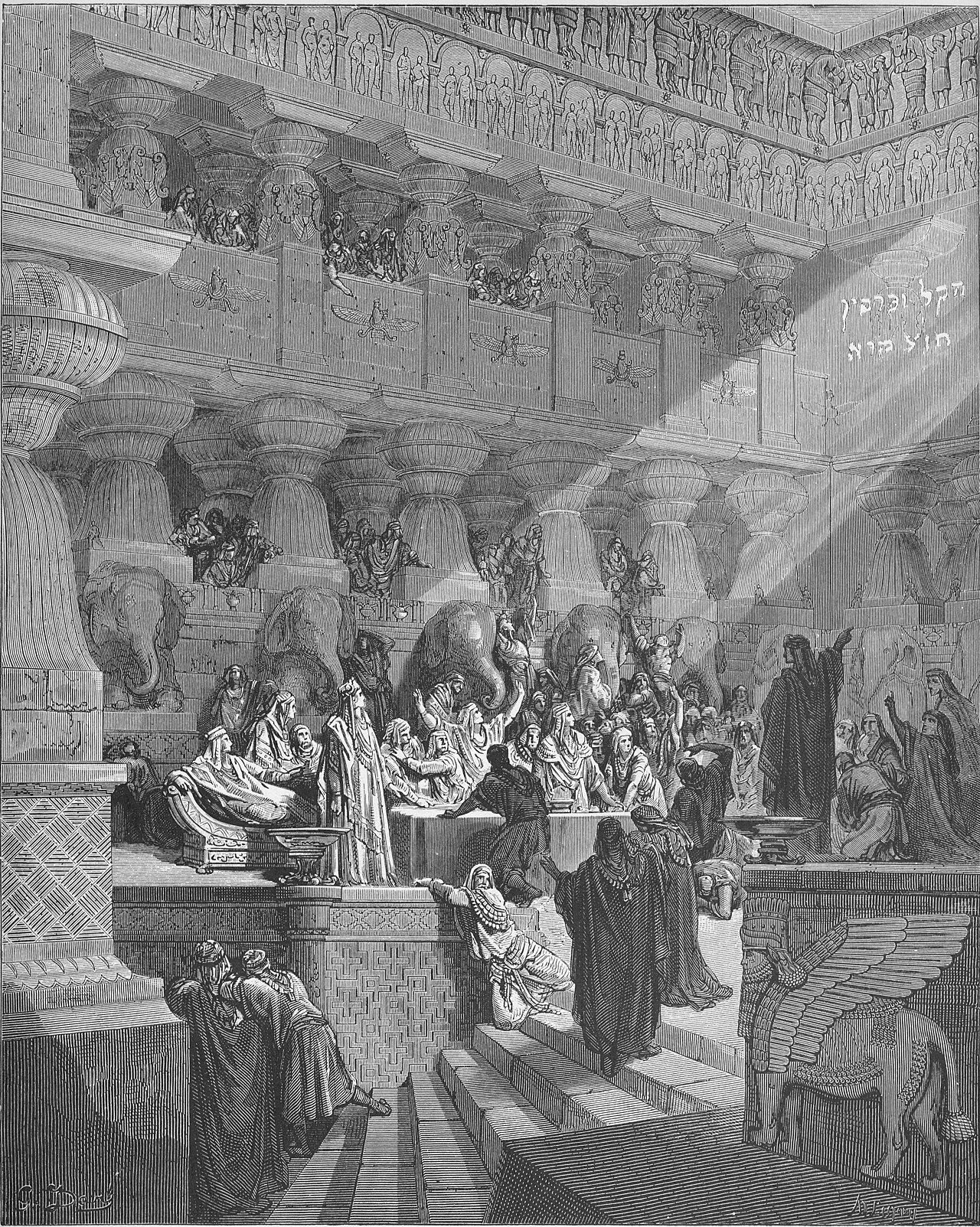
in Daniel 5The king called out for the enchanters, astrologers, and diviners to be brought in, and he said to these wise men of Babylon, “Whoever reads this inscription and tells me its interpretation will be clothed in purple and have a gold chain placed around his neck, and he will be made the third highest ruler in the kingdom.”
BSB
The same verse in ASV and KJV ▾
ASV
The king cried aloud to bring in the enchanters, the Chaldeans, and the soothsayers. The king spake and said to the wise men of Babylon, Whosoever shall read this writing, and show me the interpretation thereof, shall be clothed with purple, and have a chain of gold about his neck, and shall be the third ruler in the kingdom.
KJV
The king cried aloud to bring in the astrologers, the Chaldeans, and the soothsayers. And the king spake, and said to the wise men of Babylon, Whosoever shall read this writing, and shew me the interpretation thereof, shall be clothed with scarlet, and have a chain of gold about his neck, and shall be the third ruler in the kingdom.
⋯
This verse in Daniel 5
Commentary
10 notes on this verseVerse 7. The king therefore cried out vehemently that the magicians should be brought in, and the Chaldeans and the soothsayers..." Forgetting about the experiences of Nebuchadnezzar, he was following after the ancient and ingrained error of his family, so that instead of summoning a prophet of God he summons the magicians and Chaldeans and soothsayers. "...he shall be clothed in purple and he shall have a golden necklace about his neck."
This site's exposition
the third ruler in the kingdom
on Daniel 5:7-9
The king's wise men are called for exactly as Nebuchadnezzar once called for his, and fail exactly as they once failed, the second such scene in the book and the second time Babylon's own experts cannot read what Babylon's own God has written. The promised reward, scarlet clothing, a gold chain, and the third ruler in the kingdom, has puzzled readers expecting first or second place, and the evidence lane answers it directly below rather than treating it as a slip of the pen. Verse 9 leaves the whole court astonied, the same word used of Nebuchadnezzar's counselors, tying this failure to the pattern the book has already established twice.
The record, by era
The Church Fathers2 voices
Now we have to consider the mere ornaments and trappings of office. Each has its proper dress for daily and for ceremonial use. In Egypt and Babylon, the purple robe and gold necklaces were marks of rank, just as provincial priests have their golden wreaths and their robes of state.… But there was a difference in the obligation. They were conferred on men who earned the king's friendship, simply as a mark of honor.… Purple as such, then, was not yet a mark of high office among the barbarians, but of free birth. Joseph, who had been a slave, and Daniel, who had changed his status by captivity, attained citizenship of Egypt or Babylon by means of the garments that indicated free birth among the barbarians.
When the king saw this he quaked in fear and was in much distress, and he shouted in strength to bring in magicians, Chaldeans and soothsayers, not knowing that it is not possible for these to read the letters of God, but it is possible for those who from childhood practiced the law of God who also recognize the divine letters from their fathers.
The Puritans and the Awakening3 voices
He knew what these pretenders to wisdom aimed at, and what would please them, and therefore promised them a scarlet robe and a gold chain, glorious things in the eyes of those that know no better. Nay, he should be primus par regni--chief minister of state, the third ruler in the kingdom, next to the king and his heir apparent.
The king cried aloud to bring in the astrologers, the Chaldeans, and the soothsayers,.... Or, "with strength" (n); with a strong voice, as loud as he could; which is expressive of the fright he was in, and of his eagerness and impatience of information; laying aside all decency, and forgetting his royal majesty, like a man out of his senses, quite distracted, as it were: of the "astrologers", &c.
The interpretation of the mystical characters by Daniel, who was at length brought in to him, and dealt plainly with him, and showed him his doom written,
3 more voices on this verse
The Nineteenth Century3 voices
A commentator
Jamieson, Fausset & Brown1802–1910
Commentary Critical and Explanatory on the Whole Bible (1871)
The world wishes to be deceived and shuts its eyes against the light [CALVIN]. The Hebrews think the words were Chaldee, but in the old Hebrew character (like that now in the Samaritan Pentateuch). third ruler--The first place was given to the king; the second, to the son of the king, or of the queen; the third, to the chief of the satraps.
Whosoever shall read this writing - He knew it must be some awful portent, and wished to know what.
A commentator
Albert Barnes1798–1870
Notes, Explanatory and Practical, on the Old and New Testaments (1832-1869)
proposed
And the king cried aloud - Margin, as in the Chaldee, “with might.” This indicates a sudden and an alarming cry. The king was deeply terrified; and, unable himself to divine the meaning of the mysterious appearance of the hand, he naturally turned at once to those whose office it was to explain dreams and supernatural appearances. To bring in the astrologers ... - See the note at Dan 2:2; Dan 4:
The words behind it
31 Hebrew wordsEvery Hebrew word of this verse in the order it stands, with what it means and the door to its own study. The last column counts the times a word stands in the whole Bible: the rarer the word, the more the places it appears belong together.
| Hebrew | Sound | Meaning | Word study | In the Bible |
|---|---|---|---|---|
| קָרֵ֤א | kare' | [was] calling | H7123 → | 11 times |
| מַלְכָּא֙ | malka' | king the | H4430 → | 180 times |
| בְּחַ֔יִל | bechayil | with power | H2429 → | 7 times |
| לְהֶֽעָלָה֙ | lehealah | to bring in | H5954 → | 14 times |
| לְאָ֣שְׁפַיָּ֔א | leashefaiya' | <obj.> conjurers the | H826 → | 6 times |
| כַּשְׂדָּאֵ֖י | kasdae | Chaldeans the | H3779 → | 8 times |
| וְגָזְרַיָּ֑א | vegazeraiya' | and astrologers the | H1505 → | 6 times |
| עָנֵ֨ה | ʾaneh | [was] replying | H6032 → | 30 times |
| מַלְכָּ֜א | malka' | king the | H4430 → | 180 times |
| וְאָמַ֣ר׀ | veamar | and [was] saying | H560 → | 71 times |
| לְחַכִּימֵ֣י | lechakimei | to [the] wise men of | H2445 → | 14 times |
| בָבֶ֗ל | vavel | Babylon | H895 → | 25 times |
| דִּ֣י | di | that | H1768 → | 345 times |
| כָל־ | khol- | any | H3606 → | 82 times |
| אֱ֠נָשׁ | ʾenosh | person | H606 → | 25 times |
| דִּֽי־ | di- | who | H1768 → | 345 times |
| יִקְרֵ֞ה | yikreh | he will read aloud | H7123 → | 11 times |
| כְּתָבָ֣ה | ketavah' | writing the | H3792 → | 12 times |
| דְנָ֗ה | denah | this | H1836 → | 58 times |
| וּפִשְׁרֵהּ֙ | ufishreh | and interpretation its | H6591 → | 31 times |
| יְחַוִּנַּ֔נִי | yechavvinani | he will declare to me | H2324 → | 14 times |
| אַרְגְּוָנָ֣א | ʾargevana' | <the> purple | H711 → | 3 times |
| יִלְבַּ֗שׁ | yilbash | he will be clothed | H3848 → | 3 times |
| וְהַֽמְנִיכָ֤א | vehamonkha' | and necklace the | H2002 → | 3 times |
| דִֽי־ | di- | of | H1768 → | 345 times |
| דַהֲבָא֙ | dahava' | <the> gold | H1722 → | 23 times |
| עַֽל־ | ʾal- | [will be] on | H5922 → | 104 times |
| צַוְּארֵ֔הּ | tzavereh | neck his | H6676 → | 3 times |
| וְתַלְתִּ֥י | vetalti | and third | H8523 → | |
| בְמַלְכוּתָ֖א | vemalkhuta' | in kingdom the | H4437 → | 57 times |
| יִשְׁלַֽט׃ ס | yishlat | he will rule | H7981 → | 7 times |
קָרֵ֤א[was] calling
kare'H7123 →11 times
מַלְכָּא֙king the
malka'H4430 →180 times
בְּחַ֔יִלwith power
bechayilH2429 →7 times
לְהֶֽעָלָה֙to bring in
lehealahH5954 →14 times
לְאָ֣שְׁפַיָּ֔א<obj.> conjurers the
leashefaiya'H826 →6 times
כַּשְׂדָּאֵ֖יChaldeans the
kasdaeH3779 →8 times
וְגָזְרַיָּ֑אand astrologers the
vegazeraiya'H1505 →6 times
עָנֵ֨ה[was] replying
ʾanehH6032 →30 times
מַלְכָּ֜אking the
malka'H4430 →180 times
וְאָמַ֣ר׀and [was] saying
veamarH560 →71 times
לְחַכִּימֵ֣יto [the] wise men of
lechakimeiH2445 →14 times
בָבֶ֗לBabylon
vavelH895 →25 times
דִּ֣יthat
diH1768 →345 times
כָל־any
khol-H3606 →82 times
אֱ֠נָשׁperson
ʾenoshH606 →25 times
דִּֽי־who
di-H1768 →345 times
יִקְרֵ֞הhe will read aloud
yikrehH7123 →11 times
כְּתָבָ֣הwriting the
ketavah'H3792 →12 times
דְנָ֗הthis
denahH1836 →58 times
וּפִשְׁרֵהּ֙and interpretation its
ufishrehH6591 →31 times
יְחַוִּנַּ֔נִיhe will declare to me
yechavvinaniH2324 →14 times
אַרְגְּוָנָ֣א<the> purple
ʾargevana'H711 →3 times
יִלְבַּ֗שׁhe will be clothed
yilbashH3848 →3 times
וְהַֽמְנִיכָ֤אand necklace the
vehamonkha'H2002 →3 times
דִֽי־of
di-H1768 →345 times
דַהֲבָא֙<the> gold
dahava'H1722 →23 times
עַֽל־[will be] on
ʾal-H5922 →104 times
צַוְּארֵ֔הּneck his
tzaverehH6676 →3 times
וְתַלְתִּ֥יand third
vetaltiH8523 →
בְמַלְכוּתָ֖אin kingdom the
vemalkhuta'H4437 →57 times
יִשְׁלַֽט׃ סhe will rule
yishlatH7981 →7 times
A shaded row is a word that stands 400 times or fewer in the Bible.
The walk
8 stopsEach card is a verse this one points to, and under it the verses that one points to in turn. Where several paths arrive at the same place, that place is listed first: the text keeps returning to it.
Through
Daniel 5:16But I have heard about you, that you are able to give interpretations and solve difficult problems. Therefore, if you can read this inscription and give me its interpretation, you will be clothed in…
it leads to
- Daniel 5:29
Then Belshazzar gave the command, and they clothed Daniel in purple, placed a gold chain around his neck, and proclaimed him the third highest ruler in the kingdom.
Reached by 3 separate paths from here.
- Genesis 40:8
“We both had dreams,” they replied, “but there is no one to interpret them.” Then Joseph said to them, “Don’t interpretations belong to God? Tell me your dreams.”
- Daniel 5:29
Through
Daniel 2:48Then the king promoted Daniel and gave him many generous gifts. He made him ruler over the entire province of Babylon and chief administrator over all the wise men of Babylon.
it leads to
- Daniel 2:6
But if you tell me the dream and its interpretation, you will receive from me gifts and rewards and great honor. So tell me the dream and its interpretation.”
- Daniel 4:9
“O Belteshazzar, chief of the magicians, I know that the spirit of the holy gods is in you and that no mystery baffles you. So explain to me the visions I saw in my…
- Daniel 5:11
There is a man in your kingdom who has the spirit of the holy gods in him. In the days of your father he was found to have insight, intelligence, and wisdom like that…
- Genesis 41:39–43
Then Pharaoh said to Joseph, “Since God has made all this known to you, there is no one as discerning and wise as you.
- Daniel 2:6
Through
Daniel 5:29Then Belshazzar gave the command, and they clothed Daniel in purple, placed a gold chain around his neck, and proclaimed him the third highest ruler in the kingdom.
it leads to
- Daniel 5:16
But I have heard about you, that you are able to give interpretations and solve difficult problems. Therefore, if you can read this inscription and give me its interpretation, you will be clothed in…
- Daniel 5:16
Through
Daniel 2:6But if you tell me the dream and its interpretation, you will receive from me gifts and rewards and great honor. So tell me the dream and its interpretation.”
it leads to
- Daniel 2:48
Then the king promoted Daniel and gave him many generous gifts. He made him ruler over the entire province of Babylon and chief administrator over all the wise men of Babylon.
- Daniel 2:48
Where this verse is studied
About Daniel
Who and where
1 name in this verse with a page on the site.
This page draws on 10 works. Open the list of works
This page draws on Adam Clarke, Commentary on the Bible; Albert Barnes, Notes on the Book of Daniel; Albert Barnes, Notes, Explanatory and Practical, on the Old and New Testaments (1832-1869); Hippolytus of Rome, Commentary on Daniel 3.15.1; Jamieson, Fausset & Brown, Commentary Critical and Explanatory on the Whole Bible; Jerome, St. Jerome, Commentary on Daniel, CHAPTER FIVE; John Gill, Exposition of the Old Testament; John Gill, Exposition of the Old Testament (1748-1763); Matthew Henry, Commentary on the Whole Bible and Tertullian, ON IDOLATRY 18.