
Daniel 5:10
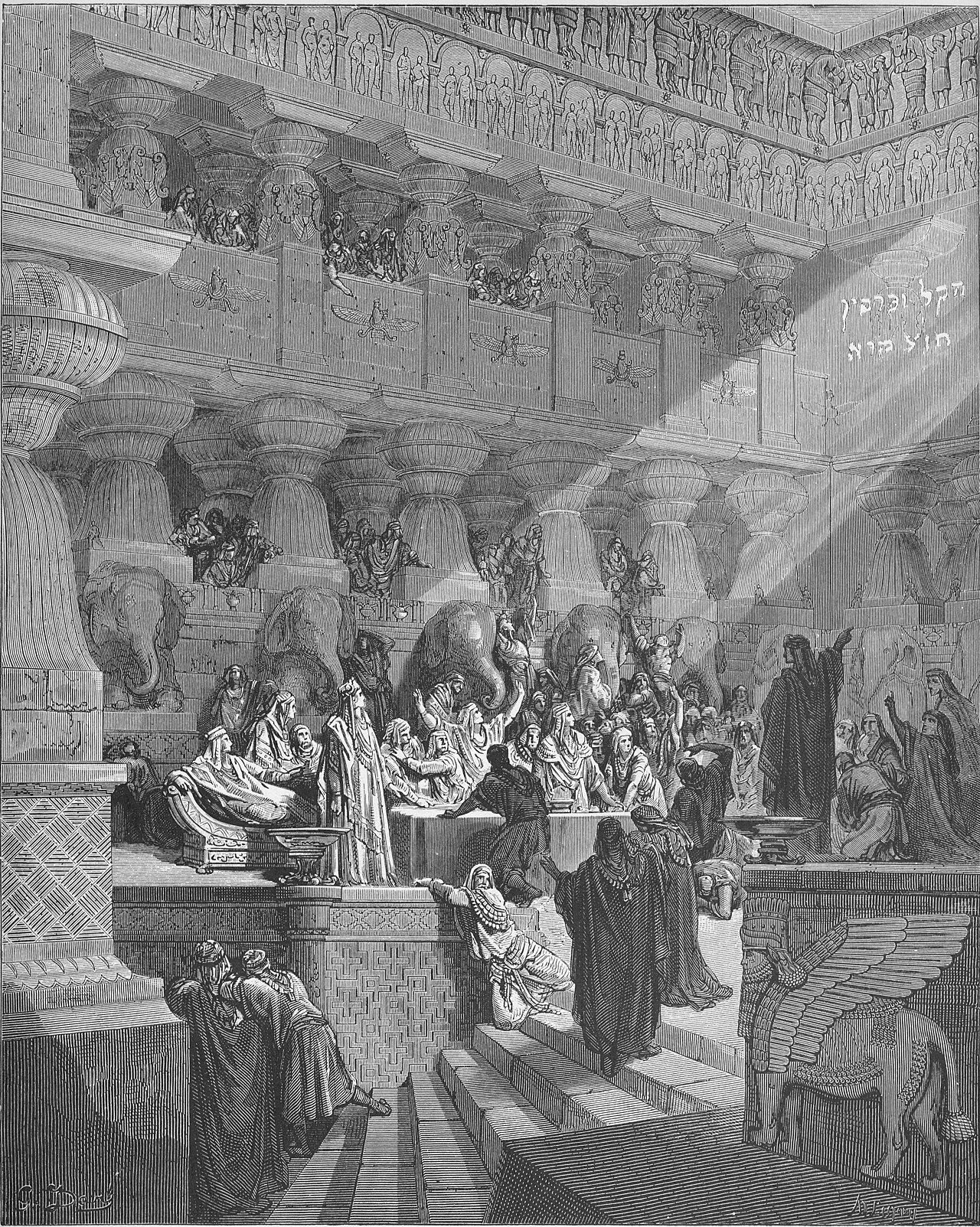
in Daniel 5Hearing the outcry of the king and his nobles, the queen entered the banquet hall. “O king, may you live forever!” she said. “Do not let your thoughts terrify you, or your face grow pale.
BSB
The same verse in ASV and KJV ▾
ASV
Now the queen by reason of the words of the king and his lords came into the banquet house: the queen spake and said, O king, live for ever; let not thy thoughts trouble thee, nor let thy countenance be changed.
KJV
Now the queen, by reason of the words of the king and his lords, came into the banquet house: and the queen spake and said, O king, live for ever: let not thy thoughts trouble thee, nor let thy countenance be changed:
⋯
This verse in Daniel 5
Commentary
9 notes on this verseVerse 10. "Now the queen, by reason of what had happened to the king and his nobles, entered into the banquet-hall..." Josephus says she was Belshazzar's grandmother, whereas Origen says she was his mother. She therefore knew about previous events of which the king was ignorant. So much for Porphyry's far-fetched objection, who fancies that she was the king's wife, and makes fun of the fact that she knows more than her husband does.
This site's exposition
the queen
on Daniel 5:10-12
The queen who enters unsummoned is read by the bench as the queen mother, likely Nebuchadnezzar's own widow, since she remembers Daniel's service under the former king in detail Belshazzar's own generation had apparently forgotten or ignored. Her praise of Daniel, an excellent spirit, knowledge, understanding, and the interpreting of dreams, is offered as inherited memory rather than new information, which the bench reads as an indictment of a court that had let Daniel slip to the margins during Belshazzar's reign. She names him precisely, Daniel whom the king named Belteshazzar, closing the identification before Daniel is even sent for.
The record, by era
The Church Fathers3 voices
This was probably an introduction offered at that time to kings by their subjects; even to this day this custom prevails.
Then at this point, "the queen, having heard what happened, came into the house of the drinking bout and said to the king, 'Let not your thoughts trouble you, and let not your form be changed. There is a man in your kingdom in whom is the Spirit of God, and in the days of your father watchfulness and understanding were found in him. And king Nebuchadnezzar your father set him as chief of the enchanters, magicians, Chaldeans, and soothsayers. Because the Spirit of God abounds in him and thoughts and understanding are his, he interprets dreams and explains difficulties, and solves riddles; his name is Daniel. And the king gave him the name Baltasar. And so now let him be called and he will explain the interpretation to you.'" [Daniel 5:10-12] And so for what reason did the queen enter and call to mind Daniel? For did all the magistrates and friends of the king not know him? Or did they not know the things which occurred to Nebuchadnezzar, as he alone saw the dreams which were meant for him, and he set him as chief of the wise men of Babylon? They themselves also knew, but being destroyed by him, since he was adorned with heavenly wisdom, they did not want to proclaim to the king concerning him, so that he might not come and interpret the writing, and later they would be shamed. This not only happened to Daniel then, but also even now it occurs to many. For when one of the saints acquires grace from God and is found wiser than others, immediately everyone begins coveting, hating, persecuting, insulting, dishonoring, talking down, and setting him at naught, so that by this they imagine him to be nothing. For similarly it also happened upon the prophets and upon the Lord and upon the apostles. In this way also we observe these things coming upon Daniel in Babylon. For Scripture puts forth these things as a proof that they happened in this way.
"Amid the king's and his nobles' words the queen entered the banqueting hall," that is, with them pondering what should be done and various people making various suggestions under pressure of fear, the queen entered. Now, in my view, this lady was his mother: the …
The Puritans and the Awakening1 voice
Now the queen, by reason of the words of the king and his lords, came into the banquet house,....
The Nineteenth Century1 voice
The queen - came - This is generally allowed to have been the widow of Nebuchadnezzar; if so, she was the queen Amiyt, daughter of Astyages, sister of Darius the Mede, and aunt of Cyrus, according to Polyhistor, cited by Cedrenus. See Calmet. Others think that Nitocris was the person who is said to be queen when Cyrus took the city; and is stated to have been a lady of eminent wisdom and discretion, and to have had the chief direction of the public affairs.
2 more voices on this verse
The Nineteenth Century2 voices
A commentator
Jamieson, Fausset & Brown1802–1910
Commentary Critical and Explanatory on the Whole Bible (1871)
proposed
queen--the queen mother, or grandmother, Nitocris, had not been present till now. She was wife either of Nebuchadnezzar or of Evil merodach; hence her acquaintance with the services of Daniel.
quarantine:debris (2026-07-29) — starts-lowercase
A commentator
Albert Barnes1798–1870
Notes, Explanatory and Practical, on the Old and New Testaments (1832-1869)
proposed
Now the queen - “Probably the queen-mother, the Nitocris of Herodotus, as the king’s wives were at the entertainment.” - Wintle. Compare Dan 5:2-3. So Prof. Stuart. The editor of the “Pictorial Bible” also supposes that this was the queen-mother, and thinks that this circumstance will explain her familiarity with the occurrences in the reign of Nebuchadnezzar. He says, “We are informed above, that the ‘wives and concubines’ of the king were present at the banquet. It therefore seems probable that the ‘queen’ who now first appears was the queen-mother; and this probability is strengthened by the intimate acquaintance which she exhibits with the affairs of Nebuchadnezzars reign; at the latter end of which she, as the wife of Evil-Merodach, who was regent during his father’s alienation of mind, took an active part in the internal policy of the kingdom, and in the completion of the great works which Nebuchadnezzar had begun in Babylon. This she continued during the reigns of her husband and son, the present king Belshazzar. This famous queen, Nitocris, therefore, could not but be well acquainted with the character and services of Daniel.” On the place and influence of the queen-mother in the Oriental courts, see Taylor’s Fragments to Calmet’s Dictionary, No. 16. From the extracts which Taylor has collected, it would seem that she held an exalted place at court, and that it is every way probable that she would be called in or would come in, on such an occasion. See also Knolles’ “History of the Turks,” as quoted by Taylor, “Fragments,” No. 50. By reason of the words of the king and his lords - Their words of amazement and astonishment. These would doubtless be conveyed to her, as there was so much alarm in the palace, and as there was a summons to bring in the wise men of Babylon. […]
How the passage was read
What the Jewish commentators add
The queen, in response to the words of the king The queen, because she heard the words of the king and his princes, came to the banquet hall.
This section is reception history: how the passage was read and kept in the Jewish tradition. Where a reading parts from an essential of the Christian faith, the section says so at that point.
Texts and citation data: Sefaria; each excerpt follows its version’s licence. 2 further sources are cited on this chapter that carry no English text this site may quote or only restate the verse.
The words behind it
20 Hebrew wordsEvery Hebrew word of this verse in the order it stands, with what it means and the door to its own study. The last column counts the times a word stands in the whole Bible: the rarer the word, the more the places it appears belong together.
| Hebrew | Sound | Meaning | Word study | In the Bible |
|---|---|---|---|---|
| מַלְכְּתָ֕א | malketa' | queen the | H4433 → | |
| לָקֳבֵ֨ל | lokovel | <to> before | H6903 → | 29 times |
| מִלֵּ֤י | milei | [the] words of | H4406 → | 24 times |
| מַלְכָּא֙ | malka' | king the | H4430 → | 180 times |
| וְרַבְרְבָנ֔וֹהִי | veravrevanohi | and nobles his | H7261 → | 8 times |
| לְבֵ֥ית | leveit | to [the] house of | H1005 → | 44 times |
| מִשְׁתְּיָ֖א | mishteya' | feast the | H4961 → | |
| עַלַּ֑ת | alalat | she went in | H5954 → | 14 times |
| עֲנָ֨ת | ʾanat | she replied | H6032 → | 30 times |
| מַלְכְּתָ֜א | malketa' | queen the | H4433 → | |
| וַאֲמֶ֗רֶת | vaameret | and she said | H560 → | 71 times |
| מַלְכָּא֙ | malka' | king O | H4430 → | 180 times |
| לְעָלְמִ֣ין | lealmin | for ever | H5957 → | 20 times |
| חֱיִ֔י | cheyi | live! | H2418 → | 6 times |
| אַֽל־ | ʾal- | may not | H409 → | 4 times |
| יְבַהֲלוּךְ֙ | yevahalukh | they alarm you | H927 → | 11 times |
| רַעְיוֹנָ֔ךְ | ra'yonakh | thought[s] your | H7476 → | 6 times |
| וְזִיוָ֖יךְ | vezivaikh | and brightness<es> your | H2122 → | 6 times |
| אַל־ | ʾal- | may not | H409 → | 4 times |
| יִשְׁתַּנּֽוֹ׃ | yishtano | they be changed | H8133 → | 21 times |
מַלְכְּתָ֕אqueen the
malketa'H4433 →
לָקֳבֵ֨ל<to> before
lokovelH6903 →29 times
מִלֵּ֤י[the] words of
mileiH4406 →24 times
מַלְכָּא֙king the
malka'H4430 →180 times
וְרַבְרְבָנ֔וֹהִיand nobles his
veravrevanohiH7261 →8 times
לְבֵ֥יתto [the] house of
leveitH1005 →44 times
מִשְׁתְּיָ֖אfeast the
mishteya'H4961 →
עַלַּ֑תshe went in
alalatH5954 →14 times
עֲנָ֨תshe replied
ʾanatH6032 →30 times
מַלְכְּתָ֜אqueen the
malketa'H4433 →
וַאֲמֶ֗רֶתand she said
vaameretH560 →71 times
מַלְכָּא֙king O
malka'H4430 →180 times
לְעָלְמִ֣יןfor ever
lealminH5957 →20 times
חֱיִ֔יlive!
cheyiH2418 →6 times
אַֽל־may not
ʾal-H409 →4 times
יְבַהֲלוּךְ֙they alarm you
yevahalukhH927 →11 times
רַעְיוֹנָ֔ךְthought[s] your
ra'yonakhH7476 →6 times
וְזִיוָ֖יךְand brightness<es> your
vezivaikhH2122 →6 times
אַל־may not
ʾal-H409 →4 times
יִשְׁתַּנּֽוֹ׃they be changed
yishtanoH8133 →21 times
A shaded row is a word that stands 400 times or fewer in the Bible.
The walk
8 stopsEach card is a verse this one points to, and under it the verses that one points to in turn. Where several paths arrive at the same place, that place is listed first: the text keeps returning to it.
Through
Daniel 6:6So the administrators and satraps went together to the king and said, “O King Darius, may you live forever!
it leads to
- Daniel 2:4
Then the astrologers answered the king in Aramaic, “O king, may you live forever! Tell your servants the dream, and we will give the interpretation.”
Reached by 2 separate paths from here.
- Daniel 2:4
Through
Daniel 3:9saying to King Nebuchadnezzar, “O king, may you live forever!
it leads to
- Daniel 6:6
So the administrators and satraps went together to the king and said, “O King Darius, may you live forever!
Reached by 2 separate paths from here.
- Daniel 6:21
Then Daniel replied, “O king, may you live forever!
Reached by 2 separate paths from here.
- Daniel 6:6
Through
Daniel 2:4Then the astrologers answered the king in Aramaic, “O king, may you live forever! Tell your servants the dream, and we will give the interpretation.”
it leads to
- Daniel 3:9
saying to King Nebuchadnezzar, “O king, may you live forever!
- Ezra 4:7
And in the days of Artaxerxes king of Persia, Bishlam, Mithredath, Tabeel, and the rest of his associates wrote a letter to Artaxerxes. It was written in Aramaic and then translated.
- Isaiah 36:11
Then Eliakim, Shebna, and Joah said to the Rabshakeh, “Please speak to your servants in Aramaic, since we understand it. Do not speak to us in Hebrew in the hearing of the people on…
- 1 Kings 1:31
Bathsheba bowed facedown in homage to the king and said, “May my lord King David live forever!”
- Daniel 3:9
Through
Job 21:34So how can you comfort me with empty words? For your answers remain full of falsehood.”
it leads to
- Job 16:2
“I have heard many things like these; miserable comforters are you all.
- Job 16:2
Where this verse is studied
About Daniel
This page draws on 9 works. Open the list of works
This page draws on Adam Clarke, Commentary on the Bible; Albert Barnes, Notes, Explanatory and Practical, on the Old and New Testaments (1832-1869); Carl Friedrich Keil, Biblical Commentary on the Book of Daniel; Hippolytus of Rome, Commentary on Daniel 3.15.5-16.5; Jamieson, Fausset & Brown, Commentary Critical and Explanatory on the Whole Bible; Jerome, St. Jerome, Commentary on Daniel, CHAPTER FIVE; John Gill, Exposition of the Old Testament (1748-1763); John Wesley, Explanatory Notes upon the Old Testament and Theodoret of Cyrus, COMMENTARY ON DANIEL 5:10.