
Daniel 5:24
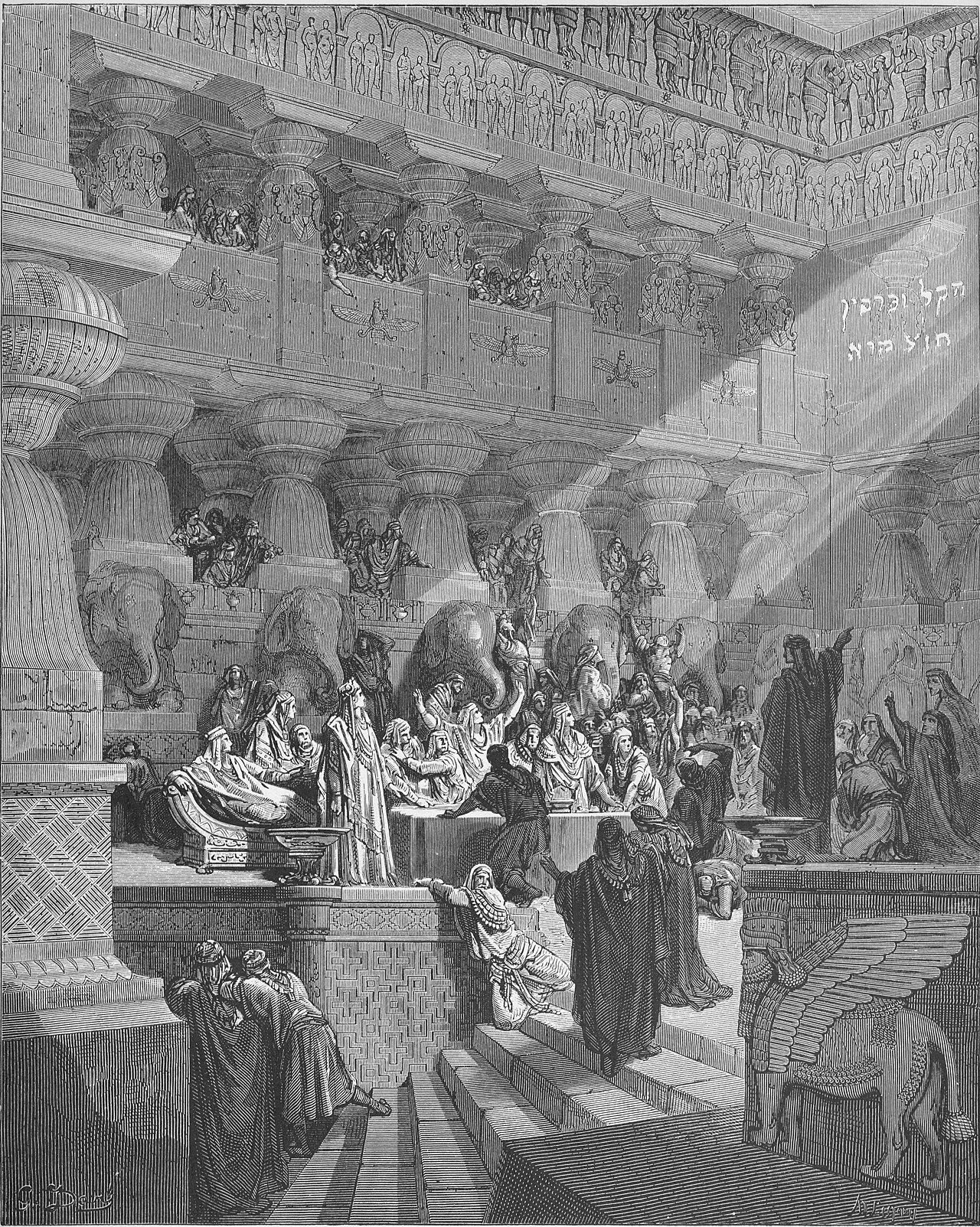
in Daniel 5Therefore He sent the hand that wrote the inscription.
BSB
The same verse in ASV and KJV ▾
ASV
Then was the part of the hand sent from before him, and this writing was inscribed.
KJV
Then was the part of the hand sent from him; and this writing was written.
⋯
This verse in Daniel 5
Commentary
6 notes on this verseThen was the part of the hand sent - This was the filling up of the cup of thy iniquity; this last act made thee ripe for destruction.
This site's exposition
the part of the hand sent
on Daniel 5:24-25
The writing itself is given in Aramaic weights and measures, MENE, MENE, TEKEL, UPHARSIN, terms Keil identifies as a mina, a mina, a shekel, and half-minas or divisions, ordinary units of commercial weighing turned into a sentence on a kingdom. The bench notes the words were likely legible to the wise men as vocabulary and unreadable only as meaning, which is why Daniel's contribution is interpretation rather than decipherment, reading a message hidden in plain words rather than in a foreign script.
The record, by era
The Church Fathers1 voice
And after saying these things he added the following, at once rebuking the king and not receiving his face so that having heard this the king would be afraid and so that he who committed trespasses might immediately recognize them. And so it says, "And you his son, Belshazzar, you have not humbled your heart before God; do you not know all these things? And you have been exalted against the Lord God of heaven and have brought the vessels of his house before you and you and your magistrates and your mistresses and your concubines drank wine from them, and you have praised golden and silver and bronze and iron and wooden and stone gods, which do not see and which do not hear and which do not understand, and God, of whom your breath is in his hand and all your ways are as well, you have not glorified him. On account of this the fingers of a hand have been sent from his face and he ordered this writing: 'Mane, Thekel, Fares.' This is the interpretation of the phrase: 'Mane,' God has measured your kingdom and ended it, 'Thekel,' it has been weighed in the balance and been found wanting, 'Fares,' your kingdom is divided and has been given to the Medes and Persians." [Daniel 5:22-28]
The Puritans and the Awakening2 voices
It is he that now writes bitter things against thee, and makes thee to possess thy iniquities, " Job xiii. Note, As the sin of sinners is written in the book of God's omniscience, so the doom of sinners is written in the book of God's law; and the day is coming when those books shall be opened, and they shall be judged by them.
quarantine:debris (2026-07-29) — odd-straight-quotes
Then was the part of the hand sent from him,.... That is, from God: being thus reproached and blasphemed, at that very instant, and for that reason, because the vessels of his sanctuary were profaned, and idol gods were praised, and he despised; he caused part of a hand, the writing fingers of it, to appear on the wall of the king's palace: and this writing was written; which was then upon the wall, and he points to it.
The Nineteenth Century1 voice
A commentator
Albert Barnes1798–1870
Notes, Explanatory and Practical, on the Old and New Testaments (1832-1869)
proposed
Then was the part of the hand sent from him - To wit, the fingers. See Dan 5:5. The sense is, that when it was fully perceived that Belshazzar was not disposed to learn that there was a God in heaven; when he refused to profit by the solemn dispensations which had occurred in respect to his predecessor; when his own heart was lifted up with pride, and when he had gone even farther than his predecessors had done by the sacrilegious use of the vessels of the temple, thus showing special contempt for the God of heaven, then appeared the mysterious handwriting on the wall. It was then an appropriate time for the Most High God, who had been thus contemned and insulted, to come forth and rebuke the proud and impious monarch.
The words behind it
10 Hebrew wordsEvery Hebrew word of this verse in the order it stands, with what it means and the door to its own study. The last column counts the times a word stands in the whole Bible: the rarer the word, the more the places it appears belong together.
| Hebrew | Sound | Meaning | Word study | In the Bible |
|---|---|---|---|---|
| בֵּאדַ֙יִן֙ | bedayin | <in> then | H116 → | 57 times |
| מִן־ | min- | from | H4481 → | 109 times |
| קֳדָמ֔וֹהִי | kodamohi | before him | H6925 → | 42 times |
| שְׁלִ֖יַחַ | sheliyaach | it was sent out | H7972 → | 14 times |
| פַּסָּ֣א | pasa' | palm the | H6447 → | |
| דִֽי־ | di- | of | H1768 → | 345 times |
| יְדָ֑א | yeda' | hand the | H3028 → | 17 times |
| וּכְתָבָ֥א | ukhetava' | and writing the | H3792 → | 12 times |
| דְנָ֖ה | denah | this | H1836 → | 58 times |
| רְשִֽׁים׃ | reshim | it was inscribed | H7560 → | 7 times |
בֵּאדַ֙יִן֙<in> then
bedayinH116 →57 times
מִן־from
min-H4481 →109 times
קֳדָמ֔וֹהִיbefore him
kodamohiH6925 →42 times
שְׁלִ֖יַחַit was sent out
sheliyaachH7972 →14 times
פַּסָּ֣אpalm the
pasa'H6447 →
דִֽי־of
di-H1768 →345 times
יְדָ֑אhand the
yeda'H3028 →17 times
וּכְתָבָ֥אand writing the
ukhetava'H3792 →12 times
דְנָ֖הthis
denahH1836 →58 times
רְשִֽׁים׃it was inscribed
reshimH7560 →7 times
A shaded row is a word that stands 400 times or fewer in the Bible.
The walk
5 stopsEach card is a verse this one points to, and under it the verses that one points to in turn. Where several paths arrive at the same place, that place is listed first: the text keeps returning to it.
Through
Daniel 5:5At that moment the fingers of a human hand appeared and wrote on the plaster of the wall, near the lampstand in the royal palace. As the king watched the hand that was writing,
it leads to
- Daniel 4:31
While the words were still in the king’s mouth, a voice came from heaven: “It is decreed to you, King Nebuchadnezzar, that the kingdom has departed from you.
- Daniel 5:24–28
Therefore He sent the hand that wrote the inscription.
- 1 Thessalonians 5:2–3
For you are fully aware that the Day of the Lord will come like a thief in the night.
- Job 20:5
the triumph of the wicked has been brief and the joy of the godless momentary?
- Colossians 2:14
having canceled the debt ascribed to us in the decrees that stood against us. He took it away, nailing it to the cross!
- Daniel 4:31
Where this verse is studied
About Daniel
This page draws on Adam Clarke, Commentary on the Bible; Albert Barnes, Notes on the Book of Daniel; Albert Barnes, Notes, Explanatory and Practical, on the Old and New Testaments (1832-1869); Carl Friedrich Keil, Biblical Commentary on the Book of Daniel; Hippolytus of Rome, Commentary on Daniel 3.17.5-6; John Gill, Exposition of the Old Testament (1748-1763) and Matthew Henry, Commentary on the Whole Bible.