
Daniel 5:6
in Daniel 5his face grew pale and his thoughts so alarmed him that his hips gave way and his knees knocked together.
BSB
The same verse in ASV and KJV ▾
ASV
Then the king’s countenance was changed in him, and his thoughts troubled him; and the joints of his loins were loosed, and his knees smote one against another.
KJV
Then the king’s countenance was changed, and his thoughts troubled him, so that the joints of his loins were loosed, and his knees smote one against another.
⋯
This verse in Daniel 5
Commentary
8 notes on this verseVerse 6. "Then the king's expression was altered..." Here too it is to be observed concerning those Psalms entitled: "For those who will suffer alterations (or vicissitudes)," that the alteration of fortune is not only the lot of the saint but also of the sinner. For we read in this connection: "King Belshazzar was considerably disturbed and his countenance was altered."
This site's exposition
fingers of a man’s hand
on Daniel 5:5-6
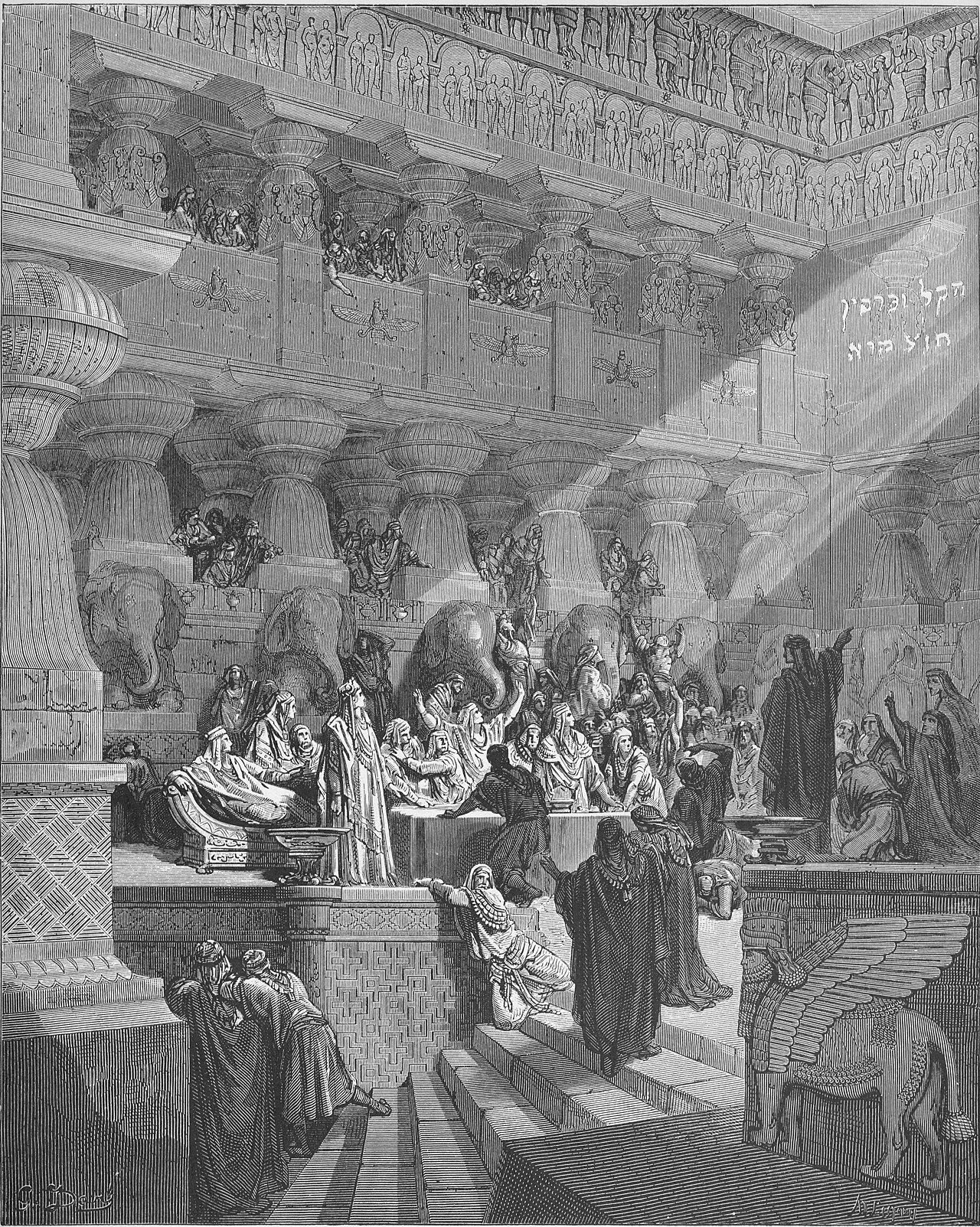
The fingers of a man's hand appear with no body attached, writing over against the candlestick where the light makes the writing plain to every eye in the hall, and the commentators mark the staging as itself a rebuke: the very lamp Belshazzar lit for his feast becomes the lamp by which his sentence is read. The king's countenance changes, his thoughts trouble him, and his knees smite one another, a physical collapse the older writers read as conscience answering before any word is interpreted. Keil notes the terror is proportioned to guilt rather than to the mystery, since a hand alone, without a voice, ought to be less terrifying than what it plainly is to this king.
The record, by era
The Church Fathers1 voice
When the king saw this he quaked in fear and was in much distress, and he shouted in strength to bring in magicians, Chaldeans and soothsayers, not knowing that it is not possible for these to read the letters of God, but it is possible for those who from childhood practiced the law of God who also recognize the divine letters from their fathers.
The Puritans and the Awakening3 voices
Then the kings countenance changed,....
Why is he in such a fright? He perceives not what is written, and how does he know but it may be some happy presage of deliverance to him and to his kingdom?
The interpretation of the mystical characters by Daniel, who was at length brought in to him, and dealt plainly with him, and showed him his doom written,
The Nineteenth Century1 voice
The king’s countenance was changed - Here is a very natural description of fear and terror. 1. The face grows pale; 2. The mind becomes greatly agitated; 3. Pains seize on the lower part of the back and kidneys; 4. A universal tremor takes place, so that the knees smite against each other; 5. And lastly, either a syncope takes place, or the cry of distress is uttered, Dan 5:7: “The king cried.”
1 more voice on this verse
The Nineteenth Century1 voice
A commentator
Albert Barnes1798–1870
Notes, Explanatory and Practical, on the Old and New Testaments (1832-1869)
proposed
Then the king’s countenance was changed - The word rendered “countenance” is, in the margin, as in Dan 5:9, “brightnesses.” The Chaldee word means “brightness, splendor” (זיו zı̂yv), and the meaning here is bright looks, cheerfulness, hilarity. The word rendered was changed, is in the margin changed it; and the meaning is, that it changed itself: probably from a jocund, cheerful, and happy expression, it assumed suddenly a deadly paleness. And his thoughts troubled him - Whether from the recollection of guilt, or the dread of wrath, is not said. He would, doubtless, regard this as some supernatural intimation, and his soul would be troubled. So that the joints of his loins were loosed - Margin, “bindings,” or “knots,” or “girdles.” The Chaldee word rendered “joints” (קטר qeṭar) means, properly, “knots;” then joints of the bones, as resembling knots, or apparently answering the purposes of knots in the human frame, as binding it together. The word “loins” in the Scriptures refers to the part of the body around which the girdle was passed, the lower part of the back; and Gesenius supposes that the meaning here is, that the joints of his back, that is, the vertebral are referred to. This part of the body is spoken of as the seat of strength. When this is weak the body has no power to stand, to walk, to labor. The simple idea is, that he was greatly terrified, and that under the influence of fear his strength departed. And his knees smote one against another - A common effect of fear Nah 2:10. So Horace, “Et corde et genibus tremit.” And so Virgil, “Tarda trementi genua labant.” “Belshazzar had as much of power, and of drink withal to lead him to bid defiance to God as any ruffian under heaven; and yet when God, as it were, lifted but up his finger against him, how poorly did he crouch and shiver. […]
The words behind it
13 Hebrew wordsEvery Hebrew word of this verse in the order it stands, with what it means and the door to its own study. The last column counts the times a word stands in the whole Bible: the rarer the word, the more the places it appears belong together.
| Hebrew | Sound | Meaning | Word study | In the Bible |
|---|---|---|---|---|
| אֱדַ֤יִן | ʾedayin | then | H116 → | 57 times |
| מַלְכָּא֙ | malka' | king the | H4430 → | 180 times |
| זִיוֹ֣הִי | ziyohi | brightness<es> his | H2122 → | 6 times |
| שְׁנ֔וֹהִי | shenohi | they changed him | H8133 → | 21 times |
| וְרַעיֹנֹ֖הִי | verayonohi | and thoughts his | H7476 → | 6 times |
| יְבַהֲלוּנֵּ֑הּ | yevahaluneh | they alarmed him | H927 → | 11 times |
| וְקִטְרֵ֤י | vekitrei | and [the] joints of | H7001 → | 3 times |
| חַרְצֵהּ֙ | chartzeh | loin[s] his | H2783 → | |
| מִשְׁתָּרַ֔יִן | mishtarayin | [were] loosened | H8271 → | 6 times |
| וְאַ֨רְכֻבָּתֵ֔הּ | vearkhubateh | and knees his | H755 → | |
| דָּ֥א | da' | this [one] | H1668 → | 6 times |
| לְדָ֖א | leda' | to this [one] | H1668 → | 6 times |
| נָֽקְשָֽׁן׃ | nakeshan | [were] knocking | H5368 → |
אֱדַ֤יִןthen
ʾedayinH116 →57 times
מַלְכָּא֙king the
malka'H4430 →180 times
זִיוֹ֣הִיbrightness<es> his
ziyohiH2122 →6 times
שְׁנ֔וֹהִיthey changed him
shenohiH8133 →21 times
וְרַעיֹנֹ֖הִיand thoughts his
verayonohiH7476 →6 times
יְבַהֲלוּנֵּ֑הּthey alarmed him
yevahalunehH927 →11 times
וְקִטְרֵ֤יand [the] joints of
vekitreiH7001 →3 times
חַרְצֵהּ֙loin[s] his
chartzehH2783 →
מִשְׁתָּרַ֔יִן[were] loosened
mishtarayinH8271 →6 times
וְאַ֨רְכֻבָּתֵ֔הּand knees his
vearkhubatehH755 →
דָּ֥אthis [one]
da'H1668 →6 times
לְדָ֖אto this [one]
leda'H1668 →6 times
נָֽקְשָֽׁן׃[were] knocking
nakeshanH5368 →
A shaded row is a word that stands 400 times or fewer in the Bible.
The walk
8 stopsEach card is a verse this one points to, and under it the verses that one points to in turn. Where several paths arrive at the same place, that place is listed first: the text keeps returning to it.
Through
Nahum 2:10She is emptied! Yes, she is desolate and laid waste! Hearts melt, knees knock, bodies tremble, and every face grows pale!
it leads to
- Isaiah 13:7–8
Therefore all hands will fall limp, and every man’s heart will melt.
Reached by 2 separate paths from here.
- Joel 2:6
Nations writhe in horror before them; every face turns pale.
- Psalms 22:14
I am poured out like water, and all my bones are disjointed. My heart is like wax; it melts away within me.
- Jeremiah 30:6
Ask now, and see: Can a male give birth? Why then do I see every man with his hands on his stomach like a woman in labor and every face turned pale?
- Isaiah 13:7–8
Through
Ezekiel 7:17Every hand will go limp, and every knee will turn to water.
it leads to
- Ezekiel 21:7
And when they ask, ‘Why are you groaning?’ you are to say, ‘Because of the news that is coming. Every heart will melt, and every hand will go limp. Every spirit will faint, and…
- Ezekiel 21:7
Through
Daniel 7:28Thus ends the matter. As for me, Daniel, my thoughts troubled me greatly, and my face turned pale. But I kept the matter to myself.”
it leads to
Through
Daniel 4:5I had a dream, and it frightened me; while in my bed, the images and visions in my mind alarmed me.
it leads to
- Daniel 2:1
In the second year of his reign, Nebuchadnezzar had dreams that troubled his spirit, and sleep escaped him.
- Daniel 2:1
Where this verse is studied
About Daniel
This page draws on Adam Clarke, Commentary on the Bible; Albert Barnes, Notes, Explanatory and Practical, on the Old and New Testaments (1832-1869); Carl Friedrich Keil, Biblical Commentary on the Book of Daniel; Hippolytus of Rome, Commentary on Daniel 3.15.1; Jerome, Commentary on Daniel; John Gill, Exposition of the Old Testament (1748-1763) and Matthew Henry, Commentary on the Whole Bible.